
 BATMAN versus RED HOOD
The Killing Joke (DC)
Where: Batman: The Killing Joke When: May 1988
Why: Alan Moore How: Brian Bolland
The Story So Far...
So this guy walks into a bar... He had a plum job working as a Lab Assistant for Ace Chemicals, but all he wants to be is a comedian. So what did he do? Up and quit his job to line up an audition! Only catch is: His girl Jeannie is waiting at home -- six months pregnant in a cruddy one-room apartment with the rent overdue!
So this guy goes to his audition with everything on the line. He's real nervous. He blows a punch line. He's dead! Nobody's laughing! The dream is over before it even began! He goes back home and all Jeannie can say is "oh". Guy feels like a total loser! She makes some joke about him being good in bed, but now all this guy can think about is needing cash. So where's he gonna come up with the loot? That's the joke!
After running around town humiliating himself the guy winds up right back where he started: Ace Chemicals! Only this time it's after hours, and a couple of mobsters convinced him to put on a tuxedo and red dome to guide them to the card store next door. It was bound to go bad, but at least it'll make a great story!
Tale of the Tape...

 Strength: Batman 3 (Athlete)
Intelligence: Batman 5 (Professor)
Speed: Batman 3 (Athlete)
Stamina: Draw 5 (Marathoner)
Agility: Batman 4 (Gymnast)
Fighting: Batman 5 (Martial Artist)
Energy: Batman 4 (Arsenal)
Total: Batman 29 (Metahuman)
The dynamic between Batman and The Joker is fairly well established.
The Joker rarely poses any significant physical threat to the supremely trained & conditioned Batman. Instead, he thrives on tormenting the razor sharp mind of The Dark Knight Detective with his own brand of demented genius.
This legendary arch-rivalry has been one of the most studied here on Secret Wars on Infinite Earths. In the last encounter we looked at: The Joker finally broke his losing streak with a rare draw found in Crisis on Infinite Earths #2!
That cosmically assisted escape was a change of pace from the one-sided beat downs we've usually seen. Typically if a fight has broken out, Joker has already lost a bigger game. Detective Comics #781 showed Batman dominating his nemesis in the prison yard. Even with the Injustice League surrounding him, Joker was still isolated for a swift kayo in Justice League of America #15.
The most popular examples of Batman's supremacy remain those that explore a finality that can never really come about: Batman #614 presents a moment of violent contemplation and restraint, while the alternate future of The Dark Knight Returns #4 reveals an endgame that The Joker chooses to bring about.
Today we're exploring a very different perspective of the Batman/Joker rivalry: the beginning!
This time the man who will become Joker is merely a hapless, wannabe comedian dressed up as The Red Hood. Red Hood is a domed, tuxedo-wearing patsy cooked up by mobsters as a phantom target for cops. Not to be confused with Jason Todd, who adopted the vacant moniker of his one-time killer later.
Red Hood offers no real advantage or unique abilities. In fact, there seems to be an issue of restricted vision to consider. Otherwise, this is an inexperienced and reluctant criminal far more green than he'll become as Gotham's Clown Prince of Crime. No matter how early Batman is into his career, he's a clear favourite!
History: Batman (7-0-1)
The Tape: Batman Ranking: Batman (#1)
What Went Down...
Barely able to see through the narrow lens of the crimson dome stuffed over his head: Red Hood gingerly negotiates the steps to Ace Chemicals Processing Plant with the aide of the criminal cohorts ushering him into this life of crime.
The roles are soon reversed as the trio relies on the former Ace employee's insider knowledge to lead the way through the facility.
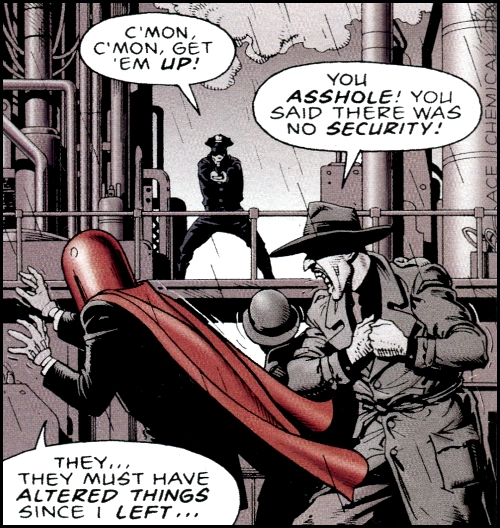
Things go bad almost immediately as a voice from the gloom orders the crooks to freeze! They're caught dead to rights in the gun sight of a security guard on a nearby elevated runway -- an unforeseen change, according to the Red Hood!
The sound of gunfire echoes inside his dome as Red Hood finds himself caught between armed guards and angry mobsters!

Returned fire gives the trio a chance to flee from their precarious predicament, while the security guard radios for backup. Their efforts once again undermined as the panic-stricken Red Hood finds himself unable to see clearly enough through his helmet to guide them to safety.
The mobsters swear bloody murder as they run aimlessly through the plant, but the hapless Hood is the only one who isn't caught in a sudden hail of bullets!

Extra security guards mow the quickstepping crooks down with a wall of gunfire -- but the Red Hood is rescued by straggling behind!
One of the mobsters only takes a bullet to his calves and attempts to play the Red Hood's unscathed survival as part of a master plan! He completely sells the Hood out as the mastermind the guards want, but is still shot dead as he fingers at the pistol in his coat.
Still in a panic -- Red Hood darts for a nearby ladder to an overhead gangway while a bullet clips his flapping cape! He's still within range when a cool, commanding voice dissuades them from further shooting. Enter: The Batman!
The Dark Knight looms for a moment before leaping over the heads of the huddled security guards. He rushes down the gangway, unaware his prey is not the same Red Hood he previously encountered. It pushes Red Hood to the edge!
Where: Batman: The Killing Joke When: May 1988
Why: Alan Moore How: Brian Bolland
The Story So Far...
So this guy walks into a bar... He had a plum job working as a Lab Assistant for Ace Chemicals, but all he wants to be is a comedian. So what did he do? Up and quit his job to line up an audition! Only catch is: His girl Jeannie is waiting at home -- six months pregnant in a cruddy one-room apartment with the rent overdue!
So this guy goes to his audition with everything on the line. He's real nervous. He blows a punch line. He's dead! Nobody's laughing! The dream is over before it even began! He goes back home and all Jeannie can say is "oh". Guy feels like a total loser! She makes some joke about him being good in bed, but now all this guy can think about is needing cash. So where's he gonna come up with the loot? That's the joke!
After running around town humiliating himself the guy winds up right back where he started: Ace Chemicals! Only this time it's after hours, and a couple of mobsters convinced him to put on a tuxedo and red dome to guide them to the card store next door. It was bound to go bad, but at least it'll make a great story!
Tale of the Tape...
Strength: Batman 3 (Athlete)Intelligence: Batman 5 (Professor)
Speed: Batman 3 (Athlete)
Stamina: Draw 5 (Marathoner)
Agility: Batman 4 (Gymnast)
Fighting: Batman 5 (Martial Artist)
Energy: Batman 4 (Arsenal)
Total: Batman 29 (Metahuman)
The dynamic between Batman and The Joker is fairly well established.
The Joker rarely poses any significant physical threat to the supremely trained & conditioned Batman. Instead, he thrives on tormenting the razor sharp mind of The Dark Knight Detective with his own brand of demented genius.
This legendary arch-rivalry has been one of the most studied here on Secret Wars on Infinite Earths. In the last encounter we looked at: The Joker finally broke his losing streak with a rare draw found in Crisis on Infinite Earths #2!
That cosmically assisted escape was a change of pace from the one-sided beat downs we've usually seen. Typically if a fight has broken out, Joker has already lost a bigger game. Detective Comics #781 showed Batman dominating his nemesis in the prison yard. Even with the Injustice League surrounding him, Joker was still isolated for a swift kayo in Justice League of America #15.
The most popular examples of Batman's supremacy remain those that explore a finality that can never really come about: Batman #614 presents a moment of violent contemplation and restraint, while the alternate future of The Dark Knight Returns #4 reveals an endgame that The Joker chooses to bring about.
Today we're exploring a very different perspective of the Batman/Joker rivalry: the beginning!
This time the man who will become Joker is merely a hapless, wannabe comedian dressed up as The Red Hood. Red Hood is a domed, tuxedo-wearing patsy cooked up by mobsters as a phantom target for cops. Not to be confused with Jason Todd, who adopted the vacant moniker of his one-time killer later.
Red Hood offers no real advantage or unique abilities. In fact, there seems to be an issue of restricted vision to consider. Otherwise, this is an inexperienced and reluctant criminal far more green than he'll become as Gotham's Clown Prince of Crime. No matter how early Batman is into his career, he's a clear favourite!
History: Batman (7-0-1)
The Tape: Batman Ranking: Batman (#1)
What Went Down...
Barely able to see through the narrow lens of the crimson dome stuffed over his head: Red Hood gingerly negotiates the steps to Ace Chemicals Processing Plant with the aide of the criminal cohorts ushering him into this life of crime.
The roles are soon reversed as the trio relies on the former Ace employee's insider knowledge to lead the way through the facility.
Things go bad almost immediately as a voice from the gloom orders the crooks to freeze! They're caught dead to rights in the gun sight of a security guard on a nearby elevated runway -- an unforeseen change, according to the Red Hood!
The sound of gunfire echoes inside his dome as Red Hood finds himself caught between armed guards and angry mobsters!
Returned fire gives the trio a chance to flee from their precarious predicament, while the security guard radios for backup. Their efforts once again undermined as the panic-stricken Red Hood finds himself unable to see clearly enough through his helmet to guide them to safety.
The mobsters swear bloody murder as they run aimlessly through the plant, but the hapless Hood is the only one who isn't caught in a sudden hail of bullets!
Extra security guards mow the quickstepping crooks down with a wall of gunfire -- but the Red Hood is rescued by straggling behind!
One of the mobsters only takes a bullet to his calves and attempts to play the Red Hood's unscathed survival as part of a master plan! He completely sells the Hood out as the mastermind the guards want, but is still shot dead as he fingers at the pistol in his coat.
Still in a panic -- Red Hood darts for a nearby ladder to an overhead gangway while a bullet clips his flapping cape! He's still within range when a cool, commanding voice dissuades them from further shooting. Enter: The Batman!
The Dark Knight looms for a moment before leaping over the heads of the huddled security guards. He rushes down the gangway, unaware his prey is not the same Red Hood he previously encountered. It pushes Red Hood to the edge!

Completely losing his cool, Red Hood opts to jump over the rails rather than face the punishment of the dark avenger descending upon him!
Batman lunges to catch him, but it's too late! The Red Hood plunges into the chemical waste filter and washes out of the building through a drainage pipe!

Crawling onto the outer bank doesn't end Red Hood's suffering. His body stings and itches, his hands burning as he scrambles to remove the suffocating dome that hides a horrible truth.

Hunched on his knees, he sees himself distorted in a puddle puckered by the spitting rain. For a moment, he holds his head in silence, absorbing the pallid reflection staring back at him. He lurches to his feet, staggers, and laughs...
The Hammer...
As time marches on: I'm beginning to realize I prefer to think there is a true origin story behind The Joker, even if his in-fiction past is lost to bleached skin, and a poisoned body that no longer offers any valid genetic identifiers.
I don't necessarily need intricate details. The growing tendency to over-work key milestones in comic book history has become a real drag. Most often in life, major events just happen -- and while it's satisfying to have stories eventuate with later payoffs -- we don't need to constantly relive our history, bogging it down in an increasingly absurd mess of retroactive, future entanglements.
All I really need from a good Joker origin is a simple, mythic transformation: A vat of chemicals, an unfortunate fall, and a lanky man emerging from the mix with ghastly white skin, green hair, and 'a nice big smile'.
The Killing Joke's backstory contains most of these elements, but almost goes too far away from them. The iconic details of Joker's fall are glossed over. We don't really see his fated plunge into the weird stew. This telling dwells more on what brought him to that moment, and his emergence from the waste water.
Maybe some of this glossed take speaks to the first-person perspective of The Joker. Batman is only seen on a single page, obfuscated by shadow, motion, and the narrow red-tinted lenses offered by the Red Hood's dome.
In the four panels he appears in; Batman is mere shoulders & cowl, a hunched and almost beastly leaping figure, a demonic shadow seen in double, and a hand -- too late to stop the Red Hood's doomed leap over the gangway rail. He is humanoid, but reveals no clear human face in any of these panels.
It could be taken that these are the memories of an unreliable narrator, but I also wonder if established understanding had an impact on Alan Moore's script, and Brian Bolland's pencils. After all, much of the Red Hood sequence can be traced back to its introductory origins in 1951's Detective Comics #168.
"The Man Behind the Red Hood" was a Bill Finger story that saw repeat reprints every decade after its original run. It was even collected in The Greatest Joker Stories Ever Told the same year as The Killing Joke: 1988 - a good year!
The story finds Batman & Robin reopening a cold case with university students, inadvertently coaxing The Red Hood back to action after ten years in obscurity. It has its Scooby Doo red herring moment before The Joker is finally revealed, and explains some of what's retold in The Killing Joke.
The Red Hood identity is a pretty strange convolution to layer on top of The Joker's origin. If you were reading The Killing Joke years after the fact, you might've mistaken it for a post-modern appropriation of an earlier Detective Comics story. In truth, it has all the hallmarks of a story ten years into an established character's history. It awkwardly adds something new to obscure and refresh a quantity as well known as The Joker. Even as the first reveal of the Joker's largely unimportant origin, it's still a little odd and cluttered.
That obscuring aspect is also part of what lends the story to the idea that it could be a lie. A contrivance played with in later retellings that arguably enhances the myth of The Joker as the ultimate intangible and unknowable villain for The Dark Knight Detective. A crime that won't be solved.

You'll note in the images above that the majority of these flashback scenes in The Killing Joke have an almost sepia tone. Red is the exception, highlighting the Red Hood's cape and helmet. It's not until his transformation into The Joker that colour invades the world as his suit turns purple, and hair goes green.
It's a nice little Wizard of Oz type technique that could be subtly informed by the stages of Joker's metamorphosis, but maybe it also reflects a filter of doubt on the telling of the story. The picture is drained of truth until The Joker shows up bloodshot and laughing maniacally [above].
Hopefully at some point we can revisit the subject via Detective Comics #168 and the present-set story that also unfolds during The Killing Joke. There's certainly plenty more to say!
If you'd like to take a closer look at The Killing Joke yourself, you can grab yourself one of the many printed editions currently available via the Amazon links provided! If you do, Amazon will help support the site at no extra cost to you!
You can also find more combative featured fights involved Joker, Batman, and more by following links throughout this post -- or by diving into the Secret Archive for a complete index of battles by publisher, series, and issue!
Follow Secret Wars on Infinite Earths on Twitter and Facebook to get links to daily fights inspired by the topics of the day! Be sure to throw in a like, comment, and share to boost your favourite battles!
Winner: Batman
#1 (--) Batman
#407 (--) Joker


 The Fight: 4 The Issue: 5.5


