Showing posts with label Scarecrow. Show all posts

Friday, October 25, 2019

SWAMP THING versus SCARECROW
Urban Jungle (DC)
Where:
Swamp Thing #19 When: June 2013
Why: Charles Soule How: Kano

The Story So Far...
A mysterious figure known as The Seeder has been leading Swamp Thing on a grim quest across the globe. As champion of The Green, it has been Swamp Thing's solemn duty to restore balance by destroying the lush crops created in unnatural environments.

Weary of his mission after destroying a war torn tropical rainforest in the Sahara; Swamp Thing seeks the solace of the man-made cities he left behind in his former life. Thus, he travels the network of The Green to arrive in Metropolis, where night has fallen, and the Botanical Garden sits quietly nestled within the concrete jungle.

The solitary, after hours walk reconnects him with fond memories of past visits when Alec Holland was a mere grad student. He hears rustling excitement shimmering through the trees as their defender walks near, but the rats gnawing at banyan roots aren't the only threat. An interloper has broken in to prune samples of a rare poisonous flower -- The Scarecrow!

Tale of the Tape...
Strength: Swamp Thing 6 (Invincible)
Intelligence: Draw 5 (Professor)
Speed: Draw 2 (Average)
Stamina: Swamp Thing 6 (Generator)
Agility: Swamp Thing 7 (Unlimited)
Fighting: Swamp Thing 3 (Street Wise)
Energy: Swamp Thing 4 (Arsenal)
Total: Swamp Thing 33 (Super)

Scientist Alec Holland was working on a bio-restorative formula when a bomb planted in his Louisiana laboratory set off an unforeseen chain reaction! Aflame, and doused in his own experimental formula -- Holland ran burning to the swampland outside, infusing the marsh with his consciousness as his body was returned to the earth and replaced by the form of Swamp Thing!

As an avatar for the collective will of all natural life and vegetation, Swamp Thing has access to a broad range of abilities associated with "The Green".

Along with the super-human strength his humanoid plant-form possesses, Swamp Thing is also intrinsically linked to flora, able to conjure and manipulate a mighty forest from a simple sapling. He can also benefit from the properties of plants, allowing him to regenerate, grow an entire new body, and travel along root systems. He commands these skills with the intelligence of Alec Holland.

Scarecrow is a learned man himself, but his interest lies in the nature of the mind. A former psychologist: Jonathan Crane's focus on the field of fears and phobia became a sadistic obsession he inflicted on the citizens of Gotham City.

Crane specializes in turning plant toxin and chemicals into potent hallucinogens capable of inducing intense terror in unwilling subjects. We saw an example of these results when Batman attacked his protégé Robin in Batman #629.

The Batman remains Scarecrow's most persisting arch-nemesis. He was there to thwart an attempt to poison children through manufactured dolls in Batman: Dark Victory #3, and provided dread when Crane's experiments robbed him of the sensation of fear in Batman: Gotham Knights #49!

For the most part, Scarecrow poses very little physical threat. He briefly gained the ability to transform into a towering Scarebeast, as in Batman #628, but this Jekyll & Hyde ailment was ultimately short-lived.

Scarecrow's dominion remains that of the mind. His devious ability to refine & reinvent his fear-inducing formulas -- and their method of delivery -- makes him a constant danger to even those who've been inoculated. Which leaves only one question for today's featured battle: Does a plant know what it is to be afraid?..

The Tape: Swamp Thing Ranking: Scarecrow (#382)

What Went Down...

The seclusion of Metropolis Botanic Gardens after dark is interrupted when a wiry figure breaches the outer gate and prowls towards a small bed of blue flowers. Ignoring the warning signs, he squats to begin pruning the bulbs.


Knowing these buds as the potentially deadly digitalis terrorem -- Swamp Thing intervenes with a long, green tendril extending from the shadows of surrounding trees. The vine snags Scarecrow by the wrist and pulls his clippers skyward.

Swamp Thing's disembodied voice booms through the night, explaining the peril of the fear-inducing plant, which causes terrifying hallucinations and can kill if ingested. Properties he knows no doubt attracted the sack-masked villain.

Scarecrow explains his interest in the plant while hurriedly clipping away at the vine ensnaring his arm. The plant recoils back to its source in the dark, allowing the Scarecrow to finish stuffing his bag and smell the flower.


At last Swamp Thing emerges from the dark to loom suddenly in the moonlight. Even the fear-mongering villain finds himself startled by the monstrous figure!

The avatar of The Green orders Scarecrow to stop what he's doing, but he refuses, throwing a cloud of fear gas at the towering figure!


The Swamp Thing disappears within a pinkish-red cloud of gas, but his plant body is unfazed by its typical terror-inducing properties.

The powers of The Green prove far more effective against Scarecrow. With but a thought, Swamp Thing stirs the straw in Scarecrow's costume to grow anew, stretching into strands of ensnaring grass that wraps around his head!


In an act of desperation Scarecrow throws his hand out and sprays more jets of fear-toxin. While his right hand frantically grapples with the choking strands of grass, the other blasts a rainbow of gas in yellow, blue, green, and orange!


Swamp Thing is once again dismissive of the attack -- until the orange haze begins to take effect! His words fade to a long groan and his body goes limp.

The grass around his face and throat goes dead and Scarecrow is free to analyze his success. His fear formula comes in many varieties, prepared for any number of threats that might come his way. In the orange concoction - a brew of sixty-percent carbon dioxide perfectly absorbed by a plant body!


Scarecrow's gloating over the motionless body of his victim is cut short as a great rumble rolls in from the direction of the city.

As he turns, Jonathan Crane finds a most unexpected consequence of Swamp Thing's fearful rest: Metropolis is being overrun with gigantic vines!

The Hammer...
A simple choice of chemical ingenuity gives Scarecrow an unlikely victory, but you can bet its a temporary one! Not only is there out of control greenery to contend with, but also the hovering presence of Metropolis' favourite son, who has a sneaking suspicion he should be looking for Swamp Thing, at issue's end.

I've been looking for an opportunity to do much the same for quite some time now. This weird and wonderful combat combination is another installment in our October of Halloween horrors, but regular readers will also know it marks the long overdue arrival of Swamp Thing on Secret Wars on Infinite Earths!

Swamp Thing was one of the great creations of the Bronze Age, and an icon of the loosening standards of the Comics Code Authority in the early 1970s. He was the retro-tinged brainchild of Len Wein, whose work with artist Bernie Wrightson was beaten to the muck monster publishing trend by Marvel's Man-Thing just a few months earlier.

Both creations owed a tremendous debt to the 1940s comic book swamp monster, The Heap, as well as the convergent inspirations of movies like The Creature From the Black Lagoon, Frankenstein, and horror's general resurgence within the censored comic book medium.

The original Swamp Thing first appeared in House of Secrets #92 (July 1971), before the character and concept was refined for the introduction of Alec Holland in the pages of Swamp Thing #1 (November 1972).

The Holland incarnation was the one that would become a pop cultural icon, surpassing Swamp Thing's contemporaries and forebears with a particular boost in the eighties through Alan Moore's revered run writing the series, and the two theatrical releases it helped to spawn.

Swamp Thing's influence at that time could also be felt in unrelated creations, like The Toxic Avenger, which participated in some indirect way with my fandom for the character's iconography.

Moore's work also facilitated the formulation of DC's Vertigo imprint. Swamp Thing was effectively tied up by Vertigo for the better part of three decades, allowing for the character's adult and conceptual potential to be fully explored.

You could never ask for that to be undone, but when Swamp Thing made his return to the DC Universe proper in 2010's Brightest Day, it was exciting. The line-wide reboot of The New 52 was very much not exciting, but in spite of its core foundational issues, it continued the further re-integration of Swamp Thing into the modern DCU, and the push for varied publishing was generally positive.

As a young reader, one of the few Swamp Thing comics I actually owned was a black & white oversized reprint that featured a story with Batman. Sadly, I don't remember what the story was, but if memory serves, it wasn't the type of action-packed crossover we would necessarily be talking about here.

Swamp Thing #19 in some small way echoes that childhood reading with the unusual challenge of Scarecrow against Swamp Thing. An irregular match-up that might be a little bit more interesting on paper than in execution.

At only twenty pages, the issue is generally a fairly light read split into two parts. The first half strolls casually through an episode of The Seeder plot, with a broad recap of Swamp Thing's musings and abilities transitioning to the second-half guest villain battle. It's good, but offers little in the way of nuance.

I don't want to dwell on the negatives too much. I'm quite simply not a fan of the New 52 and all it wrought. Some of that appears to inform things I didn't love about this issue, such as its relative simplicity. These read like introductory models of the characters, possibly informed by lesser multimedia incarnations.

That the crux of Scarecrow's appearance hinges on collecting blue flowers reads like a very weak reference to the derivative media of Batman Begins. It's not the worst thing in the world, but pretty on-the-nose for a medium that should offer so much more. Before the reboot, DC were fantastic at rooting character's appearances in deeper exploration and refinement of character's core concepts.

Artist Kano renders the type of iconic Swamp Thing you would expect to see in this kind of comic and that's a positive. Some of his layouts, particularly in the Scarcrow fight, leave some dead space with their large slanted panels, but the storytelling is clear, and tremendously supported by colorist Matthew Wilson.

For the most part I enjoyed this issue and that's the note we'll end on. If you'd like to get a taste for it yourself, you can pick this issue up collected in Swamp Thing Vol.4: Seeder.

Use the Amazon link provided when you shop and you'll not only get a pretty darn good deal, but also ensure Amazon wields The Green to support Secret Wars on Infinite Earths at no extra charge to you!

Hopefully we'll be seeing more Swamp Thing on the site in the future. You can find and discover more by following links in this post, or by diving into the Secret Archive for a complete index of featured fights in order of publisher, series, and issue.

Follow Secret Wars on Infinite Earths on Twitter and Facebook to get daily links to superhero smackdown inspired by the topics of the day. Don't forget to like and share those fabulous fights! It's only natural!

Winner: Scarecrow
#125 (+257) Scarecrow
#891 (new) Swamp Thing (Alec Holland)

Saturday, September 05, 2009

Hero of the Week #14: Scarecrow

SCARECROW (DC)
Real Name: Jonathan Crane
First Appearance: World's Finest Comics #3 (Fall, 1941)
Group Affiliation: The Society
Gaming Credentials: Batman: The Animated Series (1993); Adventures of Batman & Robin (1994); Batman: Rise of Sin Tzu (2004); Batman Begins (2005); Lego Batman (2008); Batman: Arkham Asylum (2009); DC Universe Online (TBA)
Infinite Wars Cumulative Ranking: #313

By inferrence, if not popular demand, I am compelled to spotlight Scarecrow as Hero of the Week!
If there's a phrase I've heard more than 'zOMG Mickey & Spidey' this week, it's that Scarecrow "steals the show" in the critically acclaimed comic book release, Batman: Arkham Asylum.

Since his creation in the forties, Scarecrow has gone on to be one of the enduring stars of the famous Batman rogues gallery, but arguably never quite reached the A-list status he received from appearing in the cinematic revamp, Batman Begins. The character gets another boost into the mainstream consciousness through Arkham Asylum, where the outlandish potential of the villain is explored with a fitting visceral interpretation sure to solidify his status with gamers.

Over the decades, Scarecrow has been interpreted in a multitude of ways. The movie appearance inspired a new subset of horror fans who saw great potential in the fear-inducing villain, while in the comics, the character has ranged everywhere from an inconsequential weakling fighting out of his weight class, to a torturer fixated on the torment of his victims. With a consistent undercurrent of "fear" -- the Scarecrow has proven to be as versatile a character as The Dark Knight himself.

One of my favourite interpretations is of a Dr. Jonathan Crane who, after years of experimentation with fear gasses and innoculations, has himself been rendered almost incapable of feeling such an emotion. A distanced character of esoteric interests and reference, unaffected by the threatening world around him, and consequently empowered to devise his own nightmares.
This version was implied in a 2004 B&W Geoff Johns/Tommy Castillo back-up story in Batman: Gotham Knights #49. It suggests a version of the Scarecrow motivated to commit crimes both in the interest of experiencing the fear of others, while also dancing with the fate of fearing Batman himself. A poetically double-edged sword of horror and delight for the demented villain.

Batman: Arkham Asylum makes full use of the context of the character, using it to create scenes in the game that capture an unsettling atmosphere befitting of the gothic Arkham setting. It's no doubt those Silent Hill-esque scenes of nightmarish hallucination are what led many to proclaim Scarecrow as the unlikely star of the game, even though battling the villain takes on a disappointingly conventional and stilted "video game" approach. I discussed exactly that in a previous article about the game, which you might like to read.

Despite any flaws, I think Arkham Asylum has to be considered a resounding success. It has made a contrasting effort to balance the harmony of game and comics license, and in doing so, consequently made it impossible to deny Scarecrow as this week's HOTW!

Secret Wars on Infinite Earths: The Comic Book Fight Club is updated with varying consistency, promising a feature fight for every Friday on the calendar (even if sometimes they're late). The site acts as an information resource, discussion site, review blog, and frighteningly good time.

<< Hero of the Week 09/11: Spider-man       [Home]       Hero of the Week 08/25: Joker >>

Originally posted: http://www.1up.com/do/blogEntry?bId=9003394

Saturday, December 08, 2007

QUICK FIX DOUBLE FEATURE: Silent Knight!
BATMAN versus SCARECROW
Toys (DC)
Where: Batman: Dark Victory #3 When: February 2000 Why: Jeph Loeb How: Tim Sale

Quick Fix...
Dark Victory was the welcomed gritty sequel to the mid-nineties thriller maxi-series, Batman: The Long Halloween. Long Halloween was an instant classic, bringing together the oft overlooked mystery writing techniques that compliment the Dark Knight Detective; combining them with the world of Gotham City in an unofficial sequel to Miller's Year One.

Dark Victory is an equally revered piece of Batman fiction, but why should the Infinite Wars happen upon these issues now? As is often the case, there's a simple, if veiled explanation!

On the one hand, the Loeb/Sale maxi-series' have both been incredibly influencial to the Christopher Nolan directed feature film(s); with Nolan, [co-writer; David] Goyer, and cast members regularly quoting both stories as invaluable references. Empire magazine, (along with various websites), have featured the first official promotional shots of The Dark Knight's Heath Ledger in full Joker regalia, making now as good a time as any to delve into DK countdown mode!

That, and also, we're featuring an single issue spotlight on reviews from the past twenty-five years in weekly Cover to Cover features. If you're inclined to scour the back issues based on printed year, then you'll already realise that 2000 was a slow year for me. So, just to make sure there aren't any gaps, I'm ramming a couple of 2000 reviews in for four week's time. Haw!

Of course, just to lift the curtain to spoil the magic, in the time it took to start this post, to reach this point, we've also seen the release of a fantastic Dark Knight poster [alluding to the Joker with a dripping red bat isnignia] -- and I've also bumped this entry back several days, making room for another.

So, while a shred of the original intention remains, we should get this show on the road to make way for other entries of immediate interest.

A killer is following in the footsteps of the Holiday killer who terrorized the Gotham crime families with a murder for every month. Now the game is Hangman, and the new killer is eliminating corrupt cops, following a similar seasonal modus operandi as the supposed original Holiday.

The Batman, unclear as to who is responsible, interrogates all available sources, arriving at Boss Zucco, who failed to fullfil his usual routine of receipt collecting from one of the fine establishments owned by the Maroni family. The Cheetah Room gentleman's club was manned by Arnold John Flass - former marine and disgraced police Detective - with all the motive in the world to go after Commissioner Jim Gordon, and Harvey "Two-Face" Dent, for bringing him down under affiliation with criminal activity. Too bad he's not the guy.

Zucco gives up the Scarecrow as the catalyst for variation in his operations: and a potential suspect, or witness, for the Hangman murders. Batman tracks Scarecrow to the abandoned Gotham Toy Factory, where Scarecrow is hatching a plan to release his fear toxin through children's dolls.

Scarecrow proves less than cooperative, attacking Batman with a cloud of his sickly green gas that masks his gangling escape from the Dark Knight's clutches. The weight of a pulley proves vital, swinging like a pendulum through the muck to strike the Batman in the head.

Far more physical a foe than the gawky Jonathan Crane; Batman finds his way outside to the snow, where he lands atop the Scarecrow's getaway truck.

Reciting lines from nursery rhymes to the very end; the Scarecrow opts to plunge his vehicle into the icey depths of a Gotham River. He cuts loose from the noose that binds him to the man crouching atop his caboose; leaving him on the pier to suffer the effects of terror and fear.

See what I did there? Yeah, well, before we spiral down into the abyss of my apparent fixation with alliteration and/or rhyming, let us steer this train back to the rails of a valued entry. Actually, it's probably worth noting that we very nearly discussed this earlier as part of our Halloween spillover!

While the Scarecrow has roughly fifty years of history, it's his depiction in this series (and Long Halloween) that comes right to mind when I think of the character. It's almost contradictory to go from talking so much about pseudo-realism [New Avengers #35], to talking about preferring this fairly outlandish visual take on the Scarecrow character, but that's a surface observation.

These are really points coming at the same rules from different ends of the spectrum, and therefore opposite references. For me, it's the fusion of fiction with inspiration taken from reality that makes these sorts of urban characters so wonderful and enduring.

Scarecrow is famously one of the characters they struggled to totally come to terms with in the much beloved animated series. In my opinion, while the final visual of a bulky man who may or may not be something supernatural is quite neat, it actually gets too far away from the heart of the character.

If I could envision my ultimate interpretation of the Scarecrow it would be very specifically referenced in this contemporary tales. It would be the eerie but stylized appearance of Tim Sale's character; with shades of Loeb's distanced insanity, and Geoff Johns' deranged motivation and desensitization [as seen in Batman: Gotham Knights #49].

Scarecrow is already confirmed for an appearance in the upcoming Batman Begins sequel, and while sources close to the film downplay the cameo as being comparable to Willem Dafoe's returning role in Spider-man 3, one still can't help but imagine how a reference point like Dark Victory might come to play. Will the fractured remains of Jonathan Crane, last seen screaming into the night in Begins, be a silent observer of crimes in the new chapter, or could the Scarecrow and his toxins even be tied to the emergence of a new version of the Joker?

Mmm, me thinks that might just be discussion for another time... Now!

The Fix: 3 The Issue: 6.5
Winner: Draw

It seems a great many comics reader missed out on the experience of the Long Halloween, only to catch up by immediately diving into the 2000 sequel. If you haven't had the opportunity to read either of these modern masterpieces, I strongly recommend them as great Christmas gifts. That said, I would suggest you stay tuned for links to the original, if you're only going to seek out one, because it's there that the intrigue begins, that is inadvertently spoiled if reading Dark Victory first. Note efforts to avoid giving any clues to the final identity of either Holiday, or The Hangman!


THE JOKER versus HARVEY DENT
Christmas (DC)
Where: Batman: The Long Halloween #3 When: February 1997 Why: Jeph Loeb How: Tim Sale

So, this is the kind of thing that happens when you bounce your entries around. I did scan and upload the next issue of Dark Victory, which is a Solomon Grundy story I've been trying to shoe-horn onto the site since it's very inception!
However, with measured enthusiasm I must declare that I am but a humble servant of a higher power, and that is creative logics. It was just too tempting an offer to do an all Christmas Bat-entry, given the date, and all.

So, here we are, doing it in reverse order!
I stress again for the uninitiated or for anyone who skims over the names and dates at the beginning of entries -- Batman: The Long Halloween is the story to which Batman: Dark Victory is a sequel!

So, here we are, three years before the last entry.
This is a very different time. Movie goers will have recognised the Dark Victory mention of ex-Detective Flass. The man you know as an overweight vision of corruption actually began life in the pages of Frank Miller's Batman: Year One, as a tall and deadly peroxide blonde with special forces combat training. The visions you're having of Bridgette Nielsen are actually reasonably accurate, substituting silicon implants for Miller's standard olive trenchcoat.

Batman: The Long Halloween, like various stories that have followed, serves as a sort of unofficial sequel to Year One. While it provides inspiration for the big screen Batman Begins, it's worth noting that Year One serves more as a vignette of concepts, than a vivid depiction of the early rise of the Dark Knight Detective.
It's this fact that leads Loeb and Sale to quite successfully begin a tradition of telling tales early in hero's careers, elaborating on the Gotham criminal underworld, the corruption that facilitates the existance of a Batman, and the rise of the community of "freaks" and their costumed gimmickery.

While the period of transition (from conventional crook, to freaks) is more specifically explored in Dark Victory, the underpinnings are certainly quite well conceived in Long Halloween. In fact, one of the most vivid analogies of this transition of crime in Gotham is the transformation of Harvey Dent into Two-Face, which was apparently a wise tip from Miller himself, who recognised Two-Face as one of the under utilized gems of the Bat rogues gallery.

Actually, the story does well to further enhance Two-Face's motivations and character, differentiating him from the cooky insanity of his predecessors by drawing on his driven life as a District Attorney. It is no doubt this characterization that will steer Aaron Eckhart's depiction of the character in The Dark Knight; and it's here, in the Long Halloween, that we get a glimpse of the speculated relationship between Two-Face and Joker.

The popular bet is that it will be the clown prince of crime who scars Harvey Dent in this new big screen canon; but in the Long Halloween that is an honor reserved for a vastly different character (who is also rumored to appear) -- I won't spoil it for those of you making eagerly making Christmas purchases.

Having had his home previously destroyed by gang violence; Harvey Dent surprises his chair-bound wife, Gilda, with a bow wrapped cottage on Christmas Eve. Having carried his excited bride across the threshold, the DA encourages his wife to explore the upstairs, having observed unsolicited footprints in his home.

Lurking around the Christmas tree stirs a grinning Joker.

Dent charges the Joker, exploding in a furious delivery of fists that smack the jester's twisted grin left and right of his face. Though the blows might have shaken an average man, the Joker will forever be remembered as anything but average.

Investigating the Holiday murders in his own bizarre way, Joker swiftly puts chief-suspect Harvey Dent down with a swift kick to the crotch.
The uncermonious maneuver sufficiently floors the Distict Attorney, and gives the Joker the opportunity to examine him beneath his magnifying glass.

The Joker notes that Harvey is not Batman; as suspected by some citizens of Gotham; but remains uncertain of his potential as the killer called Holiday. Discontent with the presence of another themed maniac, Joker leaves Dent with a stern warning that should he indeed turn out to be the killer, he will return with intentions far less "forgiving" than this visit.

Joker disappears into the night, leaving Dent to be discovered beside the toppled Christmas tree in a quivering heap. A humiliation the District Attorney will not soon forget.

Boy! Wasn't that a cheery Christmas tale?
Alright, so it might not leave you warm and fuzzy before the jolly fatman slides down the chimney, but it's none the less a piece of a fantastic puzzle! A puzzle in both the story itself, and as a piece of The Dark Knight to come.

As both a fan of play-along mysteries, and Batman and his cast of supporting characters, I fall in that massive category of fans who regard these tales with reverence and awe. Say what you will about Loeb's lesser outings, but undeniable is the stoic execution of this gritty, urban mystery.

Often on the Infinite Wars we've discussed the typical divide of what a fanboy regards as their penultimate Batman. If such a thing is seen in print, for me, it may just be in the pages of The Long Halloween and Dark Victory.
Tim Sale's visuals deserve all the credit in the world for enhancing what is a relatively well constructed story. It is mind boggling that Sale, colour blind, can be so deft at laying down the perfect greys, blues and greens.
I think ultimately the visuals and written execution deserves more kudos than the mystery itself, which I find gets a little muddy, and maybe hides behind the safety net of being coy, just a little too much.

This is historic Batman, and if not for it's connected relevance, it would be a must-have perhaps only surpassed by The Dark Knight Returns; another Frank Miller inspiration for the big screen (re; The Dark Knight).

The Fix: 3 The Issue: 6.5
Winner: Joker

If you can't wait six months for The Dark Knight, or have a loved one who loves Batman and doesn't already own this, then it's the ultimate Christmas gift! If they're really special, you can't go past the oversized Absolute Edition with hardcover, slip case, and tonnes of extras. For everyone else, the complete collected trade isn't a bad way to go, at all! Actually, I kinda think the matte paper stock has a special charm!

Tuesday, November 06, 2007

QUICK FIX DOUBLE FEATURE: Nothing but fear itself!
BATMAN versus THE SCAREBEAST
As The Crow Flies Part Three: Scary Monsters (DC)
Where: Batman #628 When: Late July 2004
Why: Judd Winick How: Dustin Nguyen

Quick Fix...
Well, at this point we can deduce several things:
Clearly daily posting has been completely derailed; apparently freeing up Mondays has left me completely lost; and this is clearly another belated opportunity for an exciting dose of Halloween hangover!
Let's be honest, it wouldn't be a comic site Halloween without a solid appearance clocked by the Scarecrow!

If zeitgeist is the theme of the website right now, it's fair to say season 04/05 was Scarecrow's time! The good Dr. Crane received a mainstream shot in the arm when he made his overdue big screen debut in 2005's, Batman Begins. The feature film not only reinvigorated his stock in the comic books, but also introduced the character to the uninitiated, creating a whole new fanbase out of fans of horror, and fan-fiction sub-culture.

Joining Golden Age alumnists like the Joker and Catwoman; for my money, Scarecrow ranks amongst the quintesential Batman villains.

Working in the character's favour are many attributes found in the most successful villains to endure the decades of the Bat-franchise. Crane, a former psychologist, possesses the necessary degree of intelligence to properly combat the dark knight detective, and much like Joker or the Riddler, marries it to a special brand of crazy.

For the most part Scarecrow connects to the underlying theme of mental illness in Batman, which in an obscure way stems directly from the character himself. Though usually only by implication, the theory that Batman is as damaged as the crooks he brings in, has been well explored with projects like Arkham Asylum, Dark Knight Returns, and various other stories.

A majority of Scarecrow's earliest appearances typified the character as a more standard career criminal. Despite his flair for theatrical gimmickery, Scarecrow did not regularly utilize his trademark fear gas until decades after his first 1941 appearance. This came after the character endured one of the most noteworthy disappearances of a villain spanning from the mid-fifties to the sixties.

Though the lead-up to Begins saw a wave of refresher and introductory appearances of Scarecrow in comics, an unlikely change was about to occur in the character as the high-flying Batman experienced it's own period of transition.

In the past we've touched upon a boom period of Batman that propelled the title back to the top of the sales charts with the blockbuster teaming of Jeph Loeb and Jim Lee, for Hush. After such a success the follow-up task went to the unlikely team of Brian Azzarello and Eduardo Risso (of 100 Bullets fame), before a concerned hand over to Eisner-nominee, Judd Winick [and Dustin Nguyen].

With Hush having moved such substantial quantities, any team was going to have a struggle on DC's renewed flagship title, but after the culture shock of Broken City, Winick's credentials were quickly characterized as few and removed. The only thing worse than a perceived untested writer was the prospect of a major change in franchise characters, which probably wasn't as publicized as it might have otherwise been...

In an effort to expand his criminal interests, the Penguin employs Jonathan Crane with a mandate to develop a new generation of fear toxin.
Working under the thumb of the mob proves uncomfortable for Crane, who lives at the mercy of Penguin and his funding. Finding solace in his supplied laboratory assistant, disgraced physician, Linda Friitawa, Crane conducts secret experiments which make him the prime suspect in a spate of underworld murders perpetrated by a monstrous Scarebeast. Crane swears his innocence.

With many of his associates already murdered by the Scarebeast, Penguin moves Crane to a new location and calls a meeting for his generals. During the heated debate he has the misfortune of spying the monster coming for them.

As the Scarebeast smashes through the massive windows of Cobblepot's mansion, he screams the order to fly to his flat-footed associates. The squat gangster runs for his life while his fellows kiss theirs goodbye, opening fire on a monster that seems as invulnerable as it is unfeeling.

Marching a bloody path through Penguin's mansion, the Scarebeast runs afoul Batman, perched behind the balustrade of a higher level. He tosses a batarang and line around the beast's maw, but it is for naught.
Foregoing stairs, the Scarebeast bursts through the second-floor balcony, surviving broken teeth and the burying of a taser in it's motley hide.

Batman moves into close quarters, tossing a grenade down the monster's gullet. Though the explosion does some damage, it fails to topple the Scarebeast.

Batman, hoping to restrain the creature, draws his grapple gun, but finds he has under estimated his opponent's resilience. In the grip of the terrible Scarebeast, Batman struggles for another explosive, only to cop a face full of gas breathed from the Scarebeast's toothy maw.

With his lung filled with gas, Batman soon recognises the concoction of the fright gas.

Falling into the abyss of terror, the issue closes with Batman's head engulfed in green fear gas, the Scarebeast speaking a soft request, "Scream. Scream for me."

By the end of As the Crow Flies we would learn that much like Hush, the presumption of the obvious being a diversion was inaccurate. Despite his claims of innocence, Jonathan Crane is indeed revealed to be the terrifying Scarebeast, though totally unaware of it.
The transformation proves to be part of a much larger plot, but that is a discussion and reveal for another day of Infinite Wars!

I'm told the Scarebeast eventually appeared again during War Games, but I can't vouch for that, having endeavoured to skip the multi-title crossover. War Games followed this story immediately, dividing it from Winick's induction as regular writer on the series -- a period we have discussed many times in the past.

I don't know what general fan reception was for the concept, but I kinda like the Jekyll & Hyde aspect of the Scarebeast. Though there have been variations, I generally prefer to think of Scarecrow as one of the least effective combatants in Batman's rogues gallery, making this a useful twist for inventing a physical threat of the Scarecrow.

I wouldn't want to see it overwhelm the heart of the character, but as an underlying potential in any situation, it's a bit of fun. Of course, there are much more interesting takes on the character, which leads us to the next issue in our double feature...

The Fix: 5.5 The Issue: 4.5
Winner: Scarecrow

Though the conclusion of the issue spills over into the next, for the sake of book keeping, the Infinite Wars regard issue-end as a point of conclusion. Thus, this is considered a victory for Scarecrow, irrespective of the following events in Batman #629.

BATMAN versus SCARECROW
Fear is the Key (DC)
Where: Batman: Gotham Knights #49 When: March 2004 Why: Geoff Johns How: Tommy Castillo

Quick Fix...
... It seems just about every major Bat-character has at least a few shades of characterization. Certainly the seventies shift to grim darkness recast characters in steady contrast to their fifties counterparts, but even then, it's in the minutia that we find many alterations.

Depth of origins and motivations tend to vary, but I think it's safe to say a definitive Scarecrow is intent on invoking fear in his victims. His methodoloy may as well be as specific to a story as the circumstances of his involvement.
In this black and white back-up story, written by Geoff Johns, we get a fresh perspective on the character and his relationship with fear. Essentially a vignette; Crane narrates as he tortures a trio of GCPD officers, noting each of their fears as he sends them to brutal deaths. This narrative culminates in the reveal that Jonathan Crane himself has ceased to feel fear.

Spinning out of the defense of Bendis' references to real-world scenarios [Daredevil #75], I like the potential application of fact in the Scarecrow's methodology. It's this grounded logic and relative humanity to the Bat-villains that makes them among the very best, and beloved.

It's reasonable to assume that prolonged and repeated exposure to his fear inducing toxins would leave Scarecrow immune to their effects, in fact, in more cartoony terms, that's been explicitly stated, perhaps along with some form of innoculation. Likewise, cognitive therapies practise repeated exposing events in an effort to desensitize a patient from obsession or anxiety. Scarecrow's repeated exposures to fear and the results of fear could, in a comic book super-logic, also contribute to his total disassociation with horror and phobia.

I love the idea of characterizing the Scarecrow as desiring the experience to feel fear. We can imagine this as the numb desire of the disassociated desperately seeking to engage and experience the visceral quality that we might all associate with excitement or eroticism -- likewise, there's the intellectual quality of Dr. Jonathan Crane, who may desire the pursuit of this seemingly unattainable goal. He becomes a type of adreneline junky, desperate to push the boundaries to find what finally sets him off.

I'm a big fan of Jeph Loeb's eerie depiction of the character as a silent and disengaged individual whose motives are somewhat disguised. I feel the marriage of these ideas can root an erratic agenda in the logic of Scarecrow as a volatile character willing to take unexpected risks and turns in an effort to experience fear.

Johns takes us through an implied history of a sociopath who has commited a variety of crimes over a lifetime, and has been unafraid to stare down the barrel of a loaded gun; all of which logically culminate in the Scarecrow. "I wanted to share my fears. Share them with the world. So I did what everyone with an idea does in Gotham City -- I put on a costume."

The conclusion is the obvious solve to the Scarecrow as a riddle.
Emerging through the downpour of the Gotham gloom, Batman descends like a dark angel of death. Too late to save the policemen, he pursues the lithe Scarecrow across the smock stacks and rooftops of industrial-suburban Gotham.

The Dark Knight is there waiting, cutting the Scarecrow's path off with his bulky visage and a black glove that moves like a predator's sting. It pounds Crane's already malformed face, before snatching the safety of his ragetty mask away.
Jonathan Crane loves every bone chilling minute of it.

Here, we peel away everything that makes the Batman crucial to Scarecrow's life as a costumed villain. The argument that Batman fuels the fire inevitably creeps up here, but is arguably quashed by the promise that Crane would have continued to seek the fear he desires, perhaps killing hundreds of thousands on a rampage that had no logical end. Instead, Batman is the beacon that attracts him, like the moth to the flame, delighted by the light that will burn him.

For Crane, the Batman represents fear.
Batman is every bit the brawny bully that taunted him through the high school years of shame. Every bit the disapproving surrogate guardian that slapped him for his many mistakes. Every bit the pretty person that laughed at his crooked frame, and stooped shoulders.

Perhaps worst of all, Batman is the intellect that can challenge this rarely opposed, criminally brilliant man. The mind who can undermine his every thought, and reduce him to the terror of redundancy, just as the disapproving board of his college work did. Batman controls fear without toxin. For Crane, Batman is toxin, and for that he is ever grateful.

And boy shouldn't we have talked about this one on Halloween?
Friends, this is Criminal Intent calibre stuff. You have just been inside the mind of a killer. I highly recommend you rinse your psyche off with a healthy dose of wide-eyed manga style multi-colour Street Fighter treatment! Me? I'm going to go down some fruit juice, step into the warmth of the sun, and maybe have a shower to wash away the insane... Remember kids, I'm a trained writer schooled in comics-crazy. Don't try this at home!

The Fix: 3 The Story: 6
Winner: Batman

If you don't feel like scouring the back issues or online stores for Gotham Knights back-up stories, why not click your way to Amazon, where you can pick up the collected Black and White stories? Some of comics' biggest names feature, doing what Alex Maleev has often described as a goal!

Monday, May 22, 2006

DC versus MARVEL
(DC/Marvel)
Where:
DC versus Marvel #1/#4, Marvel versus DC #2/#3 When: March/April 1996
Why: Ron Marz/Peter David How: Dan Jurgens/Claudio Castellini

The recap...
- Captain Marvel versus Thor
- Aquaman versus Sub-Mariner
- Flash versus Quicksilver
- Robin versus Jubilee
- Green Lantern versus Silver Surfer
- Catwoman versus Elektra
- Lobo versus Wolverine
- Wonder Woman versus Storm
- Superboy versus Spider-man
- Superman versus Hulk
- Batman versus Captain America

For the past three months Secret Earths has featured the events of the mini-series that broke all the boundaries, and brought DC and Marvel face to face, ten years ago.

Pitted against one another by two cosmic entities; champions from the Marvel and DC universes did battle to save their universe from extinction.
In the end Batman and Captain America would be catalysts for saving both universes, as the young new cosmic hero, Access, merged realities to create the 'Amalgam' universe.

Though this merged universe could not last, in the end, the triumphs and tribulations of the lives lived by Captain America and Batman were enough to save their worlds. In the last moments the two cosmic 'brothers' that waged war with their pawns were satisfied, and spoke for the first time to say, "You've done well!"

Despite officially winning it six-to-five, Marvel and DC, represented by these two cosmic entities, make a rare gesture of sincerity and congratulate each other on a job well done. Which is all good and well, but what about the 'unofficial' fights peppered and alluded to throughout the series?

Superman versus Juggernaut (DC versus Marvel #1)
What originally begins as yet another tussle between the X-Men and Juggernaut, takes a curious twist. As the mighty Juggernaut prepares to deliver a crushing blow to a floored Wolverine, he finds himself among the earliest targets of this cosmic crossover event.
The follow through of the previous punch collides with the side of a building - the Daily Planet - which doesn't make a great first impression.

A streaking blue collides with the helmet of the Juggernaut, and actually manages to floor the unstoppable force! Though this encounter was brief, this is deemed conclusive of a result.
Winner: Superman

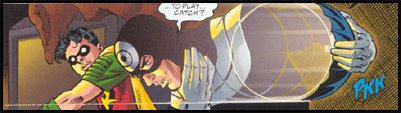
Batman & Robin versus Bullseye (DC versus Marvel #1)
What a delicious turn of events. While the Joker was crazy enough not to engage a disaplaced Spider-man - Bullseye is unstable enough to snatch the nearest kid in a cave, and start demanding answers.
Unfortunately for him, one of those answers is "Batman."

With a knife to Robin's throat, Bullseye holds Batman in a stand-off, batarang drawn. The man who doesn't miss teases Batman, cutting at the mask of Robin and speculating his chances of a miss.

The boy wonder, hardly helpless, elbows the fiend in the neck, giving Batman an opening to toss his batarang. However, even stunned, Bullseye is able to snatch the weapon out of the air, and whip it right back at the target.

Much to Bullseye's dismay, however, Batman is able to duck and weave the return attack, and swiftly plant a stiff left on the chin of the Marvel villain.
"You hit... even harder than... than... Daredevil..."
Winner: Batman (w/ Robin)

Wolverine versus Killer Croc (Marvel versus DC #2)
Bursting from the sewers, Killer Croc and Wolverine go at it tooth and nail - literally!
With several on lookers (including Clark Kent and Ben Reilly), the two feral fighters do battle and exchange quips. The two battle their way into the streets, careering into a toy store, as Wolverine takes an apparent offensive.

While no definitive blow is struck on the page, Wolverine is free to accompany Gambit in stealing the Batmobile. Though apparent that Killer Croc is defeated, it is possible he escaped.
Winner: Inconclusive (draw)

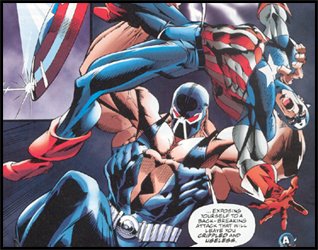
Bane versus Captain America (Marvel versus DC #2)
The battle of the serum enhanced super soldiers!
As Cap's shield hurls out of reach, Bane mocks his opponent as he prepares to deliver a back breaking finishing move that will leave the Captain crippled and helpless.

As Bane mocks the Captain's strategy, his full frontal assault turns out to be an error of judgment. Cap's shield, ever a faithful weapon, comes boomerang around right into the back of Bane's skull. Ouch. Schooled by the master!
"Now... No more back talk from you."
Winner: Captain America

Peter Parker versus Scarecrow & Scarecrow (Marvel versus DC #2)
Walking the streets alone can be dangerous, but that goes double when you're Lois Lane - professional damsel in distress!
In a meeting of gimmicks, both the Marvel and DC Scarecrows come up with the genius plan of kidnapping Superman's gal for whatever genius reason that goes unsaid.

Luckily Planet photographer Peter Parker is nearby, and able to unload some mean martial arts skills on the two fear enducing putzes.
Winner: Peter "Ben Reilly" Parker

Hulk & Superman versus Metallo (Marvel versus DC #3)
Beamed to Metropolis, Hulk finds himself dealing with a metallic hulking maniac called Metallo. Using a nearby giant Superman statue, Hulk smashes the 'metal geek' around a bit, until Superman finally shows up.

Confronting each other for their official bout, the two do away with Metallo switfly with a double punch, before being teleported to clearer grounds.
Winners: Superman & Hulk

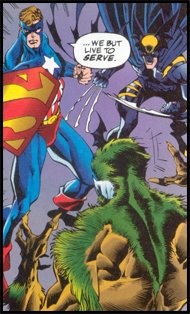
Dark Claw & Super-Soldier versus Hyena (DC versus Marvel #4)
Dark Claw lurks across the rooftops, pursuing his arch-nemesis the Hyena.
Dark Claw attempts to put an end to the pursuit, hurtling a bomb at his foe, but Hyena is able to rip a chimney from a roof and swat it away toward innocents below.

The intervention of Super-Soldier sees a happy ending for the folks below.
As Hyena thinks he's finally made his get-away, the two heroes loom on the rooftop waiting for him.

Hyena backflips away, and makes his way to the streets below where Access, a character with newly acquired powers, finds himself the target of a hostage situation.

Of course, as Hyena leaps at his potential ticket out, Access creates a portal to someplace unknown, and lets Hyena send himself away.
Access attends to more important business, like seperating the Amalgam universe into the Marvel and DC universe via bits hidden in Captain America and Batman.
Winner: Access (w/ Dark Claw & Super-Soldier)

Hulk & Superman versus Moleman & the Moloids (DC versus Marvel #4)
In the batcave, Hulk emerges to tackle the swarming Moloid masses led by the Moleman. Using a well shined giant penny, Hulk flattens an armada of Moloids, and then tussles it up with the little freaks himself.
The cavalry arrives in the form of Superman, who deflects a blast from the Moloids' "greatest weapon" - a very Kirby laser canon.

Moleman and his Moloids are forced into retreat.
Winners: Superman & Hulk

Superboy versus Kingpin (DC versus Marvel #4)
As Wilson Fisk abuses his powers as owner of the Daily Planet, Spider-man swings in to heckle his long-standing foe.
Having already laid Perry White on his ass, Kingpin doesn't even see the brazen attack from Superboy coming. Some tight pants, a bulky jacket and a little 'tactile telekenisis' later, and Kingpin's getting dumped through a table.
Winner: Superboy

Elektra & Catwoman versus Abomination (DC versus Marvel #4)
Though the battle is sufficiently depicted (and considerably one-sided), in the end the sky turning to blood proves too much of a distraction.
Winner: Inconclusive (draw)

Flash & Quicksilver versus Venom (DC versus Marvel #4)
As the Marvel villains continue to get a good run in the wrap up of this mini-series, Flash and Quicksilver, though much better matched, find themselves sufficiently distracted during their fight.
Winner: Inconclusive (draw)

JLA/Avengers versus Darkseid & Thanos (DC versus Marvel #4)
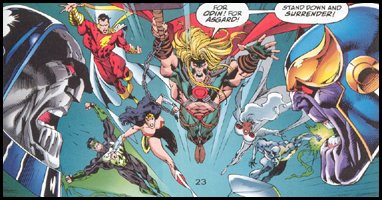
A collection of heroes from both universes charge in to do battle with the wagering titans, Darkseid and Thanos.
Darkseid takes delight in finding "fire" in the mighty Thor, who deflects deadly eye beams from the ruler of Apokolips. The Silver Surfer and Storm swoop in for attacks on Darkseid, but they prove ineffective, as Darkseid topples Thor with a second eyebeam attack.

Meanwhile Green Lantern, Wonder Woman and Captain Marvel fare better with Thanos, drawing first blood.

As the two fights converge, a thumped Wonder Woman hands Thor the mighty Mjolnir, much to his surprise.

As the sky turns to blood, these heroes too are distracted.
Winner: Draw

The hammer...
So, in the end, with these additional fights, who is the true winner?
Well, by Secret Earths standards it was a draw. While the official fights drew a 6-5 finish, additional fights ended in an 8-all draw, with a bunch o' ties and inconclusive results. Bravo to fair conclusions.

All in all this probably wasn't the greatest crossover event. As alluded to by some of these extra fights, there was a lot of fertile ground that went untouched.
That said, it's been a lot of fun taking a look at each battle the past few months, and filling the site with entries based on comics that were just made for a site like this.

Unfortunately, criticms of this mini-series come to mind far quicker than praise.
Perhaps some of the most bitter results are the chances missed. Some of the fights alluded to, but not given enough screen time to make this extras special included: Steel versus Absorbing man, Green Lantern versus Green Goblin, Daredevil versus the Riddler, Batman versus Venom, Captain Marvel versus Dr. Doom, Punisher versus Deathstroke, Etrigan versus Ghost Rider, Thing.Human Torch versus Firestorm/Martian Manhunter, Superman versus Annihilus, Spider-man versus Man-Bat and Nightwing versus Gambit.

If even a fraction of that list could have been given a look in, this series might have even scraped through with obscurity cred. Unfortunately, these just highlight a lot of missed chances, sitting next to a lot of half-done fights listed in this entry, and even in previous 'official' entries.
I would also particularly highlight the absence of big names like the Fantastic Four and the Martian Manhunter, lucky to get even a one-page mention.

Overall, I suppose a lot of this has to be put down to the era.
The writing is not at all intelligent, providing a fairly standard cosmic romp with a lot of quick, vingettes for each fight. The drama and the story of each conflict is completely absent here, and that's a shame.

Visually the book is also lacking. Castellini and Jurgens appear as somewhat unusual choices for a project so huge in the context of comics history.
For a one-time situation, it's disappointing that more range and variety couldn't have been offered up.

Personally I'd love to see another effort, with contemporary talents and characters spreading the event across several mini-series and one-shots. Guys like Brian Bendis and Ed Brubaker with Michael Lark on Daredevil/Batman.
Characters like the JSA, the JLA and the Avengers all interacting. There really are endless possibilities.

Never the less, it was a very fun series, and great to see what we did.

Next month, as voted by poll, Monday madness will feature fights starring the Hulk! Hope you enjoyed revisiting Marvel versus DC, I know I did (even if it is 2am!)!

NEXT: Another special event! Celebrating the release of X3, Wolverine takes on a bitter foe in a whole other medium! Stay tuned!