
 HULK versus SILVER SURFER
Planet Hulk: Exile Part IV (Marvel)
Where: The Incredible Hulk #95 When: July 2006
Why: Greg Pak How: Carlo Pagulayan
The Story So Far...
Approached by SHIELD to undertake a mission in space against a rogue satellite; Bruce Banner, as he so often has, attempted to turn his burdened curse into a force for good. As his alter-ego, Hulk, the conflicted hero learned of a plot to rid the Earth of his existence, hatched by Iron Man, Mr. Fantastic, Dr. Strange, and Black Bolt -- members of the secret cabal of heroes known as The Illuminati. Having grappled with internal rogue elements as dangerous as the reality altering Scarlet Witch, they no longer saw a tennable solution for the Hulk's unpredictable and devastating rampages.
Ejected into outer space; Hulk attempted to free himself from The Illuminati's vessel with brute force. The assault knocked his ship from it's course to a remote, habital planet, instead sending the green goliath through a wormhole, which deployed him to a distant, savage planet called Sakaar.
Weakened by his intergalactic journey, Hulk is quickly sold into slavery on Sakaar, powerless to prevent his admission into the Empire's gladiatorial system held in the Great Arena. Inadvertently thrust into a group of surviving warriors, Hulk's powers begin to grow anew, posing a threat to the Emperor's rule as he aids his fellows in their battles. A win away from freedom, with the Emperor's blood on his mighty green hand, "The Green Scar" and his Warbound must now face the ultimate challenge. A warrior captured from the stars and forced to fight. A master of the power cosmic. A former ally to the Hulk himself -- The Silver Savage!
Tale of the Tape...

 Strength: Hulk 6 (Invincible)
Intelligence: Silver Surfer 5 (Professor)
Speed: Silver Surfer 7 (Light Speed)
Stamina: Draw 6 (Generator)
Agility: Silver Surfer 3 (Acrobat)
Fighting: Hulk 6 (Warrior)
Energy: Silver Surfer 7 (Cosmic)
Real Name: [Bruce Banner]
Group Affiliation: [Warbound]
First Appearance: [Incredible Hulk #1] Year One: [1962]
Win Percentage: [59.26%] Last Opponent: [Rulk]
2006: [#6] 2007: [#10] 2008: [#5] 2009: [#36]
Dr. Robert Bruce Banner, a slight and insignificant scientist, lives slavishly dedicated to the pursuit of knowledge, as funded by the United States military.
Though Banner justifies his goals as means for peace, he becomes one of America's leading weapons designers after inventing a gamma radiation bomb.
 During preperations for a test launch in the desert, Dr. Banner spots a reckless youth on the testing ground, and in a moment of magnificence, knowingly throws himself on a bullet that would grant a far crueller fate than death. Bitterly aware of the Communist conspiracy of his fellow scientist, Banner struggles to usher he and the boy to safety while his colleague continues to countdown the launch.
After succumbing to an ordinarily lethal doses of gamma radiation, Dr. Banner soon finds himself undergoing a horrific transformation. Originally by night, but soon triggered by rage or unease, Banner discovers the superhumanly strong alter-ego within himself, dubbed simply - the Hulk!
As Hulk, Banner's brilliance is reduced to a childlike lumbering, while his slight frame conversely comes to possess size, strength, and durability never before imagined. After being ejected into space by the secretive superhero Illuminati, Hulk came to land on a planet called Sakaar. While there, he developed a moderate intelligence with a keen mind for combat, hardened by forced gladiatorial combat. In The Great Arena, Hulk is joined by Korg, Brood, Shadow Warrior, Elloe, and Miek, collectively the Warbound.
Hulk has no specific known weaknesses, but is fiercely protective of the few who earn his favour. Though generally good hearted, Hulk is prone to wild rages and varied personalities, particularly provoked by any challenge to the identity of his persona, particularly where matters of his physical dominance are concerned.
Real Name: [Norrin Radd]
Group Affiliation: [Galactus' Heralds]
First Appearance: [Fantastic Four #48] Year One: [1966]
Win Percentage: [50%] Last Opponent: [Beta Ray Bill]
2006: [#21] 2007: [#22] 2008: [DNR] 2009: [#119]
Once an inhabitant of the paradise world Zenn-La; Norrin Radd was forced to enter into a faustian pact for his soul in order to protect his planet and beloved, Shalla-Bal, from the endless hunger of omnipotent world devourer, Galactus.
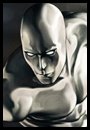
Pledged to serve as herald to the devourer and seek out planets to satisfy his sustainance, Radd was bathed in the Power Cosmic, transforming him into the chrome-coated space rider and harbinger of death, the Silver Surfer.
When first leading Galactus toward Earth, the Silver Surfer was engaged by the Fantastic Four, who were aided by The Watcher. During battle with Thing, the Surfer was knocked into the studio appartment of a blind artist, Alicia Masters. The kind touch and concern of the sculptress was key to reawakening the spirit of Norrin Radd, who then chose to use his powers against his master. Galactus spared Earth, but exiled his herald to the confines of the Milky Way Galaxy. As a result, he briefly held membership with The Defenders, along with adventuring many more times alongside the Fantastic Four.
The Power Cosmic grants Silver Surfer a near limitless array of abilities, many of which are rarely explored. At the outer limits of his skill, the Surfer has been shown to adapt telepathy, convert matter into alternate substances, and even time travel. More typically, he possesses greatly enhanced strength, stamina, and endurance sufficient enough to withstand even the harshest of environments unphased. He channels cosmic energy into projectile bolts as a means of combat, and can also control all aspects of his board, upon which he travels. The board is an extension of his being, but does not have any inherent baring on his power.
Additional: On designate Earth-2149, Silver Surfer had an encounter with zombie versions of Hulk and the other Avengers. In this reality, Silver Surfer was still herald to Galactus, arriving on Earth much later than his counterpart in mainline continuity. Hulk was strong enough to bite through the Surfer's cosmic chrome, leading both Silver Surfer, and his world devouring master, to suffer the ironic indignity of being eaten. The Surfer's fate was sealed in Marvel Zombies #3.
Despite a long association between the characters, which includes their mutual status as founding members of The Defenders, this is the first time the two have met on The Comic Book Fight Club.
History: N/A
Statistics: Silver Surfer Ranking: Hulk (#6)
What Went Down...
A triple drum call echoes throughout the realm, announcing a public holiday for the citizens of The Imperial Crown City. It means but one thing for those whose path leads to the Great Arena -- "It's gonna be a bloodbath."
 Entering the arena first are the challengers, whose record includes victory over the Maw and Wildebots, with the loss of only one warrior, Lavin Skee. They are Horoim the Shamed, the mighty Shadow Warrior; the descriptively titled Brood, from Broodworld; the stoney Korg of Kronan; loveable fighting bug, Miek the Unhived; and the hulking hero of the people, The Green Scar!
Their opponent, the ultimate contest for these Warbound warriors, is a chrome skinned hero from the stars, repackaged for the Great Arena as a board-shielded, mace wielding bad ass, The Silver Savage!
The Green Scar, Hulk, clearly recognises his opponent, revealing his identity to be that of former ally, The Silver Surfer! Controlled by the same retarding slave discs that punish any sign of rebellion amongst the Warbound gladiators, Silver Surfer is unable to resist the Emperor's demand for combat.
The first blow belongs to this Silver Savage, who delivers a devastating charging uppercut with fixed mace, powerful enough to shatter Hulk's shield and send the armored Green Scar and his fellows toppling like never before!
Hulk ties up with his former Defenders teammate, to share a piece of his mind. The Surfer plays it a little more direct, however, sending Hulk careening across the arena with a cosmically charged headbutt, for his troubles. His utterance, "forgive me...," offers little consolation to his fighting foe.
The rest of the Warbound join the fray, but Brood and Miek are just as easily defended against. Using his modified board as a shield, the Surfer blocks Miek's leaping attack, whilst tending to the more effective Brood with a swing of his arena supplied, energy crackling fixed mace.
 A rampaging Kronan would likely rock any other being to their core, but the Silver Savage is swift in his dismissal of the undisciplined assault, counter attacking with a simple rise of his board. The impact of Korg's landing sends a destructive crack through the Great Arena seating!
With an eye for a more strategic attack; Hulk, still recovering from his first dash against the cosmically powered Surfer, formulates a motivated assault on the Surfer's only obvious weakspot, on the same page as former Shadow Warrior, Hiroim. The fallen former imperialist leaps into the air for an overhead strike!
 The Silver Surfer confidently raises his shield to defend against the aerial attack, leaving himself wide open to a head-on collision from the incredible Hulk! Hulk drives Hiroim's spear directly into the control disc attached to the Surfer's chest, successfully rupturing it! The effect is quick working, freeing the Silver Surfer from the device's controlling influence. His gratitude is swift. Hulk is swifter...
 As the Green Scar's mighty fists come crashing down upon the limp silver form beneath them, something primal, old, inherent in his DNA comes out. The crowd's cheers turn to shocked silence, but the Hulk hears neither, unleashing a rage that decimates a Silver Surfer who is no longer a threat. The stoney hand of Korg stays Hulk's pounding fist, "Hulk, no. We've won."
A monster's roar gives way to a sense of clarity.
The third victory is secure.
Hulk has earned his freedom...
The Hammer...
 Given recent history, I'm reluctant to promise a lot of these 2011 updates, but I do so very much enjoy the prospect of returning to these meaty, instant classic battles. In the scheme of things, The Comic Book Fight Club has dwelled so often in obscurity, the contemporary, or personal obsession, that some of the biggest battles and most famous comic book rivalries have failed to make an appearance. In the scheme of things, this is a comics blog that has only scratched the surface of it's subject matter -- an exciting prospect!
I have to admit straight away, I passed Planet Hulk up on it's initial run. Worse still, what really inspired me to bring this particular battle to the site was the animated film based on the comic, which notably omits this fight in favour of an adaptation featuring Beta Ray Bill in Silver Surfer's place, who was licensed elsewhere. This really isn't an illigitimate way to breach characters, or stories, but as a die hard old comics reader with designs to be a credible source of information, I guess I'm just not used to resorting to second-hand second-glimpses, like that.
Ultimately, even after comic and cartoon, I'm not entirely convinced this is a story for me, but I so totally admire the conviction of Greg Pak's story, and the Planet Hulk concept as a whole, that I cannot deny it it's dues. To really get a grasp of Planet Hulk from this context, I think you need to look at the whole.
In these heavy thinking times, Hulk has become a far more difficult character to write than the basic concept might suggest. A brilliant, peaceful scientist who becomes victim to the raging beast within is still a very interesting and viable concept, but the Hulk's legend has grown over time so much so that accepting his simple existence in a Marvel Universe has become a tricky subject.
Some of my favourite features on the site come from guest-spots, or one issue stories, but Hulk can no longer meander from one appearance to another as freely as he did in decades gone by, certainly not without raising larger questions from an increasingly savvy audience. Causality is nothing new in superhero comics, but the bredth of it's reach has expanded and intertwined with other concerns, such as a tone of consistency and greater, more plausible balance of risk and threat in fiction that depends on the survival of it's iconic characters.
This conspiracy of ideas, to refine the purity of Hulk's status as "strongest one there is," alongside the desire to do so with a sense of superhuman versimiltude, has meant that the classic enterprise of pitting the Hulk's mindless strength against other heroes now demands an event unto itself. It's not enough to have Matt Murdock meet Bruce Banner in New York City by chance [Daredevil #163], or let Hulk walk away from a clash that threatened the lives of the American Winter Olympic team [Marvel Treasury Edition #25]. Now there must be consequence, and if forty years of an unpredictable power of Hulk's significance demands a sense of consequence, then attempts at longterm solution become inevitable.
I like Planet Hulk because it comes from a couple of good places.
On the one hand, the premise of ejecting Hulk into space comes from the simple perspective of wanting heroes to have the credibility of recognising a threat, in a world where an ultimatum between franchises can never be made. Ejecting the character into space, even in the knowledge that it won't last, is as elegant a way to make everyone look good without creating an unsolvable, impossible situation. Quite the contrary, when, this is the basis for an opportunity to work with a high concept that, in one sense, plays very much to the character, but in another, takes it to a whole new place.
[Greg] Pak credits Marvel Editor-In-Chief, Joe Quesada, with the invention of the Planet Hulk story. There seems to be no denying, however, that the success of the story comes straight from the writer himself, who was given enough rope to tell an unlikely story, his way. The result is a textured approach to event comics, as big an idea as something like Civil War, without the loss of character that comes from such a large scope. This is "event comics" with the grounding of the tried and true method of writing storyarcs, bolstered by a dedication to a focal point, even if attention is shared with other strong characters.
The gladiatorial aspect of Planet Hulk seems right up a vintage alley, relevant to some of the earliest Stan Lee adventures, which gleefully pitted Hulk against his fellow Marvel heroes in some of the earliest examples of these classic rivalries [ie; Tales to Astonish #79]. The idea of dropping Hulk on an alien planet, where his powers aren't at their height, is twisting that original combative premise on it's head in a way that makes good use of the unique situation. Combine this with the presence of the Warbound supporting cast and their converging plotlines, and you've got a very admirable and unique chapter in the Hulk's illustrious history.
You couldn't talk about the event of Planet Hulk without mentioned World War Hulk, which bridges the gap between then, and now. The most enduring legacy of World War Hulk remains the invention of Red Hulk -- gamma irradiated alias of General Thunderbolt Ross -- which has very specifically represented a rebuttle to the kind of thinking that brought us to now. "Rulk" and Hulk have been a part of a couple of years of storytelling under Jeph Loeb [and Ed McGuinness], who've very much retreated back into a way of approaching the Marvel Universe that has very few signs of consequence, initiated by the mass destruction of World War Hulk, but taking it much farther in it's disregard for other characters.
Personally, I think Planet Hulk got it right.
There's a balance in the world that takes a very individual, removed perspective, but retains a referencial tone. Pak balances his own goals with the pop precepts that drive Loeb's action-heavy guest spots, giving us this rather exciting issue of Hulk versus Silver Surfer, with a more organic consideration for what's plausible or appropriate. Granted, the story makes a time-based exception to allow for the concurrent Annihilation event that featured Silver Surfer, but does so quite elegantly, with the overriding consideration that Silver Surfer is an enticingly connected character within the Hulk mythos, with every potential to be there. It's something the Loeb stories lack, or at least, fail to exhibit with as much delicacy.
Back matter in the letters page of single issues includes blog-like scans and reference material from classic Hulk comics -- a feature that almost redeemed farcical opus, Cry For Justice -- which reveals Pak's efforts even further. As a side, it not only makes buying the back issues well worth it, but also exhibits a technique that really should've been more prevelant in comics since the 2006 cover date. As an invested fan, I enjoy the context and wallowing in the history and continuity of the canon. For younger readers who have become notoriously characterised as stupid and lazy, this kinda stuff should be a good way to indoctrinate some backstory and perspective into them without the contextual vagaries of Wikipedia descriptions.
Visuals are vibrant and exciting, with Pagulayan looking equally comfortable when emoting the melodramatic expressions the story demands, or having the Silver Surfer explode into a fullpage assault with a fixed mace. He's joined by Marshall Rogers early in the issue, who contributes for a flashback sequence describing how the Silver Surfer came to be on the planet Sakaar.
All in all, if you fully comprehend that this is as far removed from the Marvel Universe and Hulk stories of the norm', then there's no reason to hesitate in getting a closer look. By it's removed nature, I'm not sure it can ever stand as one of the all-time great Hulk tomes, but as time goes on, I'm sure Planet Hulk will be fondly remembered as something a little bit different.
Winner: Hulk & Hiroim [w/ Brood, Korg, and Miek.]
The Fight: 5 The Story: 4.5 The Pictures: 4.5


 Strength: Hulk 6 (Invincible)


