
 THE INVADERS versus THE AVENGERS
Once an Invader... Part 4 (Marvel comics)
Where: New Invaders #0 When: August 2004
Why: Allan Jacobsen & Chuck Austen How: CP Smith
The story so far...
Alarm bells sound when intelligence received by the Avengers informs them that former US Secretary of Defense, Dell Rusk, has covertly formed a new team of Invaders. This team, composed of WWII veterans and successors to mantles familiar to the time, join the Sub-Mariner in an Atlantean strike on the polluting oil-rich nation of Mazikhandar.
Learning that Dell Rusk was actually a disguised pseudonym for the Red Skull; Captain America and the Avengers leap into action to stop the Invaders from causing an International incident.
Despite their interference, the Avengers fail to prevent upheavel in Mazikhandar, and a new leader is enstated by the Invaders. To the dismay of all concerned, this new leader exposes his corruption immediately, executing his predecessor infront of the gathered heroes. Now the conflict boils over, as the Invaders' Thin Man operates covertly behind the scenes, and the teams come to blows!
Previous Form:
Invaders [#24]: Struggled against a Hydra-controlled Wolverine.
Avengers [#3]: Victories over the forces of Atlantis & the Sinister Twelve.
Tale of the tape...

 Strength: Sub-Mariner 6 (Invincible)
Intelligence: Thin Man 5 (Professor)
Speed: Spitfire 5 (Super Speed)
Stamina: Blazing Skull 6 (Generator)
Agility: Thin Man 6 (Rubber)
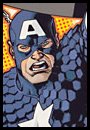
Fighting Ability: Captain America 6 (Warrior)
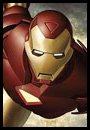
Energy Powers: Iron Man 5 (Lasers)
- The Invaders are: USAgent, Sub-Mariner, Blazing Skull, Spitfire, Union Jack, Tara and Thin Man. Accompanying the Sub-Mariner is Atlantean Counselor Sulumor, and soldiers in the Atlantean Royal Guard. For many members, their adventures span the decades, the Invaders at their height during the Second World War. Many of them have sustained their youth by means of natural mutation, meta-mutation, or magic.
- As Atlantean monarch, the mutant Sub-Mariner, Namor, commands not only an army of Atlantean soldiers, but also the respect of many of the Marvel Universe's most prominent identities. His tenure with the team began in the forties, where he, Captain America and the Human Torch represented the super-powered front of the allied forces. His mutant super-human strength, flight, and durability made him a powerful ally.
- During an expedition to climb Mount Kalpurthia of the Himalya, explorer Bruce Dickson discovered the lost civilization of Kalahia. The Kalahians accepted him into their culture, and altered his physiology with their advanced technologies, to give him powers comparable to their own. As Thin Man, Dickson would not only possess the ability to become razor thin through dimensional shifting, his aging process would also be brought to a halt.
Thin Man would utilize advanced Kalahian technology in the future, embodied during his tenure as covert leader of the New Invaders by the design of a destroyer ship capable of shifting through dimensional space in much the same way his body does.
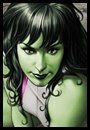
- The Avengers are: Captain America, Iron Man, Giant-Woman, Hawkeye, She-Hulk and Lionheart. Affectionately referred to as Earth's Mightiest Heroes, they represent the forefront of America's modern age of superheroes.
Though recently torn apart by the events of the registration Civil War, the Avengers still prevail, represented by factions on both sides of the debate.
- Captain America is the physical emodiement of the ideals of truth, justice and the American way. Many times this ideological status has brought him into conflict with government administrations, but never at the price of his patriotism. It was this nationalistic fervor that saw frail, young Steve Rogers volunteer for an experiment that would turn him into the super-soldier the world has known for six decades. Captain America was himself a former Invader.
- At the time of this story, Tony Stark aka; Iron Man, was serving as United States Secretary of Defense. As Iron Man he harnesses cutting edge technology and his own mechanical genius, along with a vast fortune amassed from industrialist activities that have not always characterized him in the most positive light. It was his own weapons that lodged life-threatening shrapnel near his heart, which led to the creation of the first Iron Man armor as a means of survival.
The Math: Invaders (Total) Avengers (Average)
The Pick: The Avengers
What went down...
With Atlantis and the Invaders responsible for staging a political coup in the nation of Mazikhandar, the Avengers attempt to intervene as the situation escalates with the new leader, General Rafiq, shooting the dictator Hassan in cold blood as a show of strength.
The Atlantean monarch, Sub-Mariner, remains steadfast in his opposition of Mazikhandar's wanton pollution of surrounding waters, justifying his actions to his respected ally, Captain America, by lives of his Atlantean kingdom equally lost.
Personal greivances give way to political powers, as the Thin Man makes an order from extra-dimensional space, prompting the USAgent to break free of the bonds already blaced on him by Avengers. He marches on his star-spangled predecessor with an explanation of jurisdiction. The Avenger Hawkeye fires one of his arrows at the non-lethal fleshy area of John Walker's behind, prompting action on the USAgent's part.
 The other Invaders follow suit in the retaliation, providing the Thin Man with a distraction fitting to his own secret agenda. With the Avengers sufficiently distracted by flaming attack, he enters the unguarded Manizkhandian palace.
Inside, the corpse of the deceased Hassan appears decomposing at an increased rate. Thin Man emerges from inter-dimensional space, where General Rafiq chastises a fellow for being anything but vigilant about defending the capital from the foreign incursion of the Avengers and Invaders, both.
Thin Man expresses his own disappointment, furious that Rafiq would renege on their arrangement to position him into power, in exchange for a live specimen of synthetic humanoid -- Hassan having already been murdered and replaced long ago, by unnamed clandestine forces.
Captain America and Iron Man storm the palace fortress, with the Atlantean Sulumor and Sub-Mariner in hot pursuit. Sulumor's bloodlust proves contrary to Namor's reluctance to see any further deaths on this day of war.
As is common of Namor's reign as Atlantean ruler, the Counselor challenges the Sub-Mariner's loyalties. He questions whether Namor is an ally or puppet of the surface dwelling heroes, prompting a knock-out blow from the proud ruler.


Thin Man reveals his manipulations, unwilling to leave Rafiq unpunished for his indescretions, but certain that the Atlanteans need support he and the Invaders in their actions. It is this truth that sees Namor extend a hand to Sulumor.
Meanwhile the Avengers pairing of leaders, Cap and Iron Man, storm through the palace, Iron Man disarming soldiers with his repulsor rays. They discuss the possibilities of Red Skull's continued manipulations when Thin Man appears to them. The Captain challenges Thin Man's ethics, quickly quashed by his own country's exoneration of Dickson in exchange for his services in resolving mistakes incurred during "Dell Rusk's" tenure as Secretary.
 Iron Man lifts Cap for a jet propelled getaway, but Thin Man's opposition proves more potent than they might have imagined. Calling upon his Kalahian powers, Thin Man extends himself into the air and whips his flattened arms in an arc, scattering Captain America and Iron Man through the air.
As the battle between Invader and Avengers rages outside, the tiled palace floor begins to rumbled from the inside. A terrified General Rafiq scrambles with pistol clutched to breast, narrowly avoiding the collapse of the palacial floor!
Emerging from the destruction, a floating Namor and Sulumor, certain of their intentions. As Rafiq makes a pathetic claim of friendship, Namor denounces his actions and declares the requirement of a trial. The cowardly General bows before the two Atlanteans with the solace of martyrdom as his world crumbles around him at the hands of the foreign invaders.
 At that moment, Blazing Skull brings an entire wall down, toppling the gargantuan body of the giant-sized Wasp! The falling beauty narrowly avoids a rope-swinging Union Jack, while Blazing Skull is whisked to safety by Tara.
Jack comes face-to-face with his idol, Captain America, who appears less than lively. The living legend is suffering the effects of an inter-dimensional pummeling at the hands of the Thin Man, who appears from nothingness again to whip the Captain into the air! Cap emplores to Thin Man to seek a better way, highlighting the differing ideals between the two World War veterans.


The secretary of defense blasts USAgent into the air with repulsor rays, declaring his seniority. Union Jack and Spitfire step-up, armed, to defend the injured USAgent, meeting the stern warnings of a frustrated Iron Man.
Sick of playing games, Iron Man meets the Thin Man on his own level, blasting him in the back as he continues to hurl Captain America around the palace.
The repulsor burst knocks the stretchy Thin Man into unconsciousness as he folds onto the floor, freeing Cap from his sub-spacial grip.
Outside, Avenger and Invader stand down as the Sub-Mariner hovers above the crowd holding General Rafiq by the scruff. He reveals a change of heart, forming a new alliance with Mazikhandar and offers politically solid Royal Atlantean protection to the oil-rich nation.
 With a single decree, Namor declares a new era of peace between the feuding sea and land, installing Sulumor as an Atlantean diplomat in the nation for the progress ahead. With that, he hands Rafiq to International justice, leaving the Avengers to make their own peaceful way out of Mazikhandar air-space.
 The hammer...
Ugh, y'know, this is such an awkward one for the Infinite Wars record books. Essentially the conclusion is a draw, but given the physical prowess of the Invaders, and Namor's role in concluding the battle, I'm going to give this one to the Invaders and Atlantis.
Something worth noting iss the interesting way the issue places priority on the story. The action is wrapped very specifically around character and story beats, omitting a large portion of the supporting Avengers and Invaders from battle. Though characters like She-Hulk and Lionheart pose as little more than filler during early wide-shots, for our stats, we'll give them the benefit of the doubt, conceptually having carried on the fight outside.
It was writing like the above that made me a really big fan of this series.
I had intended to use the announcement of a new Captain America as an excuse to pull this out as a chance to talk about USAgent, but I might save that for something a little later.
When it comes to New Invaders, I find myself with a lot to talk about.
It was the Enemy of the State tie-in, an abberation, that initiated the series into the Infinite Wars way back in December of 2005 - our first month! One of the stinging disappointments of making that the only issue featured, was the fact that I didn't get to acknowledge CP Smith's visual work on the series.
The art was but the most obvious thing that really set this series apart as something different to the rest of the Marvel catalogue in 2004.
It was operating within the context of the Marvel Universe, but it was a world where political espionage and vintage superheroics clashed to create a very fresh and vibrant reenvisioning of the Invaders model.
Pencillers, colourers and inkers have pushed the model of a Marvel superhero comic before and after, but what CP Smith did with this title really excited me.
It's a CG style you see more often now with guys like the Luna Brothers pushing traditional pencils and the digital realm together in mainstream titles like Girls, or their work on Spider-Woman; but at the time, Smith's work was so different in a mainstream comic, it was often cited as one of the reasons people weren't buying the book. Which I think is a damned shame, and something I know a lot of people got over upon the release of the complete series in trade paperback.
The weaknesses were definitely there: Sometimes characters could appear a little stiff in their interactions; backgrounds might have been lacking; and there was a tendency to reuse elements in panels in very different contexts -- but when one doesn't dwell on these negatives, there was a very fresh, and exciting differentiating quality to what Smith did. It had a charming simplicity, but at it's best never undercut it's ability to cast a full illusion of human depth.
For many, the series started with a black mark next to it's name even before they saw the radically different artwork. This zero issue reminds us that the Invaders were spun out of an introductory storyarc in Chuck Austen's brief run on the Avengers.
Say what you will about Austen, but Jacobsen should be well commended for his work on the series, which was far and above much of Austen's anchoring repetoire.
Top 25 Golden Age
#1 Batman (DC)
#2 Captain America (M)
#3 Superman (DC)
#4 Green Arrow (DC)
#5 Catwoman (DC)
#6 Sub-Mariner (M)
#7 Hawkman (DC)
#8 Nightwing (DC)
#9 Winter Soldier (M)
#10 Wonder Woman (DC)
#11 Dr. Fate (DC)
#12 Dr. Occult (DC)
#13 The Spectre (DC)
#14 Aquaman (DC)
#15 Captain Marvel (DC)
#16 Hawkgirl (DC)
#17 Wizard Shazam (DC)
#18 Alfred Pennyworth (DC)
#19 Phantom Lady (DC)
#20 The Ray (DC)
#21 Doll Man (DC)
#22 Blazing Skull (M)
#23 Captain Nazi (DC)
#24 Scarecrow (DC)
#25 Two-Face (DC)
Key to the series' unique approach was a fresh, but respectful look at the best-known Marvel Golden Age characters. At the time some purists might have been uncomfortable with the radical departure, but I think even the treatment of Namor, a personal favourite, saw these characters distilled to some of their very best qualities; played off one and other with a weight on scenario.
It was summer-action movies. It was maybe not as intelligent as a Bourne Identity, but it brought together the history of the superheroes, and smashed it up against war-themed conflict and intrigue. It's probably in these issues that we see for the last time, just to pick on a personal favourite, a strong Sub-Mariner.
We've talked a lot in the past about Black Adam doing Namor better than Namor [52 #45], and while that's a particularly harsh assessment of Marvel's use of the character, this issue in particular highlights how uncharacteristically still the character has been, particularly in the wake of his cousin's death.
[The recently launched Sub-Mariner mini-series, not withstanding...]
If there's a seperating factor, it might be experience and motivation as a ruler, and the fact that Namor for the most part does have a world-view about things. In this very issue we see a similar scenario to Adam's Kahndaq coup, with the notable exception that Namor marrys political hindsight to his violent solution to the conflict with Mazikhandar.
Cease Fire Update!: Readers of the Infinite Wars will be relieved to know I have again turned my Batman-esque level 5 brilliance to give my broken old computer-machine another life. This phoenix-like resurrection will, with any luck, not slow productivity any more than it already has. Hussah!
The Fight: 4.5 The Issue: 5
[I'd hold off recommending you march out and find the New Invaders trade until you've had a taste of the core series, but it is certainly now one of the hidden gems of the Marvel Universe. Hopefully in the coming months you'll get another taste of New Invaders: War-mongering mutates from the golden age!]


 Iron Man has to deal with the repercussions of his initial arc in this story, racially motivated attacks on foreign countries as American secretary of defense. Talking about flattening countries with bombs before turning them into amusement parks is generally considered something of a faux pas, even if it is Latveria.
 As the rampage continues in the streets surrounding Avengers Mansion, Hawkeye does his best to make an emotional plee to the woman inside the beast, but it has little effect.
 The hammer...


