skip to main |
skip to sidebar
 THE INVADERS versus THE NAZI PARTYOut of Time: Part 5 (Marvel)
Where: Captain America #5 When: May 2005
Why: Ed Brubaker How: Michael Lark
The Story So Far...
The mysterious murder of Red Skull serves as a bizarre precursor to the unravelling of history within the memories of Steve Rogers; known to the world as Captain America!
Cap finds himself distracted by the pursuit of truth as he begins suffering flashbacks to key events in his long history, each changed ever so slightly. The distractions prove so severe they nearly cost the hero his life, when Crossbones emerges to attack after the Captain investigates the desecrated graves of his allies from the Second World War.
Nick Fury: Director of SHIELD uncovers clues that lead to a rogue Soviet General, Aleksander Lukin. Cap's history folds back on him once more when Lukin is revealed as director of an international company called Kronas Industries. Named after a Russian village destroyed by the Red Skull, Cap recalls the battle to save it, accompanied by Lukin's mentor, Colonel Vasily Karpov...
Tale of the Tape...
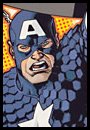
 Strength: Master Man 6 (Invincible)
Intelligence: Red Skull 5 (Genius)
Speed: Sub-Mariner 4 (Olympian)
Stamina: Sub-Mariner 5 (Marathon)
Agility: Captain America 4 (Gymnast)
Fighting Ability: Captain America 6 (Warrior)
Energy Power: Human Torch 6 (Mass Destruction)
- The Invaders are: Captain America, Human Torch, Sub-Mariner, Toro, Bucky.
The Invaders were the premiere superhuman line of defense of the Allied Nations during the Second World War. Their membership was captained by the combined forces of; Captain America, Namor, the Sub-Mariner, the Human Torch, Toro, Bucky, and several other recruits, such as Union Jack, Whizzer, Spitfire, and Blazing Skull.
The Invaders were chiefly positioned to defend the world from the threat of the Nazi Party and their many superpowered machinations and allies. This struggle against tyranny would extend to the modern era, with many of the Invaders roster enduring through time by means of science, magic, and mutation.
Their legacy endures into the modern age, where the team is reunited on occasion to undertaker varying missions, such as; the liberation of Mazikhandar.
 - The National Socialist German Workers Party, better known as the Nazi Party, was founded in the shadow of the first World War, in 1919. The party was built on the principle of philosophically uniting Germany free of social, economical, or ethnic division. Criteria for this homogeny was dependent on interpretations of the perfect Aryan race, and diffentiated from other movements by emphasising inclusion of the social middle classes.
A young German corporal, Adolf Hitler, was ordered to investigate the group, entering into political debate during his stay. This led to his invitation into the Party, and eventual ascension as it's iconic leader in 1933, appointed by Chancellor Paul von Hindenburg.
Hitler's fascinations were diverse and bizarre, including experimentation with elements scientific and occult. Attempts to recreate the famed Super-Soldier serum developed by Dr. Abraham Erskine for the United States of America resulted in Master Man: a frail American of German descent who was embued with powers far exceeding his American counterpart; Captain America. Master Man, Red Skull, and Warrior Woman represent the Third Reich's superhuman champions.
The Math: The Invaders Ranking: Captain America (#8)
What Went Down...
In the dying months of 1942 the Nazis had burrowed deep into the Soviet landscape, accompanied by Hilfswillige; Russian soldiers forced or willing to fight for the Nazi movement. Stalin's forces had plans to trap their enemies in the frost of a Russian winter, but word of a German super-weapon draws the intervention of the Invaders, who join the Russians to investigate.
The Invaders descend on Kronas, a northern village held by the Nazis.
Their scout, the diminutive teen, Bucky Barnes, leads the charge, evading defensive measures armed with but a knife. He swiftly and silently eliminates the frontline of the Nazi guard, clearing the way for his companions.
 A trigger-happy Russian alerts the camp to the incursion, raising the alarm to not only the Nazi soldiers, but also their dormant super-soldier: Master Man!
On the ground, Captain America gives the order to Karpov and his men to protect the villagers, launching a personal assault against the Nazi soldiers. Like a one man army, Captain America successfully fronts a group of five soldiers, armed only with his shield and determination!
 Meanwhile, in the skies above, the supermen do battle!
Sub-Mariner meets Master Man in aerial combat, appearing evenly matched with the Nazi super-soldier. The Human Torch and Toro do their best to tip the balance, but their flames threaten the Atlantean more than Master Man.
 Bucky joins the Captain as he maneuvers his way across the compound in search of the German secret weapon. A congregation of Nazi guards makes finding the weapon easy, and despite their impressive numbers, Cap is able to defend the duo with his shield, leaving Bucky free to blow the machine gunners away with a grenade!
The young soldier proves hasty in his approach when a crackling, green energy bolt blasts through the wall of the village hut, leaving Bucky to narrowly avoid death, saved only by the intervention of his seasoned mentor!
 Captain America and Bucky have but mere moments to survey the carnage wrought by the strange energy beam, before the onslaught of successive blasts begin to reach out like tendrils of death! The beams zig-zag across the battlefield, destroying poperty and soldier indescriminately!
 Through the burning wreckage Cap spies his arch-nemesis, the Red Skull, manning the controls of the Nazi super weapon. He points the barrel with little regard for the lives of Americans, Russians, or even his own German soldiers!

 The spreading flames threaten to ravage the small village, forcing the Torch and Toro to abandon their battle with Master Man to attempt to curb the damage. They do their best to absorb flames and melt the snow to rain, but it provides little relief. Leaving the super weapon to self-destruct, the Red Skull makes an escape with the Master Man, knowing full well that the Invaders will stay to fight the losing battle to save Kronas.
 The Hammer...
This was such a tough one to call I was forced to convene with the judges! I was about ready to call this a draw, and maybe it's just July Fourth patriotism, but I've been forced to declade the Invaders the victors, by points! [Namor, Human Torch, and Toro only pick-up the assist!]
Those scoring along at home might like to note: while Master Man and Red Skull escaped after the former fought Sub-Mariner (and co.) to a stalemate; they were the representing exceptions of the Nazi Party, who suffered mass casualties in the exchange.
That, ladies and gentlemen, is good housekeeping!
Those of you displaced in time will be happy to join us in our indulgence of the July 4 pseudo-meme! While the Infinite Wars bares no special affinity for apple pie, we would be remiss to pass up the opportunity to discuss the thorough whacking of Germans. Nazis, I mean.
One has to exercise a little self-awareness and acknowledge that, on most outings with Ed Brubaker, we've had a consistent underlying theme of negativity. While I'm reluctant to retract any previously described acronyms or reactionary redefinition - I do feel compelled to balance the scales!
[EDITOR'S NOTE: Lazy Brubaker Syndrome; not to be confused with "IBS"]
Blogging boffins have flocked to Brubaker's work on Captain America, declaring it one of the most significant Marvel comics of the decade for it's contrivances, and it's sense of lasting consequence. While the reinvigoration of Cap's blood feud with the Red Skull has benefitted from the tempered urbana of it's presentation, it's the 'inconsequential' superheroics that have inspired my joy!
Flashbacks to WWII add a sense of disorientation and context to certain key components of Brubaker's stories, but ultimately, the deviation as it's seen in this issue is pure indulgence of the superhero medium -- and I love it!
Credit where credit's due: as is the case with early issues in most Brubaker series, the economy of story remains bouyant. Relevant insights delivered are mostly present to give weight to certain key characters in the story. Included is the vaguely Magneto-esque birth of Aleksander Lukin, punctuated by a single panel at the end of the conflict, while other beats deliberately emphasise the history of Captain America's relationships with Bucky and Red Skull (at the expense of any elaboration on Sub-Mariner or the Torches).
Recent history has taught us to resent this kind of revisionist history, but the number of writers making competent and measured efforts is growing! Geoff Johns remains the master of the clean-up, but Brubaker deserves a lot of credit for his many flashbacks that allude to a more grounded and belieable War-era history for Captain America. The sad truth for many of these characters is that their past does not reflect what we like to think of them in the modern era.
As someone who has not enjoyed Steve Epting's critically acclaimed work, it was a joy to read an issue dedicated to secondary artist, Michael Lark! The artist; whose contributions defined the worming flashbacks of the first year; provides his trademarked style of curiously squared and sometimes incomplete lines, which cast the illusion of reality far more efficiently than you might imagine.
Full credit goes to colorist, Frank D'Armata, whose allergy-inducing palette for present day scenes have been a major contributor to [my] depreciation of Epting's series pencils. Muted blues and greys have a softed gradient in the flashbacks, making them much less aggravating, and benefit from the clean juxtaposition of Russia's snowy whites. D'Armata shines with bold colour pops in scenes depicting the red of the Red Skull bursting amidst the glowing flames of Kronas' misfortune.
As with many golden age reboots there's nothing especially retro about the artistic presentation of these stories. Even so, there's a certain timeless quality to the pages, in spite of the prevelance of the Larks of today's popular comics.
It works! Especially when one remembers these are the beginnings of the golden age revival for Bucky: a character who, until this story, had enjoyed the rare honor of being a superhero left dead for decades. It makes for a solid start, leading in to an era of Bucky Barnes as the new Captain America, something we're disappointed to have been unable to feature on the site.
I can't tell you anything about this issue that you won't be able to see for yourself. I can, however, enjoy documenting a scene that might have been lost amidst the headline-grabbing exploits of a series that may have enjoyed acclaim for everything but the strengths of what it really brings. I just wish Brubaker could maintain the kind of energy these first storyarcs bring. Aquela é a vida da maneira é!
The Fight: 4.5 The Issue: 5
Something missing from your Fourth of July? Don't get caught out next year! Remember Captain America's last great adventures with a trade paperback from Amazon! By using purchase links provided on the site, you help sponsor the future of the Infinite Wars, which is the patriotic thing to do! Check out the entire range of reviewed and recommended reads in the Infinite Wars Gift Shoppe!
 CROSSBONES versus CAPTAIN AMERICAOut of Time: Part 4 (Marvel)
Where: Captain America #4 When: April 2005
Why: Ed Brubaker How: Steve Epting
The story so far...
He was the legendary super soldier of the Second World War, and after being frozen in a block of ice, Captain America was thawed out by the Avengers to have a second chance to change the world as a beacon of all the American dream hoped to be.
Of the past, all the man behind the mask has is memories, but when Steve Rogers begins having flashbacks, things no longer seem the way they once did. As the flashbacks increase, so too do the deviations in what Captain America recalls as fact, including fateful events like the scene that saw the death of his partner, Bucky Barnes.
The subversive attack continues as the unmarked graves of two wartime mystery men; Spirit of '76 and Patriot; are desecrated, sending a direct message to the man whose mantle both men would at one time occupy.
Having investigated the graves Cap spins into yet another flashback, before finding himself under fire on the freeway from an old foe -- Crossbones!
Tale of the Tape...
 Strength: Crossbones 4 (Steroids)
Intelligence: Draw 4 (Tactician)
Speed: Captain America 4 (Olympian)
Stamina: Captain America 5 (Marathon Man)
Agility: Captain America 4 (Gymnast)
Fighting Ability: Captain America 6 (Warrior)
Energy Powers: Crossbones 2 (Projectile Weapons)
 - With a death on his hands, the juvenile Brock Rumlow would flee New York City and seek refuge with one of the Taskmaster's infamous schools for criminals and mercenaries. There he would excel in the fighting techniques Taskmaster taught, which would allow him to graduate into a prominent mercenary in his own right.
His career would bring him to the attentions of the Red Skull, with whom he would pledge permanent employment and allegiance, and gain his codename.
Crossbones is a highly skilled hand-to-hand fighter trained extensively in various martial arts styles, military combat techniques, and street fighting.
He is also extremely proficient with a wide variety of weaponry including a catalogue of guns, knives, and other projectile weapons.
- A scrawny and frail individual, despite his best efforts, Steve Rogers was unable to enlist to serve his country on the cusp of the Second World War.
Given his gusto, Rogers was invited to partake in the top secret Operation: Rebirth, which intended to chemically alter a man's biology to grant him fantastic speed, strength, and endurance, making him a super-soldier! The serum proved successful in turning the diminutive Rogers into a battle ready super-soldier, but the serum's creator, Dr. Abraham Erskine, lived only long enough to see the fruits of his labours, before being assassinated.
Thus, Rogers lives on to honor Dr. Erskine as America's only super-soldier, and sentinel of liberty: Captain America!
The serum grants Captain America peak human physical conditioning, a sharp mind, and an altered physiology that drastically slows his aging. These physical and mental attributes are complimented by extensive training in hand-to-hand combat, (including the use of a vibranium-steel alloy shield), and briefing in tactical maneuvers, urban military combat, and survival tactics.
The Captain has amassed decades of experience in the heat of combat, and carries with him a confidence that reflects this, and exudes the authority that he has established throughout the superhero community as leader of the Avengers.
The Math: Captain America Ranking: Captain America (#5)
What Went Down...
Distracted by flashback, the motorcycle mounted Captain America is snapped back to reality by gunshots that puncture his front tyre. He is able to gracefully tumble from the jacknifing bike, and takes immediate shelter behind his shield, as the mercenary Crossbones walks across the road firing.
As Cap ponders the likelihood of Crossbones' involvement in the destruction of his allies' graves, he finds himself yanked into a flashback of his partner being tortured right before his eyes by the first Baron Zemo.
 Crossbones mercileslly beats the Captain, ignorant of his struggles between distorted images of the past, and the present. Reliving the moment, Captain lets out an uncharacteristic howling objection.
Fighting to stay in the present and to protect himself; Captain America throws himself into a charging maneuver that puts his shield between he and his burly assailant. Crossbones relishes the opposition, but puts on a show of his strength, punching the shield before yanking it aside with the barrel of his gun.
 Cap continues to struggle with his uncontrollable memories, recognising the threat they pose to his survival, let alone victory. He is barely able to jump aside as Crossbones threatens with a clubbing blow that leaves a dent in a car trunk.
 Evasive maneuvers prove futile as Crossbone's fists catch up with the Captain, dropping him with one fell blow. Crossbones puts the boot in, mocking his arch-nemesis, only to find unexpected retorts calling him a coward.
Down, but not out, Cap suffers another boot to the gut, before getting a total denial from the masked mercenary. Seeking vengeance for the murder of Red Skull, Crossbones reveals that he was told of the Captain's whereabouts by an anonymous Russian tip.
 With the truth verbalized, Crossbones throws another boot to the already floored Cap, before declaring disinterest in facing him in his weakened and distracted state. Showing a rare taste for ceremony, Crossbones disappears into the surrounding wilderness, leaving the beaten Captain to the scattered traffic on the highway, and the plaguing flashes of memories that did not occur.
The Hammer...
Despite being the bigger man, (for walking away), we've got no choice but to declare this a victory for Crossbones and an awful start to the year for Captain America, who is already the most defeated character on the books!
If you're just joining us, it might be nice to know that we're beginning he year by serving up first dibs to the top ten characters of 2007, which saw the good Captain come in at number three. Really not too shabby for a dead guy who got beat up more than anyone remembers!
So, speaking of being beaten up, we've got another one of those 'benefit of hindsight' scenarios which raises a great frustration found in a good many superhero stories: the villain and a sense of ceremony.
 It's worth acknowledging that the presence of the Red Skull makes for two very different contextual settings, but never the less, the problem I find here is that Crossbones leaves Captain America, not content with beating him in a situation that has him anywhere but his best. A contorted warrior's logic, but something not too difficult to give to a comic book villain.
Unless, of course, a couple of years later they're at the centre of story built on shooting a shackled Captain America from a sniper's post miles away.
Again, I acknowledge there are a lot of variables involved. In the latter example, Crossbones is acting with instruction from the Red Skull. Likewise, there's a larger plot surrounding mind games with Sharon Carter and a whole lot of convoluted mess that really only raises different script issues, but at the heart of it, the scenes depicted here really feel awkward.
I suppose part of that is due to the nature of Crossbones as a villain.
I think these street level mercenaries more than others ask for an honesty in their depiction, which isn't easy to carry in the serialized medium. The balancing act of serving a story, maintaining a character's competence, and allowing your hero to escape, are not necessarily easily managed -- particularly when your villain is supposedly a highly skilled, amoral mercenary who hates the hero.
When you look at the motivations of the character and the stark scope of the reality, it becomes a very difficult pill to swallow. Here it might even require a greater suspension of disbelief than Batman's constant decisions to allow the Joker to live. It's the difference between a costumed vigilante and a multi-coloured murderer who kills with fish -- and a soldier versus a man with a gun.
We've been critical of Brubaker's work a lot, and I have to say at the very least, these early issues really helped summon an atmosphere that I don't ever recall being around Captain America. Though he's operated independently and on an urban scale, the art direction, and motley colours of Frank D'Armata really help sell the more urban movements of Captain America in a pseudo-real world.
That said, the visual direction comes with criticism. Though it seems to have been very well received, I personally find the inks and droning colours on Epting's pencils to be a little more than unattractive. Though the general concept is definitely complimentary to the tone of the fiction, in it's isolation it clashes with some of the comic book conventions, and it proves stoicly unexpressive, much like a lot of the writing.
The dark colour palette, at it's worst, feels more like a broad allusion to something, in essence similar to Brubaker's insinuations of a story more involving than it is. On the flipside, the Brubaker/Lark combination is much more palatable, even if it features Lark's trademark unfinished lines.
We've talked a lot about the myth of 'Lazy Brubaker Syndrome', and though the story gradually built to it's first milestone - the return of Bucky - I found myself becoming distracted and disinterested by around issue five. Which, at the time, was of great frustration because otherwise it was a very positive push forward for the character, I feel.
You might measure the story's penchant for rewriting history against the recent One More Day debacle, but I think you'll find far purer motivations here, even if it isn't particularly well represented by the transition of canon.
Contrary to more widespread opinion, I find Bucky's 'resurrection' almost as silly as the Prime-Punch return of Jason Todd. While Winter Soldier presents a more grounded explanation, the relation it holds with decades of stories doesn't gel particularly well. Even so, Winter Soldier has proved a welcome addition to the Captain America family, and will officially don the Cap costume in 2008.
Overall, I think it's the broad conceptual strokes that leave Brubaker deserving of praise. Even if execution has been frustratingly lacking, the map of ideas has been there enough to bring me back to Cap for the odd taste. I just wish it was the kind of must-read book it clearly wants to be.
The Fight: 4.5 The Issue: 4.5
Agree or disagree with our opinions? Under the on-going team of Ed Brubaker and Steve Epting; Captain America has been one of the most popular titles published by Marvel, revered by many. If you're looking for an easy way to scoop yourself an acid test, why not head to Amazon where the first trade serves up the first storyarc in a convenient little package! Mmm, kick-backs!

 - The National Socialist German Workers Party, better known as the Nazi Party, was founded in the shadow of the first World War, in 1919. The party was built on the principle of philosophically uniting Germany free of social, economical, or ethnic division. Criteria for this homogeny was dependent on interpretations of the perfect Aryan race, and diffentiated from other movements by emphasising inclusion of the social middle classes.
 A trigger-happy Russian alerts the camp to the incursion, raising the alarm to not only the Nazi soldiers, but also their dormant super-soldier: Master Man!
 Meanwhile, in the skies above, the supermen do battle!
 Bucky joins the Captain as he maneuvers his way across the compound in search of the German secret weapon. A congregation of Nazi guards makes finding the weapon easy, and despite their impressive numbers, Cap is able to defend the duo with his shield, leaving Bucky free to blow the machine gunners away with a grenade!
 Captain America and Bucky have but mere moments to survey the carnage wrought by the strange energy beam, before the onslaught of successive blasts begin to reach out like tendrils of death! The beams zig-zag across the battlefield, destroying poperty and soldier indescriminately!
 Through the burning wreckage Cap spies his arch-nemesis, the Red Skull, manning the controls of the Nazi super weapon. He points the barrel with little regard for the lives of Americans, Russians, or even his own German soldiers!

 The Hammer...


