skip to main |
skip to sidebar
 INVADERS versus BARONESS BLOODBlood: Part 2 of 2 (Marvel)
Where: New Invaders #5 When: February 2005
Why: Allan Jacobsen How: CP Smith
The Story So Far...
Having relinquished leadership over the V-Battalion to the Human Torch, Roger Aubrey finds himself uncertain of his decision when he learns of the Torchs allegiance to the new Invaders. Retired to Dymhurst, United Kingdom, the former Mighty Destroyer finds himself requiring of their services when he is attacked by vampires.
The proximity of the attack earns the interests of Spitfire and Union Jack, whose histories with the vampire legacy of Baron Blood cost them the lives of loved ones.
Believing the attack to be an isolated incident, Thin Man and the Sub-Mariner dedicate the majority of the team to their on-going concerns with the Axis Mundis Pterrorist attacks on a recently liberated Mazikhandar.
The Human Torch opts to accompany his British allies to the UK, drawn by his connection to Spitfire. His presence proves valued when Spitfire is kidnapped from Falsworth castle, taken prisoner by the cult of Baroness Blood!
Tale of the Tape...

 Strength: The Destroyer 3 (Athlete)
Intelligence: Human Torch 4 (Tactician)
Speed: Spitfire 5 (Superhuman)
Stamina: Tara 6 (Generator)
Agility: Union Jack 3 (Acrobat)
Fighting Ability: Union Jack 4 (Trained)
Energy Power: Human Torch 6 (UWMD)
- The Invaders are: Human Torch, Union Jack, Tara, Destroyer, (and Spitfire).
The Invaders were the premiere superhuman line of defense of the Allied Nations during the Second World War. Their membership was captained by the combined forces of; Captain America, Namor, the Sub-Mariner, the Human Torch, Toro, Bucky, joined by expansions of the team, such as; Union Jack, Whizzer, Spitfire, and Blazing Skull.
The Invaders were chiefly positioned to defend the world from the threat of the Nazi Party and their many superpowered machinations and allies. This struggle against tyranny would extend to the modern era, with many of the Invaders roster enduring through time by means of science, magic, and mutation.
Their legacy endures into the modern age, where the team is reunited on occasion to undertaker varying missions, such as; the liberation of Mazikhandar.
 - A slave to Dracula; Dr. Jacob Cromwell was ordered by his master to revive a deceased John Falsworth, who had aided Germany during WWII as the vampiric, Baron Blood. Acting briefly as Falsworth's familiar, Cromwell was ultimately killed by his new master, along with one of his daughters. The other daughter, however, was merely turned, becoming herself an immortal vampire.
Upon the Barons death at the hands of Captain America; Cromwell's daughter became Baroness Blood, dedicating herself and her hordes to the cult of her creator. The Baroness succeeded in obtaining the Holy Grail, and upon drinking from it, gained the ability to exist in sunlight freed from her undying thirst. She turned her powers on Falsworths defiant family, beginning a vendetta against Spitfire that claimed the life of the hero's adult son.
Baroness Blood possesses most abilities associated with mystic vampires, including enhanced strength, speed, agility, flight, transformations, and the projection of lightning. The gifts of the Holy Grail can be transferred to vampires who drink her blood, but only on a temporary basis.
Math: The Invaders Ranking: Tara (#59)
What Went Down...
The Union Jack leads the Invaders to Falsworth Caverns, quickly figuring the repetitive strategums of Baroness Blood. There they discover a small army of unsuspecting vampires, the sentries the first to be vanquished by a sneak assault by the Human Torch!
 Deeper into the caverns a colony of sleeping suckheads gets a rude awakening, the first feeling the glow of Union Jack's torch nestled close to his gun. The heat gets turned up again as Tara enters the fray, roasting her way through the hordes as they drop from their ceiling perch.

 A shrunken Destroyer lifts his game to catch the fleeing undead, curbing their plans to inform the Baroness with a few well placed shots with silver bullets.
While the Invaders navigate through the underground caverns, the Baroness reveals her need for Spitfire's unique blood to sustain the child she sired with the hero's son, Kenneth Falsworth. The pain of the infants feeding channels to the Human Torch, who developed a connection with Spitfire after a blood transfusion.


 Union Jack finds himself taken by the surprise of the vampires ability to channel lightning even in the depths of the Earth, but is once again saved by the gunship of the Mighty Destroyer. Concerned for Spitfire's safety, they regroup with renewed urgency.
Unbeknownst to the team, Spitfire launches her own rescue attempt, tearing free of her shackles to strike at the Baroness with a devestating punch-kick combo!
She rescues her grandson from a fall, but her dedication proves her undoing as the Baroness summons her minions. The skinhead vampires swarm like ravenous dogs, dragging Spitfire to the ground, whilst tearing the baby from her grasp.
 The sudden ignition of flame comes to the embattled Spitfire's aid, but fails to stem the flow of undead. The creatures of the night renew their attack, biting and sucking at Spitfire like a well of super powered blood.
Enraged by the prospect of vampires embued with the powers of synthetic blood he donated, the Torch summons a firestorm rarely seen from the aging android.

 Union Jack fails in his attempt to retrieve the Falsworth baby, who disappears in the arms of the Baroness like an eerie apparition, but the day is won.
 The Hammer...
With a whole stack of charcoal vampires to his name; Human Torch leads the Invaders to a solid team victory! Which also concludes our belated October of Halloween monsters, machines, maniacs, and mystics! [Applause!] The obsessive among you can lump the Baroness and her vampires in with the monsters, if you like!
Regular readers will probably know by now that I will constantly refer to New Invaders with fondness. Reading issues of the ill-fated series, I could never make any claim that increased sales would've done anything but prolong cancellation, but I take solace in the fact that I can continue to enlighten those that overlooked this rare treasure in the Marvel stable.
With next month's Mortal Kombat vs DC Universe game casting a new perspective on the understanding of the medium of comics, a subject that's found prominence is the conservative censorship forced upon the traditionally violent game series.
From a perspective of comics publishers, I almost tend to observe Marvel as the more conservative, at least in terms of their willingness to experiment. Marvel, though ocassionally straddling a conceited modern design, often steers more closely to the tried and true - a symptom of it's economic structure.
New Invaders marked a rare departure (from the familiar) for a Marvel that was looking to secure a readership recouped by the experimental Bill Jemas era. It was a Marvel that backtracked the X-Men revolution pilotted by Grant Morrison and revamped the lagging Avengers property with it's chief cash cows.
After struggling to maintain the integrity of the artwork when scanning panels for this review, I have to willfully acknowledge that CP Smith's digital art style was a crucial blow to the series' success. While I feel it always maintained a necessary professional quality, it's sometimes static and repetitive nature was sure to rub obsessive compulsive readers up the wrong way, to say nothing of it's departure from conventionalism. I quite like it. It's vibrant and distinct graphical properties got me excited at the time, and continue to do so.
I cannot fathom how difficult it must have been to remian on schedule with the style, even with it's printed shortcuts, like the pixelated photocopy-style backgrounds (presumably) provided by "colorist," Cory Walker.
Conceptually the series was like nothing on the Marvel catalogue at the time, and perhaps, since. Post-Civil War tensions held by the Secret Avengers might be vaguely comaprable to the political controversy of the Invaders' tactics, but the world stage the series played to gave even that aspect a unique quality.
The moral ambiguity of the Golden Age stars also laced their actions with a sense of curiosity. Fuelled by that political intrigue, their intentions held a sincerity under Jacobsen that projected a modern sensibility, without devolving the Golden Age war heroes to vehicles for hollow anti-heroism.
Between the undercurrent of war, the guns, and the slightly wacky villains; I almost get a British sensibility from the series, but it's early superheroics remain uniquely American by design. Starting the series as a spin-off from the Avengers might have upset the balance of sales, but struck me as a well intending way to motivate the series by plot, rather than marketting. It may have given the series an unfortunate association with then Avengers-writer, Chuck Austen, but the benefit of hindsight should leave those aspersions recognised as misplaced.
 Since cancellation, the stars of New Invaders have struggled to relocate.
Spitfire's recent tenure with MI:13; where her vampiric nature caused violent tension between her and fellow recruit, Blade; was one of the key attractions to ending our Halloween October with this issue. A reference in the issue is made to a previous bite by Baron Blood, which apparently had some apparent effects on the hero's aging process. I do wonder if it was the events of this issue, however, that contributed to Spitfire's current pseudo-vampiric state. I certainly do not recall the detail appearing in the series.
Spitfire's life after Invaders included a guest-spot early in Ed Brubaker's Captain America, where both she and Union Jack aided in attempts to stop a terrorist attack in London by the Red Skull. Chapman's anti-terrorist adventures continued in a short-lived Union Jack series, before a cameo in Spitfire's MI:13.
Sub-Mariner, perhaps the team's most present member in the Marvel universe, has continued to make multiple appearances in his role as Atlantean monarch and a member of the Illuminati. Post-Civil War tensions led to an alliance made between Namor and the ruler of Latveria, Dr. Doom. Most recently, however, Namor clashed with Hercules amidst an invasion on Atlantis by the Amazons.
USAgent, after relinquishing the self-appointed title of Captain America, grappled with the implications of Steve Rogers' legacy after his death. As the Agent he chose to remain loyal to the establishment, finding himself reassigned to Canada's last ditch effort to fund a superteam, now called Omega Flight. The team continued in the relaunched Marvel Comics Presents after a mini-series.
Blazing Skull's membership in the Superhero Registration Act sends him to Jersey where he takes part in another ill-fated Initiative spin-off, Nighthawk's Last Defenders. He joined a rotating cast that included She-Hulk, Colossus, and other.
Human Torch and Tara remain deactivated; the former was destroyed when he absorbed Tara's excess energies when a self-destruct sequence was initiated. The Torch was honored upon the construction of the Initiative training camp, Camp Hammond, where as statue carries the inscription, Jim Hammond, The First of the Marvels: He Showed Us Heroes Can be Made.
Thin Man remains at large, having escaped incarceration upon the disbanding of the team. I eagerly anticipate the next time he should resurface, and any other projects that might see the New Invaders allumni find more permanent station within the Marvel Universe.
The Fight: 3.5 The Issue: 5
The "Blood" two-parter is included in the complete collection of the New Invaders, along with all other issues of the short-lived series. Printed in it's entirety, I truly believe this is one of the most unique series Marvel has ever released, and hope anyone enticed by our reviews will enjoy it. By using purchase links provided, you help sponsor future entries in the Infinite Wars, which will no doubt feature more New Invaders at some point!
 PTERRORISTS versus INVADERSTo End All Wars: Part 1 of 3 (Marvel)
Where: New Invaders #1 When: October 2004
Why: Allan Jacobsen How: CP Smith
The Story So Far...
When the Invaders are reformed by US Secretary of Defense, Dell Rusk, they are deployed to the oil-rich nation of Mazikhandar, unwittingly the pawns of the the Red Skull!
The Invaders come to blows with the Avengers, but despite their struggles, still manage to unseat an attempt by the Axis Mundi to replace the Nation's ruler with a synthetic duplicate. The ensuing battle sees the Sub-Mariner compelled to declare the sovreign protection of Atlantis for the Middle Eastern state as part of an alliance of protection. Along with his fellow New Invaders, Namor promises to ensure the safety of this section of the world.
When Thin Man invites Jim Hammond and his V-Battalion to become involved in the operations of the militant new Invaders, the former Human Torch soon discovers exactly what the team is up against. With the Battalion's chopper coming under Pterrorist fire, the Torch's war of good against evil is reignited!
Tale of the Tape...

 Strength: Sub-Mariner 6 (Invincible)
Intelligence: Thin Man 5 (Professor)
Speed: Spitfire 5 (Super)
Stamina: Blazing Skull 6 (Generator)
Agility: Thin Man 6 (Rubber)
Fighting Ability: Sub-Mariner 6 (Warrior)
Energy Power: Human Torch 6 (Mass Destruction)
- Pterrorists are insect-like synthetic humanoids modelled on the Nazi villain, Agent Axis, using similar technology to that of the World War II android hero, the Human Torch. They are a technological clone army employed by the Axis Mundi, capable of utilizing Kalahian science to shift within sub-dimensional reality. Not terribly durable, their strength lies in numbers, and the diversity of airborne attack.
 - The Invaders are: USAgent, Thin Man, Blazing Skull, Spitfire, Union Jack, Tara, and Sub-Mariner. They are joined by Human Torch and the V-Battalion.
The Invaders are the premiere superhuman line of defense of the Allied Nations during the Second World War. Their membership was captained by the combined forces of; Captain America, Namor, the Sub-Mariner, the Human Torch, Toro, Bucky, and several other recruits, such as Union Jack, Whizzer, Spitfire, and Blazing Skull.
The Invaders were chiefly positioned to defend the world from the threat of the Nazi Party and their many superpowered machinations and allies. This struggle against tyranny would extend to the modern era, with many of the Invaders roster enduring through time by means of science, magic, and mutation.
The Math: Invaders Ranking: Sub-Mariner (#16)
What Went Down...
 As V-Battalion helicopter transport hovers over the Republic of Mazikhandar, it quickly comes under attack from unseen agents of the Axis Mundi! The fast-moving drones damage the choppers propeller blades, leaving the Battalion to make a crash landing on the battlefield.
With minimal casualties, the V-Battalion find themselves set upon by a lone soldier of the Pterrorist clone army. Jim Hammond, the original Human Torch, projects heat that explodes the synthezoid villain. As more Pterrorists swoop into the field, the Torch suffers under the use of his powers that had previously been dormant for extended periods. A shield carrying shadow looms to protect him, driving the spiked disc through the mid-section of the synthezoid... Captain America!
The Human Torch recognises his rescuer not as the original Captain, but rather John Walker, former USAgent who had assumed the mantle whilst operating with the Invaders under Dell Rusk.
A swarm of Pterrorists appears overhead prompting renewed combat from the forces of the Invaders and V-Battalion. Their missiles cut through the descending curtain of synthezoids, but the sheer volume of creatures remains potent.
 Dr. Bruce Dickson, the Thin Man, reaquaints himself with his former ally, while using his own fantastic powers of malleability to stretch himself across the battlefield. With knife in hand, and no remorse for the manufactured soldiers, his hand is swift to slice through the competition.
The Torch again summons his powers, exploding yet more Pterrorists as they fly over the heads of both he, and the Thin Man. Also airborne is their ally, the Sub-Mariner, who combats the Pterrorists by more personal means.

 One of the many faceless synthezoids descends on Namor, using it's own body as a missile. The creature expresses distain for the human-atlantean hybrid, inspiring the indomitable wrath of the scion of land and sea. Namor accepts the wicked -isms of race and creed, but demonstrates the false claim of weakness, using his mutant stength to rip the creature's head from it's shoulders.
 On the ground; inheretor to the Union Jack mantle, Joseph Chapman, continues to fight the good fight, using more conventional weapons to stem the threat of the Pterrorist hordes. Though lacking in superhuman flair, Chapman's methods prove exceptionally effective. Joined by his lover, Spitfire, he directs her super speed to the V-Battalion, who find themselves overwhelmed by the Pterrorists.
Moving at staggering speeds, Spitfire races toward the beseiged Battalion with a blade sufficient to tear through the synthetic Pterrorists at blistering velocity.
Across the plane; Jim Hammond finds himself overwhelmed by the swarming hordes of synthezoids, only to be saved by a creature of similar design. Tara, a flaming android designed from Hammond's template, comes to his aid, engulfing him in the glow of wild flames he can no longer generate himself. She burns through the opposition with robotic efficiency!
 Elsewhere still, another flaming fighter makes his presence felt, in the Blazing Skull. The manic mystic marches into the field, turning rubble from the destroyed buildings into his weapon, while delighting in his own invulnerability.
The USAgent continues to mow his way through the opposition, wielding shield and machine gun like a gladiator of old. He stuns one of the Pterrorist synthezoids with his weapon, before finishing it off with his spiked shield.

 Having sustained substantial casualties, the remaining Pterrorists retreat as quickly as they emerged; leaving the Invaders none the wiser to the reasons for their assault.
 The Hammer...
With everyone pulling their weight in the fight, much to the convenience to new readers looking to get individual introductions to each member of the team, we give you Invaders victorious! Hey, and let's not forget the vital contribution of the V-Battalion, also.
Last week we held a poll to give readers the chance between two subjects of discussion: movies and teams.
Not surprisingly, overwhelming response [of two!] went the way of the major motion picture, and voted so last week we took a look at Iron Man, Hulk, and Batman; the starring line-up of 2008's mid-year blockbusters!
This also allowed us to continue discussion about characters and the importance of characterization, which brings us to today's convenient segue from that discussions, through the filter of a continued Golden Age presence, to talk about teams and the prominence and place of the reboot in mainstream comics.
This was to be Monday's entry in a jam packed week of superhero super-teams, but as you can see, time got the better of me. Best of intentions to carry that plan into April, where we'll hopefully get a chance to get a balanced look at both Golden Age line-ups from Marvel and DC, as well as their contemporary descendants. Ooo, a little bit of a tease for what's to come!
 Anyway, here we are, looking back at Marvel's ill-fated response to 2004's rising success of Geoff Johns and his work on JSA. The Golden Age revival seems to be in full swing, expanding prominently to the DC Silver Age. Elsewhere; Marvel continues to potter around it's forgotten Golden Age properties with revivals in Agents of Atlas and The Twelve, each met with fairly strong response given the relative obscurity of most of Marvel's classic characters. More prominently positioned in the spotlight is the upcoming Invaders/Avengers crossover series, which details the post-Civil War reception of time displaced WWII heroes. Also worth a mention is Dynamite Entertainment's recent Project Superpowers, which revives expired properties from now defunct, Nedor Comics. The series continues Alex Ross' long association with classic properties, as does the latter mentioned Marvel book.
The reboot has copped it's fair share of flack over the decades. After deciding characters and characterization are king [Iron Man Annual #11], you expect an upturned nose when it comes to the trend inherent in New Invaders, but of course, you'd be wrong. Actually, I maintain to this day against, despite fierce opposition, that New Invaders was among the most exciting titles on the Marvel catalogue in 2004!
Golden Age Top 25#1 Batman (DC)
#2 Captain America (Marvel)
#3 Superman (DC)
#4 Black Adam (DC)
#5 Sub-Mariner (Marvel)
#6 Catwoman (DC)
#7 Green Arrow (DC)
#8 Hawkman (DC)
#9 The Phantom (King Features)
#10 Robin (DC)
#11 Bucky Barnes (Marvel)
#12 Patsy Walker (Marvel)
#13 The Spectre (DC)
#14 Aquaman (DC)
#15 Wonder Woman (DC)
#16 Black Canary (DC)
#17 Hawkgirl (DC)
#18 Dr. Occult (DC)
#19 Thin Man (Marvel)
#20 The Sandman (DC)
#21 Sandy (DC)
#22 Wildcat (DC)
#23 Blazing Skull (Marvel)
#24 Lex Luthor (DC)
#25 Slam Bradley (DC)
We last checked ranking progress
of the Golden Age characters in
October 2007! [New Invaders #0]
Got thoughts about their progress
in the ranks? Drop a comment!The Invaders are interestingly a fairly strong argument for both consistent characterization, and the benefits of revamps. Though I'm sure examples could be cited, for the most part, the characters have avoided the blemish of 90's "Xtreme makeovers", despite having much of their history defined decades after their initial 1940s appearances.
New Invaders pushes these vintage characters through a very modern filter. One need only glance at CP Smith's digitally treated artwork to recognise that this is a very contemporary experiment in the comics form. It's for this sense of adventure and artistic experimentation that I so fondly look back on the title, particularly because the visuals really reflect the daring Marvel showed when it handed over it's warhorses to King of the Hill TV writer, Allan Jacobsen.
Jacobsen does well to draw upon the wartime history of the characters, while also maintaining a great respect for the period of writing which greatly established the characteristics of the team - the 1970s - where writers like Roy Thomas mapped out the depth of the Second World War's forgotten tales, and brought in iconic new characters, like the retrofitted Union Jack (James Falsworth).
Of course, Jacobsen had a great pedigree to draw upon, and a surprisingly open slate. With populary maligned writer, Chuck Austen, responsible for launching the characters in Avengers, Jacobsen had the opportunity to take a run with a unique blend of the old; Human Torch, Sub-Mariner, Thin Man, and the new; USAgent, Tara, Union Jack (Joseph Chapman).
It's no doubt that the association these characters came to have with Austen drastically damaged their chances of success, but that's speculative digression.
What I find particularly interesting to observe is not just the way in which Jacobsen reinvigorates each character, which remains very true to strong facets of each character, but the history of the revamp/reboot in Marvel Comics.
The "Marvel Age" of comics began in the 1960s with the introduction of new characters like, Fantastic Four, Spider-man, Hulk, Iron Man, and the X-Men. Each was the creation of then Marvel Editor, Stan Lee, as envisioned by talented artists including legendary co-creators, Jack Kirby and Steve Ditko.
Crucial to Lee's success was an editorial attention that allowed him to tie his characters together, presenting a cohesive Marvel Universe. Stories told in such a way were relatively unique in a post-fifties industry directed almost exclusively at children, who were assumed to be unable to cope with complex story devices.
Marvel Comics was itself something of a reboot, formerly Timely Comics.
Taking it's name from one of Timely's popular sci-fi superhero titles, Marvel Comics; Lee also brought along some of the popular characters featured in the 1940s title. Here we find what is arguably the first major example of a superhero revamp as we know it today, and at the centre: Namor, the Sub-Mariner!
Clearly a fan of the stories that had come before; Lee inserts former Timely title characters, recasting them as guests in his new series. Early issues of Fantastic Four, X-Men, and Daredevil all featured the character in the role of ambiguously aligned antagonist, clashing with the heroes with typically ambivalent results.
As vengeful ruler of Atlantis, the undersea king would make many reappearances that would earn him lasting association with the Fantastic Four. Here, the character remains a similarly surly anti-hero to his early 1940's appearances, but gained greater motivation through an ecological message, and a romance for the Invisible Woman. This series also brought Namor into contact with another Stan Lee revamp - the Human Torch - who was a direct reinvention of the 1940s flaming android, featured in this very review of New Invaders!
Namor would go on to permeate throughout the new Marvel Universe, often terminally coloured by Lee's early entries into the character's new chapter. The ecological consciousness established of the character would make for many uninspired wars declared against the surface.
Captain America makes up the final piece of the Golden Age trinity; another prime example of a Stan Lee revamp. In fact, like his fictional fellows, much of Cap's history would be explicitly defined years after his World War II exploits.
Lee himself would recast the wartime warrior as a firm presence in the superhero world, joining popular individuals like Thor, Hulk, and Iron Man, as the original Avengers!
So, how do we feel about revamps and reboots?
I think the inevitable answer has to be mixed. Stan Lee may have made good on his resurrection of dying properties, but most comic fans can effortlessly recall the besmirchment of some of their favourite characters through distanced redirection. I think if we can draw nothing else from discussions like this on the Infinite Wars, it's that every case should be measured on it's individual merit. I certainly like to think I bring a balanced opinion, but you might disagree. Be sure to drop a comment if you've got any favourite revamps of your own, or just want to yam about the Golden Age Invaders!
Some say it's currently a Golden Age of comics blogging, but those people are probably just trying to protect themselves from devouring. That's right, it's Friday, and by pushing this entry back to Friday Fight Night, we're inadvertantly running on time for Bahlactus's Friday Night Fights! Bahlactus is a blog devouring cosmic entity whose hunger must be appeased by combat to save the universe!
If you're joining us for the first time, hey! Where you been, jerkface?! Hit up the issue index and do some catch-up, ya lousy poozer! Everyone else -- enjoy the weekend -- in much the same way! Yaaaay combat!
The Fight: 4.5 The Issue: 5.5
If you missed out on the New Invaders, then I would greatly recommend you check out some of our previous reviews, and consider picking up the complete collection. Sadly the series was cancelled with it's tenth issue (#9), suffering low sales possibly due to association with Chuck Austen, and timid reception of CP Smith's radical art style. Personally I was a very big fan, and consider it one of many examples where I've been ahead of the curve in slow acceptance. Don't believe me? Tell me you haven't come around to Dark Knight Strikes Again. Thaaat's right, fanboy! Amazon have the collection for a very low price, and if you use purchase links provided by the site, you help sponsor future entries through their affiliate program. And hey, don't forget to visit the Infinite Wars Gift Shop, which includes this, and most other issues reviewed (in collection format). Mmm, comics!
 THE INVADERS versus THE AVENGERSOnce an Invader... Part 4 (Marvel comics)
Where: New Invaders #0 When: August 2004
Why: Allan Jacobsen & Chuck Austen How: CP Smith
The story so far...
Alarm bells sound when intelligence received by the Avengers informs them that former US Secretary of Defense, Dell Rusk, has covertly formed a new team of Invaders. This team, composed of WWII veterans and successors to mantles familiar to the time, join the Sub-Mariner in an Atlantean strike on the polluting oil-rich nation of Mazikhandar.
Learning that Dell Rusk was actually a disguised pseudonym for the Red Skull; Captain America and the Avengers leap into action to stop the Invaders from causing an International incident.
Despite their interference, the Avengers fail to prevent upheavel in Mazikhandar, and a new leader is enstated by the Invaders. To the dismay of all concerned, this new leader exposes his corruption immediately, executing his predecessor infront of the gathered heroes. Now the conflict boils over, as the Invaders' Thin Man operates covertly behind the scenes, and the teams come to blows!
Previous Form:
Invaders [#24]: Struggled against a Hydra-controlled Wolverine.
Avengers [#3]: Victories over the forces of Atlantis & the Sinister Twelve.
Tale of the tape...
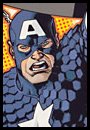 Strength: Sub-Mariner 6 (Invincible)
Intelligence: Thin Man 5 (Professor)
Speed: Spitfire 5 (Super Speed)
Stamina: Blazing Skull 6 (Generator)
Agility: Thin Man 6 (Rubber)
Fighting Ability: Captain America 6 (Warrior)
Energy Powers: Iron Man 5 (Lasers)
- The Invaders are: USAgent, Sub-Mariner, Blazing Skull, Spitfire, Union Jack, Tara and Thin Man. Accompanying the Sub-Mariner is Atlantean Counselor Sulumor, and soldiers in the Atlantean Royal Guard. For many members, their adventures span the decades, the Invaders at their height during the Second World War. Many of them have sustained their youth by means of natural mutation, meta-mutation, or magic.
- As Atlantean monarch, the mutant Sub-Mariner, Namor, commands not only an army of Atlantean soldiers, but also the respect of many of the Marvel Universe's most prominent identities. His tenure with the team began in the forties, where he, Captain America and the Human Torch represented the super-powered front of the allied forces. His mutant super-human strength, flight, and durability made him a powerful ally.
- During an expedition to climb Mount Kalpurthia of the Himalya, explorer Bruce Dickson discovered the lost civilization of Kalahia. The Kalahians accepted him into their culture, and altered his physiology with their advanced technologies, to give him powers comparable to their own. As Thin Man, Dickson would not only possess the ability to become razor thin through dimensional shifting, his aging process would also be brought to a halt.
Thin Man would utilize advanced Kalahian technology in the future, embodied during his tenure as covert leader of the New Invaders by the design of a destroyer ship capable of shifting through dimensional space in much the same way his body does.
- The Avengers are: Captain America, Iron Man, Giant-Woman, Hawkeye, She-Hulk and Lionheart. Affectionately referred to as Earth's Mightiest Heroes, they represent the forefront of America's modern age of superheroes.
Though recently torn apart by the events of the registration Civil War, the Avengers still prevail, represented by factions on both sides of the debate.
- Captain America is the physical emodiement of the ideals of truth, justice and the American way. Many times this ideological status has brought him into conflict with government administrations, but never at the price of his patriotism. It was this nationalistic fervor that saw frail, young Steve Rogers volunteer for an experiment that would turn him into the super-soldier the world has known for six decades. Captain America was himself a former Invader.
- At the time of this story, Tony Stark aka; Iron Man, was serving as United States Secretary of Defense. As Iron Man he harnesses cutting edge technology and his own mechanical genius, along with a vast fortune amassed from industrialist activities that have not always characterized him in the most positive light. It was his own weapons that lodged life-threatening shrapnel near his heart, which led to the creation of the first Iron Man armor as a means of survival.
The Math: Invaders (Total) Avengers (Average)
The Pick: The Avengers
What went down...
With Atlantis and the Invaders responsible for staging a political coup in the nation of Mazikhandar, the Avengers attempt to intervene as the situation escalates with the new leader, General Rafiq, shooting the dictator Hassan in cold blood as a show of strength.
The Atlantean monarch, Sub-Mariner, remains steadfast in his opposition of Mazikhandar's wanton pollution of surrounding waters, justifying his actions to his respected ally, Captain America, by lives of his Atlantean kingdom equally lost.
Personal greivances give way to political powers, as the Thin Man makes an order from extra-dimensional space, prompting the USAgent to break free of the bonds already blaced on him by Avengers. He marches on his star-spangled predecessor with an explanation of jurisdiction. The Avenger Hawkeye fires one of his arrows at the non-lethal fleshy area of John Walker's behind, prompting action on the USAgent's part.
 The other Invaders follow suit in the retaliation, providing the Thin Man with a distraction fitting to his own secret agenda. With the Avengers sufficiently distracted by flaming attack, he enters the unguarded Manizkhandian palace.
Inside, the corpse of the deceased Hassan appears decomposing at an increased rate. Thin Man emerges from inter-dimensional space, where General Rafiq chastises a fellow for being anything but vigilant about defending the capital from the foreign incursion of the Avengers and Invaders, both.
Thin Man expresses his own disappointment, furious that Rafiq would renege on their arrangement to position him into power, in exchange for a live specimen of synthetic humanoid -- Hassan having already been murdered and replaced long ago, by unnamed clandestine forces.
Captain America and Iron Man storm the palace fortress, with the Atlantean Sulumor and Sub-Mariner in hot pursuit. Sulumor's bloodlust proves contrary to Namor's reluctance to see any further deaths on this day of war.
As is common of Namor's reign as Atlantean ruler, the Counselor challenges the Sub-Mariner's loyalties. He questions whether Namor is an ally or puppet of the surface dwelling heroes, prompting a knock-out blow from the proud ruler.

 Thin Man appears to sponsor the provocation of the ill-tempered Sub-Mariner, suggesting Sulumor's words may have been out of turn, but bitterly correct.
Thin Man reveals his manipulations, unwilling to leave Rafiq unpunished for his indescretions, but certain that the Atlanteans need support he and the Invaders in their actions. It is this truth that sees Namor extend a hand to Sulumor.
Meanwhile the Avengers pairing of leaders, Cap and Iron Man, storm through the palace, Iron Man disarming soldiers with his repulsor rays. They discuss the possibilities of Red Skull's continued manipulations when Thin Man appears to them. The Captain challenges Thin Man's ethics, quickly quashed by his own country's exoneration of Dickson in exchange for his services in resolving mistakes incurred during "Dell Rusk's" tenure as Secretary.
 Iron Man lifts Cap for a jet propelled getaway, but Thin Man's opposition proves more potent than they might have imagined. Calling upon his Kalahian powers, Thin Man extends himself into the air and whips his flattened arms in an arc, scattering Captain America and Iron Man through the air.
As the battle between Invader and Avengers rages outside, the tiled palace floor begins to rumbled from the inside. A terrified General Rafiq scrambles with pistol clutched to breast, narrowly avoiding the collapse of the palacial floor!
Emerging from the destruction, a floating Namor and Sulumor, certain of their intentions. As Rafiq makes a pathetic claim of friendship, Namor denounces his actions and declares the requirement of a trial. The cowardly General bows before the two Atlanteans with the solace of martyrdom as his world crumbles around him at the hands of the foreign invaders.
 At that moment, Blazing Skull brings an entire wall down, toppling the gargantuan body of the giant-sized Wasp! The falling beauty narrowly avoids a rope-swinging Union Jack, while Blazing Skull is whisked to safety by Tara.
Jack comes face-to-face with his idol, Captain America, who appears less than lively. The living legend is suffering the effects of an inter-dimensional pummeling at the hands of the Thin Man, who appears from nothingness again to whip the Captain into the air! Cap emplores to Thin Man to seek a better way, highlighting the differing ideals between the two World War veterans.

 Meanwhile; Cap's ideological successor, USAgent, is handing out a pummeling to his own contemporary adversary, Iron Man. The palace floor cracks as flesh beats down upon alloy, as does USAgent's attempts to hide behind classified information.
The secretary of defense blasts USAgent into the air with repulsor rays, declaring his seniority. Union Jack and Spitfire step-up, armed, to defend the injured USAgent, meeting the stern warnings of a frustrated Iron Man.
Sick of playing games, Iron Man meets the Thin Man on his own level, blasting him in the back as he continues to hurl Captain America around the palace.
The repulsor burst knocks the stretchy Thin Man into unconsciousness as he folds onto the floor, freeing Cap from his sub-spacial grip.
Outside, Avenger and Invader stand down as the Sub-Mariner hovers above the crowd holding General Rafiq by the scruff. He reveals a change of heart, forming a new alliance with Mazikhandar and offers politically solid Royal Atlantean protection to the oil-rich nation.
 With a single decree, Namor declares a new era of peace between the feuding sea and land, installing Sulumor as an Atlantean diplomat in the nation for the progress ahead. With that, he hands Rafiq to International justice, leaving the Avengers to make their own peaceful way out of Mazikhandar air-space.
 The hammer...
Ugh, y'know, this is such an awkward one for the Infinite Wars record books. Essentially the conclusion is a draw, but given the physical prowess of the Invaders, and Namor's role in concluding the battle, I'm going to give this one to the Invaders and Atlantis.
Something worth noting iss the interesting way the issue places priority on the story. The action is wrapped very specifically around character and story beats, omitting a large portion of the supporting Avengers and Invaders from battle. Though characters like She-Hulk and Lionheart pose as little more than filler during early wide-shots, for our stats, we'll give them the benefit of the doubt, conceptually having carried on the fight outside.
It was writing like the above that made me a really big fan of this series.
I had intended to use the announcement of a new Captain America as an excuse to pull this out as a chance to talk about USAgent, but I might save that for something a little later.
When it comes to New Invaders, I find myself with a lot to talk about.
It was the Enemy of the State tie-in, an abberation, that initiated the series into the Infinite Wars way back in December of 2005 - our first month! One of the stinging disappointments of making that the only issue featured, was the fact that I didn't get to acknowledge CP Smith's visual work on the series.
The art was but the most obvious thing that really set this series apart as something different to the rest of the Marvel catalogue in 2004.
It was operating within the context of the Marvel Universe, but it was a world where political espionage and vintage superheroics clashed to create a very fresh and vibrant reenvisioning of the Invaders model.
Pencillers, colourers and inkers have pushed the model of a Marvel superhero comic before and after, but what CP Smith did with this title really excited me.
It's a CG style you see more often now with guys like the Luna Brothers pushing traditional pencils and the digital realm together in mainstream titles like Girls, or their work on Spider-Woman; but at the time, Smith's work was so different in a mainstream comic, it was often cited as one of the reasons people weren't buying the book. Which I think is a damned shame, and something I know a lot of people got over upon the release of the complete series in trade paperback.
The weaknesses were definitely there: Sometimes characters could appear a little stiff in their interactions; backgrounds might have been lacking; and there was a tendency to reuse elements in panels in very different contexts -- but when one doesn't dwell on these negatives, there was a very fresh, and exciting differentiating quality to what Smith did. It had a charming simplicity, but at it's best never undercut it's ability to cast a full illusion of human depth.
For many, the series started with a black mark next to it's name even before they saw the radically different artwork. This zero issue reminds us that the Invaders were spun out of an introductory storyarc in Chuck Austen's brief run on the Avengers.
Say what you will about Austen, but Jacobsen should be well commended for his work on the series, which was far and above much of Austen's anchoring repetoire.
Top 25 Golden Age
#1 Batman (DC)
#2 Captain America (M)
#3 Superman (DC)
#4 Green Arrow (DC)
#5 Catwoman (DC)
#6 Sub-Mariner (M)
#7 Hawkman (DC)
#8 Nightwing (DC)
#9 Winter Soldier (M)
#10 Wonder Woman (DC)
#11 Dr. Fate (DC)
#12 Dr. Occult (DC)
#13 The Spectre (DC)
#14 Aquaman (DC)
#15 Captain Marvel (DC)
#16 Hawkgirl (DC)
#17 Wizard Shazam (DC)
#18 Alfred Pennyworth (DC)
#19 Phantom Lady (DC)
#20 The Ray (DC)
#21 Doll Man (DC)
#22 Blazing Skull (M)
#23 Captain Nazi (DC)
#24 Scarecrow (DC)
#25 Two-Face (DC)
Key to the series' unique approach was a fresh, but respectful look at the best-known Marvel Golden Age characters. At the time some purists might have been uncomfortable with the radical departure, but I think even the treatment of Namor, a personal favourite, saw these characters distilled to some of their very best qualities; played off one and other with a weight on scenario.
It was summer-action movies. It was maybe not as intelligent as a Bourne Identity, but it brought together the history of the superheroes, and smashed it up against war-themed conflict and intrigue. It's probably in these issues that we see for the last time, just to pick on a personal favourite, a strong Sub-Mariner.
We've talked a lot in the past about Black Adam doing Namor better than Namor [52 #45], and while that's a particularly harsh assessment of Marvel's use of the character, this issue in particular highlights how uncharacteristically still the character has been, particularly in the wake of his cousin's death.
[The recently launched Sub-Mariner mini-series, not withstanding...]
If there's a seperating factor, it might be experience and motivation as a ruler, and the fact that Namor for the most part does have a world-view about things. In this very issue we see a similar scenario to Adam's Kahndaq coup, with the notable exception that Namor marrys political hindsight to his violent solution to the conflict with Mazikhandar.
Cease Fire Update!: Readers of the Infinite Wars will be relieved to know I have again turned my Batman-esque level 5 brilliance to give my broken old computer-machine another life. This phoenix-like resurrection will, with any luck, not slow productivity any more than it already has. Hussah!
The Fight: 4.5 The Issue: 5
[I'd hold off recommending you march out and find the New Invaders trade until you've had a taste of the core series, but it is certainly now one of the hidden gems of the Marvel Universe. Hopefully in the coming months you'll get another taste of New Invaders: War-mongering mutates from the golden age!]

 - A slave to Dracula; Dr. Jacob Cromwell was ordered by his master to revive a deceased John Falsworth, who had aided Germany during WWII as the vampiric, Baron Blood. Acting briefly as Falsworth's familiar, Cromwell was ultimately killed by his new master, along with one of his daughters. The other daughter, however, was merely turned, becoming herself an immortal vampire.
 Deeper into the caverns a colony of sleeping suckheads gets a rude awakening, the first feeling the glow of Union Jack's torch nestled close to his gun. The heat gets turned up again as Tara enters the fray, roasting her way through the hordes as they drop from their ceiling perch.


 The sudden ignition of flame comes to the embattled Spitfire's aid, but fails to stem the flow of undead. The creatures of the night renew their attack, biting and sucking at Spitfire like a well of super powered blood.

 Since cancellation, the stars of New Invaders have struggled to relocate.


 Strength: Sub-Mariner 6 (Invincible)


