Showing posts with label Articles. Show all posts

Sunday, April 10, 2016

LONG STORY SHORT: A DARK KNIGHT RISES SEQUEL?
I think it's fair to say there's been a lot of handwringing over the state of DC heroes on the big screen in the past few months. We've certainly waxed grim in the Hero of the Week [Batman, Wonder Woman], staggering gingerly away from the cultural warzone of Zack Snyder's March release: Batman v Superman: Dawn of Justice.

The post-game story is one of disappointment, but even as the shine of that initial box office success dims, it's far too soon to write the book on Warners Brothers' cinematic DC Universe. The future is as yet unpublished: Suicide SquadWonder Woman, Justice League and Aquaman - all still on the short-term slate.

Four years ago, Christopher Nolan ended his blockbuster directorial tenure with Batman, delivering The Dark Knight Rises. His three picture reign could be considered prestigious, groundbreaking, hugely influential, and financially successful to a point of absurdity. Indeed, few were all together pleased to see the wild ride end ambiguously in 2012. When the messy sequel went out of its way to leave all doors and windows open in the final reel, no options seemed entirely satisfying.

Rumors Christian Bale was courted with offers of innumerable millions for the 2016 Superman fight are plausible, but denied by the actor. He describes a sliver of jealousy for Ben Affleck's new role as a dark, unhinged version of Batman. Who could forget the time he told Brandon Routh he'd kick Superman's arse given the chance while on stage at the MTV Movie Awards? He may not miss the cowl-induced headaches, but he speaks as an artist with unfinished business.

Is a Dark Knight Rises sequel an option?...
The movie business is as franchise fixated as its ever been. Nostalgic remakes and reboots litter the landscape as widely as inter-woven, grandiose movie universes. DC are already juggling disparate versions of their characters on television, and have even started dabbling in the multiverse within the shows themselves. Furthermore; 2017 will see a second theatric version of Batman return in The Lego Batman Movie. Comics readers have rationalized multiple universes and creative directions for decades and moviegoers are fast developing a similar understanding in a pop saturated market.

Is a Dark Knight sequel with Christopher Nolan and Christian Bale possible all these years later?

Assuming the principle players were motivated, I think audiences and Warner Brothers would both welcome Dark Knight 4 with open arms. The bigger question is whether or not it would signal a panic button that deletes grand plans for the Justice League's universe, or if it would adversely affect either property to distribute concurrent parallel superhero universes. One Batman to rule them all is certainly preferable, but it's up for debate.

What happened at the end of The Dark Knight Rises?...
At the time, a Dark Knight continuation seemed difficult and unwieldy. Much of that was owed to the knowledge and/or assumption Nolan and Bale were unlikely to return. Any confusion is quickly lifted as soon as you commit to a sequel with the key players signed on.

In summary: Bruce Wayne repaired The Bat auto-pilot, escaped safely before The Bat exploded in open water, did his best Jason Bourne to swim to safety, and decided to take a vacation in Europe with Selina Kyle to recover from his ordeal. Faithful Alfred Pennyworth, who oversaw the aftermath of Bruce Wayne's apparent death, had arranged to meet Bruce at a particular restaurant. Alfred was genuinely shaken during the events of Rises, did indeed split for a time, and did not cry crocodile tears at the symbolic, empty grave of young Master Bruce. With a nod, he's grateful to be reunited.

Most of this information is ultimately unimportant to a sequel story, but would have some natural relevance to the premise, and be communicated efficiently during the course of the plot. We saw this type of delivery in both Dark Knight sequels, where relevant backstory was usually discussed.

Where is Bruce Wayne at the beginning of Dark Knight 4?...
While the end of Rises offered a nice opportunity to tell a story of Batman abroad, I think the obvious route is to bring him back to Gotham City. If Warner Brothers have managed to put together a Dark Knight 4, they can always shift their franchise priorities over here and tell a Catwoman: When In Rome story in a later spin-off. She's completely optional in Dark Knight 4, maybe better absent.

Donating Wayne Manor to orphans isn't enough. Much as Bale feels he has unfinished business with the character -- the character has a lot of unfinished business with the city. Bruce Wayne has more reason to be compelled by his sense of guilt than ever before:

- Gotham City was nearly destroyed by a fusion reactor he built.
- The entire event was in part motivated by a revenge plot targeting him.
- It was revenge for choosing to allow Ra's al Ghul to (apparently) die in Batman Begins.
- The revenge plot was staged by Talia al Ghul, to whom he handed all necessary power.

Much as Rises wasn't concerned with Bruce Wayne's ailments once he got back in the suit, Dark Knight 4 won't worry about it too much. He's still wearing mechanical enhancements under the suit, the knee brace and such. It doesn't really matter. Time in Tuscany is about recovering and when he returns to Gotham City we assume he's ready to Batman.

What has happened in Gotham City while Bruce was away?...
Bane's takeover of Gotham likely left city infrastructure in physical and philosophical ruin. There are obviously a lot of valid ways to follow through on this, but as we're venturing into what I think might make a good Dark Knight 4, we're heading deeper into ideas I find interesting.

Gotham City is in a state of rebuilding and renewal, with those deposed or deceased leaving a power vacuum for new players to fill. Good men, like Lucius Fox, have found ways to both help the city and profit from renewal. They are the pillars around which a shiny political message is built.

The political message emphasises a Gotham City proud and united in togetherness in the wake of Bane's takeover - akin to New York City after 9/11. Beneath the surface, things are worse than ever, Gotham's corrupt and criminal using the opportunity to establish a new foothold within rebuilt infrastructure.

It was considered a stroke of good fortunate that social activism delivered the "Occupy Wall Street" movement during filming of The Dark Knight Rises. The crest of financial imbalance and social unrest dovetailed perfectly with themes in the film. It's at its peak in Gotham City in DK4, where the middle classes have evaporated, and street crime has grown amid a depression.

Per the end of The Dark Knight Rises; Batman is believed dead, exonerated of the death of Harvey Dent, and celebrated as a hero. Even so, there are persistent rumors that he still stalks the streets of Gotham by night, exacting increasingly brutal punishments on the wicked. An urban legend once again.

What is the theme of Dark Knight 4?...
It was seen as a turn of good fortune that the "Occupy Wall Street" movement began during filming of The Dark Knight Rises. It dove-tailed neatly with some of the films plot, even if it didn't totally represent its central themes. Several years after the collapse of the Occupy phenomenon, the issue of wealth and power has taken on strange new forms. The social and political climate begs a lot of questions about concepts of power, responsibility, corruption, and social equality. I think these could very naturally be explored in a Dark Knight 4 that explores a central theme of power and corruption.

Who are the bad guys in Dark Knight 4?...
When Batman returns to Gotham City he finds the veneer of gentrification hides an infestation of corruption and crime. The power vacuum left by Bane and the League of Shadows has taken Gotham City back to its darkest days, inciting a mob war between the leaders of opposing factions who have bought their way into government. Batman must scramble to combat a new generation of street crime, the warring mobs, corrupt militarized police, a politician trying to turn Gotham into a walled police state, and worst of all - a failed replacement Batman making it all possible.

- Rupert Thorne: Gotham City politician running for Mayor. Rejects hero worship of Batman, who he claims has been conspiring with Commission Gordon for a decade. His platform blames Batman for creating an outlaw climate that encouraged mercenaries like Bane to target Gotham City, and for the "alleged" demise of Harvey Dent. Wants to make Gotham City great again. In favour of permanently militarizing the Gotham City Police Department and building a security wall around the city that monitors the movements of anyone coming or going.

- Hamilton Hill: A vocal politician running for Mayor of Gotham City. His message is heavy on sentimentality and Gotham City pride. Generally panders to the people with hollow assurances that make him a frontrunner in the election. Finds himself blackmailed when Thorne drops out of the race in disgrace.

- Roman Sionis: Wealthy businessman bankrolling Rupert Thorne's campaign, while manouevring to seize control of the Gotham City criminal underworld. Also known as Black Mask.

- Oswald Cobblepot: Old money businessman who enters the spotlight when he launches The Iceberg Lounge - a heavily publicized gambling den intended to rejuvenate the entertainment district. Cobblepot is also a notorious gun smuggler vying for a piece of the new criminal order in Gotham.

- Sofia Gigante: Daughter of Carmine Falcone, she is the new face of the Falcone family empire. She publicly vows to atone for her father's black legacy by helping to rebuild Gotham City. Behind the scenes, she is aggressively pursuing control over the criminal underworld.

Robin Blake: Following the end of Dark Knight Rises, Blake enters the Batcave and becomes the replacement Batman while Bruce Wayne is in Tuscany. He uses the popular belief Batman died to his advantage, prowling the shadows while he tries to stem the crime war. Without the training and personal discipline of Bruce Wayne, his methods become increasingly aggressive and violent until he is merely another side inflaming the crime war. A psychotic, morally bankrupt shadow of his former self. When Batman returns he attempts to reconnect with Robin Blake, but the young vigilante rejects him, eventually repurposing his equipment into a new identity of his own.

- The Jokerz: A gang of clown masked individuals struggling to adjust to the restored Gotham City after running amok during Bane's occupation. Generally anti-social youths with no specific goal who merely complicate the growing issue of street crime.

- Paul Sloan: A small time actor with an uncanny resemblance to deceased distract attorney Harvey Dent. Participates in a Rupert Thorne scheme to impersonate the scarred DA, claiming his death was faked by Batman and Commissioner Gordon while he was swept away in secret to Arkham Asylum. As Harvey Dent, Sloan condemns Batman and Thorne's political opponents. The charlatan is eventually exposed, forcing Thorne to drop out of the race.

- Scarecrow: Still on the loose since working with Bane.

Is a Dark Knight Rises sequel worth it?...
The chance to go back and right the wrongs of a slightly disappointing final Nolan Batman with a sequel that makes its final parts work is tempting. I don't know if it's tempting enough to win the will of the principle players, or the people who make the decisions, but I've certainly talked myself into thinking its a good idea. Then again, that's what staying up all night to watch The Dark Knight Rises will do to you.

Tugging the strands of The Dark Knight Rises's mostly unsatisfying ending actually opens it up to a better end. Instead of the half-in/half-out compromise of "Robin John Blake" - using that character to demonstrate the dangers of a Batman who doesn't stick to rules of heroism is attractive. The chance to lay some meta-textual accusations about the replacement universe of Batman v Superman is a fine idea, too. Particularly given the moral bankruptcy of Ben Affleck's [film] character.

That said, as long as Warner Brothers are committed to creating their own version of a superhero universe on film, I think the best course is to focus wholeheartedly on that.

One of the things that let The Dark Knight Rises down was the sense that there were too many messy loose ends and hard decisions that weren't made. The joy of The Dark Knight was its singular focus, and what ever disappointments Batman v Superman: Dawn of Justice may have brought about, it's by no means time to justify the entire concept. There's still a chance to get some good out of the long awaited arrival of other DC superheroes on screen and that needs a chance to exist without the complication of going back to a previous success.

Should things continue on a sour path, though. Should Christopher Nolan or Christian Bale be inspired by the increasingly strange world we live in, with its twisted politics and angry online rabble. Should they ever feel the need to send their vision of Batman back into the stylized urban reality they created... I think that would be something worth exploring. Even if only in a blog article.

Thursday, November 03, 2011

15 YEARS LATER: THOR VS CAPTAIN MARVEL!
Like a lot of good comic book stories, there was more to consider in the construction of Marvel versus DC than the in-fiction propositions of parallel dimensions at war. The cliché had a real-world truth to bare as the two biggest publishers in American comics submitted themselves to a set of true-blue competitive circumstances, which no doubt required delicate negotiation around some amount of ego.

The great heroes of comics are often servicing higher ideals than the simple test of one ability against another, but here, bonafide diplomacy was as much on the agenda as the previously established wills of man-gods and super-soldiers. An appropriate acknowledgment of status and expectation would surely need to be recognised to some degree, to the satisfaction of the corporate overseers and the fans, even if the ultimate victory would be decided by a democratic vote of five key seats. Selections would require thematic resonance, iconic representation, and an organization that didn't compromise the integrity of characters beyond their ability to cope.

With the conventional wisdom of most modern pay-per-view fight cards; DC vs Marvel promised a gradual escalation in battles, starting with an undercard of six independently contrived match-ups that would build tension toward the deciding results of the fan-voted five main events. The complete list, along with the most fleshed out incidental battles that occurred along the way, can be found in my somewhat sophomoric tenth anniversary summary, which you might have read before, if you've researched the subject. Five years on, I hope I can dwell on the subject a little more without repeating myself too much, in honor of the (belated) fifteenth anniversary [as previously mentioned].

All things considered, opening the contest with Captain Marvel and Thor was an unexpected stroke of genius. In the mid-nineties I personally wasn't thinking about these characters much at all, even though Captain Marvel was in the throes of Jerry Ordway's well received The Power of Shazam! series, and Thor's transformation into a slightly generic shadow of his former-self was probably part of an initiative intended to actually provoke interest from people. What ever the case, 1996 was not always the most assuringly definitive era for comics, and this otherwise very exciting match-up could have easily been occupied by something far more bizarre.

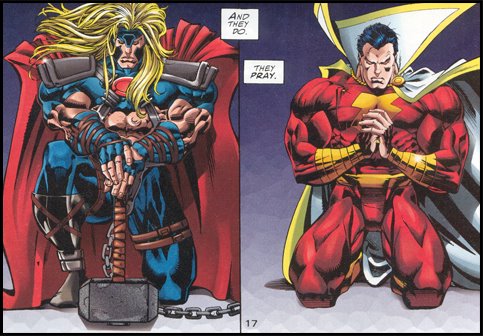
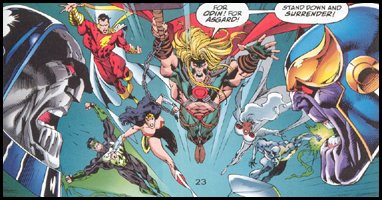
Playing cosmic mcguffin to the entire series' contest of champions were two cosmic, mega-monolithic siblings introduced on the final page of DC versus Marvel #1. Transcending sex, race and creed (in as much as representative red and blue allows), the two reawakening entities are uber-gods of the basic concept of conflict, in all of its ancient, mythic, polarized iterations. Representing the possibility of a cosmic 'one being' that shattered to create the idea of DC and Marvel universes, they add an interesting subtext to the persistent violence inherent in superhero comics, to say nothing of the moment when gods stopped to pray.

I suppose it's actually quite natural for Thor and Captain Marvel to pray, given that they're both agents of senior figures. Odin and the old Wizard Shazam are a natural council for the two to seek, given that the stipulations of the event require the losing team's universe be destroyed. If you observe the predominantly red and blue uniforms of the two, however, you might regard them as particularly fitting avatars for the two universes. The reversed red/blue motif manages to repeat itself in Flash/Quicksilver, corrects for Elektra/Catwoman, and gets all jumbled up when Superboy and Spider-man go at it, to a point of meaningless primary coloration, but in these two godly protectors, it seems special, cosmic, appropriate. Part of a newly discovered mythology, revealing string theory secrets that make the multiverse resonate a shared sense beyond its exclusive, officially trademarked reasonings.

I've always employed a philosophy of professional sports in elements of The Comic Book Fight Club format, and it's always fun to see that play out in the comics themselves. Like extras from the post-apocalyptic outskirts of cinema's The Running Man; Snapper Carr and Rick Jones do as they do best, representing the reader by making the follow along at home scorecard a sub-plot, taking bets on winners in opposing booths stationed outside the abandoned fairground setting for the first fight.

Crossover one-shots like Green Lantern/Silver Surfer immediately preceeded the four issue mini-series, and I have to believe that each of the fights could easily sustain their own over-sized special, if not a complete mini-series. Afterall, as already lamented upon, this kind of encounter doesn't happen every day. A generous perspective might say that the sudden nature of the interdimensional battles, and the rapid threat of their consequence, elevated an otherwise rote premise of heroes fighting within contradiction to a more intense level. Really, I think it was just a bit of a missed opportunity, particularly given the relationship between the two companies continued for more than a year, resulting in the "Amalgam Age of Comics" and a string of thinly conceived, co-published specials, (including the adventures of jointly created hero of both worlds, Access).

It would have been nice if the battles could have had some of the embellishment a one-shot or series might afford them. It's always nice when a superhero fight can provide something more than the simple slugfest, revealing detail about the characters, or a subtext relevant to the unfolding tale. I think it's healthy to forgive a comic like this for playing it simple and direct, but perhaps more of a sense of strategy and sport might have been appreciated. This was a decade before Ultimate Fighting Championship exploded into the mainstream and brought chess-battle Mixed Martial Arts fights into the family living room, but comics have always been capable of more than their most basic.

As the Captain and Thor go to blows for the fate of their universes [in the opening fight], there's certainly the expected amount of simplistic exchange of Herculean man-god punches, and Nordic hammer swipes. Fortunately, Peter David (with credited thanks to Ron Marz that, for all I know, includes the following) was able to reach a bit deeper than the machismo marinated bravado of Thor, (who none-too-subtly beckons for a merciful surrender from his opponent, who in turn figures destruction of fairground property for a better option), to find a poignant, if challenging gimmick.

Using his Greek inspirations to full effect, Captain Marvel hurls an entire ferris wheel like a deadly discus! An airborne Thor is well equipped to deal with such feats, contorting the iron amusement ride with a mighty swing of his enchanted hammer -- sufficient to return it to sender. Captain Marvel braces for impact, but finds himself pinned by the crumpled metals that sandwich him with the ground. Rather than waste time powering his way out, he instead resorts to the now classic, graphic convenience of simply reducing his size, shouting a magic world that returns him to the diminutive alter-ego of youthful Billy Batson! An act that highlights the resonant common theme between the two godly heroes and the destined undoing of Captain Marvel -- lightning!

I'm not entirely sure I'm comfortable with the idea that the Shazam lightning bolt that transforms Batson into his superhero alter-ego can so easily be tampered with, but I suppose if we're given to think that the good Captain can dart out of its trajectory, quick enough to flash-fry an opponent with the "lightning ambush" attack made famous by Kingdom Come; I suppose there's margin for interference. Regardless of my feelings, Thor does indeed profess that it is "... only through my good graces that your power would reach you -- and I am not feeling especially graci--," whilst tossing his hammer Mjolnir in the path of the transformative bolt, interrupting its intended path of empowerment.

The resulting short-circuited "SHAZAAK!" delivers smouldering defeat to the helpless Billy Batson, making it 1-0 for Team Marvel. Restoring balance rather quickly, however, is the fact that the bizarre clash of mythologies has left Thor short one mystically enchanted hammer -- to be collected on the following page by Wonder Woman!

Wonder Woman's retrieval of Thor's hammer obviously lent an interesting footenote of trivia for the annals of comic book geekery, confirming that she is as true of spirit as you might think, and worthy of the power of Thor. It also chalked one up not just for DC's bruised ego, but also the Greek pantheon, who failed to boost Captain Marvel (S.H.A.Z.A.M) to victory. Wonder Woman, of course, is a proud Greek Amazon, and would be one of the feature players later in the series, matched up against Storm in one of the five key, fan-voted deciding fights.

Within the heirarchy of comicdom, Wonder Woman is understood to be a pretty big deal, on the level with Superman in the modern day feats of strength, and pretty much more than a match for any wind riding mutant. With the gentle negotiation of ego and expectation in mind, there was, of course, the small matter of the massive popularity the X-Men were enjoying in the mid-nineties. The cartoon had made Storm and her fellows household icons, a legacy that is still evident in the fetishized interest of people who've, at most, picked up a couple of floppys with their favourite X-Man on the cover, but mostly resigned themselves to writing internet fan-fiction and gushing on non-comics message boards.

In other words; Wonder Woman might have had Storm outclassed in the powers department and will probably always have more stroke for her significance to the aged DC catalogue, but perhaps needed a perception boost to help win the vote with the inclusion of the hammer? [I don't know, but I'm sure we'll speculate more when revisiting their fateful duel, in a later entry.]

In 2011, I suspect the result of a rematch would be much the same.

Arguments might be made about the gods and legends from which Captain Marvel derives his powers, or the magnitude of his feats measured against rivals, but that issue of character stroke weighs heavily on any cross-company encounter. Thor might have been fit for a curtain jerking opener with a gimmick finish in 1996, but in 2011, he's a multi-million dollar franchise, having just enjoyed success as a feature film that is key to the development of Marvel's Avengers movie dynasty.

I suspect any contemporary encounter would be more likely to pit Thor against Superman (as was the case in JLA/Avengers #1), to better reflect the stature of the character, while also meeting thematic expectations. The only drawback -- at least until Zack Snyder's Man of Steel hits theatres -- is that Thor might have the popular vote too well covered to be chanced in a democratic battle against comics' biggest, most significant icon. Then again, these days the nature of these characters seems to be increasingly fickle.

At the time of this writing, Captain Marvel (or something like it) has been announced to be primed for an overdue relaunch in a tangent mini-series from DC's "New 52," spearheaded by Geoff Johns, with visuals by Gary Frank. Johns was instrumental in restoring the Shazam dynasty to trendy main event status in the middle of last decade, starting with plotlines in JSA that unfolded to make Black Adam the t-shirt selling bad ass of the late '00s. By now, Geoff Johns will probably be best known as the powerhouse behind the Green Lantern franchise, but there was a time when his reputation was founded on a gentle, caring touch, which restored darling old characters to prominence with artful compromise for the times that were, and the times that are. One would hope this reputation for delicacy and genius will continue through to this latest reboot of the "Shazam" magic word, but the crackling uncertainty of the DC linewide reboot brings with it the potential for greatness, or yet more pointless, ugly costumed reboots that will be reviled until nobody remembers why and the same mistakes can be repeated.

A newfound mainstream status should protect Thor from a return to his gaudy '96 look, but it hasn't stopped the character entering -- what I'm told -- is his second death in under ten years. Fear Itself, a Marvel event series that has arguably been a fate worse than death, apparently featured the dramatic sacrifice of the Odinson in a story that lived by the high concept of 'everybody gets magic hammers' and died by the sheer boredom that the graduating new school, fronted this time by Matt Fraction, supplanted in the ideas place. Having been so utterly turned off by every conceivable mention of the slow-burn, seven issue horror, so as to not read it, I won't be too certain about the legitimacy of the death, which will be overturned, regardless. It does, however, potentially put the character back on equal footing with Captain Marvel, particularly if a reboot proves successful. Maybe. Sort of. Possibly.

I'm sure I could veer off into salivating criticisms of the present trends and how they would cripple any contemporary DC/Marvel crossover book far worse than the mid-nineties -- where even the worst story usually managed to make it through an issue with a bunch of sound and fury paced faster than a crawl, without the underming pretentions of straight-faced incohrrent coreography. I could, but I won't. I know how uncomfortable that makes you.

When next we meet, I will likely still be without scanner, but just as enthusiastic about talking more about the battles that were -- and the battles that might be! Lurking a mere four or five pages from Thor versus Captain Marvel are the exciting, pre-fab filler fights between Aquaman v Sub-Mariner, and Flash v Quicksilver! So, you guys get excited and introspective, while I try to fix my scanner.

You Might Also Be Interested In:

Monday, October 17, 2011

15 YEARS LATER: DC vs MARVEL - THE RIVALRY RAGES ON!
Somewhere in the eighties and nineties, a small child sits in his bedroom with an A3 tablet of paper, writing all the names of the superheroes and villains he can think of. He draws pictures and wonders how their chemical properties will react when smashed together in the two-dimensional collider of a universe of imagination. The boy grows up, gets hair in funny places and starts noticing girls, but never forgets those Infinite Wars waged across Secret Earths.

If you've honestly never once considered what would happen if Iron Man matched wits and resources with Lex Luthor, or Superman all his powers against the Hulk, I think you've probably been doing it wrong. No matter the art, philosophy, or science of comics, there's an undeniably inherent joy in the comparison of these wonderful, everlasting characters. Characters who burst off the page with power and colour and excitement! Characters who've thrived on the alchemy of tossing raw elements into a four-colour spread, just to see what would happen! Stan knew it, Jack knew it. Johns knows it, Bendis knows it. We all know it to be true, deep down.

The seasonless thrill of superhero comics went hand-in-hand with the internet the minute it became accessible to the common reader. By 2005, there was a whole multiverse of 24/7 fansites and blogs to stumble upon, making it the perfect time to realise the dreams of a seven year old who never had the technological means to do so. The Comic Book Fight Club was a long time coming. Discussing tiers of law enforcement, social equality issues, or the ins and outs of an artform is great on its own, but it's a unique hook with cream whipped dessert when overlayed by Powergirl v Mister Atom, or X-Men v Namor. There was, of course, another reason to finally indulge this overdue concept at the crest of 2005, which brings me back to the beginning...

With a cover date of March (1996); 2006 marked the little talked about tenth anniversary of DC versus Marvel #1 -- the perfect time to launch into the epic world of superhero smackdown! Afterall; the two biggest companies in American comics might have negotiated crossovers in decades previous, but never had they thrown their biggest icons into deliberate conflict with such reckless abandon! DC versus Marvel/Marvel versus DC wasn't just an attempt to appease the imaginations of all those ponderous six year olds -- this was a rare opportunity to actually engage them in a free-for-all of vox pop armchair editing! There would come a winner -- no draws! A daring feat for any corporate company, never seen before [in comics], and not since repeated!

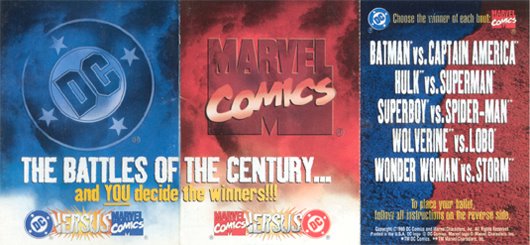
For those who were there, it goes without saying that the DC vs Marvel project wasn't without its significant flaws. For those who weren't, you can glean as much from my own very flawed, oft-sourced accounts of the landmark event and it's many key (and incidental) battles. Ideally, this will serve as an introduction to an improved retrospection, as 2011 technically marks the cover dated fifteenth anniversary of the epic crossover event! Remember -- ultimate victory was decided by public vote in a best-of-five series [collectible ballot card picture above]!

This time around, the occasion has been much better recognised.
Speculation and suspicion has been relatively rampant in these uncertain times, with many fans wondering if DC's line-wide upheaval, and the general decline of industry sales, might not lead to another rare détente between the two giants. Newsarama has discussed it, iFanboy veered into clumsy conspiracy theories, and sites aplenty [including Bleeding Cool] fooled around with the idea, back in April. To say interest is alive and well is to state the bloody obvious.

There's something to be said for representing the DC and Marvel heroes at their most iconic.

Many a mistake has been made with flimsy high concepts and short-lived stunts that malform the fine archetypes that began our favourite eighty-year old universes. It's true that this can be one of the least admirable traits of this wonderous world of fiction, but sometimes, every now and then, the times pull off something completely strange, but fondly memorable.

It's fair to say that distance between the now and the nineties is only just becoming large enough for people to start forgiving. In another blog post, it would probably be intelligent to acknowledge that this reconciliation with our bombastic past is leading us down a path of repeating mistakes, but for this post, let's just assume that not every oddity of the nineties was brilliant. That said, I do rather appreciate that the DC versus Marvel crossover -- with all of its popular vote bragging rights -- didn't shy away from the strangeness some of the characters were experiencing at the time, and would gladly forget, soon after.

With Ben Reilly occupying the Spider-man suit; Aquaman bearded, angry, and missing a hand; Batman baring the registered yellow oval around his symbol; and Thor clad in futuristic bondage gear from Marvel UK's summer fashion line -- the 1996 four issue mini-series is as much a cultural yearbook, as it is an exciting, corporate phenom of a fight comic.

Superboy still had his tragic, nineties undercut, Jim Lee coat and genetically engineered ability to act like a dickhead. Catwoman was still dressed in form fitting purple; Kyle Rayner was the fresh-faced Green Lantern with no thought for a grey-templed Jordan; and truly placing it in the past, Storm manages to be relevant enough from the X-books to match-up with Wonder Woman! This really is a comic series that reminds us how much can change in fifteen years! Change that makes it all the more enticing to think about doing it again in 2011, with the characters who matter now, and who possibly missed out last time!

At the risk of partaking in another horrid comic book cliché -- the unfulfilling zero issue -- I'll simply state my intention to revisit the crossover in greater detail in the coming weeks, with a fresh look back at the battles of the original, and what it might look like today.

The odds of such a project actually existing still seem slim, even if the players who've famously stood against it are beginning to move on. Twenty years after conception, JLA/Avengers might've found its way into publication in 2003, but the previous decade will be remembered for renewed hostility between the big two. A friendly enough rivalry for the most part, spiked at times by public displays of affection, such as the 2004 Chicago convention panel, where Brian Bendis took it upon himself to air grievances about the now infamous illfated Batman/Daredevil crossover -- which in turn provoked a surprise appearance by then-DC Vice President of Sales, Bob Wayne, in a moment straight out of any Monday primetime professional wrestling programme. The project remains condemned in particular by an apparent dislike shared between then-DC President, Paul Levitz, and Marvel's enduring Editor-in-Chief and all around Sicilian rabble rouser, Joe Quesada.

Could bridges be mended as the business reform themselves? Maybe.
Then again, as much as there is mutual interest in the expansion and reconstruction of a once again flailing direct market, the two companies remain in steady competition. With the battleground moving ever more expensively into the cinema, DC and Marvel's balance between competition and industrial sustainability has never been more precarious. The perfect time for a team-up -- or the most vital time to keep separate in a war for the ideaspace?

Questions to consider, to be sure, but not here. Not when the spirit of the six year old, with his long list of characters and imagined fantasy fights must be answered! See you then, true believer.

Thursday, September 29, 2011

LONG STORY SHORT: MAKE MARTIAN MANHUNTER!
With Marvel's successful construction toward a cinematic shared universe culminating in 2012's [Joss] Whedon directed Avengers; it's difficult to shake the sense of inevitability that hovers over DC Comics' counterpart hero-team, The Justice League.

DC may have made their mark with seminal blockbuster pictures like Superman (1978), Superman II (1980), and Batman (1989), but it's Marvel who have spent the following decades defining an industry.

Films based on Blade, X-Men and Spider-man went a long way to dispelling any belief that superheroes could not transition convincingly to the big screen (beyond momentary fad), but even these trailblazing efforts have become footnotes to subsequent developments in a veritable Hollywood takeover. For better or worse, Iron Man (2008) marks the turning point for the average superhero adaptation.

Embued with a sense of indulgence afforded by the standardizing movies released between 1995 and 2005; once unlikely colours and iconography from the four-colour medium finally became par for the course after Iron Man, which refreshed audiences with robotic heroics and a strong core of character and story.

Combining credible talent with an approach that services conventional storytelling and the broad basics of superheroes [earnestly, for the most part]; Marvel distanced themselves from awkward pubescent disappointments like Daredevil and Fantastic Four. By getting it so right, they earned the credibility to pose the question of going deeper, (starting with a much talked about Nick Fury cameo), declaring their intentions with Hulk, Thor and more Iron Man -- a gradual build that brings us to the present post-Captain America world, where movie marketting has done what comics sorely needs to -- sell people the excitement of franchise accumulation.

Earlier this year, DC (probably) thought they were buying in to the same philosophy when they launched Ryan Reynolds toward certain doom in Green Lantern. Only the most apologetic or optemistic observer could have advanced without a sense that GL was being set up for cannibalized mediocrity, a very distant second to its supposed Iron Man equivalent (and franchise brethren).

It was by virtue of the 2007-2008 Writers Guild strike that DC missed out on beating Marvel to the cinematic ensemble punch, inadvertently averting the even bigger disaster of a JLA film that was reported to have cast a group of youthful alternates (such as model, Megan Gale), before cooler heads prevailed. The project, which had every likelihood of undermining DC's pantheon of franchise vehicles in a single stroke -- including Green Lantern -- speaks to the struggles Warner Brothers have had when converting anything unrelated to Christopher Nolan's critically acclaimed efforts with Batman -- another character almost threatened by the post-Begins lowrent JLA.

The obvious hasn't completely escaped 'the powers-that-be.'
Over the past couple of years, DC has undergone significant structural change, to not only hand over greater powers to the cross-media aspects of the business, but also shock the comics world with a massive brand-wide reboot of all the major properties (currently in its fourth week). The two events seem likely related and it remains to be seen if it's for better, or worse.

After squandering the marketshare of Green Lantern (and Blackest Night) in two mediums, DC in its many forms is clearly reevaluating. In 2012, they relaunch cinematically with the hotly anticipated Batman reboot trilogy end, The Dark Knight Rises, while [Christopher] Nolan also spirtually coaxes Superman in his life after Returns, delivering a second bite at the cherry, Man of Steel, directed by Zack Snyder [of 300 and Watchmen fame]. Representing the modern Hollywood method of repeating tried and true projects, it isn't exactly the most inspiring direction forward, but at least offers respite from the confused antics of mismanaged B-properties.

While there appears to be a massive gulf between the representative brilliance of The Dark Knight (2008) and the confused clusterfuck of Catwoman (2004), DC hasn't had it all bad. Somewhere in between lurk tangents like Watchmen (2009), V for Vendetta (2006), and Constantine (2005), which might not have reached the heights of the comics they were based on, but made for respectable mainstream departures from the extremes of their best and worst. Though not financially successful to the degree expected by more dominant superhero franchises, each is a movie with cache that could soften the blow of more public letdowns, and inform a better way forward, if they were more readily identified with the parent company in the way Marvel's best brands have been.

Not every franchise will be Nolan's Batman reboots, nor should they be.

Just as comics have had to reconcile the creative influence of forces like Frank Miller and Alan Moore over decades of lesser knock-offs, so too has cinema been harmed by the popularity of the 'gritty realistic reboot', which continues to give way to ham-fisted imitators intent on devouring the past.

Marvel have found success in the most logical way, with movies that, to a significant degree, repel from the grim 'n' gritty colourless trends of recent history. There's plenty of room for argument about the details, but by launching their Avengers properties with the robot Iron Man, monster Hulk, fantasy laden Thor, and wartime Captain America, Marvel have at least shown a minimum aptitude for offering diversity in their present movie line-up. From a certain dough-headed Hollywood perspective, this could be interpreted as a necessary live example of the virtues of doing something 'different.'

Where DC has dominated for quite some time is the domain of animation.
With Marvel now under the ownership of Disney, it seems entirely reasonable to suggest that the next great frontier for corporate superheroes in cinema might be animated features. Granted, this would be a battle far bigger than comparing live-action muscle men, requiring a change in box office trends that have condemned traditional animation to DVD and television, but who better to fight the fight against CG (in)animate objects than some of the greatest 2D characters who've ever been drawn?

1993 saw such a feat broached by Batman: Mask of the Phantasm, the first feature spin-off of the critically acclaimed Bruce Timm Batman animated series, which gave birth to the on-going collection of now unrelated DC DTV (Direct To Video) movies. Limited theatrical release delivered high praise and a quality product still relevant. Then there's the more recent acclaim of The Incredibles (2004), a Pixar CG superhero movie that enjoyed plenty of success, playing computer animation against itself, arguably the closest thing the world has to a bloody good Fantastic Four movie.

As a repeat offender, DC needs to invest in good people working on good projects, preferably outside the box, to cleanse the palette of their past mistakes. Throwing millions behind traditional animation might be a bit of a big ask in 2011, but it would be the kind of bold move that might start to rebuild a credibility fitting of the fictional historic heroes they are custodians of, and build a buzz that Green Lantern certainly lacked. It could even have broader implications for the company that owns them, the once proud purveyors of animation, Warner Brothers. There is certainly potential already existing in the lower budget projects hitting Blu-Ray and DVD, ie; upcoming Batman: Year One, and past projects like the 2008 adaptation of DC: The New Frontier [pictured above], but you've gotta learn to walk before you run.

If one accepts that it's preferable for executives (and other potential obstacles) to work from existing evidence, then I think DC's credible sleeper hit is one of the most obvious, but least likely characters, that they could source. Often affectionately referred to as the 'heart and soul' of the Justice League, he is a character that, if successful, could be a preliminary marker for expansion similar to Avengers, who also possesses many unique qualities that would allow for a strong, focused three act film, with unique and intriguing dressing.

I, of course, am talking about Martian Manhunter.

I don't doubt for a minute that Zack Snyder will do good things with his version of the Superman mythos, but with General Zod confirmed as a villainous presence, I can't help but feel flattened by the prospect of repeating the Richard Donner era all over again -- a factor that severely crippled Bryan Singer's infamous (loveletter) approach in Superman Returns. I also can't help but wonder if Snyder's skills as a filmmaker might not have been better utilized on a character like Martian Manhunter!

It isn't at all irrelevant to note that I've been watching Dark City very recently.
The 1998 [Alex] Proyas film is not a great example of a theatrical blockbuster, but has certainly overcome any marketted shortcomings to become an acclaimed cult film as years have gone by. I mention it, because, as pictured above in art by Darwyn Cooke (and less obviously, Ken Steacy), there is an associated nostalgia to Martian Manhunter that, visually, could certainly learn from the retro inspiration of much of Dark City's forties noir costume and set design. Like Dark City, a film based on Martian Manhunter could also pastiche genres in ways that would make it quite unique, particularly in the present market. To what extent the retro aspects were fulfilled would be subject to a director.

Based on the CG embellishments of Sucker Punch300, and design of Watchmen, particularly the urban latter with its neon flourishes; I think of a Martian Manhunter film as a technicolor delight, well handled by a director of Zack Snyder's persuasion.

In a world where CG is so often used as a meaningless gratuity -- or ham-fisted gimmick, see; Green Lantern's hideous costume -- I imagine a Martian Manhunter film as a visual exercise that makes technical use of CG as an artistic, graphic statement, lending a vaguely similar factor of intrigue to Robert Rodiguez' work with Sin City. I see unnatural, deep glowing purples and greens, tech-noir neon highlights, burning red eyes, and a movie that revels in fiction. In a way, it could almost be this era's answer to the bold design of Warren Beatty's Dick Tracy (1990). Then again, there's margin for a much more naturalistic approach, too. More literally like Dark City. Martian Manhunter is really a versatile property, when you start thinking about it.

The story of Martian Manhunter can be approached in many different ways, but is generally a simple high concept with key mythology. Scientist's experiments accidentally transports Martian to Earth; shocked scientist dies a mournful death; Martian is alone in a world he doesn't understand. Martian learns human culture from television, assumes identity of gumshoe detective, battles evil with steely resolve and uncompromising squint. William Hurt's character in Dark City doesn't make for a bad approximation, which is something that inspired elements of The Kirby Martin Inquest, a comic book I wrote that is yet to move past the first issue.

The work of Mark Verheiden and Ken Steacy from Secret Origins #35 tells much of this tale as a flashback, and is a beloved reference that stays with me to this day. It also bares many similarities to the later work of Darwyne Cooke in DC: The New Frontier, which hits a few extra beats about discrimination, humanity, and superheroics. Between the two, I think you have a very thorough bible for a working script, with additional mythology about Mars and Martians worth keeping in mind, even if it's best left unelaborated upon, at least until a sequel.

As much as design and visuals would be a motivating factor for this film -- (probably more comfortably titled Manhunter from Mars); character study and development would provide much of the meat of the project. Establishing Dr. Erdel -- the scientist responsible for bringing MM to Earth -- as more than a mere mcguffin, might be nice. I've always been quite taken by the idea that he was a kind, gentle man, who regretted his mistake in his final moments, providing a positive influence before dying in front of a confused and unprepared alien. The New Frontier captured this, and MM's television education, quite well. The latter of which influences his decision to become a gritty noir detective, buoyed by the backstory of his life on Mars.

In the Verheiden story, "Detective John Jones" (an alias based on his martian name, J'onn J'onnz) finds himself on the trail of kidnappers. In The New Frontier, Slam Bradley and he investigate satanic cultists, intersecting with Batman in the process. The New Frontier pulls upon allusions to modern Batman interpretation as a paranoid, suspicious figure, who famously threatens Martian Manhunter with a hypothetical pack of matches. These themes provide a thriller aspect to the story, lending an interesting narrative of human frailty while also giving Detective John Jones additional stakes. Grafted on to a fellow detective, or perhaps even a government presence, the concept would provide danger for the Second Act, and spice in the Third Act.

Martian Manhunter spent the fifties embroiled in spy tales and that's certainly an interesting element to draw upon, represented in The New Frontier by government interference via King Faraday, who captures the Martian when he attempts to stow away on a rocket headed for Mars. The pair resolve their differences in a series of events that both commit the Martian Manhunter to becoming a heroic influence on Earth, while redeeming the human perspective. I think a tighter, more intensely character driven arc might be necessary to make the Martian Manhunter film worthwhile, but the sentiments are certainly echoed in the source.

Long story short: I'd really like it if someone made a Martian Manhunter film. A good one! With the right balance of indulgence, ingenuity and design, I think it would have the potential to be a very unique project, capable of spinning out into sequels and franchise crossovers, while sustaining itself.

With the right mix of elements, I think this is the type of concept that could really lend itself to the mass market. A good script would balance action, intrigue, character, and atmosphere in ways that reflect the 'swiss army' alien powers of the hero himself. A character of pathos, of bold heroism, of action, of mystery, of heart. Everyman and no man, all at the same time. Relatable, but completely wrapped in the wonderous world of fiction that should be ten times as important.

I'm not sure Martian Manhunter would be the franchise ticket, the one that picks up the slack when Christopher Nolan confirms his departure from the successful Bat-films. Done right, in ways GL wasn't, it would have every potential to be the surprise breakout hit that Iron Man was, though, and above all else, lend a little prestige, versatility and credibility to DC superhero films. If the sense of inevitability that hovers over the JLA is at all true, I think this is the unlikely, but perfect place to start.

Wednesday, September 08, 2010

EDITORIAL: "WHAT COULD MARVEL BE DOING BETTER?"
It was mere moments ago, (over on Twitter), that Editor Extraordinaire Tom Brevoort threw the digital doors open to the peasants and asked a question. THE question! A question so bold I feel the need to voice some disbelief at it's sincerity, at least in terms of the ire it means to invite.
In his double-post, Mr. Brevoort enquires, "What could Marvel be doing better? Where are we dropping the ball?" Elaborating, "Along those same lines, I feel a real ebb in the overall enthusiasm of the readers, not just Marvel's. So what's got you down on comics?"

Being the good Twit I am, I jumped to a response. One that was sincere, but vaguely phrased and tinged with the expectation of being ignored. Never the less, it's a timely question for me, as I find myself the most exhausted by the prospect of blogging about comics here on The Comic Book Fight Club, where business has been stagnant for a year.

The last couple of years have seen me join weekly readers for the most consistent period ever in my twenty-plus years of reading. I stick mostly to the classics, but have been veering wider week to week in my selections. Back issues represented in this blog's archives reveal a Marvel tendency, but there can be no denying that DC has dominated by readership over the last few years, to a point where I actually feel some contempt toward Marvel titles. Not a competitive or loyalist's ire, so much as a consumer's disatisfaction and a critic's disappointment.

In conjunction with a slide in creative direction, I've felt Marvel have willingly indulged in an antagonist's role, biting and sniping at a competition who've done so much similar, so much better.

I mentioned "banners" in my Twitter response to Mr. Brevoort, but wouldn't honestly blame the big picture storyarcs, or branding that's been a fond part of corporate comics for the last twenty years, for their jaded association. DC have stretched the limits of a comic book event/crossover further than ever before with their Blackest Night efforts, but their unprecedented extention was supported with a lot of genuine investment in ideas and story. For the past five years, I've seen Marvel seemingly follow DC trends, as if their basic cofiguration was license to bring back much of what was reviled from the nineties collectible boom and crossover fever. Shallow mirror images, with the same structural tendrils of one-shots and mini-series, without the soul or heart of their "Distinguished Competition".

"Where are we dropping the ball?," Mr. Brevoort asked.

An example jumps straight to mind: X-Men: Curse of the Mutants - Blade #1.

In the past, on this very blog, I've written about my fascination and frustration with the treatment of Blade in lieu of his cinematic successes. Never would I have expected that the character would provide such a succinct example of the types of things that have left me jaded about the Marvel Comics method.

This one-shot -- relating to the X-Men's latest vampire tryst in Curse of the Mutants -- was quite well illustrated, and probably written with good intentions that included some fun and interesting unexplored ideas, but surely must have looked like longform fluff, even at a script, or pitch stage.

It provides context for what I'm sure will be Blade's entry into the main story, but does so with a plot that could've been expressed in a four-page back-up feature, or even a paragraph of dialogue in whatever team-up will eventuate in the main book. It was a soulless one-shot that made little to no use of it's title character, elaborated very little on larger plot-points, and had no significant hook unto itself. It was exactly the kind of shallow one-shot that DC have done very well to avoid, in my experiences with their most recent event-branded comics.

I don't think anyone can rightly blame the format, or Marvel's willingness to print this book.
Mistakes are inevitable and it's this pulp manufcature of comic books that, for the most part, represents it's greatest attributes. I want Marvel to continue to experiment with unlikely ideas, and produce storylines that make use of their shared universe of characters. I just wish it was done with a more artful consideration for the characters, the storyarcs, and the consumer.

I enjoy the wide variety of influences that can direct a corporate comic book, but find myself, based on assumptions, wishing that the acting influences had more to do with concept and investment in building genuine intellectual properties. In the mid-nineties Marvel ran adverts boasting the quality of their characters. Sometimes, especially in the last five years, it's felt like Marvel is more whim to dividing it's time between drinking buddies, registered trademarks, and $3.99 fluff pieces. It feels like they ushered in a character-driven era that reimpowered the writer at the beginning of the decade, only to fail to sustain that savvy investment with the boost in sales and cross-media attention that followed.

Cases may vary, and Marvel have certainly done some things very right!
Amazing Spider-man became a must-read book with it's reinvention around #611, up until The Grim Hunt, proving that investment in classic characters and strong conceptual stories is a great way to go! New Avengers has had aspects of that energy, hanging characters on similarly well conceived arcs with the kind of colourful indulgence fitting of this era of modern comics. To be fair, even many of the recent Dark Reign issues proved Marvel is capable of making good on "banner" ideas, even if it's Siege conclusion was thoroughly underwhelming!

Articulating the good and bad isn't always easy, and in itself is a personalized endeavour, but if Tom Brevoort is asking these questions with a genuine desire to seek answers, I'm happy to try to contribute! Twenty-plus years of faithful readership has given me a wonderful passion for the world of serialized fiction. I think comic books have the greatest potential of all entertainment mediums, with so many unique attributes and talents. Introspection is just one of them!

I'm sure Tom Brevoort wouldn't say no to your replies, but if you're reading this and have thoughts of your own, I'd be interested to hear them to! Comments are free.

Monday, June 14, 2010

Hero of the Week 2010 #23: Spider-man

SPIDER-MAN (Marvel)
Real Name: Miguel O'Hara
First Appearance: Spider-man 2099 #1 (November, 1992)
Group Affiliation: Exiles
Gaming Credentials: Spider-man (2000); Spider-man 2: Enter Electro (2001); Spider-man: Web of Shadows (2008)Marvel Super Hero Squad (2009); Spider-man: Shattered Dimensions (TBR/2010); Super Hero Squad Online (TBA)
Infinite Wars Ranking: DNR


From one futuristic hero of the week [Batman Beyond] to another, we arrive at Spider-man 2099!

Featured in several games as an unlockable costume swap for your regular, friendly neighbourhood, garden variety Spider-man -- Miguel O'Hara, the Spider-man of the year 2099, will make his first full fledged appearance as a playable character when Activision release the latest in their long line of titles this year, the reality-hopping epic, Spider-man: Shattered Dimensions.

Shattered Dimensions looks to reinvigorate the lagging Spidey license with the introduction of four new modes built around the classic adventures of Spider-man, and three alternate universe versions based on the comics. Spider-man Noir and Spider-man 2099 are the two confirmed alternate Spider-men who will be joined by a fourth mystery universe to be revealed at the coming San Diego Comic-Con, all piloted by a plot crafted by fan-favourite comics writer, Dan Slott.

Interestingly enough, this isn't the 2099 Spidey's first brush with playable gaming fame.
In the mid-nineties, Saffire were to develop a game called Marvel 2099: One Nation Under Doom; a title designed to place control over the various 2099 properties (versions of Ghost Rider, Daredevil, X-Men, Punisher, and others) in the hand of gamers. In 1996, it's fair to say it would've been a strange title to join the pantheon of games, but one that received coverage at SDCC at the time and was even previewed in some magazine publications. Alas; Marvel's Earth-928 (as it's now known) would have to wait until now to get a gaming realization.

Not your father's Spidey: Miguel O'Hara is a different Spider-man for a different time in Shattered Dimensions!
Spider-man 2099 tells the tale of Miguel O'Hara -- an intelligent student whose work with Alchemax, a sinister corporate science tank full of legal drugs and other nasty future predicaments, forced him to attempt genetic tampering to avoid the addictive effects of the incredibly addictive "Rapture" drug he'd been given by his evil overlords. Jealous skullduggery meant his sciencey solution was altered and he was given the proportionate strength, speed, and agility of a spider (not unlike a certain Peter Parker). With a sinister Spidey-looking costume ready and waiting for celebrating the Day of the Dead, Miguel O'Hara leaps into the world as the Spider-man of the year 2099!
Originally posted: Incomplete Article Not Published

Monday, June 07, 2010

Hero of the Week 2010 #22: Batman

BATMAN (DC)
Real Name: Terry McGinnis
First Appearance: Batman Beyond Ep.1 (January, 1999)
Group Affiliation: Justice League
Gaming Credentials: Batman Beyond: Return of the Joker (2000)DC Universe Online (TBA/2010)
Infinite Wars Ranking: DNR


I have to admit -- I'm coming at this entry somewhat ignorant in contrast to the usual HOTW.

While I could certainly appreciate the atmospheric noir and embellished comic book influences that gave us the 1992 Batman animated series, I was never so dedicated to the show that I would follow along to it's subsequent extentions. Continuations of this animated universe in Superman and the Justice League were certainly something I took a look at, but in the detached possible-future of Batman Beyond, I saw a pubescent vision of Batman that just didn't meet my interests at the time. The more I investigate, the more I realise I might've been a little hasty in my judgments.

The animated world that spun out of the original series -- dubbed by many the "Timmverse" for writer/producer Bruce Timm -- has done a lot of good for the promotion of DC comics and their characters. There's an associative assumption that Marvel characters are somehow more instantly relatable than DC's caped originals. This common misconception no doubt owes a lot to Marvel's steadfast maintenance of characters like Spider-man -- who has remained present in animation and film starting with the famous animated series. While DC have certainly had their television successes, it was this "Timmverse" that helped shake certain assumptions that came from varied interpretations of the characters, allowing for a reestablished modern persona that has inducted a generation of new fans.

For me, a reader of comics for most of my life, this success of the Timmverse has been a mixed blessing. While it's certainly done great things for the comics, not just in terms of exposure, but as an influence that steered the Batman franchise through the late nineties to it's own surpassing successes of the animated series, the cartoons have also had their drawbacks. Most frustrating is the eventuating ignorance of the source material which comes from many fans failing to follow their favourite characters to their home in the four-colour comic book format. A barrier that I would have to admit goes two ways -- adding to my resistance to indulge the Batman Beyond cartoon.

Beyond features a Bruce Wayne in his decline -- aged to a point where he can no longer patrol the futuristic streets and skyscraping rooftops of Gotham City as the Batman. Terry McGinnis is the teenage pupil in which he finds a successor, unaware of the conspiracy that brought him to his attention. I'm told it was revealed late in the character's life that Terry McGinnis' adoption of the Batman mantle was no mistake, originally contrived by long standing DCU manipulator, Amanda Waller.
Fortunately, as Batman Beyond joins the comic book world that inspired him, this is information you don't really need to know. Which brings us to the reason for this week's HOTW spotlight!

The Batman of this possible-future has appeared in various DC Universe cameos, most recently joining the ranks of canonized legitimacy brought about by DC's fifty-two universes introduced in the series, 52. The elaboration of this in comic book form has had to wait several years, but in the recent Superman/Batman Annual #4 [pictured above], we got our first taste of the upcoming mini-series that will continue the adventures of McGinnis as the hi-tech futuristic Batman. And I liked it!

The annual features a story very generous to the intimidated and stubborn alike, following up on storylines from the final episode (actually part of Justice League Unlimited) that boast Superman in his Beyond form, with the evil Lex Luthor still intact to cause trouble. This leads into a six issue mini-series that will test the waters for more projects with the character, coming up this month in the form of Batman Beyond #1. You can find more information about that at DCcomics.com!

I wouldn't say I'm a complete convert, but I'm certainly reassessing what entertainment might lie in the world of the cartoons, which still seems to demand teen indulgence in things that aren't quite as serious as all that. The animated film Return of the Joker (which has a video game counterpart) certainly reveals more avenues of interest to the traditional fan, however, which is for me an example of the true spirit of comic book pulp fiction. There's always time to follow a thread, new or old, to discover something exciting along the way. I've written about this philosophy before, and I'm pleased to be an example of putting it into practise.

<< Hero of the Week 06/13: Spider-man       [Home]       Hero of the Week 05/29: Batman >>

Originally posted: http://www.1up.com/do/blogEntry?bId=9032995

Saturday, May 29, 2010

Hero of the Week 2010 #21: Batman

BATMAN (DC) (2009)
Real Name: Bruce Wayne
First Appearance: Detective Comics #27 (May, 1939)
Group Affiliation: Justice League
Gaming Credentials: Batman (1986); Batman: The Caped Crusader (1988); Batman (1989)Batman (1990); Batman: Revenge of the Joker (1991); Batman Returns (1993); Batman: The Animated Series (1993); Adventures of Batman & Robin (1994); Justice League: Task Force (1995); Batman Forever (1996); Batman & Robin (1997); Batman Beyond: Return of the Joker (2000); Batman: Gotham City Racer (2001); Batman: Vengeance (2001); Batman: Dark Tomorrow (2003); Batman: Rise of Sin Tzu (2004); Batman Begins (2005); Justice League Heroes (2006); Lego Batman (2008); Mortal Kombat vs DC Universe (2008); Batman: Arkham Asylum (2009); Batman: The Brave and the Bold (TBR/2010)DC Universe Online (TBR/2010); Batman: Arkham Asylum 2 (TBR/2011)
Infinite Wars Ranking: #1

It'll be a busy few years for the famed Dark Knight Detective, with a full slate of video game titles like the highly anticipated unnamed sequel to Arkham Asylum (2011), the cartoon-inspired Batman: Brave and the Bold in September (2010), and full MMO duty as a feature hero nestled in the story-driven interactive world of DC Universe Online, also scheduled for the end of 2010. The big announcement spurring the Bat-franchise onward as our Hero of the Week must be a third and final feature film from director Christopher Nolan, who will juggle his time between overseeing production of a new Superman film, while closing the saga of Christian Bale's Batman.

It's interesting that, in announcing the new film, director [Christopher] Nolan felt the need to stress the finite nature of his vision of The Batman. I think it's fair to say there was always a sense of a short term bond between the filmmaker and this new interpretation of The Dark Knight -- which he so successfully brought to life in the film sequel of the same name. It has obviously been a very fruitful collaboration for creator and character, but it's in that sense of controlled distance that the strengths of Batman Begins and it's sequel have lied. Nolan -- the first to admit his ignorance of the complexities of Batman canon -- outsourced perspective from writers like David Goyer, who helped corral references from some of the best Batman stories, such as Batman: Year OneThe Long Halloween, Dark Victory, and The Man Who Falls.

With his collaborators in tact and a growing familiarity with the Batman world he himself created, Nolan moves forward with a confidence no doubt gained from the unprecedented success of his Bat-filtered crime thriller inspired in part by the canon of the stories mentioned above, and film sources such as Heat. The question now begs -- where does the Batman's creative custodians look to in their third and final instalment? I'm beginning to think it might be the most obvious, but least likely of places!

The influence of Frank Miller on the Batman character can be seen readily in both comic book and film, his stories Year One and The Dark Knight Returns rating among the most revered texts in the seventy year history of the legend. The latter can be described as having the most influence on the demeanor of the Batman, whose meticulous detective mind and ultimate human physique was taken to gruff, grim, and gritty new extremes, emphasising the internal aspects of Batman, his perspective of a literal war on crime, and bastardly penchant for out-thinking even the great Superman to morally victorious ends.

The difficulty of adapting the layered text of The Dark Knight Returns for film lies not in the Reagan-era politics that runs throughout the story, it's references to a DC Universe that were elaborated upon in it's comic book sequel, or even the splashes of uncompromising violence that would push the boundaries of the bloodless PG rating The Dark Knight was able to achieve.

As a direct adaptation; the story of DKR requires casting Batman in an almost villainous outsider role. It is a tale set in the twilight of Batman's career, continued in 2001's long promised sequel, The Dark Knight Strikes Again, but ultimately a story of the end of Batman, a Clint Eastwood inspired Dirty Harry-type in his golden years, fighting with very little to lose. For it's decidedly uncommercial and unfriendly perspective, it's the type of story that would rarely be accepted through the many tiers of red tape Hollywood films need to conquer to be written, produced, and advertised in the many franchised venues that inevitably follow. Nolan's Batman isn't just any franchise, however, and in stressing the next film as the end of his vision, I'm beginning to wonder if the sequel to The Dark Knight might not utilize it's financial and creative cache to bring the intent of The Dark Knight Returns to the film, if not the specifics of it's dressing.

The Dark Knight leaves us with a Batman wanted for the apparent death of Harvey Dent (a detail not quite set in stone by his literal and metaphoric fall from a great height) and willfully established as the outsider. In name and context, The Dark Knight readies audiences for a DKR-inspired film that might just achieve the impossible of realising this great story in a cinematic fashion. Superman is unlikely to appear. The Joker, established before his death by Heath Ledger, has been said to be omitted from any sequel plans, meaning that sub-plot of the comic might also have to be adapted in other ways, but the intent may remain the same. Which has me very excited about what might lie ahead, even if this is purely speculation. Whatever lies ahead almost certainly promises a big bang to close what has been the benchmark of these comic book adaptations.


The Dark Knight watches over Arkham Asylum with Gotham City looming ominously in the background.

Gamers no doubt look forward a very different sequel, one baring more in common with it's comic book counterparts, in the as yet unnamed follow-up to Arkham Asylum. The former game brought an even darker vision of Batman to home consoles, borrowing from a variety of sources, including another of the great Batman comic book tales unlikely to reach the big screen, Grant Morrison and Dave McKean's psychological thriller, Arkham Asylum: A Serious House on Serious Earth.

"Arkham 2" promises to bring Two-Face to the fore in a Gotham City bound dash for justice with the same hyper-stylized pseudo-realism of the first game. It's a steady contrast to stories unfolding in the comic books right now, where the afforementioned [Grant] Morrison takes Batman through the ages in Batman: The Return of Bruce Wayne -- a follow-up to the apparent death of the character at the hands (or eyes) of New God of evil, Darkseid, in the end of DC's universe-spanning Final Crisis. In truth, Bruce Wayne was sent hurtling through time by the mysterious "Omega Sanction," the death that is many lives, each destined to end in ambiguous frivolity -- the ultimate punishment for a hero as controlling and obsessive as Batman!

These indulgent references, which typify Morrison's treatment of the character right through a run that features embellished tales inspired by the fifties bizarre of post-Comics Code Batman, are much more in keeping with the fantastical elements sure to be found in the Nintendo-exclusive adaptation of Batman: The Brave and the Bold. The game, based on the animated series of the same name, takes similar cues from the fifties, notably the garrish designs of many classic heroes and villains, sourced directly from the art style of early pencillers such as Dick Sprang -- who also influenced Frank Miller's burly visual take on the character in the Dark Knight Returns. Which brings us full circle, from film speculation, to comic book storylines, and the video games they have spawned!

If you're at all overwhelmed by this spiralling HOTW adventure, be sure to investigate the Batman's recent plight through DCcomics.com, where you'll find information about the Return of Bruce Wayne and the still running exploits of former-Robin, Dick Grayson, who has filled in as Batman for over a year's worth of stories now. Likewise, follow links throughout this article to find more information on 1UP about each of the games discussed.

<< Hero of the Week 06/06: Batman       [Home]       Hero of the Week 05/23: Thor >>

Originally updated: http://www.1up.com/do/blogEntry?bId=9032995