skip to main |
skip to sidebar
QUICK FIX DOUBLE FEATURE: Harsh Vintage Justice HAWKMAN versus MATTER MASTER
Black Reign: Part Two (DC)
Where: Hawkman #23 When: Early March 2004
Why: Geoff Johns How: Rags Morales
Quick Fix...
Lately we've been talking a bit about harsh justice, and it's application to the superhero world, and this entry gives us the opportunity to take a look at that theory in practise.
It's a particularly interesting topic, given all the different angles. Generally speaking, the sacred cows [like Wonder Woman] are protected from the moral ambiguity of lethal justice, yet, oft times it's these vintage characters that are more likely to be identified with harsh enforcement reflective of the war-torn times they were created in.
The debate rages on between the two schools of thought. For many the definition of a superhero is to be above the moral ambiguity average humans, soldiers, or heroes are regularly faced with. It means not being forced to pull the trigger to save innocent lives, instead using the fantastic to end danger.
We recently discussed a similar argument of whether or not Captain America ever used lethal force during his times in the frontline of the Second World War [Captain America #405].
The morally ambiguous hero got a bit of a tarnished reputation, passing through the eighties and nineties with the baggage of excess, and poor interpretation. The posterboy becomes characters like The Punisher, who more overtly straddle the line of what's right and wrong with a stonecold attitude toward life and death. For the most part these characters do good, eliminating the evils that evade justice by conventional law, but there is always that underlying negative of what we know in reality of the vigilante.
It's almost a funny sort of thing, that "vigilante" takes on such a distinctly different feel across the major spectrum of superhero comic books. Never would any of us truly look twice at a Batman, or Captain America, no matter how rebellious they may be to an administration of excessive order. Yet, in the real world, I struggle to think of many examples of positive vigilante activity.
Sure, there's those cases of a liquor store clerk fighting back, or even a community under siege taking action to patrol the streets, but those stories are either short lived, or mild mannered deterents for relatively simple problems.
What I associate with broad coverage of vigilantes is men and/or women who kick back at personal injustice, flagrantly ignoring what is universally just, and often running the risk of making a greivous error, or crossing an invisible line.
It's a line that seems to seperate the golden arches of true superheroes, and the guys who undermine what that means in a fictionalized society. Characters who in some ways reflect that real-world vigilante scenario, and face that kind of scrutiny, but ultimately have the roll of protagonist, and live decades beyond those characters that would briefly hound them.
What about the other characters, though? Wonder Woman inevitably finds herself reset to a mould more appropriate for a family, cartoon viewing audience; but what about those characters who can drift closer to the line, longer?
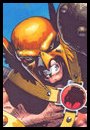
Hawkman represents just such an example. A character, who from his beginnings in the early 1940s, he has held memberships with both the Justice Society and Justice League, but has still grown into one of the many violent characters of today's comics landscape. Few stories highlighted Hawkman's violent nature than Black Reign, where he wages his forces against Black Adam in a battle that pits them against one another, but also shows the destructive similarities.
 In his new home of St. Roch, the villain called Matter Master seeks a means of retribution against a foe who has defeated him time and again. Using his matter manipulating wand to take a gala of the wealthy hostage, he eagerly awaits the arrival of his alien-winged rival.
Hawkman bursts into the arena through large glass windows, only to have the shards of glass hurled at him as a weapon by the villainous Master. Tiny slithers of glass bury themselves in Hawkman's only partially armoured body, but do little to slow his wrath.
 The Matter Master elaborately announces the abilities granted by his matter manipulating wand, delighting in the battle that will ensue. He is a steady contrast to the stoic Hawkman, whose demeanour is of one no longer willing to indulge the fancys of colourfully dressed criminals.
Possessing both fixed mace and battle axe, he hurls the latter in the direction of the Matter Master. The blade slices through the Master's arm with ease, burying itself in the wall adjacent.
Having successfully seperated the villain from his weapon, the silent Hawkman pulls his axe from the wall and coldly remarks, "Fight's over."
Harsh justice is something, I think, Hawkman wears very well, and Geoff Johns does well to reinvigorate the character with everything that makes him familiar, but with a confident new edge. This story steers Hawkman toward another character we're about to talk about, bouncing off one of the past lives established as part of the streamlining reveal that both Hawkman and Hawkgirl are caught in a perpetual cycle of resurrection.
I wouldn't be confident in saying where the line lies for Hawkman, but as a character so thoroughly connected to the various houses of the DC heirarchy, I think it's great to have this interpretation of justice among them. It might never be the prevailing argument, but in a medium often gagging on it's own tail, it's characters of diverse opinions on issues important to the fictionali world that will always be a saving grace.
 The Fix:5.5 The Issue: 5
Winner: Hawkman
[Without a doubt one of the greatest crossovers of recent times, all crucial to the reinvention of not only the Justice Society of America, but more importantly, Hawkman. Hawkfans should definitely track down the trade of these issues, and maybe anyone else looking to get their feet wet, particularly post 52/World War III.]
 BLACK ADAM versus KOBRA
Prince of Darkness Coda: Justice Eternity (DC)
Where: JSA #51 When: October 2003
Why: David Goyer & Geoff Johns How: Leonard Kirk
Quick Fix...
This quite naturally leads us to cross that invisible line that seperates the right from the wrong, and the justified from the murderers.
In Black Reign it was Hawkman that, in many ways, walked away the bad guy. Teth-Adam, having invaded his homeland of Khandaq, is revered as a hero by the Khandaqi people, while Hawkman is decryed by both the liberated, and the Justice Society themselves, who were led by the usurping Chairman into a joyless bloodbath.
Even so, it is Black Adam who has more traditionally walked the path of villain, recast in that role during a genocidal rampage coming out of the pages of 52.
We can make no bones about sponsoring Black Adam throughout 2007.
It's arguably this moral ambiguity that has propelled Black Adam to the status of the most enjoyable of rising stars to be pushed by DC all year. Dealing with a role as ruler of a nation, Adam has been the slate for reflecting the responsibility and potential carnage incurred by a superpower unchecked.
Like many great villains, Adam is essentially a well intending individual, marred by his regular association with death and bloodshed. The descent into madness began long before 52, starting in the pages of JSA where, having broken away from the group that agreed to take him in, Adam is leading a small group of soldier against those who have escaped justice as they see it.
 One such example is the terrorist cult leader, Kobra.
Having launched attacks across the globe, Kobra was responsible for the death of the mother of one of Black Adam's pliant recruits, Atom Smasher.
Both left the Society over Kobra's subsequent trial and escape, disillusioned by the JSA's archaic notions of legality. With the aid of Brainwave, the group of super-militants track Kobra to his hidden lair in the Himalayas, where they exact the only suitable punishment for a mass murdering menace such as he: death.
 With Brainwave confirming claims of a network of explosives beneath New York are false, Adam plunges his fist through Kobra's chest, ripping his heart out.
With that, justice is served, and the cult of Kobra is left to legend, or methods supernatural.
Much like Hawkman, Geoff Johns earns his stripes as a major comics writer perfecting his skills with the reinvigoration of classic properties. These events have been referenced many times [Hawkman #24] on the site, already described in this very entry for their role as the first action in the spiral that has led to today, where Black Adam is a mass murderer himself, and a broken man.
I've seen relatively recently a Hawkman referring casually to killing a villain, and in much the same way, I would express some disappointment for how frivilously the characters have been allowed to cross that invisible line. For Hawkman, it is obviously a scenario rarely fulfilled, but for Black Adam, it has again been a fullblown devolution into villainy.
Putting a character to blows with the Justice League is almost always going to cast them as villain, but when the motives involve genocide, it's hard to argue.
Perhaps it's the inevitability of so-called "harsh justice" that these characters slip into ill-defined rampages, or off-the-cuff murders, but I've got to wonder.
Just like iconic superheroes define themselves in fiction as characters capable of handing out justice without the cost of human life, so too can't we suggest that super warriors can live by the sword, without impaling their sanity upon it?
In a world where law enforcement still hands down sentences of death, and where wars are waged over just causts, is it so inevitable that those that battle these evils become them? Or is there a school of thought to say controlled lethality is a requirement of an efficient system of justice? Does their come a time when a cheek must demand a cheek in turn, or is simply invite corruption as another symptom of decadence and war?
Can anyone begrudge a police officer that draws a weapon in confirmed self-defense, or is the threat of an error of judgment too great and too common?
Maybe someone like Hawkman, or even Wonder Woman, will be the character to eventually answer the question: Can a hero kill responsibly?
 The Fix: 5 The Issue: 4.5
Winner: Black Adam & Atom Smash (w/ Brainwave)
[This issue marks the end of David Goyer's tenure on the relaunched JSA title. In the main feature, the story features a big ol' magical throwdown between Mordru and Dr. Fate, which will inevitably turn up in a future entry of the Infinite Wars.]
 BLACK ADAM versus CAPTAIN MARVELBlack Reign (DC comics)
Where: Hawkman #24 When: Late March 2004
Why: Geoff Johns How: Rags Morales
The story so far...
Having attempted to prove his redemption through serving with the Justice Society of America; Black Adam soon comes to realise that the effective betterment of the persecuted will not be achieved through the good intentions of the Golden Age heroes.
Gathering a band of the willing and likeminded, Adam sets about righting the wrongs of his time with the JSA, fighting and executing his way to his homeland of Kahndaq.
With the aid of his fellows; many connected to the Justice Society themselves; Adam wages a coup against the oppresive rulers of the once proud and ancient Middle Easter country. Their militia no match for brute super strength, Adam liberates the Kahndaqi people, who are none too happy when the JSA, led by Hawkman, come to interfere in the rule of their new hero.
Previous Form:
Black Adam (#13): Undefeated over Four Horseman of Apokalips, Freedom Force & Psycho-Pirate.
Captain Marvel (#201): Mixed results in battles with Thor, and an Eclipso posessed Superman.
Tale of the tape...
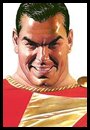 Strength: Draw 6 (Invincible)
Intelligence: Captain Marvel 5 (Professor)
Speed: Draw 5 (Super Speed)
Stamina: Draw 6 (Generator)
Agility: Black Adam 3 (Athlete)
Fighting Ability: Black Adam 7 (Born Fighter)
Energy Powers: Draw 3 (Explosives)
Most recently it was Sabretooth/Wolverine [Wolverine #50], and arguably again with Batman/Ra's Al Ghul [Batman Begins]. The clash of arch-nemesis'. The inevitable blows waged by hero and villain, described-so conversely through the perspective of each character's eyes, a thin line seperating their differences.
While Black Adam has shot to the top as one of the most improved players to come out of DC's year-long 52, his heroic counterpart, Captain Marvel, has suffered the squalor of low priority mini-series, and loyalist interests. Not even the lofty intervention of Bone's Jeff Smith was enough to breathe the life that Judd Winick's contemporary revamp probably should have.
So, what does any of this have to do with the fighting potential and prospective chances of winning a battle? Well, if that's all this section were about, we'd run even shorter on discussion than we ordinarily do; but of course, it also does have a lot to do with our protagonist's predicament -- for you see!...
Yes! Captain Marvel, despite a massive power boost and long overdue starring role in a mini-series, struggles to endure in the contemporary market in the way his elf-eared, windows peaked, black and gold counterpart does.
There are a lot of fair theories about why that is. They do, afterall, describe luck as the process of motivation meeting opportunity, but then again, how many on-going series have They starred in recently? I think there's a direct link with the character's distinct potentials that has contributed to one success: The killer instinct and drama of good pathos.
Black Adam beats out his SHAZAM-ing sucessor in the tape for the simple reason that he has evolved to be a fully realised warrior, with no qualms about turning his strength to tasks such as face removal, one-way heart transplants, and drawing and halving of evil doers.
Captain Marvel; a character who reached even greater heights in his time than the massively successful Superman, in many ways, represents the Golden Age more than any other character. I mean, you've got old timers who had an edge that made their transition into the more violent and conflicted contemporary landscape simple. Batman, The Phantom, Hawkman... The list is much longer than I would have you believe, here.
Other characters were fantastical enough, or had enduring successors that allowed their torch to be carried to a time where they were out of the picture long enough to be interesting prospects again. Many of the JSA elite fall under that category, and it's to an extent applicable to Adam cum Captain Marvel.
[Captain] Marvel; despite the best efforts of a Winick or an Ostrander; cannot seem to escape the obscured view of his squinted eyes. Eyes that view the world through the refracted rosie glow of his big red chest.
He's a character that represents what is referred to as a "simpler" time, and therefore suffers the characterization of grinning, dim-witted stupidity -- despite possessing the mighty wisdom of Solomon.
Black Adam has the killer instinct, and he knows how to use it, and despite hovering above and blow the strength level of Cap, is the safe bet that reflects the times in which we live.
The Math: Black Adam (Super Class)
The Pick: Black Adam (Because it isn't forty years ago...)
What went down...
Upon entering Kahndaq airspace, the JSA find themselves in a freefall as their plane is ripped asunder by a sneak attack launched by Black Adam! Most of the super powered heroes find ways to land, each finding their own antagonised welcome at the hands of the Kahndaqi people, but Captain Marvel stays behind with an injured Wildcat to search for survivors in trouble.
Black Adam, orchestrating the containment of those he has dubbed invader, employs the aid of Brainwave to prepare to face his Shazam powered counterpart, Captain Marvel.
Content to find no bodies amongst the wreckage, Marvel is shocked when Wildcat is knocked out with a piece of the plane. He becomes aware of the unceremonious entrance of his fallen arch-nemesis, suffering a similar fate as he's swatted acrosh the crash site by Black Adam.
 The Captain recovers with the stamina of Atlas, striking Adam furiously with a solid left. Black Adam, with his own impressive strengths, returns the favour with an uppercut that tosses Marvel airborne until he lands in nearby ruins.
Marvel joins Black Adam in the sky, the two coming to blows with explosive results. Every strike echoes with thundering booms no doubt heard across the land, the magical energies bursting from their bodies in sparks of lightning.
Marvel presses the advantage, riding Black Adam through rubble and wreckage face-first into the ground he so viciously claimed as his own.
 Having mocked Marvel's perception of the modern world, Adam rises from the crater created by their impact to taunts concerning his strategic alliances.
With bitter efficiency, Adam makes psychic contact with the waiting Brainwave, giving the order to act upon his "lock" on Captain Marvel.
 Having telepathically maneuvered his way around Solomon and the other influences in Marvel's mind; Brainwave forces the hero to utter the magic keyword that calls down the lightning of the wizard Shazam, and transforms him back into his pubescent alter-ego, Billy Batson!
With the cold determination to do whatever is necessary to pursue his goals, Black Adam raises his hand in the air and strikes Batson with a swift backhand. The boy is knocked through the air, helpless against the super strength provided by the sun god, Amon.
Adam's attack not only puts the punctuation on a strategic assault on one of the JSA's most powerful allies, but also comes with the bitter verbal slap to the Wizard from whom each man derives his fantastic power. Adam declaring, "The wizard abandons you, Billy. Just as he did me."
Victorious, Adam learns from the psychic of Batson's growing affections for Stargirl. As a future contingency, he orders the capture of the girl, playing a card all too personally recognisable to the dark monarch, whose own beloved was once lost in battle.
The hammer...
Your win, and still undefeated 2007 MVP -- Black Adam!
I mention MVP, because if you've been with us over the past eight months, you'll be familiar with the previous entries that have sponsored Black Adam into our 2007 top five rankings.
With the last entry [Marvel Zombies #5] looking to turn the top rankings into a Civil War promotional shot, it seemed like as good a time as any to revisit the slowly fading anti-hero, whose recent rise to prominence has been pretty well documented, with the exclusion of the beginning of that path.
To really get the full picture we should ideally go further back still, to earlier in the rebooted JSA series where Black Adam made his return, and gained membership to the Justice Society, before slipping from their views. It was in tiny background scenes that Adam's indescretions were detailed, as he gathered and led his band of allies against foes like Kobra.
These actions culminate in full-fledged war waged on Kahndaq in the pages of the Hawkman/JSA crossover - Black Reign. It's here, as already described in the recap, that Adam swiftly takes control of the nation, and as we would see through the end of this story, remains in power to the chagrin of the JSA.
Through Infinite Crisis we then saw Adam's story continue, as he threw in with the mounting powers of the Secret Society of Supervillains. Much like a Dr. Doom styled figure, his motives were largely in the interests of the betterment and protection of his nation. He proves an unwitting pawn in Alexander Luthor's plot to power a device that will allow him to control and reshape the multiverse as he desires it.
Adam aids in the defeat of vital characters like The Ray [Infinite Crisis #1], but is eventually revealed as a potential target himself. When The Society betray him, needing a Shazam powered here, Black Adam turns readily on the mob of evil, brutally defying the empathic influence of Psycho-Pirate [Infinite Crisis #6].
Black Adam continues to battle on the side of angels until the ultimate defeat of the alternate Luthor, before returning to his duties in Kahndaq.
Resuming his political duties, Adam swiftly deals with villainous elements attempting to trade through Kahndaq. His public execution of villains becomes the international catalyst of fear and loathing, while prompting criminal element Intergang to attempt to buy his favour with a female offering.
Adam deals with Intergang harshly, while becoming romantically involved with the girl, who is eventually slain by the incursion of a new Monster Society [52 #44], funded by the neighbouring nation of Bialya, and created by Dr. Sivana and the Intergang employed scientists of Oolong Island.
Azraeuz, the only surviving horseman of the Monster Society, escapes to Bialya, where the government is abandoned by their villainous allies in the wake of Black Adam's arrival.
Furious and suspicious of everyone, Adam devolves into a rage that sees him slaughtering Bialya's government, and millions of their innocent citizens in the pursuit of Azraeuz. Though the mass casualties empower the horseman of death further, Azraeuz is ultimately defeated and tortured by Adam [52 #45].
Methodically pursuing those responsible for the deaths of his adopted family, Adam immediately travels to Oolong Island off of the intelligence gained from Azraeuz. There, he is surprisingly defeated by the super-sciences of the sinister thinktank. Before he can be auctioned off as a living weapon, the Justice Society are able to intervene, freeing him with the unsuccesful intent to take him into custody.
 With Adam's bloodlust explicitly crossing the line from harsh justice, to intolerable genocide; the heroes and political powers of various nations are maneuvered into position for the events of World War III. Though inter-political turmoil slows the process, the American heroes of the Justice League and Society eventually defeat Black Adam. Though unable to strip Adam of his powers, it is with the aid of several other mystics that Captain Marvel returns Adam to his human alter-ego of Teth-Adam, and changes his magic trigger word before he can again utter the cry of "Shazam!"
If you're reading Countdown or the just released mini-series, Black Adam: Dark Age, you'll know that he has since discovered his new word - sorry - and has taken refuge in the Kahndaq embassy in Gotham City, where he has corrupted Mary Marvel.
It looks like post-52 Black Adam's path is more explicitly evil, which I think is a real shame. The character, whose bitter pathos made him one of the most exciting new stars of DC's lineup, was something I regard as quite refreshing and global, responsible for pushing him away from the stagnant disappointments of the developing Shazam branding [discussed in the tape].
As a Sub-Mariner/Dr. Doom style monarch, Black Adam had the opportunity to stand out as something more than many other heroes or villains in the DC Universe. Keeping his motivations more ambiguous and personalized (like the best Dr. Doom stories) meant the character could become broadly relevent, interacting with political agencies like the currently superb Checkmate, but also other superheroic and villainous elements that would cross his path.
Projecting their solicitations quite far into the future, we can see DC comics alluding to a return to more straight evil for Black Adam in the pages of JLA. The cover to issue #13 suggests a renewed association with much the same collective that turned against him in the Society, this time operating under the branding of a new Injustice League.
It's too soon to scowl the turn of events too certainly, but it seems like a potentially disappointing downward turn for the character in the final quarter of 2007. A bitter conclusion to what has otherwise been the culmination of a story that began small, but was brilliantly steered into the spotlight and beyond, largely by original contributor Geoff Johns, who made his name on titles like JSA and Hawkman, and with this story, Black Reign.
It was here, having received this issues personally from Johns, that I certainly became hooked as a fan not only of these characters in the modern age, but of his competence as a writer accepting of things oft dismissed. A writer who brought Black Adam to the prominence he now seems to be leaving behind.
With that, we wrap up our informative slant on this particular conclusion.
The DC Nation, whom I know is still watching, should take some faith out of this. It seemes, dare I speak too soon, that there are a couple of DC entries coming our way in the Infinite Wars, as our discussion spins out of the Batman Begins review. I'll probably see you again Friday, before the September punch-up.
Remember to check out the smashing review of The Kirby Martin Inquest at the reputable review site, BrokenFrontier.com. If you haven't already, you should think about heading over to Nite Lite Theatre, and picking yourself up a copy via online purchase through the good people at ComixPress! Cheers!
The Fight: 5 The Issue: 6
[An absolutely brilliant storyarc, best read in it's entirety. Hardcore superhero fun filtered through the pastiche of contemporary political concepts. The first major step into the modern rise of Black Adam as a neo-political conqueror. A must-read for fans of the character, particularly out of the pages of fifty-two.]

 In his new home of St. Roch, the villain called Matter Master seeks a means of retribution against a foe who has defeated him time and again. Using his matter manipulating wand to take a gala of the wealthy hostage, he eagerly awaits the arrival of his alien-winged rival.
 The Matter Master elaborately announces the abilities granted by his matter manipulating wand, delighting in the battle that will ensue. He is a steady contrast to the stoic Hawkman, whose demeanour is of one no longer willing to indulge the fancys of colourfully dressed criminals.
 The Fix:5.5 The Issue: 5
 One such example is the terrorist cult leader, Kobra.
 With Brainwave confirming claims of a network of explosives beneath New York are false, Adam plunges his fist through Kobra's chest, ripping his heart out.

 Strength: Draw 6 (Invincible)


