
 HAWKMAN versus MATTER MASTER
Black Reign: Part Two (DC)
Where: Hawkman #23 When: Early March 2004
Why: Geoff Johns How: Rags Morales
Quick Fix...
Lately we've been talking a bit about harsh justice, and it's application to the superhero world, and this entry gives us the opportunity to take a look at that theory in practise.
It's a particularly interesting topic, given all the different angles. Generally speaking, the sacred cows [like Wonder Woman] are protected from the moral ambiguity of lethal justice, yet, oft times it's these vintage characters that are more likely to be identified with harsh enforcement reflective of the war-torn times they were created in.
The debate rages on between the two schools of thought. For many the definition of a superhero is to be above the moral ambiguity average humans, soldiers, or heroes are regularly faced with. It means not being forced to pull the trigger to save innocent lives, instead using the fantastic to end danger.
We recently discussed a similar argument of whether or not Captain America ever used lethal force during his times in the frontline of the Second World War [Captain America #405].
The morally ambiguous hero got a bit of a tarnished reputation, passing through the eighties and nineties with the baggage of excess, and poor interpretation. The posterboy becomes characters like The Punisher, who more overtly straddle the line of what's right and wrong with a stonecold attitude toward life and death. For the most part these characters do good, eliminating the evils that evade justice by conventional law, but there is always that underlying negative of what we know in reality of the vigilante.
It's almost a funny sort of thing, that "vigilante" takes on such a distinctly different feel across the major spectrum of superhero comic books. Never would any of us truly look twice at a Batman, or Captain America, no matter how rebellious they may be to an administration of excessive order. Yet, in the real world, I struggle to think of many examples of positive vigilante activity.
Sure, there's those cases of a liquor store clerk fighting back, or even a community under siege taking action to patrol the streets, but those stories are either short lived, or mild mannered deterents for relatively simple problems.
What I associate with broad coverage of vigilantes is men and/or women who kick back at personal injustice, flagrantly ignoring what is universally just, and often running the risk of making a greivous error, or crossing an invisible line.
It's a line that seems to seperate the golden arches of true superheroes, and the guys who undermine what that means in a fictionalized society. Characters who in some ways reflect that real-world vigilante scenario, and face that kind of scrutiny, but ultimately have the roll of protagonist, and live decades beyond those characters that would briefly hound them.
What about the other characters, though? Wonder Woman inevitably finds herself reset to a mould more appropriate for a family, cartoon viewing audience; but what about those characters who can drift closer to the line, longer?
Hawkman represents just such an example. A character, who from his beginnings in the early 1940s, he has held memberships with both the Justice Society and Justice League, but has still grown into one of the many violent characters of today's comics landscape. Few stories highlighted Hawkman's violent nature than Black Reign, where he wages his forces against Black Adam in a battle that pits them against one another, but also shows the destructive similarities.
 In his new home of St. Roch, the villain called Matter Master seeks a means of retribution against a foe who has defeated him time and again. Using his matter manipulating wand to take a gala of the wealthy hostage, he eagerly awaits the arrival of his alien-winged rival.
Hawkman bursts into the arena through large glass windows, only to have the shards of glass hurled at him as a weapon by the villainous Master. Tiny slithers of glass bury themselves in Hawkman's only partially armoured body, but do little to slow his wrath.
 The Matter Master elaborately announces the abilities granted by his matter manipulating wand, delighting in the battle that will ensue. He is a steady contrast to the stoic Hawkman, whose demeanour is of one no longer willing to indulge the fancys of colourfully dressed criminals.
Possessing both fixed mace and battle axe, he hurls the latter in the direction of the Matter Master. The blade slices through the Master's arm with ease, burying itself in the wall adjacent.
Having successfully seperated the villain from his weapon, the silent Hawkman pulls his axe from the wall and coldly remarks, "Fight's over."
Harsh justice is something, I think, Hawkman wears very well, and Geoff Johns does well to reinvigorate the character with everything that makes him familiar, but with a confident new edge. This story steers Hawkman toward another character we're about to talk about, bouncing off one of the past lives established as part of the streamlining reveal that both Hawkman and Hawkgirl are caught in a perpetual cycle of resurrection.
I wouldn't be confident in saying where the line lies for Hawkman, but as a character so thoroughly connected to the various houses of the DC heirarchy, I think it's great to have this interpretation of justice among them. It might never be the prevailing argument, but in a medium often gagging on it's own tail, it's characters of diverse opinions on issues important to the fictionali world that will always be a saving grace.
 The Fix:5.5 The Issue: 5
Winner: Hawkman
[Without a doubt one of the greatest crossovers of recent times, all crucial to the reinvention of not only the Justice Society of America, but more importantly, Hawkman. Hawkfans should definitely track down the trade of these issues, and maybe anyone else looking to get their feet wet, particularly post 52/World War III.]
 BLACK ADAM versus KOBRA
Prince of Darkness Coda: Justice Eternity (DC)
Where: JSA #51 When: October 2003
Why: David Goyer & Geoff Johns How: Leonard Kirk
Quick Fix...
This quite naturally leads us to cross that invisible line that seperates the right from the wrong, and the justified from the murderers.
In Black Reign it was Hawkman that, in many ways, walked away the bad guy. Teth-Adam, having invaded his homeland of Khandaq, is revered as a hero by the Khandaqi people, while Hawkman is decryed by both the liberated, and the Justice Society themselves, who were led by the usurping Chairman into a joyless bloodbath.
Even so, it is Black Adam who has more traditionally walked the path of villain, recast in that role during a genocidal rampage coming out of the pages of 52.
We can make no bones about sponsoring Black Adam throughout 2007.
It's arguably this moral ambiguity that has propelled Black Adam to the status of the most enjoyable of rising stars to be pushed by DC all year. Dealing with a role as ruler of a nation, Adam has been the slate for reflecting the responsibility and potential carnage incurred by a superpower unchecked.
Like many great villains, Adam is essentially a well intending individual, marred by his regular association with death and bloodshed. The descent into madness began long before 52, starting in the pages of JSA where, having broken away from the group that agreed to take him in, Adam is leading a small group of soldier against those who have escaped justice as they see it.
 One such example is the terrorist cult leader, Kobra.
Having launched attacks across the globe, Kobra was responsible for the death of the mother of one of Black Adam's pliant recruits, Atom Smasher.
Both left the Society over Kobra's subsequent trial and escape, disillusioned by the JSA's archaic notions of legality. With the aid of Brainwave, the group of super-militants track Kobra to his hidden lair in the Himalayas, where they exact the only suitable punishment for a mass murdering menace such as he: death.
 With Brainwave confirming claims of a network of explosives beneath New York are false, Adam plunges his fist through Kobra's chest, ripping his heart out.
With that, justice is served, and the cult of Kobra is left to legend, or methods supernatural.
Much like Hawkman, Geoff Johns earns his stripes as a major comics writer perfecting his skills with the reinvigoration of classic properties. These events have been referenced many times [Hawkman #24] on the site, already described in this very entry for their role as the first action in the spiral that has led to today, where Black Adam is a mass murderer himself, and a broken man.
I've seen relatively recently a Hawkman referring casually to killing a villain, and in much the same way, I would express some disappointment for how frivilously the characters have been allowed to cross that invisible line. For Hawkman, it is obviously a scenario rarely fulfilled, but for Black Adam, it has again been a fullblown devolution into villainy.
Putting a character to blows with the Justice League is almost always going to cast them as villain, but when the motives involve genocide, it's hard to argue.
Perhaps it's the inevitability of so-called "harsh justice" that these characters slip into ill-defined rampages, or off-the-cuff murders, but I've got to wonder.
Just like iconic superheroes define themselves in fiction as characters capable of handing out justice without the cost of human life, so too can't we suggest that super warriors can live by the sword, without impaling their sanity upon it?
In a world where law enforcement still hands down sentences of death, and where wars are waged over just causts, is it so inevitable that those that battle these evils become them? Or is there a school of thought to say controlled lethality is a requirement of an efficient system of justice? Does their come a time when a cheek must demand a cheek in turn, or is simply invite corruption as another symptom of decadence and war?
Can anyone begrudge a police officer that draws a weapon in confirmed self-defense, or is the threat of an error of judgment too great and too common?
Maybe someone like Hawkman, or even Wonder Woman, will be the character to eventually answer the question: Can a hero kill responsibly?
 The Fix: 5 The Issue: 4.5
Winner: Black Adam & Atom Smash (w/ Brainwave)
[This issue marks the end of David Goyer's tenure on the relaunched JSA title. In the main feature, the story features a big ol' magical throwdown between Mordru and Dr. Fate, which will inevitably turn up in a future entry of the Infinite Wars.]


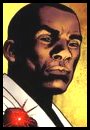
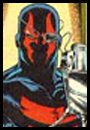 Strength: KGBeast 3 (Trained Athlete)
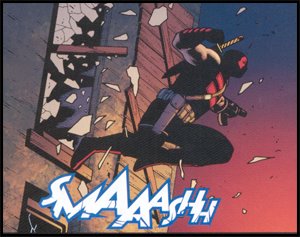 Suddenly, without warning, gun fire rings out into the night, cutting through the barrel of the assassin's weapon.
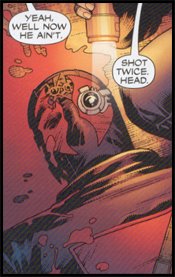 Tackled by his attacker, the two struggle, with bullets flying from the KGBeast's cybernetic weaponry.


