Showing posts with label Rags Morales. Show all posts

Saturday, March 25, 2023

BLACK ADAM versus JUSTICE SOCIETY
Thunderstruck (DC)
Where:
JSA #27 When: October 2001
Why: Geoff Johns How: Rags Morales

The Story So Far...
In ancient times Teth-Adam was considered a champion, but the Black Marvel has a long road to walk if he's to undo centuries of damage and restore his reputation as a hero.

Submitting himself to the Justice Society of America, Black Adam begins probationary tenure with the heroic ensemble -- but not everyone is convinced he should be there.

As Captain Marvel pays a visit to vouch for his predecessor, tensions are boiling over with Atom Smasher, who believes Black Adam will inevitably turn on the group like every other villain who attempts to reform.

Tale of the Tape...
Strength: Black Adam 6 (Invincible)
Intelligence: Mr. Terrific 5 (Professor)
Speed: Captain Marvel 5 (Super-Human)
Stamina: Black Adam 6 (Generator)
Agility: Sand 7 (Unlimited)
Fighting: Black Adam 7 (Living Weapon)
Energy: Stargirl 6 (Mass Destruction)
Total: Black Adam 34 (Super)

Black Adam is the ancient champion of Shazam, who gains the stamina of Shu, the swiftness of Heru, the strength of Amon, the power of Aten, and the courage of Mehen, when he speaks the wizard's name and receives his magic lightning!

The Justice Society are: Sand, Mister Terrific, Wildcat, Hawkgirl, Doctor Mid-Nite, Star-Spangled Kid, and Atom Smasher, with Captain Marvel.

The JSA have Black Adam outnumbered, but they don't particularly have him out-gunned. The Black Marvel has gone toe-to-toe with Superman and only Atom Smasher gets close to matching his incredible strength!

The enlarging strongman is generally in a lower class than Black Adam, but we saw him handle himself relatively well when Atom Smasher led the Suicide Squad against the Black Marvel Family, many years later, in 52 #34.

Fortunately for the JSA: Captain Marvel has come calling! With his own godly gifts supplied by SHAZAM, he's every bit Black Adam's equal, enduring his own battles with Superman, and besting the likes of the Seven Deadly Enemies of Man, an all-star Monster Society of Evil, and Neron corrupted Justice League.

Black Adam had the help of Brainwave when he defeated Captain Marvel some years later in Hawkman #24. This time the dynamics are very different, and it's Captain Marvel who has the entire JSA to back him up! Will it be enough?

The Tape: Justice Society & Captain Marvel Ranking: Black Adam (#22)

What Went Down...
Black Adam has Atom Smasher by the throat as Captain Marvel makes his entrance into the JSA brownstone.

"I heard you were seeking salvation, Black Adam. That you were looking to prove to the world that you've changed your ways. I came to vouch for you[,] but a bit of advice -- Don't choke potential teammates."

The Black Marvel releases his grip, blaming his impulse on the temper of the mortal Theo Adam. He apologises to his teammate, who preemptively responds in kind -- delivering a giant-sized uppercut he'll be sorry for later!


Adam explodes through the glass ceiling as he's launched into the night sky!

Atom Smasher knows he's made a bigger mess of things as Captain Marvel takes flight to pursue his fellow. He meets an enraged Black Adam in mid-flight -- cutting off his furious path back to the JSA brownstone.


The powers of SHAZAM collide in spectacular fashion as the strength of Hercules meets the might of Amon-Ra!

The Captain maneuvers himself to wrap a mighty bicep around Black Adam's throat and hold him back. He compels his comrade to reject the influence of Theo, but the anger incited by Atom Smasher's insult is great!

The Justice Society arrive on the scene just in time to see Black Adam power through Captain Marvel's hold and torpedo dive Atom Smasher!


Team chairman, Sand, draws his sleep gun and orders Atom Smasher to subdue the probate, with Hawkgirl looming in support holding a spear.

Atom Smasher leans in to Black Adam and pins an arm over his shoulder, while shoving Captain Marvel out of the way.


In the ensuing chaos, Black Adam's out reaching hand grabs Sand's gun and crushes it -- unleashing a bursting cloud of sleep gas that stuns Atom Smasher and Hawkgirl!

Wildcat darts around the room, questioning Black Adam's loyalties, as Doctor Mid-Nite looms behind the peril. The query appears to snap Adam out of his rage and pause him in introspection, but the zipping of two of Terrific's T-Spheres around his face renew his aggravation.

Sand commends the tactical potential for beaming holograms directly into Adam's eyes, but Mister Terrific finds himself unable to command his T-Spheres to execute the strategem!


He can only speculate the lightning storm and rain raging overhead is disrupting communication channels. It leaves his T-Spheres autonomously whirring around Adam as he bats Wildcat and Mid-Nite away with each hand.

With imminent threats dealt with, Adam sets his scornful sights on Sand and Mister Terrific.


Slamming his hands together -- Black Adam unleashes a shockwave that launches Sand and Terrific flying through the air!

While Stargirl spurs Captain Marvel to rejoin the fray -- Adam looms over Sand, cast in shadow by the lightning cracking behind him.

Whatever the Black Marvel's intentions for the Chairman may've been, they go unfulfilled as a spiked mace smashes into the ground at his feet, and Hawkman descends from the storming skies to declare: "This fight is over."

The Hammer...
The authoritative word of Hawkman helps bring Black Adam out of his rampage, but the intervention of the former-chairman only creates further divisions as he appears to undermine the leadership of Sand.

Inter-personal dynamics are criss-crossed all over this battle, with Hawkman returning from a night's flight after witnessing Sand kissing Hawkgirl, and Black Adam's admission to the JSA creating tensions with Atom Smasher, and his well meaning old rival Captain Marvel.

Atom Smasher echoes the expectations of readers who'd doubt the long-term viability of Black Adam as a hero, but the twist in their relationship comes when Atom Smasher actually sees things Adam's way, joining him in his attack on Kobra, and subsequent conquest of Khandaq.

To the uninitiated: JSA might've seemed like an attempt to capitalize on the late-nineties magic of JLA, but the 1999 collaboration between David Goyer and Geoff Johns had so much more to offer, laying the groundwork for significant foundational storylines that continued under Johns throughout the next decade!

Black Adam arguably became a minor sensation with his nineties revamp in Power of Shazam, and lingering appearances in various nineties DC Comics events -- but it was his return in JSA that began the ascent to breakout superstar!

Stories running through JSA, 52, and a Black Adam mini-series, minted the once obscure Captain Marvel villain into a full-fledged icon destined for the big screen, but for a while there, JSA was also the best place to find Captain Marvel himself.

DC seemed to effectively lose confidence in Captain Marvel as a viable property throughout the 2000s, leaving JSA to carry the flag in the ensemble series after Power of SHAZAM was cancelled in early '99. It was then in issues like JSA #27, and the Black Reign crossover of Hawkman #24, that fans could again see the two Marvels renew their seemingly settled rivalry.

Issues like these highlight the absurdity of emerging reports that Dwayne "The Rock" Johnson blocked Captain Marvel from appearing with the Justice Society on the big screen, but there's a lot more to the JSA than was seen in the movies.


Once everyone has calmed down, the team decides to resolve their leadership issues with a vote, which installs Mister Terrific as the new Chairman.

An exciting new role for the genius successor to Terry Sloane's legacy of fairplay, which at least sidelines any issues brewing between Sand and the returned Hawkman, but comes at a time when his trademark T-Spheres have been infiltrated by a similar device controlled by Roulette!

The infiltration was the real reason Terrific's devices weren't responding during today's featured fight! The mistress of competition sent her drone to whisk the team away for more adventures in the next issue.

I very much intend to take a closer look at that adventure some time in the future. There are a few different sessions with Roulette that are surely right up our combat-loving alley, and I look back upon this period of DC Comics, and its revival of classics like JSA and Hawkman with great fondness. A time when Geoff Johns mastered intuitively fusing the old with the new alongside artists like Rags Morales.

As for today's contest: Although Hawkman brought proceedings to a relatively peaceful conclusion, you can clearly see that Black Adam had the best of the Justice Society. A majority of the team was subdued. A win's a win.

If you'd like to see more from the characters featured in today's entry you can follow links throughout this post, or dive into the Secret Archive for a complete index of featured fights in order of publisher, series, and issue number.

Secret Wars on Infinite Earths has featured more than 700 battles and ranked well over 1,000 characters! You can help keep us in the fight by showing your support for all this content by becoming a Patreon backer. As a thank you you'll receive access to various additional updates and customizable content options at the higher tiers, including Rank & File Top 10 lists.

Get free daily links to fights inspired by the topics of the day by subscribing to Twitter and Facebook, or by becoming a freebie follower on Patreon. Don't forget to smash that like, fave, and share -- and keep your eyes peeled for the week's top trending battles every Sunday on Twitter & Patreon!

Winner: Black Adam
#19 (+3) Black Adam
#40 (--) Captain Marvel
#51 (-3) Hawkgirl
#369 (-186) Wildcat
#429 (-48) Atom Smasher
#430 (-23) Sand
#653 (-108) Mister Terrific (Michael Holt)
#654 (-110) Doctor Mid-Nite (Pieter Cross)
#27 (--) Hawkman [+1 assist]
#100 (+3) Stargirl [+1 assist]

Sunday, November 29, 2020

MAXWELL LORD & SUPERMAN versus WONDER WOMAN
Sacrifice Part 4 of 4 (DC)
Where:
Wonder Woman #219 When: September 2005 Why: Greg Rucka How: Rags Morales, David Lopez, Tom Derenick, Georges Jeanty & Karl Kerschl

The Story So Far...
The exploitation of magic to rewrite a villain's personality began a cover-up within the Justice League that unraveled with the murder of Sue Dibny. Remembering his own mind was altered -- Batman created a stealth-concealed satellite to monitor the League and their actions in secret.

Discovered by Maxwell Lord; the Brother Eye satellite becomes a tool for a new incarnation of the covert intelligence organization Checkmate. As their Black King, Lord exploits the technology to initiate the OMAC Project and prepare for a war against super-powers.

Not content with relying on technology alone, Lord also uses his powers of mind control to turn Superman into his ultimate weapon. With the truth exposed by mental probe: Wonder Woman heads to Checkmate headquarters to confront the source of the visions that have turned Superman against the League!

Tale of the Tape...
Strength: Draw 6 (Invincible)
Intelligence: Draw 4 (Tactician)
Speed: Superman 6 (Mach Speed)
Stamina: Superman 6 (Generator)
Agility: Superman 3 (Acrobat)
Fighting: Wonder Woman 6 (Warrior)
Energy: Superman 5 (Lasers)
Total: Superman 33 (Super)

Throughout much of the modern age Superman and Wonder Woman have been shown to be approximate equals. They share in similar degrees of elevated strength, durability, stamina, speed, and even flight. So what separates them?

We're catching Wonder Woman at a time when her Amazon heritage appears to be manifesting itself through harsh justice. We observed this with a bloody follow-up issue that saw Cheetah invading The Haguge in Wonder Woman #222.

Wonder Woman's warrior training arguably makes her a more technically proficient fighter than Superman, who usually has the luxury of relying on strength and invulnerability. She demonstrated this fighting off both Vixen and Fleur-de-Lis simultaneously in JLA: Classified #3.

Although incredibly strong, Wonder Woman doesn't always hit the same peaks as Superman. In Crisis on Infinite Earths #6 the Earth-One Wonder Woman struggled to tame Mary Marvel with her lasso of truth. She fared only slightly better in Final Crisis #3, losing a one-on-one struggle. Captain Marvel was also able to endure a corrupted Wonder Woman in Underworld Unleashed #3.

Superman has had his own struggles with the powers of SHAZAM.  Captain Marvel took him to the limit in Action Comics Annual #4Superman/Batman #4, and Superman #216. A similar standstill occurred when Black Adam kept Superman to a tactical draw in DC Comics Presents #49,

Both Superman and Wonder Woman have faced the magical strength of Marvel's Juggernaut and passed with flying colours. Superman kayoed him with a sucker punch in DC versus Marvel #1, while Wonder Woman earned a more substantial win in a tag team slobberknocker with Spider-Man in Unlimited Access #1!

Superman is fighting today under the mental influence of Maxwell Lord which could be a key factor. Breaking the chemical influence of Poison Ivy was vital to Batman & Catwoman defeating him in Batman #612.

The tyrant Superman of Superman/Batman #15 showed he has the strength and speed to brutalize Wonder Woman if given the inclination. Infinite Crisis #1 showed a more reasonable disagreement. If the Lasso of Truth can overcome Max Lord's programming Wonder Woman should win.

History: 1-0-0 (Superman)
The Tape: Superman Ranking: Superman (#5)

What Went Down...
Max Lord stands gloating as The Man of Steel holds Wonder Woman to one knee with a hand around her throat. Superman is completely under his mental control.

A trickle of blood from Lord's nose is the only hint of strain dominating the world's most powerful man. He asks Superman to let her go, supremely confident that she won't attack. He tries to reach into her mind too, but cannot. She sees with the comprehension of a god. Lord's projections will not cloud her truth.

Words become Wonder Woman's weapon as the seasoned ambassador attempts to engage Lord in discussion. He recognizes her skill before revealing the entirety of his plans. Threatened, he strikes, summoning his most powerful weapon from the torment of visions of Doomsday murdering his beloved wife: Lois Lane.


Like a speeding bullet Superman darts toward them -- leading with laser focused bursts of heat vision.

Wonder Woman scrambles to throw her hands up, just barely deflecting the blasts with her magic bracelets. It is a short-lived defense as Superman is suddenly upon her, clutching her throat as he jets them out of the building.


Bereaved by telepathic visions of Lois Lane's death he screams her name. He's holding nothing back, rocketing out of Earth's atmosphere on an unknown journey with what he believes to be Doomsday.

Searing beams of heat vision find their target immediately, burning at the bones beneath Wonder Woman's cheek.

She cannot escape. Held mere inches from Superman's blazing red eyes by an unshakable choke hold. All she can do is plunge her thumbs into his eyes to try to stop the flow. Even as she does, heat begins to engulf them as they near the sun.


Superman tries to turn away, heat vision streaking around him as it bends to their incredible momentum. A moment of separation is all Wonder Woman needs to reach into her belt and retrieve the kryptonite she was given by Batman!

She thrusts it forward, but even in his confused state Superman knows the risks of exposure. He swings with all his might, hitting Wonder Woman so hard she blacks out for an instant!


Careening through space the Amazon begins to stir as the friction of her body re-entering Earth's atmosphere causes her to burn. Too late to do anything about it as gravity ushers her back to the planet with an all mighty explosion on impact!

An interstate highway in Wyoming is reduced to a massive crater. Superman hovers over it as a dazed Wonder Woman attempts to talk him down.

All Superman can see is the unstoppable monster he thinks murdered Lois. He vows to stop it, freezing his target in place with a powerful gust of exhaling.


Superman hoists a massive chunk of Earth over his head and moves in to crush his intended target. Only Wonder Woman has escaped the ice, quickly darting completely out of sight.

She waits in silence for the Man of Steel to stop talking and start listening intently with super-human accuracy. Once he does, she lingers behind him with arms out stretched. A plot to turn his incredible power into a devastating weakness!


The sound of Wonder Woman slamming her enchanted bracelets against Superman's sensitive ears is agony!

He grabs his ears as as the thundering sound echoes within and a tiny trickle of blood spurts from them both. Wonder Woman wants to hold back, but she must seize her chance.

The Amazon warrior kicks Superman in the side of the head, then buries her heel in his left knee. A snapping right hook catches him, sending his head falling hard into the ground. A combination designed to buy the time to reach for her lasso!


The gambit shows far more finesse than anything Doomsday would be capable of, but Superman suddenly seems remarkably focused on stopping the lasso.

He closes in at speed, forcing Wonder Woman to dedicate her arms to defending simultaneous incoming strikes from either side. Another blast of heat vision forces Wonder Woman to move, the two of them dancing around each other with the Lasso of Truth coiled just out of reach of snaring its subject.

Superman grabs Wonder Woman's lassoing right wrist. She retaliates with a rising palm thrust of her free hand. It catches Superman's steely chin, but he doesn't break his grip. He just squeezes and bends the wrist tighter. Then snaps it!


Wonder Woman lets out a scream. She wonders what new visions must be driving this precision attack. She realises that Maxwell Lord is the real threat.

She ducks a haymaker, supporting her injured wrist. Then charges at Superman, narrowly avoiding his heat vision to deliver a kick that sends him hurtling across the landscape!

Shifting a bracelet provides support for her broken wrist. A call to nature summons a flock of birds to provide her cover. A distraction easily dealt with by a vortex of air created by flying in circles, but enough to allow her to escape.

The Amazon returns to Checkmate's castle headquarters to confront Max Lord head-on. She easily ensnares him in her golden lasso and hoists him off the ground by the neck. As she does: Superman returns. A problem soon remedied.


With a rapid swing Wonder Woman tosses the tiara from her head like a discus -- sending it perfectly hurtling across Superman's jugular!

Shocked, the Man of Steel wraps a hand around his own throat and applies pressure to stem the flow of blood. He suddenly sees his opponent for who she really is as Wonder Woman convinces Lord to release his control.

Superman sifts through his reality as if waking from a nightmare. He holds his wound, coming to grips with the horrors he had witnessed. Illusions cast by the man Wonder Woman now has at her complete mercy...


She asks Lord how to permanently free Superman from his hideous influence. She takes him at his word. With a hand on his chin and head she twists -- snapping his neck and severing his spinal column. With that Maxwell Lord is dead.

The Hammer...
Heading into this one I thought there might be two fights to review, but upon revisiting Wonder Woman #219, it's clear there is one. Superman was a tool for the real villain Maxwell Lord. In the end: Wonder Woman defeated them both.

Max Lord's conspiracy against superheroes recalls his earlier history as a pawn of the hostile artificial intelligence Killg%re. Its plot was behind his efforts to establish a new Justice League corporation in the wake of Legends, which included the willful manipulation of the original line-up of heroes.

The corporate shark gained mind-control powers from a gene bomb detonated by The Dominators during Invasion. His time with the Justice League only saw limited exposure to Superman, but he was never the less able to gather sufficient intelligence to exploit The Man of Steel with just the right mental suggestions.

The decision to fatally snap Maxwell Lord's neck proved a pivotal step in defining Wonder Woman for the remainder of the 2000s and beyond.

There have been many defining moments in the character's history, but the sense that there was no enduring definitive reference remained a pervasive issue for her modern post-Crisis incarnation.

Who really is Wonder Woman? What sets her apart from equivalents in the DC pantheon? Her status seemingly relied on image: Lynda Carter in live-action, and the comics drawn by George Perez. This impression, true or not, invited writers to extract answers in the most logical place: her mythic Amazonian origins.

There's no ambiguity in the final page of Wonder Woman #219. She asks Max how to stop the visions that haunt Superman enacting violence against innocents. She doesn't hesitate in the slightest to act upon his lethal answer. She simply stares Lord down and twists his head.

It was a further parting of the ways for the DC trinity through their approaches to heroics. I tried to define this as part of my "Totem of Justice" around the time, where Superman was the hero of higher ideals; Batman was militaristic force in kind; and Wonder Woman the "life for a life" level of justice by warrior's code.

It's interesting that Zack Snyder featured a similar scenario in his Man of Steel film, recasting Superman as the neck-snapping protagonist - rather than the somewhat hapless, reluctant witness he is in today's battle.

Both examples appear to address misplaced internet-age criticisms of Superman's moral integrity, and his vast power to live up to it.

Snyder takes the increasingly popular cynical approach, bringing Superman down to "our" level by corrupting him and the use of his powers. Sequels doubled down on tropes of both a tyrannical "evil" Superman, and a weak Superman, specifically reprising the Death of Superman in only his second cinematic outing.

These are fundamental betrayals of the Superman character, but Wonder Woman has always walked a fine line of contradiction between an "ambassador for peace" and Amazon warrior princess. Her brutality under extreme circumstance appears measured, and in some ways feels like an enhancement of her heritage, rather than a betrayal of it.

Wonder Woman #222 requires Diana to answer for her actions, while also further establishing her tendency towards a warrior's resolution.

It's a tricky balance, but it seems relatively well struck by Greg Rucka and his collaborators, with some small debt to earlier runs that explored her heritage.

Further mitigating Wonder Woman's culpability for the death of Max Lord, at least in the eyes of the reader, is the impression that Superman was the stronger of the two. He'd already beaten up Batman and the Justice League, by this point. Left unchecked, who knows what he would've done under Max Lord's influence.

If you came here to see which icon is strongest, you could walk away with mixed impressions. Although Wonder Woman ultimately won through grit and redirected guile, it was clear Superman controlled most of the fight. Circumstances had it that he wasn't holding back the way the rational Wonder Woman might've been, but it also seems about right that he is the more powerful of the two.

That said, I'm not entirely sure how to read Wonder Woman's finishing blow.

It could be taken that the earlier introduction of kryptonite, though brief, was enough to soften Superman enough to pierce his skin.

I find that preferable to any alternative that might imply magical origins of Wonder Woman's tiara somehow allowed it to cut him. As I've said many times, I don't subscribe to the theory that magic is a "weakness". Just a vulnerability subject to the logic of spells that exist to circumvent our conventional reality -- the reality by which Superman is conceptually determined to be exceptional.

If you'd like to make your own assessments about this reality you can find the battle collected in both Superman: Sacrifice and Wonder Woman by Greg Rucka Volume 3: War in Paradise.

Use either of the Amazon links to purchase online and you'll not only get yourself a great deal to prepare you for Wonder Woman and Max Lord's big screen meeting in Wonder Woman 1984 -- you'll also support the site at no extra cost to you!

Secret Wars on Infinite Earths has featured more than 650 battles and ranked well over 950 characters! If you like what it's all about and would like to show your support you can give directly to Patreon. As a thank you, patrons receive extra updates, polling options, and customized articles!

You can also subscribe to Twitter or Facebook to get daily links to superhero smackdown inspired by the topics of the day! Be sure to like, share and comment on battles while you're there!

Find and discover more from your favourite characters by following links throughout entries, or by diving into the Secret Archive! That's where you can find a comprehensive index of featured fights ordered by publisher, series, and issue.

Winner: Wonder Woman
#11 (+2) Wonder Woman
#5 (--) Superman
#937 (new) Maxwell Lord

Thursday, September 20, 2007

QUICK FIX DOUBLE FEATURE: Harsh Vintage Justice
HAWKMAN versus MATTER MASTER
Black Reign: Part Two (DC)
Where: Hawkman #23 When: Early March 2004
Why: Geoff Johns How: Rags Morales

Quick Fix...
Lately we've been talking a bit about harsh justice, and it's application to the superhero world, and this entry gives us the opportunity to take a look at that theory in practise.

It's a particularly interesting topic, given all the different angles. Generally speaking, the sacred cows [like Wonder Woman] are protected from the moral ambiguity of lethal justice, yet, oft times it's these vintage characters that are more likely to be identified with harsh enforcement reflective of the war-torn times they were created in.

The debate rages on between the two schools of thought. For many the definition of a superhero is to be above the moral ambiguity average humans, soldiers, or heroes are regularly faced with. It means not being forced to pull the trigger to save innocent lives, instead using the fantastic to end danger.
We recently discussed a similar argument of whether or not Captain America ever used lethal force during his times in the frontline of the Second World War [Captain America #405].

The morally ambiguous hero got a bit of a tarnished reputation, passing through the eighties and nineties with the baggage of excess, and poor interpretation. The posterboy becomes characters like The Punisher, who more overtly straddle the line of what's right and wrong with a stonecold attitude toward life and death. For the most part these characters do good, eliminating the evils that evade justice by conventional law, but there is always that underlying negative of what we know in reality of the vigilante.

It's almost a funny sort of thing, that "vigilante" takes on such a distinctly different feel across the major spectrum of superhero comic books. Never would any of us truly look twice at a Batman, or Captain America, no matter how rebellious they may be to an administration of excessive order. Yet, in the real world, I struggle to think of many examples of positive vigilante activity.

Sure, there's those cases of a liquor store clerk fighting back, or even a community under siege taking action to patrol the streets, but those stories are either short lived, or mild mannered deterents for relatively simple problems.
What I associate with broad coverage of vigilantes is men and/or women who kick back at personal injustice, flagrantly ignoring what is universally just, and often running the risk of making a greivous error, or crossing an invisible line.

It's a line that seems to seperate the golden arches of true superheroes, and the guys who undermine what that means in a fictionalized society. Characters who in some ways reflect that real-world vigilante scenario, and face that kind of scrutiny, but ultimately have the roll of protagonist, and live decades beyond those characters that would briefly hound them.

What about the other characters, though? Wonder Woman inevitably finds herself reset to a mould more appropriate for a family, cartoon viewing audience; but what about those characters who can drift closer to the line, longer?

Hawkman represents just such an example. A character, who from his beginnings in the early 1940s, he has held memberships with both the Justice Society and Justice League, but has still grown into one of the many violent characters of today's comics landscape. Few stories highlighted Hawkman's violent nature than Black Reign, where he wages his forces against Black Adam in a battle that pits them against one another, but also shows the destructive similarities.

In his new home of St. Roch, the villain called Matter Master seeks a means of retribution against a foe who has defeated him time and again. Using his matter manipulating wand to take a gala of the wealthy hostage, he eagerly awaits the arrival of his alien-winged rival.

Hawkman bursts into the arena through large glass windows, only to have the shards of glass hurled at him as a weapon by the villainous Master. Tiny slithers of glass bury themselves in Hawkman's only partially armoured body, but do little to slow his wrath.

The Matter Master elaborately announces the abilities granted by his matter manipulating wand, delighting in the battle that will ensue. He is a steady contrast to the stoic Hawkman, whose demeanour is of one no longer willing to indulge the fancys of colourfully dressed criminals.

Possessing both fixed mace and battle axe, he hurls the latter in the direction of the Matter Master. The blade slices through the Master's arm with ease, burying itself in the wall adjacent.

Having successfully seperated the villain from his weapon, the silent Hawkman pulls his axe from the wall and coldly remarks, "Fight's over."

Harsh justice is something, I think, Hawkman wears very well, and Geoff Johns does well to reinvigorate the character with everything that makes him familiar, but with a confident new edge. This story steers Hawkman toward another character we're about to talk about, bouncing off one of the past lives established as part of the streamlining reveal that both Hawkman and Hawkgirl are caught in a perpetual cycle of resurrection.

I wouldn't be confident in saying where the line lies for Hawkman, but as a character so thoroughly connected to the various houses of the DC heirarchy, I think it's great to have this interpretation of justice among them. It might never be the prevailing argument, but in a medium often gagging on it's own tail, it's characters of diverse opinions on issues important to the fictionali world that will always be a saving grace.

The Fix:5.5 The Issue: 5
Winner: Hawkman

[Without a doubt one of the greatest crossovers of recent times, all crucial to the reinvention of not only the Justice Society of America, but more importantly, Hawkman. Hawkfans should definitely track down the trade of these issues, and maybe anyone else looking to get their feet wet, particularly post 52/World War III.]


BLACK ADAM versus KOBRA
Prince of Darkness Coda: Justice Eternity (DC)
Where: JSA #51 When: October 2003
Why: David Goyer & Geoff Johns How: Leonard Kirk

Quick Fix...
This quite naturally leads us to cross that invisible line that seperates the right from the wrong, and the justified from the murderers.

In Black Reign it was Hawkman that, in many ways, walked away the bad guy. Teth-Adam, having invaded his homeland of Khandaq, is revered as a hero by the Khandaqi people, while Hawkman is decryed by both the liberated, and the Justice Society themselves, who were led by the usurping Chairman into a joyless bloodbath.

Even so, it is Black Adam who has more traditionally walked the path of villain, recast in that role during a genocidal rampage coming out of the pages of 52.

We can make no bones about sponsoring Black Adam throughout 2007.
It's arguably this moral ambiguity that has propelled Black Adam to the status of the most enjoyable of rising stars to be pushed by DC all year. Dealing with a role as ruler of a nation, Adam has been the slate for reflecting the responsibility and potential carnage incurred by a superpower unchecked.

Like many great villains, Adam is essentially a well intending individual, marred by his regular association with death and bloodshed. The descent into madness began long before 52, starting in the pages of JSA where, having broken away from the group that agreed to take him in, Adam is leading a small group of soldier against those who have escaped justice as they see it.

One such example is the terrorist cult leader, Kobra.
Having launched attacks across the globe, Kobra was responsible for the death of the mother of one of Black Adam's pliant recruits, Atom Smasher.

Both left the Society over Kobra's subsequent trial and escape, disillusioned by the JSA's archaic notions of legality. With the aid of Brainwave, the group of super-militants track Kobra to his hidden lair in the Himalayas, where they exact the only suitable punishment for a mass murdering menace such as he: death.

With Brainwave confirming claims of a network of explosives beneath New York are false, Adam plunges his fist through Kobra's chest, ripping his heart out.
With that, justice is served, and the cult of Kobra is left to legend, or methods supernatural.

Much like Hawkman, Geoff Johns earns his stripes as a major comics writer perfecting his skills with the reinvigoration of classic properties. These events have been referenced many times [Hawkman #24] on the site, already described in this very entry for their role as the first action in the spiral that has led to today, where Black Adam is a mass murderer himself, and a broken man.

I've seen relatively recently a Hawkman referring casually to killing a villain, and in much the same way, I would express some disappointment for how frivilously the characters have been allowed to cross that invisible line. For Hawkman, it is obviously a scenario rarely fulfilled, but for Black Adam, it has again been a fullblown devolution into villainy.

Putting a character to blows with the Justice League is almost always going to cast them as villain, but when the motives involve genocide, it's hard to argue.
Perhaps it's the inevitability of so-called "harsh justice" that these characters slip into ill-defined rampages, or off-the-cuff murders, but I've got to wonder.

Just like iconic superheroes define themselves in fiction as characters capable of handing out justice without the cost of human life, so too can't we suggest that super warriors can live by the sword, without impaling their sanity upon it?

In a world where law enforcement still hands down sentences of death, and where wars are waged over just causts, is it so inevitable that those that battle these evils become them? Or is there a school of thought to say controlled lethality is a requirement of an efficient system of justice? Does their come a time when a cheek must demand a cheek in turn, or is simply invite corruption as another symptom of decadence and war?

Can anyone begrudge a police officer that draws a weapon in confirmed self-defense, or is the threat of an error of judgment too great and too common?

Maybe someone like Hawkman, or even Wonder Woman, will be the character to eventually answer the question: Can a hero kill responsibly?

The Fix: 5 The Issue: 4.5
Winner: Black Adam & Atom Smash (w/ Brainwave)

[This issue marks the end of David Goyer's tenure on the relaunched JSA title. In the main feature, the story features a big ol' magical throwdown between Mordru and Dr. Fate, which will inevitably turn up in a future entry of the Infinite Wars.]

Wednesday, August 29, 2007

BLACK ADAM versus CAPTAIN MARVEL
Black Reign (DC comics)
Where:
Hawkman #24 When: Late March 2004
Why: Geoff Johns How: Rags Morales

The story so far...
Having attempted to prove his redemption through serving with the Justice Society of America; Black Adam soon comes to realise that the effective betterment of the persecuted will not be achieved through the good intentions of the Golden Age heroes.

Gathering a band of the willing and likeminded, Adam sets about righting the wrongs of his time with the JSA, fighting and executing his way to his homeland of Kahndaq.

With the aid of his fellows; many connected to the Justice Society themselves; Adam wages a coup against the oppresive rulers of the once proud and ancient Middle Easter country. Their militia no match for brute super strength, Adam liberates the Kahndaqi people, who are none too happy when the JSA, led by Hawkman, come to interfere in the rule of their new hero.

Previous Form:
Black Adam (#13): Undefeated over Four Horseman of Apokalips, Freedom Force & Psycho-Pirate.
Captain Marvel (#201): Mixed results in battles with Thor, and an Eclipso posessed Superman.

Tale of the tape...
Strength: Draw 6 (Invincible)
Intelligence: Captain Marvel 5 (Professor)
Speed: Draw 5 (Super Speed)
Stamina: Draw 6 (Generator)
Agility: Black Adam 3 (Athlete)
Fighting Ability: Black Adam 7 (Born Fighter)
Energy Powers: Draw 3 (Explosives)


Most recently it was Sabretooth/Wolverine [Wolverine #50], and arguably again with Batman/Ra's Al Ghul [Batman Begins]. The clash of arch-nemesis'. The inevitable blows waged by hero and villain, described-so conversely through the perspective of each character's eyes, a thin line seperating their differences.

While Black Adam has shot to the top as one of the most improved players to come out of DC's year-long 52, his heroic counterpart, Captain Marvel, has suffered the squalor of low priority mini-series, and loyalist interests. Not even the lofty intervention of Bone's Jeff Smith was enough to breathe the life that Judd Winick's contemporary revamp probably should have.

So, what does any of this have to do with the fighting potential and prospective chances of winning a battle? Well, if that's all this section were about, we'd run even shorter on discussion than we ordinarily do; but of course, it also does have a lot to do with our protagonist's predicament -- for you see!...

Yes! Captain Marvel, despite a massive power boost and long overdue starring role in a mini-series, struggles to endure in the contemporary market in the way his elf-eared, windows peaked, black and gold counterpart does.

There are a lot of fair theories about why that is. They do, afterall, describe luck as the process of motivation meeting opportunity, but then again, how many on-going series have They starred in recently? I think there's a direct link with the character's distinct potentials that has contributed to one success: The killer instinct and drama of good pathos.

Black Adam beats out his SHAZAM-ing sucessor in the tape for the simple reason that he has evolved to be a fully realised warrior, with no qualms about turning his strength to tasks such as face removal, one-way heart transplants, and drawing and halving of evil doers.

Captain Marvel; a character who reached even greater heights in his time than the massively successful Superman, in many ways, represents the Golden Age more than any other character. I mean, you've got old timers who had an edge that made their transition into the more violent and conflicted contemporary landscape simple. Batman, The Phantom, Hawkman... The list is much longer than I would have you believe, here.

Other characters were fantastical enough, or had enduring successors that allowed their torch to be carried to a time where they were out of the picture long enough to be interesting prospects again. Many of the JSA elite fall under that category, and it's to an extent applicable to Adam cum Captain Marvel.

[Captain] Marvel; despite the best efforts of a Winick or an Ostrander; cannot seem to escape the obscured view of his squinted eyes. Eyes that view the world through the refracted rosie glow of his big red chest.
He's a character that represents what is referred to as a "simpler" time, and therefore suffers the characterization of grinning, dim-witted stupidity -- despite possessing the mighty wisdom of Solomon.

Black Adam has the killer instinct, and he knows how to use it, and despite hovering above and blow the strength level of Cap, is the safe bet that reflects the times in which we live.

The Math: Black Adam (Super Class)
The Pick: Black Adam (Because it isn't forty years ago...)

What went down...
Upon entering Kahndaq airspace, the JSA find themselves in a freefall as their plane is ripped asunder by a sneak attack launched by Black Adam! Most of the super powered heroes find ways to land, each finding their own antagonised welcome at the hands of the Kahndaqi people, but Captain Marvel stays behind with an injured Wildcat to search for survivors in trouble.

Black Adam, orchestrating the containment of those he has dubbed invader, employs the aid of Brainwave to prepare to face his Shazam powered counterpart, Captain Marvel.

Content to find no bodies amongst the wreckage, Marvel is shocked when Wildcat is knocked out with a piece of the plane. He becomes aware of the unceremonious entrance of his fallen arch-nemesis, suffering a similar fate as he's swatted acrosh the crash site by Black Adam.

The Captain recovers with the stamina of Atlas, striking Adam furiously with a solid left. Black Adam, with his own impressive strengths, returns the favour with an uppercut that tosses Marvel airborne until he lands in nearby ruins.

Marvel joins Black Adam in the sky, the two coming to blows with explosive results. Every strike echoes with thundering booms no doubt heard across the land, the magical energies bursting from their bodies in sparks of lightning.

Marvel presses the advantage, riding Black Adam through rubble and wreckage face-first into the ground he so viciously claimed as his own.

Having mocked Marvel's perception of the modern world, Adam rises from the crater created by their impact to taunts concerning his strategic alliances.
With bitter efficiency, Adam makes psychic contact with the waiting Brainwave, giving the order to act upon his "lock" on Captain Marvel.

Having telepathically maneuvered his way around Solomon and the other influences in Marvel's mind; Brainwave forces the hero to utter the magic keyword that calls down the lightning of the wizard Shazam, and transforms him back into his pubescent alter-ego, Billy Batson!

With the cold determination to do whatever is necessary to pursue his goals, Black Adam raises his hand in the air and strikes Batson with a swift backhand. The boy is knocked through the air, helpless against the super strength provided by the sun god, Amon.

Adam's attack not only puts the punctuation on a strategic assault on one of the JSA's most powerful allies, but also comes with the bitter verbal slap to the Wizard from whom each man derives his fantastic power. Adam declaring, "The wizard abandons you, Billy. Just as he did me."

Victorious, Adam learns from the psychic of Batson's growing affections for Stargirl. As a future contingency, he orders the capture of the girl, playing a card all too personally recognisable to the dark monarch, whose own beloved was once lost in battle.

The hammer...
Your win, and still undefeated 2007 MVP -- Black Adam!

I mention MVP, because if you've been with us over the past eight months, you'll be familiar with the previous entries that have sponsored Black Adam into our 2007 top five rankings.

With the last entry [Marvel Zombies #5] looking to turn the top rankings into a Civil War promotional shot, it seemed like as good a time as any to revisit the slowly fading anti-hero, whose recent rise to prominence has been pretty well documented, with the exclusion of the beginning of that path.

To really get the full picture we should ideally go further back still, to earlier in the rebooted JSA series where Black Adam made his return, and gained membership to the Justice Society, before slipping from their views. It was in tiny background scenes that Adam's indescretions were detailed, as he gathered and led his band of allies against foes like Kobra.

These actions culminate in full-fledged war waged on Kahndaq in the pages of the Hawkman/JSA crossover - Black Reign. It's here, as already described in the recap, that Adam swiftly takes control of the nation, and as we would see through the end of this story, remains in power to the chagrin of the JSA.

Through Infinite Crisis we then saw Adam's story continue, as he threw in with the mounting powers of the Secret Society of Supervillains. Much like a Dr. Doom styled figure, his motives were largely in the interests of the betterment and protection of his nation. He proves an unwitting pawn in Alexander Luthor's plot to power a device that will allow him to control and reshape the multiverse as he desires it.

Adam aids in the defeat of vital characters like The Ray [Infinite Crisis #1], but is eventually revealed as a potential target himself. When The Society betray him, needing a Shazam powered here, Black Adam turns readily on the mob of evil, brutally defying the empathic influence of Psycho-Pirate [Infinite Crisis #6].
Black Adam continues to battle on the side of angels until the ultimate defeat of the alternate Luthor, before returning to his duties in Kahndaq.

Resuming his political duties, Adam swiftly deals with villainous elements attempting to trade through Kahndaq. His public execution of villains becomes the international catalyst of fear and loathing, while prompting criminal element Intergang to attempt to buy his favour with a female offering.
Adam deals with Intergang harshly, while becoming romantically involved with the girl, who is eventually slain by the incursion of a new Monster Society [52 #44], funded by the neighbouring nation of Bialya, and created by Dr. Sivana and the Intergang employed scientists of Oolong Island.

Azraeuz, the only surviving horseman of the Monster Society, escapes to Bialya, where the government is abandoned by their villainous allies in the wake of Black Adam's arrival.

Furious and suspicious of everyone, Adam devolves into a rage that sees him slaughtering Bialya's government, and millions of their innocent citizens in the pursuit of Azraeuz. Though the mass casualties empower the horseman of death further, Azraeuz is ultimately defeated and tortured by Adam [52 #45].

Methodically pursuing those responsible for the deaths of his adopted family, Adam immediately travels to Oolong Island off of the intelligence gained from Azraeuz. There, he is surprisingly defeated by the super-sciences of the sinister thinktank. Before he can be auctioned off as a living weapon, the Justice Society are able to intervene, freeing him with the unsuccesful intent to take him into custody.

BLACK ADAM: Woulda gotten away with it too, if it weren't for that meddling kid and his pesky Justice Society!With Adam's bloodlust explicitly crossing the line from harsh justice, to intolerable genocide; the heroes and political powers of various nations are maneuvered into position for the events of World War III. Though inter-political turmoil slows the process, the American heroes of the Justice League and Society eventually defeat Black Adam. Though unable to strip Adam of his powers, it is with the aid of several other mystics that Captain Marvel returns Adam to his human alter-ego of Teth-Adam, and changes his magic trigger word before he can again utter the cry of "Shazam!"

If you're reading Countdown or the just released mini-series, Black Adam: Dark Age, you'll know that he has since discovered his new word - sorry - and has taken refuge in the Kahndaq embassy in Gotham City, where he has corrupted Mary Marvel.

It looks like post-52 Black Adam's path is more explicitly evil, which I think is a real shame. The character, whose bitter pathos made him one of the most exciting new stars of DC's lineup, was something I regard as quite refreshing and global, responsible for pushing him away from the stagnant disappointments of the developing Shazam branding [discussed in the tape].

As a Sub-Mariner/Dr. Doom style monarch, Black Adam had the opportunity to stand out as something more than many other heroes or villains in the DC Universe. Keeping his motivations more ambiguous and personalized (like the best Dr. Doom stories) meant the character could become broadly relevent, interacting with political agencies like the currently superb Checkmate, but also other superheroic and villainous elements that would cross his path.

Projecting their solicitations quite far into the future, we can see DC comics alluding to a return to more straight evil for Black Adam in the pages of JLA. The cover to issue #13 suggests a renewed association with much the same collective that turned against him in the Society, this time operating under the branding of a new Injustice League.

It's too soon to scowl the turn of events too certainly, but it seems like a potentially disappointing downward turn for the character in the final quarter of 2007. A bitter conclusion to what has otherwise been the culmination of a story that began small, but was brilliantly steered into the spotlight and beyond, largely by original contributor Geoff Johns, who made his name on titles like JSA and Hawkman, and with this story, Black Reign.

It was here, having received this issues personally from Johns, that I certainly became hooked as a fan not only of these characters in the modern age, but of his competence as a writer accepting of things oft dismissed. A writer who brought Black Adam to the prominence he now seems to be leaving behind.

With that, we wrap up our informative slant on this particular conclusion.
The DC Nation, whom I know is still watching, should take some faith out of this. It seemes, dare I speak too soon, that there are a couple of DC entries coming our way in the Infinite Wars, as our discussion spins out of the Batman Begins review. I'll probably see you again Friday, before the September punch-up.

Remember to check out the smashing review of The Kirby Martin Inquest at the reputable review site, BrokenFrontier.com. If you haven't already, you should think about heading over to Nite Lite Theatre, and picking yourself up a copy via online purchase through the good people at ComixPress! Cheers!

The Fight: 5 The Issue: 6
[An absolutely brilliant storyarc, best read in it's entirety. Hardcore superhero fun filtered through the pastiche of contemporary political concepts. The first major step into the modern rise of Black Adam as a neo-political conqueror. A must-read for fans of the character, particularly out of the pages of fifty-two.]

Friday, December 16, 2005

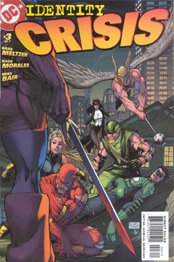
THE JUSTICE LEAGUE versus DEATHSTROKE
Where: Identity Crisis #3 When: October 2004
Writer: Brad Meltzer Artist: Rags Morales

The story so far...
Sue Dibny has been murdered, and this single death is sending shockwaves that touch each and every hero in the DC Universe.

With the most analytical and tuned heroes turning up no evidence, and a hyper technological security system showing no signs of forced entry, most of the League begin investigating the obvious suspects; teleporters, magicians, shape shifters, but one group has a different theory.

This is the event that changed the playing field, making it clear that the innocence of the past was nothing but a sham. These select few go in search of Dr. Light, a now-bumbling villain that had found his way to the Justice League satellite and raped Dibny years earlier.

Revealing their dark past, Green Arrow admits that the League had used Zatanna's magic to erase portions of the villain's minds pertaining to the secret identities of the heroes. The heroes did only what they needed to, until Dr. Light, when they crossed the line, and altered his personality forever.

Tale of the tape...
Deathstroke is really quite a scary villain for a lot of reasons, one of those being that controlling 90% of his brain function makes him pretty difficult to define. I'm not sure anyone could tell me exactly what potential 90% brain function would unlock. As it is, it just seems to make him an incredible tactician and fighter, which I guess means he's more in tune with his body and mind.

Intelligence: 4 (Tactician)
Fighting Ability: 7 (Born fighter)

Deathstroke is officially the first character to rank a seven on the Haseloff system for fighting ability. This is purely based on the determination of the advantage of his brain power, which is poorly reflected by his intelligence rating.
Though perhaps vaguely ill-defined, Deathstroke's powers must be recognised as making him an extremely impressive foe.

This particular arrangement of the Justice League roughly consists of; Hawkman, Green Arrow, the Flash, Black Canary, Atom, Green Lantern, Zatanna and Elongated Man. Not the most impressive line-up we've seen of the JL, but without a doubt still a competent mix of seasoned veterans, and incredible powers.

Even on his best day, one has to question the odds for Deathstroke to defeat that collection of heroes. The sheer strength of numbers tends to lend itself to someone getting the jump on him, while he tries to eliminate them.

This is an opinion, of course, that has particular relevence for the way they fight is choreographed.

What went down...

This really is the ultimate in fights as far as breaking it down for this particular section. It's so easily disected into neat little pieces that I can literally deliver a beat by beat account of what occured, without missing a pip. Of course, this approach is also one of the most glaring criticisms.

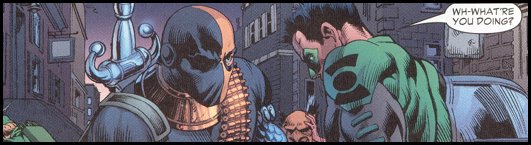
Having already taken care of Elongated Man at the end of the previous issue, Deathstroke is pretty keen to make sure everyone understands it is his fight, as per the terms of his agreement with Dr. Light. Terms involving a hefty sum of money.

The Flash, quite naturally, is the first to act.
Deathstroke's 90% function doesn't outdo Batman in the anticipation department, but it's still impressive. He sets off a series of C-5 plastique charges infront of him, prompting Flash to attack from behind. Of course, this move leaves Flash skewered on Deathstroke's rather ample sword.

Attacking the next biggest perceived threat, Deathstroke goes straight for Zatanna, tapping her liver with a well placed shot, drowning her reversed incantations in vomit. Not terribly pretty, but damn effective.

Hawkman and his long-range threat is the next targeted, and naturally Hawkman meets it with a suitable amount of controlled aggression. Apparently he was ready to fight, but not ready to have his wing harness cut from his chest.

Why Hawkman wouldn't be ready for such an attack, absolutely baffles, and this is no doubt where the fight starts to break down.

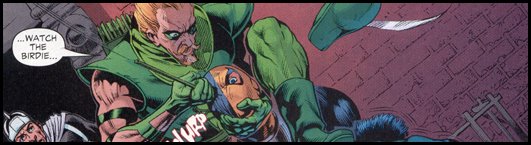
Continuing down the line, he flows into an attack against Green Arrow, with bow cocked the entire time, as he tracks his high speed target. Deathstroke's greater reflexes allow him to swat the incoming arrow away, before taking a swing at the archer himself. As Green Arrow ducks the swing, he realises that the projected target was the tails of his arrows.
As the feathers fly, Green Arrow's stock in the fight plummets, his arrows now rendered relatively useless. (Or are they?)

Black Canary prepares to unleash a sonic scream, but Deathstroke is a man who thinks of everything, coming prepared with an airtight rubber mask. He bags the Canary's head, tying it tight around the neck, and cuffs her arms behind her back for good measure.

With the backstory of Dr. Light's rape on Sue Dibney, there's actually a very disturbing potential to this panel, where he is seen lurking in the background, with Canary's bikini-fishnet clad buttocks taking precedence in the foreground.
I've read that the themes of interpreted misogynism caused a minor outcry from fans, but I think finding an objectification of women in comics is both dramatically late, and in this case, perhaps a little faceitous.

On with the fight, Deathstroke scans the battlefield for the Atom, who I must say has the nifty trick of getting forgotten. If I were the opponent to the Justice League reading this issue, I would have the little bugger bouncing around in my eardrum by now.

Again, that incredible capacity for anticipation and execution is on display, as Slade anticipates Atom's microscopic attack, and using his advanced vision blasts him with electrons and protons in a beam of a laser pointer's light.
The Atom 're-bigulates' just in time to knock Hawkman right between the eyes, as he was rising to his feet after his previous fall.

By now, there's a very real argument that it's been far too easy to take each JLer one by one. No matter how fast Deathstroke's reflexes are, and how advanced his planning, it's tough to believe the Green Lantern could have been standing idle for this long.
Granted, Kyle Rayner doesn't have the experience of the other heroes, but he's no kid anymore.

Slade locks up with Rayner, who foolishly decides it's suddenly a good idea to become a fist fighter, and gets four broken fingers for his trouble.

One assumes ninety percent brain function must give Deathstroke a pretty impressive will power, as he grips the broken hand and tries to wrestle control of the Green Lantern's ring away from him.
Of course, on previous occasions Rayner's ring has been shown to only respond to himself, and a select few of his fellows, but the injuries sustained, and Deathstroke's incredible willpower make for a feasible argument for the deadlock.
Green Arrow attempts to make some of his own luck, and shows that he's more than a one-trick pony. With his arrows no longer viable projectiles, ol' Ollie goes the low tech approach, and stabs Deathstroke in the eye.

Sent into a murderous rage, Deathstroke loses his cool, calculating advantage, intent simply on killing Green Arrow. Let's face it, with that goatee, and pathetic disguise, it's a place we've all been.

Getting the snot beat out of him long enough to let League pull themselve's together, Green Arrow buys the time necessary for the heroes to finally make a joint attack. They each grab a limb, and wrestle for it. Of course, this scene prompts a flashback for the previously mindwiped Dr. Light, where he recalls a similar instance involving himself.

The mind wiped villain has something of a meltdown, bursting into a blazing light of rage.
When the heroes come-to, they're on their arses, infront of Superman no less. Faux pas!

The Hammer...
When I first gauged potential interest in some of the greatest fights in comics of all time, this was actually the fight mentioned the most. Hopefully the few reading this website will be pleased that it made the list promptly.

As mentioned earlier, my biggest criticism would have to undoubtedly be the delivery of the fight, which suggests that no Justice League hero was able to intervene during the systematic elimination of member after member. Perhaps the toughest pill to swallow is the fact that Green Lantern, a hero who quite regularly scoops villains up in bubbles, could be left as an oversight until the very end. The neglect shown is only further exasperated by the decision to have Green Lantern, posessor of anything he can imagine, enter into a fistfight with a quite obviously dangerous threat.

Maybe the ball falls on Morales, whose art seems shakey in places, or maybe Meltzer isn't the world's greatest fight writer. Hey, they can't all be Mark Millars.

As far as calling the fight, I'd have to say I think this result was inconclusive.
Deathstroke definitely had the battle in his hand, but Green Arrow did enough to redeem the Justice League, and snatch victory from the jaws of defeat.
In light of that, I'm going to have to call this the first draw.

If you have any dispute, feel free to drop a comment.
Stay tuned next week for a showdown of blockbusting proportions, not Christmas themed, but truly a gift worthy of the holidays. Until then, some stats. Ciao!

The Fight: 6.5 The Issue: 5.5 [July 17, 2006]

Stats:
Deathstroke - Severe injury inflicted by sword. (The Flash)
Deathstroke - Critical pressure point blow. (Zatanna)
Deathstroke - Subdued with bag and cuffs. (Black Canary)
Deathstroke - Critical blow with laser pointer. (Atom)
Deathstroke - Severe injury; four broken fingers. (Green Lantern)
Green Arrow - Severe injury; stabbed eye with arrow. (Deathstroke)
Dr. Light - Present, but did absolutely nothing but watch.