Showing posts with label Ultimate Marvel. Show all posts

Saturday, January 07, 2023

SPIDER-MAN versus OMEGA RED
(Marvel)
Where:
Ultimate Comics Spider-Man #7 When: April 2012 Why: Brian Michael Bendis How: Chris Samnee

The Story So Far...
Miles Morales' life was changed forever when a secret visit puts him in the path of a genetically enhanced spider accidentally collected when his uncle robbed disgraced corporation Osborn Industries.

For a second time the Oz Formula transfers the physiology of a spider unto a young man! Miles gains incredible super-human abilities, but desires only normalcy, leaving the heroics to the web-slinging Spider-Man -- until his untimely demise!

Burdened by his decision to not help Peter Parker -- Miles adopts the dead boy's creed of great power bringing great responsibility. Thus, when an explosion abruptly ends a test of his skills, Miles boldly rushes to the source of danger!

Tale of the Tape...
Strength: Omega Red 5 (Super-Human)
Intelligence: Omega Red 4 (Tactician)
Speed: Spider-Man 4 (Olympian)
Stamina: Omega Red 6 (Generator)
Agility: Spider-Man 5 (Cat-Like)
Fighting: Omega Red 4 (Training)
Energy: Spider-Man 3 (Explosives)
Total: Draw 25 (Champion)

Miles Morales isn't your father's Spider-Man -- and that means more than just his taste in super-hero fashion!

Similar to Peter Parker; the Oz-enhanced spider bite grants Miles super-human strength, speed, stamina, agility, ability to cling to walls, and an uncanny danger-warning spider-sense -- but that's not all!

He also develops the power to discharge bio-electricity as "Venom Blasts" for a variety of offensive and defensive uses, and spider-camouflage that allows him to blend in with his surroundings -- appearing almost invisible!

These extra skills come in handy for a rookie Spider-Man who lacks Peter Parker's know-how for constructing web-shooters, which he eventually received as a gift from May Parker, but will use inconsistently, developing instead organic electro-static webs as an extension of his Venom Blasts.

Miles Morales started out as a creation of the Ultimate Marvel Universe, which means he's inherited the enemies of "Ultimate Spider-Man", including an original take on the villainous Omega Red.

The Ultimate universe version of Arkady Rossovich underwent experimentation while in a Russian prison, but lacking the Soviet ambitions of the original, took to using his mutant tendrils and toxin-emissions as a human-hating mercenary.

He developed an arch-rivalry with Spider-Man and J Jonah Jameson when bad press after an impromptu defeat cost him work. Not knowing that a change in colour scheme means a different wall-crawler, he transfers his hatred to a brand-new wise-cracking Spidey.

This Omega Red isn't nearly as terrifying as the classic who's fought Wolverine across multiple mediums, but will still pose a significant challenge for the rookie Spider-Man. How did it all go down? Let's take a look!

The Tape: Draw Ranking: Omega Red (#976)

What Went Down...
The new Spider-Man jumps from an apartment building balcony and bounds across the rooftops, nimbly leaping and springing his way towards the source of a plume of smoke rising from the heart of the city.

Descending to the wreckage of a crumbled building, he wonders if it might be the work of terrorists. A strange buzzing in his head alerts his senses to a car tossed in his general direction -- the work of the super-mercenary Omega Red!


The budding hero turns tail to stay clear as Omega Red springs into action against a Spider-Man he believes to be his old nemesis.

Mutant tendrils whip violently along the new Spidey's path, forcing the young wallcrawler to leap clear as they smash through chunks of bedrock.

Spider-Man's arc takes him gracefully over Omega Red's head -- landing to deliver a straight kick with a slightly less than satisfactory quip.


The blow sends Omega Red flying across the battlefield into a pile of rubble, but the real pain he's feeling is in his cheque book.

The delay of a grudge bout is threatening to cost the mercenary money, but when he surveys the area, he's surprised to find no sign of his would-be adversary.

He wonders for a moment if the Spider-Man has actually run away -- only to be caught completely by surprise by a sudden charging uppercut!


A joke about wearing the same outfit inadvertently convinces the madman that it is indeed the same Spider-Man who foiled his efforts before. An uncanny moment of synchronicity between the aspiring hero and his inspirational predecessor.

Omega Red wraps his tendrils around a stunned Spidey and flings him into the air!
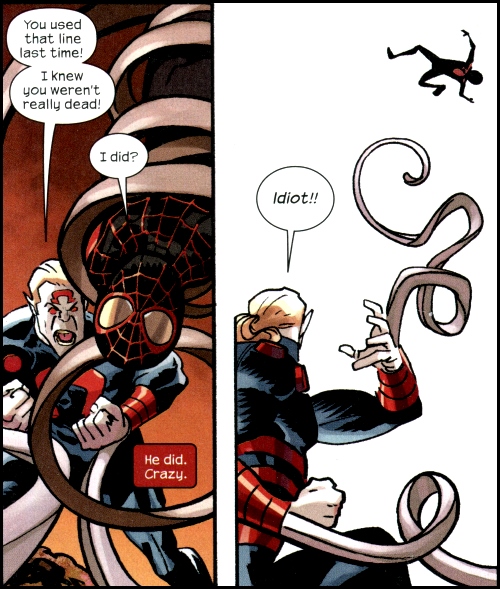

The all-new Spider-Man comes crashing down hard onto a limousine!

Omega Red remains in hot pursuit of the airborne spider, charging ahead with his tendrils reaching with intent to rip the vehicle and Spider-Man into four equal pieces!

The Spider manages to roll clear and evade detection once more -- catching the searching Omega Red with an electrically charged venom blast!


The mercenary's arms go stiff as the bio-electric charge surges through his body.

Omega Red drops unconscious to the floor. Spider-Man victorious!

The Hammer...
Just like that we welcome Miles Morales to the fight club rankings!

With return appearances in feature film and video games fast approaching, it was getting pretty difficult to ignore the secondary Spider-Man. Is that to say the last decade has been a deliberate snub? Well, it's not quite so black & white...

When Marvel first revealed plans to reinvent their classic icons for the new millennium -- it seemed like an intriguing prospect. "Ultimate" was a provocative name for the imprint brand, but seemed justified by its potential to create a new universe with all the benefits of forty years of Marvel Age hindsight.

In theory it would be a deliberate and designed construction, featuring the very best of Marvel Comics, in lockstep with burgeoning cinematic adaptations that were having a major influence on the Ultimate Marvel approach. Little wonder then that they'd begin with Spider-Man and X-Men: multimedia jewels in the crown that were about to make the leap to live-action cinema.

Ultimate Spider-Man was a little bit bloated and familiar from the outset, but the advent of Ultimate X-Men in early 2001 confirmed a sharp new image, borrowing a la carte from classic and leather-bound theatrical reference points.

The Ultimate approach was an immediate sensation, hooking a generation of new readers with the proliferation of belief that it was somehow freed from the burden of continuity, and imbued with a contemporary sense of "reality". Lies inevitably unraveling as the success of series led to the accumulation of continuity, and the aging alternative struggled with relevancy and identity opposite classic mainline titles, and expanding cinematic incarnations.

Half a decade in and things were starting to get a little stale. The Ultimates made a mark with grim introspection, Bush-era politics, and rubber piping on costumes, but Ultimate Fantastic Four pushed core ideas a little too far from centre for most fans' liking. Ultimate Marvel wasn't living up to its fresh new take, or its cinematic trappings, awkwardly stuck between being something totally original, and the referential familiarity that had been part of its creation.

With events like Avengers Disassembled and Civil War kicking off a cycle of short-lived deaths in mainline titles; 2009's Ultimatum emerged with a similar game plan, and a promise of real causality from a blockbuster cleaning of the slate.

It was sloppy and weird, killing off a roster of characters as high-profile as Wolverine, but in doing so opened a door for Ultimate Marvel to be a universe of unique consequence and progress. In 2011, that axe was swung at the brand's record-breaking standard bearer, eliminating this world's Peter Parker with a view to installing a recently made contingency -- an all-new Spider-Man.

When Marvel revealed plans to reinvent their reinvention for a new decade -- it seemed like another intriguing prospect. A Marvel Universe where it would actually be beneficial to retire seasoned icons, creating a genuine future with new heroes and possibilities. In a strange way it kinda felt like Miles Morales was exactly what Ultimate Comics needed! A fresh, real point of difference!

Flash forward another ten years and I'm obviously less excited about a second Spider-Man running around the main Marvel Universe. I lived through the Spider-Clone years, and came out with a greater appreciation for Peter Parker as the one and only Spider-Man. Mainline Marvel doesn't need another Spider-Man. Or men. Or women. The "multiverse" is a fun aside, but as Ultimate Marvel kinda proved, it works best as a carefully managed pocket that doesn't impede on the "real" universe.

The "real" Marvel Universe was built by identifying what wasn't already there and creating new characters to fill those gaps. Miles Morales kinda does that, so it's hard to knock them, but it might be a more exciting sell if he wasn't positioned as a second-rate also-ran in a world of one of comics' most recognized icons.

I appreciate that Miles Morales has his points of difference. He wasn't created simply as a direct knock-off Spidey. The Oz-laced spider bite gave him new twists on spider-based powers. There are a lot of weird and wonderful spiders in the world, doing weird and wonderful things, and Miles' camouflage and bio-electric abilities expand upon some real-world reference points in fun ways.

Movie-inspired organic-webbing would've been an obvious way to go, but I kinda like these early issues of Ultimate Comics Spider-Man where he can't web-sling. It honors the web-shooters of Peter Parker, and just gives the new kid a gritty edge that's kinda neat. The wall-crawler's wall-crawler. At least until his bio-electric skills take off, and he learns to fly like ballooning spiders described in a 2018 article by The Atlantic. If only they had a cooler name he could take.

Ultimate Omega Red doesn't fare quite so well in the originality department. The Jim Lee design that launched thousands of action figure owning "fans" is severely downgraded for a streamlined version that lacks any real flavour or mystique. It doesn't suffer from the directionless redundancy of Ultimate Blade & Morbius, but squanders the potential just the same. If more thought were put into characters like this, maybe Ultimate Marvel would've had a shot at survival.

It's a new year and if you'd like to see more you can help the site survive by becoming a supporter on Patreon. Premium tiers let you play Editor-In-Chief, but all patrons will unlock extra updates as a thank you for backing the project!

Secret Wars on Infinite Earths has featured more than 700 battles and ranked well over 1,000 characters! You can find them all by diving into the Secret Archive for a complete index of features by publisher, series, and issue number, or by following links throughout this post to discover more from your favourite topics.

Get daily links to fights inspired by the topics of the day by subscribing to Twitter and Facebook, or by becoming a freebie follower on Patreon. Don't forget to smash that like, fave, and share -- and keep your eyes peeled for the week's top trending battles every Sunday on Twitter & Patreon!

Winner: Spider-Man
#353 (new) Spider-Man (Miles Morales)
#992 (-16) Omega Red

Monday, October 13, 2008

QUICKFIX: THING vs ZOMBIE HULK
Crossover: Part 3 of 3 (Marvel)
Where: Ultimate Fantastic Four #23 When: November 2005 Why: Mark Millar How: Greg Land

The Tape...
Strength: Draw 6 (Invincible)
Intelligence: Thing 3 (Straight A)
Speed: Hulk 3 (Athlete)
Stamina: Hulk 6 (Generator)
Agility: Draw 2 (Average)
Fighting: Hulk 6 (Warrior)
Energy: Draw 1 (None)

Math: Hulk Ranking: Hulk (#4)

The Fix...
If you missed last week's shipping list you might not know that Marvel have wheeled out their fifth iteration of the Marvel Zombies franchise! Zombies 3 brings the threat of undead extinction to the Marvel Universe (616) and follows the escapades of a breakaway group of interlopers pre-Zombies 2. No doubt we'll be looking later in the month at one of the stars of Zombies 3, as well as some of our own theories about the brand, but first -- what about the beginning?!

The premise is so simple it's amazing it didn't happen sooner!
Take the heroes and villains of a parallel Marvel Universe, introduce a threat that would tempt extinction upon them all, and observe the ensuing chaos!

Conventionally the zombie is one of the weakest creatures on the monster map. It's a mathematical terror theoretically dismissed with a simple course of quarantine, but so easily overlooked in a world of invisibility, mysticism, super-strength, and the physically intangible.
If a zombie were to walk solitary into the arena of the Infinite Wars he would surely be squashed in an instant, but in their first appearance, the Marvel Zombies ahered to the tried-and-true tradition of the mythic zombie horde.

With the horde expanding into it's own marketing juggernaut, you'd be forgiven for forgetting it all began in the pages of Ultimate Fantastic Four, under the watchful high-concept eye of Mark Millar.

The ambiguously titled "Crossover" played with fan expectations, using the sci-fi vein of the Ultimate title to tease only an interdimensional meeting between the young Reed Richards, and his older counterpart from a 'familiar' universe.
Five years after the inception of of the Ultimate line (Earth-1610), it seemed feasible that the two universes might finally overlap. Instead, fans were treated to a conceptual double-whammy that introduced both Earth-2149, and by extention, the Ultimate incarnation of the Frightful Four - the zombie FF!

Millar's Frighful quartet remained a lingering plot thread for an entire year, surviving twelve issues to embody the Ultimate imprint's ability to take traditional Marvel concepts, and completely reinvent them.
This nightmarish reflection on the title characters remains one of the most memorable pauses in the title's history, surpassing the more familiar (or misguided) reinventions that have populated the series before, and since.

The glaring negative would be the marketing frenzy that resulted from the expansion of the Marvel Zombies concept. A slew of zombie-themed variations on Marvel covers infected the entire brand, extending to a catalogue of issues completely removed. This farcical pandering to the collector's market will no doubt live in infamy as one of the shameful quirks of the decade, but for the Ultimate franchise, another cost was arguably incurred.

The mission statement for the Ultimate imprint has managed to shift and morph over the course of it's life, but it seems safe to say the brand's relevance has passed for the forseeable future. While Millar (and Land) are certainly not responsible for the brand's decline, their venture into alternate universes seemed to represent the type of complication the brand was designed to avoid.

Best described as a version of the Marvel Universe for the movie generation; stories like Crossover have kicked the doors down to conventional Marvel tropes. The contemporary chic of a subdued, modern reinvention platform seems to have been compromised to a point where even dedicated neophytes have been drawn away to the 'proper' Marvel Universe. A Marvel Universe where the convolusions associated with the medium have gravitas and justification.

While stories like Crossover have expanded the boundaries well beyond the content of a theatrical release to allude specifically to the "616," it's also been made increasingly evident that the Ultimate universe is no less immune to lasting change than the core brand. One wonders if it was simply an issue of availability (or promotional agenda) that saw concepts like these fall into the Ultimate offices, rather than the traditional alternative.

For the specifics of the issue, even the often maligned Greg "photo reference" Land deserves kudos. The artist successfully delivers on a script that plays with a lot of Marvel conventions, like the arrival of a zombified Hulk to clash with Thing.

Hulk's arrival (from the air) begins with a vague reflection in a broken skyscraper window as we follow the monster's descent from Mr. Fantastic's POV, enjoying an ominus obscuring of the Hulk through continued shadow, and movement.

The Hulk really is a monstrous character! The macabre qualities that inhabited Jack Kirby's original artwork gradually faded as the creature was refined into a more palatable superhero figure. Land does well here to play with that size, giving Hulk's landing a handheld cinematic quality that really hammers home how horrific a snarling, seven-foot, green behemoth would be!

This dramatic entrance feeds into a curtailed exchange between two classic comic book rivals! All it takes is a two-fisted uppercut from the FF's Thing to topple the zombified Hulk, punctuating a brief end to the zombie onset!

The quick fix doesn't appropriately reflect the focus Millar delivers in his script, which remains consistently trained on the important details enough to convey some delightfully subtle details (like; Mr. Fantastic's gradual stretch across the zombie-invested cityscape), despite the plot's grandiose scope!

The legacy of Marvel Zombies doesn't really represent the original.
While Zombies deserves credit for maintaining more of a plot than anyone could rightly have suspected, it doesn't feel quite as complete an arc as Crossover. The tone differs considerably, a little less tongue-in-cheek in it's self-awareness than the glorified meme of subsequent additions.

Please note; our references to compromises made in the Ultimate brand are really far too broad to rest on the shoulders of this story. It is, however, part of a larger story that is the Ultimate line.

Winner: Thing
The Fight: 4 The Issue: 5

Crossover and Marvel Zombies are both available collected in trade. By using purchase links provided on the site you help sponsor future entries in the Infinite Wars! Check out the online store for more great savings on titles reviewed previously on the site!

Thursday, November 08, 2007

QUICK FIX DOUBLE FEATURE: Daywalkers!
SPIDER-MAN versus BLADE
Morbius: Part 1 (Marvel)
Where: Ultimate Spider-man #95 When: July 2006
Why: Brian Michael Bendis How: Mark Bagley

Quick Fix...
Over the past two years the Infinite Wars have slipped behind schedule more than a couple of times, but quite often there seems to be some sense of serendipty, lining the unfortunate with a silvery sheen.

I don't know how fresh the news is, but I certainly wasn't privvy to the knowledge that Marvel pencilling sensation, Mark Bagley, will be departing to new pastures at DC!
Fitting because, here we are, predetermined to take a look at the reliable pencil work of just such a fellow!

Honestly, I wish it could be under better circumstances, because it's undeniable that Bagley has been among the most iconic Marvel pencillers to survive the shift out of the nineties. His work on Spider-man, a decade before "Ultimate" became a buzzword, made him an instant icon. Many fans instantly identify Bagley by his contributions to popular storylines like one of the first major arcs to transcend the medium on a mass scale, Maximum Carnage.

What initially attracted me to this Halloween hangover post was the opportunity to introduce one of my favourite midnight sons to the Infinite Wars - Morbius.
It was perhaps the most noted absence on the site in '05/'06, and it's to my chagrin, that we breach the character like this, in an Ultimate title. Generally the Infinite Wars aren't about slinging negative reviews, but certainly these two issues have sat like burning coals in the anti-Ultimate argument.

Before we get to slamming an entire universe (and Bendis...), we should steer it back to a topic that has had many-a comic fan scratching his head for the better part of the last ten years...

It was under the pen and direction of David Goyer and Stephen Norrington respectively, that the 1970's vampire hunter, Blade, was distilled to a stoic, sleek, modern snapshot of everything the character had the potential to be.
It drew upon influences that developed the character right through to the mid-nineties [ala; Ghost Rider #40], and formed the adult structure of a modern superhero film, capable of taking itself deadly serious.

With two movie sequels following, and a TV spin-off under his belt, Blade vastly exceded reasonable expectations, and surpassed his jive-talking beginnings.
However, despite mainstream success, Blade somehow fails to sustain himself as a leading character in the medium that gave his birth. Attempts to capitalize on buzz have been mediocre at best, with many simply lacking the promotion to even penetrate the comics reading consciousness.

It was while scanning cover art by break-out talent, Marko Djurdjevic, that I was inevitably drawn back into the mystery of the character's failures. With the exception of a design-influenced receding hairline, Djurdjevic's Blade attempts the hard sale, glistening on covers with rendered sheen, and leathery blacks that conjure up the stylish glory of that first film. Which easily points to the problem.

While this is fast becoming a double feature hate-fest, I simply cannot turn away from the glaringly obvious. This newest effort to utilize Blade was simply-put, dismal. Djurdjevic no doubt swayed the tempted, but it's those that can bitterly lament upon the distinct difference between cover and interior.
Artistic direction is quickly out the window as Chaykin's pencils defy the modern covers; instead delivering pumpkin flavoured latern jaws, and a Blade that lacks the stiff cool of early Wesley Snipes, looking more like an early-eighties Steve Harvey.

Of course, sure, Howard Chaykin is an acquired taste, but the blame shouldn't fall squarely on his shoulders. Editorial is one of the most vilified quotients of mainstream comics, but at their best they steer projects to an appropriate asthetic that is the difference between a sleeper hit, and this.

The increasing pull of Hollywood writers runs amok in the worst way here as Guggenheim is seemingly allowed to do as he pleases. Bucking against the ill-fated works that carried superficial inspiration from the first movie, Guggs takes Blade in an opposite direction, gleefully revelling in the naff of meaningless peril (a villainous vampire Spider-man), gawky retroactive continuity (Blade and Wolverine in ye olde west), and the downright stupid (gun-hand Blade).

It's a harsh report card for a series that felt doomed from it's inception.
At best, a more stylistic approach to visuals might have saved this project. At worst, it is as it is. In interviews, Chaykin embarassingly refers to research of fashions, and Guggenheim throws us a movie-villain who has long been deceased in the comics all in the name of a "final" confrontation. Ugh.

So, does Marvel's on-again/off-again golden boy do any better?

As typical of Ultimate Spider-man, Blade appears in the first five pages, in an action sequence that bares the barest justification of immediately indicating the tone and portion of this world we are entering. Otherwise, like so much of USM's battle scenes, it is disconnected action that at best fullfils much needed quotas for excitement and fisticuffs.

The man we spoke of at the beginning of this entry, [Mark Bagley], instantly proves the theory of stylistic justification. Complimented by motley colours by Richard Isanove, Bagley delivers an acceptable rendition of the leathcoated, sunglasses-at-night Blade made famous by comics, cartoons and cinema, alike.

Ianove projects through satisfactory inks, highlighting Spidey's light-grabbing reds as he drops out of the moonlit night sky. Free-falling to an alley below, his descent lands him atop a gun-toting Blade who pursues unnamed prey through the city. The uninformed Spidey has no way of knowing the dangers that lurk.

Spider-man checks on the terrified prey, whilst pinning Blade down with webbing, distancing him from his hi-tech pistols. The frightened runner is unreceptive, but Spidey's continued concerns soon earn him the man's fanged attentions!

As the vampire claws at Spider-man's mask with evil intentions, a silver katana cuts through the night air, and impales through the vampire's chest. Strong and confident, the vampire hunter rips his blade through his victim's body in an explosion of green mist and blazing light reminiscent of Hollywood effects.

Stepping through the ash-cloud, Blade grabs the young hero by the throat, and slams him against the alley wall.

Bringing the tip of his katana to hover menacingly infront of Spidey's mask, Blade delivers an uncompromising threat, promising to, "... eat your heart for breakfast!" should Spider-man interfere in his affairs ever again. Which, to-date, he hasn't.

Blade disappears into the night, leaving Spider-man gasping and wheezing. An act that neatly summarizes so much of what makes this another disappointment to come from the pages of Ultimate Spider-man.

The Blade films exemplify the very best of a dumb, but thoroughly worthwhile action sequence opener.
USM's stuttered meandering sometimes clears to boast spontaneously inconsequential confrontations between characters like Gladiator or Shocker that represent a characteristic play for verisimilitude [ala; Daredevil #75]. This, however, is a case of don't-ask/don't-tell; completely overlooking everything that could have made this an all-star appearance by a character as culturally significant as Blade.

This welcomed two-issue storyarc, like so many other USM arcs, promises a fantastic concept that sucks me right in, in this case the opportunity to explore a familiar vampiric section of the Spidey mythos. Alas, instead of a contemporary retelling and modification of this theory, it's a chance for Bendis to catch-up on other scripts, neglecting the Ultimate Spidey audience that has already proven itself to be sycophantic enough to swallow decades of reviewer ravings about so-called "realistic teen dialogue," that supposedly made this the must-read book of the early double-ohs.

The Fix: 3.5 The Issue: 3
Winner: Blade

Some say Bendis writes USM for the trade. I've read the floppies back to back, and the only benefit I can imagine from trade is timelines and an immediate distraction. Scores are salvaged by Bagley's art and the minutia, but this book reaffirms much of what has made me a growing critic of the book, now seemingly in recession for reasons shared.


SPIDER-MAN versus MORBIUS
Morbius: Part 2 (Marvel)
Where: Ultimate Spider-man #96 When: August 2006
Why: Brian Michael Bendis How: Mark Bagley

Quick Fix...
While on the attack, I might as well express my malevolent opinion that USM fans largely represent the outer fringe of confused and nervous comics fans, more concerned with peer approval than a solid read.

Right now those USM die-hards among you who haven't had the pleasure of reading my work are probably vehemently questioning my credentials to make these scathing claims -- and maliciously making an effort to avoid purchasing the first issue of The Kirby Martin Inquest.

It's the danger of wearing both hats, and while I hope the Infinite Wars can benefit my small press projects, I am ever-reluctant to allow those dreams to compromise the honesty of my opinions. Lord knows I have to do enough censoring when talking to would-be collaborators, and apparently reviewers, too.
If it makes you feel any better, I would love someone to be interested enough in my work to dedicate this wordcount to understanding, and even decrying it.

Of course, this double feature isn't about me.
Although, truth be told, it is about a fetishistic fandom of the character Morbius. Not to say I'm any kind of expert on the character. Actually, I despise much of what is regarded as Morbius iconography, particularly the giant, triangular red eyes, and matching red and blue outfit which is largely the basis of the Ultimate "revamp."

Yes, it once again we find ourselves at the garrish nineties, as I delight in champining the tattered purple cape and black leather evil-doctor's uniform that featured in that previously mentioned crossover -- Maximum Carnage! Not that that is where the love came from. Again, though not an expert, the attraction of the Midnight Sons is a curious and interesting one.

Morbius differs from Blade in that he is closer connected to the purist form of vampire. He, like the film version of Blade, shares the thirst, albeit to a far greater extent, and also suffers the sensitivities of his vampiric cousins.

In my [un-published] time dealing with vampires and zombies, I like to think of them both as categorizable by two overarcing types; scientific, and mystic.
The so-called "living vampire," Morbius represents in no subtle terms, an extreme version of the scientific vampire, literally the victim of his own experiments.

Though the character was almost inevitably dragged into occult variations, and enhancements and mutations at the hands of mystic elements; the scientific specifics of his origins have been the key defining quality in his history.
He is a character at odds with his nature, but unlike the film Blade, utterly responsible. It's a pathos that has allowed the character to intrinsically walk the line between dark hero, and villain.

Alas, in a universe where Dr. Doom was reshaped as a goat-legged gas breather from a New York think tank, who spent a few months building a jealous hatred for a rival years his junior -- Morbius remains among the most disappointing conversions of a character from traditional, to Ultimate variation.

Though appearing as a suitably sinister ally in Spider-man's struggle with decidedly mystic vampires (able to transform into mist and wolves); Morbius loses much of what makes him an interesting and unique character, retaining only the superficial - a red and blue skin stretched over a dull standard.

Lurking from the shadows to the hospital bed of Daily Bugle reporter, Ben Urich, Morbius makes his reappearance. Having suffered the bite of the vampire during his expose on this secret underworld, Urich is slowly succumbing to the occult disease that encourages hunger for blood.

Apparently hoping to aid Urich in his struggle, Morbius is set upon by the reporter's hidden protector, Spider-man! Bursting through the cheap cladding of the hospital ceiling, Spidey descends with a swinging kick, and follows it with a stiff right hat topples Morbius!

The advantage of surprise is quickly lost, and Morbius exerts vampiric strength that overcomes even the comparable strength of a spider! Despite their physical confrontation, Morbius is content to simply delay Spider-man's attacks.

In a vaguely ironic twist, Morbius reveals much of himself in an effort to earn Spider-man's trusts. He tells of his life's history, revealing his origins as the son of the first vampire - Dracul! In this respect, Morbius holds an obscure relation to the Walachian descended Victor Van Damme, aka Ultimate Dr. Doom!

With his fangs leering out of his gaped mouth, Morbius leans over the delirious Urich, only to again incur the the physical defensive of the Spider-man.
With time of the essence, Morbius wastes no time freeing himself of Spidey's kung-fu bearhug, sending him hurtling through the hospital wall.

Just then, the lights go out in the hospital, and the corridor fills with an eerie mist that ushers the entrance of three demonic vampires. Their stare freezes Spider-man's apt muscles, leaving him easy prey to the animalistic swarm.
Making this a double within a double, Morbius smashes his way through the hospital room door to come to the aid of the youngster.

With superhuman precision Morbius swiftly stakes the three vampires, moving close quarters and projectile with his wooden weapons. As Parker babbles like the child he is about having been "killed", Morbius again leans over a vampire bite, sinking his own fangs into Spidey's neck.

He is able to taste the tainted blood altered by the bite of a genetically engineered Spider. Much like Urich, having been bitted by Morbius before the commotion, Peter Parker is assured safety. Showing off his handiwork, Morbius shows signs of fatigue, and disappears in a burst of mist before delivering a similar parting to Blade, "And if we ever bump into each other again... Let's both pray that you've grown the $%#@ up!"

As if to attack Bendis' so-called strengths, Morbius' dialogue, though funny for a conclusion, is indicative of one end of an awkward characterization. Dialogue typically reads along the lines of an awkward statesman, but lacks seniority, or convincing competence. He sounds less European, and more like a character lost for words, which is not what I would imagine of any interpretation of Morbius.
Then again, at the risk of sounding underhanded, no one has ever accused Bendis of writing a terrific smart person.

I really want to at least cast a positive light on the fact that good sense was applied to restrict this to a two-issue arc. As is, I can at least derive some enjoyment from this as a disposable piece of fun. Though Morbius is utterly malformed for no fantastic reason, the broad disappointment is the total inconsequentiality of the entire story. Though peppered within are B-story plot elements concerning Parker's relationship with X-Woman, Kitty Pryde, the bulk of the subject matter here is of no interest.

I would've loved to have seen a six-issue arc that placed a real weight on Blade and Morbius, but alas, that wasn't to be, and may have ultimately been familiar to the point of further emphasising the redundancy of the Ultimate universe.
It should be said that Bendis can write, and he can even write paced, very well, and I fully acknowledge this. It just seems USM fails to deliver in the same way Daredevil has -- and lord knows I've nibbled at the title enough to know!

Bagley is a treat, and I thoroughly look forward to what comes of his work at DC. With a hint of tongue in the cheek, Bagley has often been referenced as getting sick of working with Spider-man. It was earlier this year that Stuart Immonen graduated up to pencilling chores as Bagley exited with a writer/artist record for consecutive issues that cracked previous holders, Lee and Kirby on FF.

I honestly struggle to imagine what Bagley will draw for the company. Flash, perhaps for nothing more than a vague similarity to the physically kinetic Spidey, is one character that comes to mind. If I had a suggestion, it might be a 52-esque weekly series that covers a variety of characters sufficient to ease readers into a Bagley-drawn DCU.

The Fix: 4 The Issue: 3
Winner: Morbius

A rare Infinite Wars double-stat, handing Morbius victories for beating Spidey AND the vampires, with a web-slinging assist for the latter. I would also say it's rare we have such negatively strong opinions about a book, and hope readers can walk away interested and contemplative, rather than offended.

Monday, October 08, 2007

FANTASTIC FOUR versus DR. DOOM
Doom: Part 6 (Marvel comics)
Where: Ultimate Fantastic Four #12 When: December 2004 Why: Warren Ellis How: Stuart Immonen

The story so far...
Selected for a government funded think-tank, child prodigy Reed Richards is united with some of the most brilliant young minds in the United States. Forming a friendship with project director Storm's children, Susan and Johnny, the underpinnings of the Fantastic Four are born.

Experimenting with his theories of teleportation, the young Reed Richards prepares an attempt to teleport an apple, not knowing of the unsolicited intervention of his stubborn Latverian rival, Victor Van Damme, who is under the belief Richards' calculations require slight correction.

 The change results in an unexpected trip through the mysterious sub-dimension of the N-Zone, which leaves the quintet, including Richards' high-school buddy Ben Grimm, mutated in five individual ways. Spiteful, Van Damme uses his new found powers to pursue a hidden agenda of world domination, purveyed by a secret European organization, and begins by leading his tiny home nation to prosperity as the villainous Dr. Doom.

Previous Form:
Fantastic Four [#2]: Nearly unbeatable as a team, their only recorded loss coming from a future without Mr. Fantastic, against a transformed Death's Head II.
Dr. Doom (#118): The subject of Mondays in October, he suffered a quick fix defeat in the Monthly Punch-Up, facing up against Thor, norse god of thunder.

Tale of the tape...
Strength: Thing 6 (Invincible)
Intelligence: Mr. Fantastic 6 (Genius)
Speed: Human Torch 3 (Athlete)
Stamina: Dr. Doom 6 (Generator)
Agility: Mr. Fantastic 6 (Rubber)
Fighting Ability: Invisible Woman 4 (Trained Fighter)
Energy Powers: Human Torch 7 (Solar Power)

- The Fantastic Four possess much the same abilities in the Ultimate series as their standardized predecessors. Mr. Fantastic becomes an elasticated super-morph; Susan Storm gains the ability of pseudo-kinesis and invisibility; Johnny Storm becomes a man on fire as the Human Torch; and Ben Grimm's bulk is turned to stone, making him the man-mountain called the Thing.

- Their think-tank origins redefine the members of the Fantastic Four as all having particularly keen intellects, with the exception of Ben Grimm, who loses his career as a test pilot and completed college education.

- Dr. Doom undergoes the most dramatic transformation, his armored visage now organic in nature, and part of his body. Likewise, his physiology is initially altered to give him hooves instead of feet, spiney projectiles at his fists, and toxic organs, giving him the ability to breath noxious gas.

- As with the traditional Doom, Victor Van Damme eventually comes into possession of various magics through exploration into Atlantis, and also plunders advanced technologies, adding to his own considerable arsenal of invention.

The Math: Dr. Doom (Average) Fantastic Four (Total) The Pick: Fantastic Four

What went down...
Having crash landed in Latveria and already faced Van Damme's wrath, Reed Richards stands alone amidst the rubble of Latverian squabble.

Doom, arrogantly assuming Richards to be powerless, lordes his mutation as a gift from the cosmos that recognised his destiny for greatness. Richards heckles Van Damme's notions of a warrior's upbringing, referring to his monarch father's disdain. The quip finds a soft spot on the armored Doom, who charges at the young Richards with a berzerker snarl.

Mr. Fantastic reveals himself to his deranged rival, entangling him in the elasticated contortion of his rubber body.

Wrapped around Doom like a viper, Richards snags one of his goat-like legs and hurls him across the battlefield.

Doom screeches to a halt as his metallic body leaves a path of sparks along the stone of the Latverian cobble street. He lets loose a familiar growl of his rival's surname, bitterly denying demands for the faulty input that changed them each.

Continuing to flaunt his inflated ego, Doom verbally spits in Mr. Fantastic's face, declaring himself something magnificent, while Richards is but a rubber-bodied freak.

A focused burst of flame rains down upon the defiant Doom, heading his metallic body to smouldering. Richards orders his fellow, the Human Torch, to keep his super-heated assault to a minimum.

The Invisible Woman looks to get a little bit for herself aswell, encasing Doom's head in an invisible force field as reprieve for his previous death-breath indescretions.

Doom brings his taloned fingers to the field, clawing desperately enough to send a reverberation back to Invisible Woman herself. Struggling under the strain, she calls upon the aid of the strongman of the Fantastic Four -- the Thing!

A hapless victim in the transformation process, it is Thing who perhaps has the most malice to bare against Doom, trapped in an unfeeling body of stone and rock.

Coming to Susan's aid, Thing snatches Doom in the palm of his giant rocky hand, and brings him crashing down with force, smooshed into the ground.

"I only met you like twice. And I hate you already."

Just then an alarm triggered by electromagnetic activity sounds on Mr. Fantastic's wrist gauntlet.

Set-up to detect wireless control of robots, Richards quickly realises the threat is much less disposable.

Rising from his crater in the street, Doom again professes his power as a king, revealing his 'loyal' subjects, each equipped with a nano-tech tattoo of a dragon on their necks, that bites deep to take control of them.

Doom rises to an endless echo of approval. Like a herd of zombies, the Latverian people all gladly pledge their love for Victor Van Damme, willing to kill the Fantastic Four for defying him.

Surrounded by innocent pawns in Doom's game, the Fantastic Four struggle to combat the rampaging hordes without causing them harm. Richards, knowledgable in Van Damme's techniques, asks his team to buy time to negate the mind-controlling influences of Doctor Doom's technology.

The Thing barrels his way through the crowd, while Human Torch offers threats of flame. New to his powers, and perhaps underestimating of the crowd's mindless bloodlust, the Torch ignites some of the citizens by accident.

The Invisible Woman throws up a forcefield to protect the beseiged team, while Richards works on a solution to the problem. The strain eventually proves too great for the youngster and her new powers, the attacking mob pushing her to unconsciousness.

With Dr. Doom violently reciting the chain of Latverian royalty, the Fantastic Four find themselves overcome by the controlled mobs until -- shots fire from the sky and the sound of choppers washes over the small Latverian square.

The US military fires without the concern of the heroic FF, killing the controlled, much to Doom's distain. Troops emerge from the copters revealing orders to bring Van Damme into custody, but before the situation can escalate, Danish tanks roll into the square, ordering the US to pull out of their witch hunt.

Believing he has had the last laugh, Doom is shocked when he belt explodes, signifying the success of Richards' intentions to end his radio control over the human shield of Latverian peasants. Finding solace in the control of the data that could reverse the FF's mutations, Doom provokes a final assault.

Spotting one of Doom's own spikey projectiles in the sand, Richards snatches it up and whips his elastic arm to Doom. The metal of Doom's own make-up proves capable of slicing his face in a way that prevents it immediately healing.

Doom is left alone with his curse, defeated but free to fight another day.

The hammer... With a little help from the murderous US military, the Fantastic Four walk away with the win on points, if not decisive result!

As with any capialist business venture, you're always going to have much better odds of introducing new elements of change to a system if you've got some previous success. The contemporary comics industry couldn't be truer, with submissions at the major two comics companies all but shut off. In that respect, the Image concept closed one door while opening another.

Those not familiar with the second Ultimate Fantastic Four storyarc might recognise the team of Warren Ellis and Stuart Immonen from their geek-chic revamp maxi-series that followed; Nextwave: Agents of HATE.

Even big name writers and artists have roadblocks like editorial and marketing to contend with, and given the departure of Nextwave, I'd like to hazard a guess that UFF comes out of Ellis and Immonen earning a little bit of credibility (and cash) at Marvel Comics, because it certainly reads like that.

When you talk about the contemporary sci-fi setting of UFF and put Warren Ellis' name next to it, the imagination can go wild. One starts to imagine all manner of tech-savvy science fiction, and far-out distortions of what's become expected in a Fantastic Four comic. Alas; this portion of Ellis' Ultimate work tends to read much more like a mean-spirited Adventures title, putting very little into the single issue in favour of a very light superhero read. Immonen's pencils, fantastic as they are, add to this quality that far better serves a stylistic, tongue-in-cheek superhero romp like Nextwave, than what you'd expect from FF.

Not that Ellis and Immonen didn't have some obstacles working against them.

The Ultimate revamp saw to distance itself admirably from the original Four, but at the cost of many of the things considered great about the Fantastic Four.

Included in the origin to the point of being responsible for their creation, the goat-legged transformed Dr. Doom bares only superficial resemblance to what many regard as the greatest villain in comics history. His visage aside, this Doom possesses much less of the redeeming qualities of the familiar character, making him a much simpler, overtly evil opponent.

Likewise, as Dr. Doom loses a degree of pathos, so too do the Fantastic Four.

Doom's intervention in the experiment that resulted in their creation strips Reed Richards of the responsibility that made him the target of Ben Grimm's aggressions many times through history. Depression over his condition remains in the Grimm character, but without the justified internal conflict of both he, and his dear friend Richards, who constantly fails to turn his super science to reversing the effects of the cosmic radiation.

Likely due to the chagrin of many fans, Doom has since taken on a much more familiar appearance, and Mark Millar's return to the title included a story dedicated to preventing the accident to save Ben Grimm mental anguish, delivered without concern for the stripped weight of the story's drama in this world.

Which brings us to a much needed positive. It certainly isn't all bad!

Though not quite as mature and considered as Ultimate X-Men and The Ultimates, UFF found a solid run with Millar's solo return. A steady contrast to his creating collaboration with Brian "Convert for the gags*" Bendis, who wrote trademark meandering scripts based on Millar's conceptuals.

Millar not only redefined the UFF on terms more familiar to what made the original so legendary, but he also managed to expand on the mythos of the Ultimate Skrulls, and left an undying legacy of the Marvel Zombies. Granted, that last part might actually be a negative, given the nauseating over exposure of the Marvel Zombies brand since expanding out of the UFF storyarc. Look for a slew of irrelevant zombie variant covers on major Marvel titles through October. Oh, to turn against hallowe'en.

That's probably all the hating we have time for today, but join us next week as we continue a full month of DOOM in the name of the Marvel Ultimate Alliance Mondays initiative. We promise not to excede the agreed designation of this theme, which will last only for the duration of October.

The Fight: 5 The Issue: 4.5

[Adding to the absurdly named Victor Van Damme's backstory, Ellis includes direct lineage from Vlad Tepes, the Wallachian king known for his love of impaling. Tepes is widely regarded as the inspiration for Bram Stoker's famous literary account of the vampire, Count Dracula.]

Wednesday, September 05, 2007

QUICK FIX DOUBLE FEATURE: Millarky in the US
HAWKEYE versus AXIS OF EVIL
The Axis Of Evil (Marvel)
Where: Ultimates 2 #10 When: March 2006
Why: Mark Millar How: Bryan Hitch

Quick Fix...
Credit where credit's due, sure, but if you're an avid follower of the Infinite Wars, you'll probably have sussed by now that I'm really more of a character, story and leg man. Sure, creative teams are a part of the equation, but for me, a comic doesn't live or die by a writer, artist, or sychophantic obsession.

Well, okay, that last part isn't true. Maybe you get an extra look in if you've got some solid Sub-Mariner or Super-Skrull action going on -- but even then, I'm not about to sell the house to fund my comics obsessions. (Venting!)

Still, given the nature of the medium and it's intent on milking anyone or anything for all they're worth, certain creators are recurring factors in mainstream superhero comics. Then you break it down to the common denomonator of our big action smackdown format, and you refine those commonalities down to this man -- Mark "Yarrrrrrrrr!" Millar.

These two fixes do not contain individual "name" characters doing combat, and yet, they have been among the most recommended entries for the Infinite Wars.
When you consider our current most popular battles are things like Thor/Captain Marvel, Hulk/Superman, and Batman/Superman, that's no mean feat!

So, what is it about Mark Millar that makes him so enduring?
Well, it might be something he's managed to do that even his British predecessors haven't, and that's truly indulge and revel in superheroes as a summer blockbuster opportunity to go all-out action and fun!

His brief, usually year-long runs on titles, provide those books with an exciting injection of energy, often complimented and well earned by the pencillers involved. Men like Bryan Hitch, Steve McNiven, Terry Dodson, John Romita Jr; they've all been featured in the Infinite Wars delivering solid, widescreen performances in each of their unique styles.

Here, Hitch delivers a Millar script that continues the hardcore military adventures of the Ultimates. Divided and set upon by evil variations, the Ultimates are taken apart from the inside-out by their allied Communist rivals.

Already taken hostage, the embattled Hawkeye finds himself strapped to a chair in a tiny interrogation room, where one of the victims of his tour in Croatia eagerly awaits the opportunity to extract a little payback for the brutal scarring he sustained at Clint Barton's hand. The soldier of the Axis of Evil taunts the helpless Ultimate with requisites that involve keeping him alive, and with one functioning eye -- a scenario that leaves plenty of latitude for their torturous desires.

Dragomir, the interrogating soldier, grabs at his throat with a gurgle, signifying a turn of fortunes in the tiny interrogation room. Though disarmed, restrained and injured, the mercenaries soon realise they have still underestimated the supremely trained marksman that is Clint "Hawkeye" Barton.

Awkwardly ripping the fingernails from his own hands, Hawkeye systematically takes apart the cell put together to hold him. He forces the weakest of the men to free him from his shackles, before learning of the certainty of Dragomir's involvement in the murder of his family. With that, Hawkeye snaps his neck.

Alerted to the development, more heavily armed soldiers are ordered to the tiny containment cell, where Hawkeye has already claimed no less than five scalps.

The soldiers charge in to take the US Ultimate soldier's back, finding him squatting unarmed beside one of the deceased's weapons.

Despite a considerable position of leverage held against him, Hawkeye coldly refers to the scared soldiers as idiots, somehow avoiding their fire in the contained space to mow them down with much the same ease exibited previously against their comrades.

The Ultimates remains one of the most enduring of the Ultimate titles, holding on to a vision that set it apart and justified this unique take on the characters featured. Hawkeye; seen here unleashing his far more broad skills as a marksman; finishes up with ten soldiers to his belt in a fashion one would never imagine the purple-garbed, wise cracking, Secret Avenger would use.

It's easy to see why this brief exchange between a costumeless character and ten relatively faceless drones was so revered. Allowed to push the boundaries beyond the norm, Millar writes an action scene that serves the story well.
His books are now almost universally late, and his layouts often quite liberal with the use of space, but it's always that singular fact that the story is served first that separates him from his much maligned 1990's Image-cut peers.

Presented with lavish splashes of inks and colours, these artists take full advantage of a story that doesn't necessarily contain nuanced layers, but benefits greatly from the attention to detail.

The Fix: 5 The Issue: 5.5
Winner: Hawkeye

[I read recently a quote from John Byrne, decrying those who would remove the gaudy, colourful costumes of superheroes. I can see where he's coming from, but the Ultimates is a prime example of how both sides of the coin can work. Not a particularly dense read, but as is often the case, Millar delivers exactly on what he promises!]

CAPTAIN AMERICA versus SHIELD
Civil War Part One of Seven (Marvel)
Where: Civil War #1 When: July 2006
Why: Mark Millar How: Steve McNiven

Quick Fix...
Gee, am I sensing a theme here?
So, in the last double feature [Longshots] we were kinda clutching with the whole 'both involve gunshots' tie, but I think we might have some fun with themes in the next few. Things broader than just a writer.

Not that there's anything wrong with "just" a writer.
Hey, I happen to think writers are pretty important. Gee whiz, have I mentioned? I have a comic book currently onsale, and you can pick it up online right now from Nite Lite Theatre by following info on the main page to ComixPress, super online distributors extraordinaire! (If a little bit slow. Patience is a virtue!)

So, we already used up a lot of the discussive material about Monsieur Millar and what makes him such a big ape in the world of crime-fighting comics writers.
Without dredging up unnecessary medical references, I'm directed the only logical course of action: Discussing Civil War.

Yes, you might be sick of it, but consider for a moment - the options!
We can talk more about the storyline that was (and could have been) Civil War, or I can make more obscure puns based on detective primates. The choice is yours!... [Pause]... You want chimp references, don't you?...

If you somehow missed out on the media frenzy surrounding Peter Parker's canonical reveal to the world press that he is, and since age fifteen has almost always been, Spider-man: congratulations! The real world coverage of that event [featured in the second issue of the Civil War mini-series] garnered as much press as the fictional story within the Marvel universe. That deserves a crikey!

If you pick up a Marvel comic today, you'll see the repercussions of the Civil War event, that not only tore the Marvel heroes apart, but also led up to such major tangents as, the death of Captain America [Captain America #25] and the formation of the Secret Avengers, whose operations remain seperate to the SHIELD sponsored team run by pro-registrant, Tony Stark aka Iron Man.

Ultimately tensions between registered and unregistered characters have settled down. Seasoned street-level veterans like Daredevil and Moon Knight have been granted amnesty from pursuit in a time where the majority of opposing heroes have already been registered, or incarcerated. For the most part, this is a world post-sensation, where the disaster that sparked the event - an explosive accident at a school - is a forgotten catalyst for world change.

Though described as something of a bullpen story, with notable contributions from then-DC exclusive writer, Jeph Loeb; Civil War is another example of Millar blurring the lines between militant, politically charged psuedo-realism, and openly indulgent, four-colour superhero action.

The fear-driven reactionism of the superhero registration movement, and the harsh measures afforded by the political atmosphere, all closely commentate on developments in our own security-obssessed world. Even so, essentially these reference points facilitate one of the biggest superhero smackdown clashes of recent years, following in the vein of classic superhero rifts presented in stories like; Secret Wars, Infinity War, and Infinity Crusade.

During this event of broad strokes, Captain America becomes the almost zealous representation of the free-rights movement. He staunchly supports those heroes that would wish to protect their identities for reasons of their own, beginning his crusade when first approached by Maria Hill aboard the SHIELD helicarrier.

Asked by the recently appointed commander to turn on his fellows, the Captain stands his ground, driven to distain by the implication of fighting those who have done so much good for their country.

Showing brazen opposition to the impending movement for registration, Captain America finds the SHIELD soldiers present willing to enforce their rule preemptively. With their guns drawn, Captain America is forced to make a decision then and there. Like he has so many times against assembled groups of AIM or Hydra agents, he explodes like a one-man army -- against his men.

Using both armoured-soldier and adamantium alloy to deflected the tranquilizers fired by the SHIELD agents, the Captain makes his stand for the rights of his fellows. With devestating precision he strikes, using shield, fist, and expert training to shatter protective helmets of would-be oppressors.

With the writing on the wall, Captain America has no choice but to make a break for the helicarrier external windows, charging shield-first through the glass.
Hill orders the immediate capture of the super-patriot as he defends against gunfire in mid-air, making an uncontrolled descent from the SHIELD aircraft.

A maneuvering bomber provides convenient salvation for the American icon.
Taking advantage of the lack of progression on the registration movement, he plays on the uncertainties of the pilot, ordering safe passage to the ground.
Once there, he will go into hiding, beginning the rebellion against the registration act that will tear the superhero community apart.

Before I segue neatly into our conclusion I must mention the stealth bomber surfing scene (following the above panel), which closely resembles what eventually turned up in the recent Die Hard 4.0, where John McClane [Bruce Willis] beautifully recreates the scene under his own conditions.

It isn't always the most popular opinion, but off the strength of performances like Unbreakable [a movie Mr. Millar just happens to tote as a favourite!], I find it hard to go past Willis for a big screen Captain America!

Sure, you've got your whippersnapper punks who want to see a pretty boy twenty-something, or a Brad Pitt in the role, and yeah, there's that argument.
I get that Cap is supposed to have been borne into the army at a tender age, and I get that the super-soldier serum has prevented him from aging, but damn it! It's characterization like this in Civil War that just highlights the grizzled and senior quality the character holds. Something only an actor of the calibre and familiar standing of Willis can pull-off.

I also, going back to his role in Unbreakable, like to think of the possibilities presented by the 'man lost in time' angle. Something that affords the character a very basic sense of humanity, that I believe Willis could convey beautifully.
Picture Willis -- in conservative slacks and shirt -- staring solemnly into the window of a store that, forty years ago, was his favourite place to buy novels.

A man who looks everywhere and sees not the sea adverts for iPods and Playstations, but rather the ghosts of what used to be there, and all the people and places he fought for. Things he knew he probably would have had to have given up even if he hadn't found himself frozen and thawed into a modern age.

So, that's about it for the double-feature.
You might have gathered that it's 'the new toy' and there'll be a handful of doubles coming up over the next month. I'm already chomping at the bit for the opportunity to weasel in some more diverse entries, and ranking statistics.

No doubt this isn't the last we'll see of Civil War, but for now, adieu!

The Fix: 5 The Issue: 5.5
Winner: Captain America

[Lasting repercussions have made Civil War one of the most memorable event comics to come from Marvel this decade. Though it resulted in a hefty hangover, particularly in light of a weak ending, it remains a positive mark on the Marvel map. Well worth further investigation now that it's finished, if you missed out!]