skip to main |
skip to sidebar
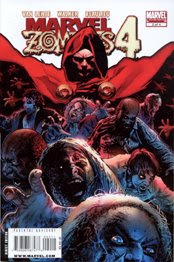
 Z-POOL versus MAN-THINGMarvel Zombies 4: Midnight Sons Part 3 (Marvel)
Where: Marvel Zombies 4 #3 When: August 2009
Why: Fred Van Lente How: Kev Walker
The Story So Far...
When zombie infected heroes from parallel Earth-2149 find their way through the Nexus of Realities hidden in the Florida Everglades, an unprepared group of C-list heroes assigned by the Fifty States Initiative find themselves under attack! Alternate universe monitors, ARMOR, succeed in preventing mass invasion from the parallel universe, but are forced to deploy a team to eradicate infected Men-Fish.
Having played a pivotal role in containing the threat and defeating the zombie invaders; Dr. Michael Morbius emerges as a new leading operative with ARMOR. He recruits traumatized survivor Jennifer Kale, along with familiar occult allies, Son of Satan and Werewolf by Night, into a new taskforce dubbed the Midnight Sons. The group succeed in destroying the Men-Fish, but fail to recognise the threat of "Z-Pool" (Zombie Deadpool's decapitated head) and Simon Dark, the latter of whom falls under the spell of Black Talon -- a voodoo mystic capable of enslaving the zombie.
Black Talon offers the interdimensional zombie plague as a weapon to Kingpin of Super-Villains, The Hood. Through a series of blunders on the island of Taino, the plague is unleashed through Black Talon's minions, ultimately mutating into a gaseous airborne form. With the plague spreading to remote populated areas, the Midnight Sons battle against the clock to contain the threat, or condemn the area to destruction by an ARMOR nuclear assault.
Jennifer Kale summons Man-Thing to pursue the threat, while Z-Pool develops a mild psychic link with the plague as it becomes rain and raises corpse pieces of super-powered Roxxon security agents to create a super-powered composite being. Thus, the monstrous Man-Thing fights for the fate of humanity!
Tale of the Tape...

 Strength: Man-Thing 5 (Superhuman)
Intelligence: Draw 2 (Average)
Speed: Man-Thing 2 (Average)
Stamina: Man-Thing 6 (Generator)
Agility: Man-Thing 2 (Average)
Fighting: Man-Thing 3 (Street Wise)
Energy: Man-Thing 2 (Projectile)
- The exact details of Wade Wilson's early life remain a mystery, perhaps even to him. During his adult life he became a mercenary who, upon learning he had developed cancer, gave up on his life to submit himself to experimentation with the top secret remnants of the Weapon X program. The project experimented with altering Wilson on a genetic level, attempting to treat him with a healing factor developed from the genome of former subject, Wolverine. However, Wilson's cancer interacted with the process in unforseen ways, reducing the effectiveness of his healing powers, and rendering him hideously disfigured.
Skilled in hand-to-hand and weapons based combat, Wilson becomes Deadpool.
In the alternate universe of Earth-2149, Deadpool is among the countless heroes and villains who are infected by a zombie plague. He crosses through the Nexus of Reality into Earth-616, where he engages members of The Command. He is sliced into a pieces by a skiff propeller during the fight, by Wundarr and Jennifer Kale, continuing life as a decapitated head. He is nicknamed Z-Pool.
 - Project Gladiator was an experiment to recreate the effects of the "Super-Soldier Serum" developed during the Second World War by assassinated German scientist, Dr. Abraham Erskine, and used to create Captain America.
Stationed in the Florida Everglades; a team of biochemists including Dr. Theodore Sallis work on Project Gladiator in secret in close proximity to agents of AIM. The science terrorist network infiltrate the project through Sallis, who defies protocol to sneak his wife into the base. Though Sallis was able to destroy his research, his escape was impeded when he injected himself with the serum, and crashed his vehicle into the neighbouring swamp. When he reemerged, it was as the marshy muck-monster, created by science and mysticism, called Man-Thing!
As Man-Thing; Sallis possesses a primitive mind rarely capable of recalling more than glimpses of the knowledge he held as a biochemist. He does possess an instinctive psychic empathy capable of sensing emotional disturbances. Via a secretion triggered by this shift, those who know fear burn at the Man-Thing's touch. The marshy composition of his form is also highly durable, capable of recovering from significant wounds and adapting significant malleability, while also producing form strong enough to deal superhuman strength.
Man-Thing also possesses mystic sensitivities and serves as the guardian of the Nexus of Reality -- an interdimensional crossroads located deep within the swamps of the Florida Everglades from which he arose.
Math: Man-Thing Ranking: Z-Pool (#449)
What Went Down...
Carried by a zombie of a very different kind, the decapitated head of Deadpool spies the looming silhouette of Man-Thing as it stalks through a red rain of gore and infection. Man-Thing, though not immune to the effects of the rain, shows considerable resilience as he is replenished by mother nature so long as he remains connected to the Earth.
Z-Pool [and Simon] takes the weather with him, and upon encountering a team of super-human security guards for a Roxxon Blackridge resort, gains the means to fight back against his stalker. The rain devours the guards, only to reassemble them as a composite revenant possessing their combined powers.
 Receiving psychic direction from Z-Pool, the creature unleashes a bolt of electricity, taken from Lightning Fist, that severs Man-Thing's right arm.
Wielding the toothed whip of Razor Wire, the revenant throws the jagged saw into Man-Thing's body, slicing down through the shoulder deep into it's torso.
Feeding from the Earth, Man-Thing reconstructs it's vegetative limb and swings it with superhuman strength at the patchwork revenant!
 The blow sends the creature hurtling into a nearby resort light, snapping the post with the impact. Gaining strength from the limbs of Ogre, the revenant creature proves strong enough to wield the lamp post as a weapon, which it again uses to bisect Man-Thing's form!
The swamp monster snaps the post and heals around the impalement, fighting on with a wild slash to the revenant's race. It is then, however, that the zombie creature makes a horrific deduction. Gaining understanding through the rain, the revenant clutches at the snapped-off post protruding from Man-Thing's chest, and denies him his connection with the Earth!

 Robbed of the replenishment of nature, the Man-Thing begins to wilt in the rain, and gradually, he succumbs to decay as the burning zombie rain destroys his form completely. Held skyward by the composite revenant, Man-Thing dies.
The Hammer...
Infinite Wars stat counters will appreciate that it's incredibly difficult to make a call on exactly who or what gained victory in this exchange. For the implication that it was he pulling the strings, I'm going to make the easy call and say it was Z-Pool, but there's an argument the Marvel Zombies plague (as rain) has gained a degree of sentience. It should also be reiterated that the revenant was created from characters called Razor Wire, Lightning Fist, and Ogre.
 After skipping MZ3, it's become apparent to me that Fred Van Lente has really been a revelation as writer of these series. We've documented in the past the origins of the high concept as a Mark Millar UFF storyarc [Crossover], and it's devolution as a thinly developed mini-series under Robert Kirkman, and a well beaten dead horse for marketting gimmicks like line-wide gimmick covers.
Even with those historic shortcomings; Marvel Zombies 4 has managed to rise above the past to be one of the very best Marvel comics published in 2009!
By utilizing a cast once popular, but now overlooked Marvel characters, Van Lente has transformed the brand into something slightly more conventional, but much more realised in it's design as a superhero-horror comic. With MZ4 in particular, he's drawn from the horror comic boom of the seventies, to create a grounding of character in the story that recalls that time period and embellishes it.
[Mark] Millar's original creation of the zombie heroes of Earth-2149, (in Ultimate Fantastic Four), played extensively with horror elements which Van Lente appears to have bifurcated between MZ3 and MZ4. The latter contains the conventional zombie horror of visualized gore and unsettling images of disfigured humans, while MZ3 inherently plays with the psychological horror of mistrust in characters who might not be themselves. This appears in MZ3 through the plot of Z-Morbius posing as our Morbius, but also through the threat of infection, ala; Jennifer Kale's turning teammates, and even Jack Russel in the cliffhanger for MZ4 [#3].
Of course, in developing the depth of plot further, Van Lente runs afoul some of the difficulties posed by Kirkman's thinly considered backstory.
The chief difficulty stems from the issue of immunity. It's a vital part of Man-Thing's almost checklist-like appearance in this issue (as another seventies horror icon), but rubs awkwardly against the list of characters who've been established as turned in the past [see; Marvel Zombies Defense Strategum].
I'm happy to not think about it too much, particularly if we assume there was never any grand plan for Marvel Zombies to explode the way they have. It's a great concept and I can't blame Marvel for wanting to expand upon it! It's just a shame there couldn't have been a greater awareness at the beginning, to allow for a more thorough design of this weird and wonderful world of undead heroes.
Kev Walker deserves a lot of credit for realising this and every other issue!
Zombie clouds, zombie rain, and all the other wonderfully wacky things going on in this issue could've made for a visual nightmare, but he pulls it off superbly. There's a suitable rough edge, but as I've mentioned before, the treatment feels a little bit more superhero friendly than the previous series. I like that it isn't quite as heavy-handed with the darkness, and not nearly as motley looking.
There are so many threads up in the air that I'm really looking forward to the fourth issue! I anticipate what might come next for this collaboration of brand and creators, because they really do seem to have a wonderful grasp of it all.
As if to go above-and-beyond the call of duty, there are also some really interesting developments in The Hood's story that will almost certainly be of interested to readers of Dark Reign and New Avengers! There's nothing as specific as references to events in other series, but the relationship between Parker Robbins and his (Dormammu) powers is explored in interesting ways.
The Fight: 4.5 The Issue: 5
Marvel Zombies 4 is a four-issue mini-series that concludes next month! You can pre-order it in collected form, or pick up one of the various previous Marvel Zombies mini-series, via Amazon! MZ3 in particular comes with recommendation for planting the seeds that gave us MZ4! You'll also find other tales in our Amazonian Gift Shop which features editions of most stories reviewed in the Secret Archives. By using any purchase links provided on the site, you help sponsor future entries in the Infinite Wars! Every referred buy is much appreciated and helps spread the Infinite Wars infection! Mmm, brains!
 NIGHT SHIFT versus MIDNIGHT SONSMidnight Sons Part 2: Night Shift (Marvel)
Where: Marvel Zombies 4 #2 When: July 2009
Why: Fred Van Lente How: Kev Walker
The Story So Far...
When zombie infected heroes from parallel Earth-2149 find their way through the Nexus of Realities hidden in the Florida Everglades, an unprepared group of C-list heroes assigned by the Fifty States Initiative find themselves under attack! Wundarr, the Conquistador, Siege, and Jennifer Kale, (known collectively as The Command), are easily devoured by the nightmarish zombies. Only Kale survives, but before his self-destruction, Siege was able to inform secretive alternate-universe unit, ARMOR.
Having played a pivotal role in containing the threat and defeating the zombie invaders; Dr. Michael Morbius emerges as a new leading operative with ARMOR. He recruits the traumatized Jennifer Kale, along with familiar occult allies, Son of Satan and Werewolf by Night, into a new taskforce assigned the job of seeking and containing infection spread by an escaped zombie head (Deadpool).
Unbeknownst to Morbius and his team, the Deadpool head was retrieved by a very different type of zombie (Simon Garth) - occult in nature - who carries the plague infected head into the hands of Black Talon. When Talon attempts to sell the head as a bioweapon to The Hood, he is advised by Dormammu to accept, leading the Kingpin of Super-villains to lead Night Shift to the island of Taino, where they will intercepted the Midnight Sons and the zombie plague.
Tale of the Tape...

 Strength: Werewolf by Night 4 (Enhanced)
Intelligence: Morbius 5 (Professor)
Speed: Werewolf by Night 4 (Olympian)
Stamina: Son of Satan 5 (Marathon)
Agility: Dansen Macabre 4 (Gymnast)
Fighting: The Hood 3 (Street Wise)
Energy: Son of Satan 6 (UWMD)
 - Night Shift are: The Hood overseeing; Dansen Macabre, Tatterdemalion, The Needle, Digger.
Originally founded by the Shroud, Night Shift was a collective of dark entities manipulated into aiding him in his pursuit of justice, with an interest in personal gain. Eventually, Shroud was overthrown as leader of the group by Dansen Macabre, who continued the group's operations in a more villainous direction.
Some time later Night Shift joined The Hood's unionized collective of super-villains. They were later hand-selected for their unique talents in the field of dark magic to accompany The Hood on an acquisition of the zombie plague that ravaged Earth-2149, from Black Talon.
- The Midnight Sons are: Morbius, Son of Satan, Jennifer Kale, and Werewolf.
It was the return of the Mother of Demons, Lilith, that first prompted the creation of a destined occult group to combat those darker than themselves. Daniel Ketch and Johnny Blaze, once known as the spirits of vengeance, were joined in their mission against evil by a host of likeminded oddities, including; Blade, Morbius, Frank Drake, Hannibal King, members of the Darkhold Redeemers, and later, allies such as Vengeance, Dr. Strange, and Werewolf by Night. The group succeeded in repelling many threats to the light before their tenuous allegiance faded, including Lilith and the exceptional demon, Zarathos.
After becoming involved with the incursion of zombies from a parallel Earth when he was kidnapped by his zombie counterpart; Morbius was installed as a scientific operative with top-secret SHIELD subsidiary, ARMOR: Altered-Reality Monitoring and Operational Response. Under ARMOR, he hand-picked Jennifer Kale, Son of Satan, and Werewolf by Night, to form a new taskforce called Midnight Sons.
Math: Draw (Avg) Midnight Sons (Ttl) Ranking: Morbius (#65)
What Went Down...
Receiving instruction from the powerful demon lord, Dormammu; Parker Robbins, better known as The Hood, rallies Night Shift to launch a surprise attack on the heroes intent upon securing and destroying the zombie head of Deadpool.
 Occult protection spells surrounding the area of Black Talon's cocain plantation inform the quartet from ARMOR of their impending predicament. Despite Jennifer Kale's aptitude for recognising magics, Morbius is still caught unawares by a shovel to the face wielded by the ghoulish serial killer, Digger, of Night Shift.
The ambush finds Tatterdemalion leaping through the air to attack the Werewolf with his enhanced acidic touch. The Hood emerges from a cloud of smoke to accept responsibility for the sophisticated magic needed to evade the enhanced senses of both Werewolf by Night, and Morbius. He blasts Daimon Hellstrom with a bolt of mystic energy, freezing him on the spot to allow Needle the opportunity to strike with his oversized impalement device fashioned in the guise of namesake. As the blade pierces Hellstrom's flesh, flames bursts forth from the Son of Satan's chest!
Jennifer Kale confronts the gracefully twisting naked form of Dansen Macabre, whose hands spiral and twirl leaving black energy in their wake. Possessing powers of Kali, the dancing Dansen snuffs out Kale's attempts at a mystical counterattak, launching into a spectacular kick that proves the effectiveness of conventional assault.
 Regaining consciousness in the pit of a grave, Morbius bleeds profusely from his beaten face with the silhouette of Digger hovering gleefully above. The living vampire wipes the stain from his face with a momentary realisation that preceeds the animalistic instincts that characterize him akin to the undead creatures of the night. He responds to Digger's quipping queries with a rapid rise from the grave!
 Gripped by bloodlust, Morbius snaps Digger's shovel with ease and plunges the spade into the top of his head. Still the morbid Digger shares his humorisms.
Upon reciting a dark incantation, hellfire spews from the mouth and eyes of the Son of Satan, bathing the protruding Needle in his torso in flame. With a roar he reduces the weapon to slag, before channeling his hellfire through his trident in the general direction of the ranting madman, Tatterdemalion.
 The overdressed vagrant burns just as his fellow, Needle, succumbs to the spell casting of Jennifer Kale. The turning tides of triumph extend to the Werewolf, who continues the battle against Digger, wielding his lycanthropic talons like sharepened blades that slash effortlessly through Digger's grim body.
The Hood expresses verbal disappointment in his team's failing performance, just as a toppled Dansen Macabre falls victim to Morbius' untamed thirst!

 Jennifer Kale compells Morbius to find a clearer head, calling him away from the neck of Dansen Macabre to observe the oncoming march of plague infected undead. In a better state of mind, Morbius fires upon the marching horde, dispensing a liquid-based vaccine designed to cure those infected. Instead, the formula results in a very different outcome, prompting a bizarre green cloud to burst forth from the bodies of the infected -- creating an airborne plague!
Night Shift remain oblivious to the onset of the green cloud that quickly engulfs them and begins shredding through their bodies. The Hood and Midnight Sons can only watch with the horrific realisation that the plague that destroyed an entire universe of heroes has been unleashed upon their world, in a mutated state.
 Morbius orders a strategic retreat, but for Jennifer Kale who confronted the first wave of invading zombies, the sight is too much to bare. Her silent prayers do not go unheard, however, prompting Dormammu to appear before her...
 The Hammer...
Despite a somewhat ambiguous predicament to bring their battle to a close, I think it's safe to declare the entire quarter of the Midnight Sons sharers in victory! [Pictured; Jennifer Kale]
It's been four years since Mark Millar first introduced the Marvel Zombies way back in 2005's Crossover. In the past, I think we've been fairly positive about that first high concept appearance. It really was one of those head slapping moments where you really had to wonder how Marvel comics hadn't done something on that scale beforehand. I mean, sure, you've got comparable examples, like the famous What if...? [#24] that unleashed vampirism upon a version of the Marvel universe, but those examples were typically fleeting.
If somehow you missed it, you might like to know that the expansion of the Marvel Zombies phenomenon began with Robert Kirkman [and Sean Phillips]'s aptly titled 2006 mini-series, Marvel Zombies. There can be no doubt that at the time the spin-off felt like a very fun and unique oddity, but as Marvel saw a cash cow to be milked without mercy, the slew of sequels, spin-offs, and tenuously related variant covers really exposed the holes of contempt in an otherwise nice deviation from usual superheroics. Of particular disappointment, the apparent lack of conceptual development at the foundation level of the concept that forced subsequent entries to seek inventiveness apparently beyond them. Or so it seemed...
Spooks & Horrors Playlist
[Site Ranking & Year One]
#1 Hulk (1962)
#2 Venom (1984)
#3 Noob Saibot (1992)
#4 Morbius (1971)
#5 The Demon (1972)
#6 Ghost Rider (1972)
#7 Spectre (1940)
#8 Blade (1973)
#9 Blazing Skull (1941)
#10 Dr. Strange (1963)
#11 Dr. Occult (1935)
#12 Mephisto (1968)
#13 Deadman (1967)
#14 Doppelganger (1992)
#15 Monolith (2004)
#16 Hellboy (1993)
#17 Quan Chi (1996)
#18 Mr. Hyde (1963)
#19 Scarlet Witch (1964)
#20 Solomon Grundy (1944)
#21 Scorpion (1992)
#22 Lilith Dracula (1974)
#23 The Werewolf (1972)
#24 Pluto (1966)
#25 Dracula (1972)The announcement of Marvel Zombies 3 -- actually more like the fifth mini to branch out from the original Ultimate Fantastic Four storyarc -- was met on the Infinite Wars with lukewarm interest [October 08, 2008]. Introducing previously unseen characters into a suggestively defined timeline was an intriguing prospect, but as much fun as it was to think about Jocasta and Machine Man battling their way into the zombie Earth was, it felt like one step too far for a seemingly endless parade of cutesy meme style archetype based stories (zombies, robots, apes...).
As you can clearly see, that initial assessment was very unfair. 2009 on the Infinite Wars has seen a deviation into contemporary releases; reviews of the weeks comics. Despite the implication, that shift of perspective hasn't been taken for granted, making the selection process from week-to-week a carefully considered one.
Today we're discussing Marvel Zombies 4 for a very good reason -- it demands attention!
Writer Fred Van Lente has been quietly improving his stock over the past couple of years. Rising from the critical independent success of Action Philosophers, he's since carved out a niche as one of the favourite driving forces behind Marvel's all-ages Adventures line. There, he's arguably instated a writing ethic more akin to classic Marvel Comics than anything produced by the current core line-up. His attention (and retention) for characters is well observed in Marvel Zombies as he makes use of some of the great under utilized characters in ways akin to his Adventures stories.
Bill Rosemann (Editor), Ralph Macchio (Senior Editor), and Joe Quesada (Editor In Chief) deserve full credit for whatever minor influences they might have had in the process of greenlighting these projects. It is, however, Van Lente who seems to be most deserving for utilizing these much loved, but often overlooked, horror characters from the seventies. Combining them with other curiosities, like the long since forgotten motley crew from the late eighties, Night Shift, not only reemphasises the diversity of the Marvel pantheon, but builds on the atmosphere established by previous Zombies series, greatly enhancing it.
Things don't look too good for the Night Shift come story end, but I really hope Van Lente hasn't killed them off. I don't think anyone would really begrudge him for taking that license, but it would perhaps diminish the praise I really feel compelled to heap upon him. As a writer, he's achieved something none of his predecessors ever did. By combining iconography that's inspirational to longtime readers, with a very well directed and written story, Van Lente has well and truly made the Marvel Zombies brand his own, finally elevating it to a level all the previous spin-offs should have reached.
As a story, Marvel Zombies 4 becomes far more significant than the sum of it's parts. While the checklist of guest characters is something to behold, it's the progress of the story, and their contribution to it, that secures the success of the four-issue mini only half way through the plot.
Fans eagerly following the exploits of The Hood and Dark Reign will find detached touchstones that connect an otherwise isolated story to the core Marvel Universe. In fact, those interested in the developments of the Hood's relationship with sponsor demon, Dormammu, might actually want to seek this story out in particular. It's unlikely the tangent series will provide any key significant developments in the on-going internal struggle of The Hood, but like good corporate comics should, it produces volume and greater context for the tale.
Of course, on the subject of so-called "continuity," we already know "Z-Pool" - the decapitated head of Zombie Deadpool - will be a lasting consequence of the story as he spins off into a secondary Deadpool title, Merc' with a Mouth.
Those keen to rationalize independently written series in the Marvel Universe might note an unlikely overlap via Son of Satan, who also appears opposite The Hood in recent issues of New Avengers. While the Avengers book, detailing the search for a new Sorcerer Supreme, specifically references Daimon Hellstrom's ignorance to the identity of Parker Robbins, MZ4 has nothing of the such.
If you're really concerned, it seems plausible, despite indirect references to similar ignorance, that MZ4 takes place after those issues. Future issues could still make a reference. I'm not sure that really matters, however, as these things are bound to happen without strict editorial intervention.
Granted; the connectivity of in-universe stories should not be underestimated in any well rounded critique, but of course, this element is additional to the quality of a story. Without a doubt, anyone reading Marvel Zombies 4 will probably want to check out the previous instalment. I'm generally reluctant to claim any issue of a superhero comic fundamentally requires previous reading, but Van Lente makes good use of in-character video recordings (last will and testament) to frame the context of each issue. It elaborates on previous events, while also informing any uninformed reader with allusions to the integrity of each character.
MZ4's Jennifer Kale will pays off big time in the final pages of the issue -- food for thought for those trade waiters among you.
All in all, Marvel Zombies 4 is just a very solid read.
It does a great service to the legacy of the seventies Marvel horror characters, returning them to the spotlight in a way that feels unique, but wholely appropriate. I hope the company can benefit from this example without losing sight of what made the feature work.
Kev Walker and colorist, Jean-Francois Beaulieu, continue the tradition of a grim tone to the art of the series. While not identical to previous series, the reference points of tones, colours, and linework, feels unmistakable. If I really had to draw such conclusion, I might say that I actually like this approach a little better.
MZ4 takes a more conventional visual approach in the pencils, both in lines drawn, and the application of inked blacks. Colours are certainly more vibrant as well, quite delightful in scenes like Dansen Macabre's rainbow effect, and in the vivid reds used both to compliment highlights on Morbius, while also giving the pale of his skin a real pop. Being that this story is set in "our" Marvel Universe, it arguably stands to reason that the art might be directed in that sense.
I wouldn't be surprised if we return to the series at a later date, hopefully to elaborate a little bit clearer on what makes the series so good. (Other than Van Lente.)
The Fight: 5 The Issue: 5
Marvel Zombies 4 is currently available monthly. For more information about release dates, you'll find archival information in our weekly Shipping List entries. You can pre-order the MZ4 hardcover edition via Amazon, but if you don't want to wait, check out Marvel Zombies 3, currently available in collected format. You'll find plenty more offers like that in the Infinite Wars Amazonian Gift Shoppe and by using purchase links provided, you help sponsor future entries in the Infinite Wars, which, let's face it, could potentially save your life in the event of an actual zombie plague outbreak. Or, at the very least, give you something to read while you're held up in a fortified area waiting for help.
 ZOMBIES versus ZOMBIESMarvel Zombies Conclusion (Marvel)
Where: Marvel Zombies #5 When: June 2006
Why: Robert Kirkman How: Sean Phillips
The Story So Far...
Earth 2419: A frightening twisted version of the Marvel Universe, infected by the decay of an alien virus that turns all infected into decomposing, viracious zombies.
With the Earth's population decimated by the super powered zombies, food supplies begin to run low.
Failing to follow their zombified Fantastic Four into a parallel universe (Earth-1610), the zombies finish the last active snack, Magneto, before the heavens present a miracle.
The timing of his arrival affected by unknown elements of this universe; the Silver Surfer descends in present-day to assess the viability of the Earth for consumption by his master - Galactus: Devourer of Worlds. Irony smiles upon the fortunes of Earth, however, and the Surfer is quickly devoured by the once heroic collective of Avengers, granting them the alien energies of the power cosmic!
With their newly aquired powers the zombies seek to feast on Galactus himself, but first they must face the zombie horde of those who opposed them in life. Freed of the moral constraints that spurred their infinite war, the rabid heroes march against their enemies in a battle to the undead-death.
Tale of the Tape...
 Strength: Hulk 6 (Invincible)
Intelligence: Dr. Doom 6 (Genius)
Speed: Colonel America 4 (Olympian)
Stamina: Juggernaut 7 (Unstoppable)
Agility: Super-Skrull 6 (Rubber)
Fighting Ability: Wolverine 6 (Warrior)
Energy Power: Super-Skrull 6 (UWMD)
- The zombie-heroes are: Colonel America, Luke Cage, Wolverine, Hulk, Iron Man, Spider-man, and Giant-Man.
The Avengers were the first to fall before the zombie infestation of Earth-2419.
 Carried by an alternate universe Sentry who had escaped from the gates of the afterlife; the plague spread to even the most powerful members, benefitting from the powers of the likes of Thor to spread the undead plague throughout the superhero community.
Despite retaining cognitive function, the heroes quickly abandon their morals, driven mad by the bloodlust of hunger, to lay waste to the Earth's population.
The few who remain uninfected whittle the zombies number, among them; Magneto, the Acolytes, Black Panther, and Reed Richards of Earth-1610.
Eventually the zombies themselves decimate their own in desperation, leaving only Hulk, Spider-man, Wolverine, Iron Man, Power Man, and Giant-Man, to devour and absorb the powers of Galactus, becoming the interdimensional menace called The Galacti.
As the Galacti they possess the immense energies of the power cosmic, while the many zombies previous retained their abilities from life, with a deminished physical integrity and penchant for bouts of mindless violence caused by the hunger.
- The zombie-villains are: Red Skull, Mole Man, Green Goblin, Super-Skrull, Rhino, Juggernaut, Venom, Dr. Octopus, Stilt-Man, Lizard, and Dr. Doom.
Like their heroic counterparts, the villains of Earth-2419 succumbed to the spread of the zombie plague. Their already questionable morals were altered far less than their counterparts, but in a world where the ravenous hordes quickly became the mainstream, their struggles are on an even kilter.
As with the hero zombies; the villains possess all the abilities they had prior to infection, albeit with a dramatically reduced physical integrity due to decay. Likewise, they are also susceptible to the intellectual haze caused by hunger.
Math: Villains (Ttl) Heroes (Avg) Ranking: Iron Man (#3)
What Went Down...
With Galactus toppled by the cosmic powers of the heroic zombies, the villains who played an integral part in the assault find themselves at odds with their traditional foes. The two factions face off to fight for their food, with the first shot fired by a cosmically endowed Colonel America, who blasts the head clean off of Mole Man's shoulders!
The two sides clash, but the villains quickly find themselves outmatched by the heroes who gained control over the power cosmic by devouring Silver Surfer [Marvel Zombies #3].
 Spider-man endures a slash from the taloned fingertips of Venom, only to return fire with a blast of cosmic energy. The costume recoils from Eddie Brock's body, revealing the zombie corpse to be an insufficient host for the symbiotic creature.
Meanwhile, the armored Juggernaut scoffs Wolverine's one-armed stand.
With his healing factor decimated by decomposition, Wolverine's own adamantium laced claws tore through his now missing limb. The already dimwitted Juggernaut suffers for his boast as Wolverine plunges his clawed hand into the exposed mouth of his magically endowed foe, only to blast his decrepid flesh with a swelling mass of cosmic energy!

 The raging X-Man turns his attentions to his undead nemesis, Sabretooth, while Giant-Man does away with Rhino with a decapitating blast of the power cosmic.
Colonel America has his own personal showdown, facing off in a physical mismatch with the Nazi, Red Skull. Already his physical superior, the zombified Skull provides little challenge for the zombie icon.

 At close quarters, Red Skull loses an arm for his troubles, but delights in the Colonel's absent mindedness. Having had the top of his head sliced open by Magneto [Marvel Zombies #1], the Colonel's wounds provide Red Skull the ultimate equaliser. Tearing at the rotting remnants of Colonel America's brain, Red Skull puts an end to the undead life of the zombie super-soldier.
 Spider-man spots the showdown too late to intervene, but scores a vengeful blow for his fallen leader, decapitating the cackling Red Skull with an energy blast, leaving the head to burst like a tomato beneath the heel of Giant-Man.
Green Goblin falls to the cosmic power of Spider-man, while Super-Skrull is stretched to breaking by Giant-Man, who also decimates Dr. Doom with the power cosmic. Finally, Wolverine finishes Dr. Octopus, severing the two remaining mechanical arms, before ending the villain.
The heroes stand triumphant as Galactus rises, crackling with energy. Little does the great devourer know, he faces an enemy like none he has ever seen... [Marvel Zombies #5]
 The Hammer...
The Marvel Zombies win! Fatali... Er, you get the idea.
Alright, let's work out how this went down.
Colonel America killed Mole Man; Spider-man took out Venom & Green Goblin; Wolverine killed Juggernaut, Sabretooth, (& Dr. Octopus); Giant-Man killed Rhino, Red Skull, Super-Skrull, and Dr. Doom; and Red Skull killed Colonel America (downgrading his contribution to an assist).
For the trainspotters: Lizard and Stilt-Man go almost unnoticed, but if you look carefully enough, you'll know they're there. The action is really focused on key skirmishes, but Philips works in enough background detail to imply vital input from heroes like Luke Cage and Iron Man, and the presence of these mostly obscured villains.
I don't want to get too wrapped up in the 'game' aspect of the Infinite Wars, but it's probably worth elaborating on the ranking aspects for those who came in late.
Our interpretation is that these alternate universe versions of characters fairly contribute to the win/loss tally by representing elements of unlocked potential. For versions deemed definitively removed (ie; Superboy-Prime) we accept a seperate ranking, but in the case of Earth-2149, only zombie infection differentiates the basic make-up of the characters.
It's a fine line that might be subject to change, and if you have an opinion on this aspect of the blog, you should feel encouraged to drop a comment. It's a discussion we usually prefer to avoid, but it doesn't hurt to hear your thoughts.
As you might have gathered Marvel Zombies is just another perfect contribution to our October spookfest here on the Infinite Wars. As is becoming characteristic of the site, our schedule is running a week behind, suitably enough this time because I had an infection of my own. We're not here to hear about that, though.
Whilst sick I fell in love with zombies all over again whilst watching plague films like Doomsday, Resident Evil, and the Dawn of the Dead remake (which turned out to be much better than I had imagined). Of course, while this immersion in the genre made it easy to come back to Marvel's version of the undead, it did shine further light on the gaping weaknesses of the series.
For a high-concept spin-off from the Ultimate books [ie; UFF #23]; Zombies probably deserves some accolade for grafting something very similar to a plot to the mini. However, after seemingly attempting to take back the derogatory 'Marvel Zombie' descriptor, the series has come to encompass the type of oveworked brand serviced by those very same mindlessly dedicated fans.
I feel a little inside-out talking about the series in negative terms.
To be fair, the most recent incarnation [Marvel Zombies 3] manages to lend gravitas to the brand by admirably introducing it to the Marvel Universe proper. This kind of investment in the concept is what I believe will win Geoff Johns' inevitably compared Black Lanterns kudos, benefitting from the more immediate sense of meaning. It's a point that encompasses Marvel's situation.
I think it's retroactive perspective that has me looking far more negatively upon the first series, which was at the time, fun enough, if already clichéd.
As if presenting a fasttrack guide to Marvel's historic development processes; the Zombies series have arguably found their narrative strength the farther they've gone. Millar's original required only a vague antagonising concept akin to the anonymous threat best associated with zombies, while Kirkman elaborates on the very same characters immediately after Millar's work, indulging moreso in retro superheroes, whilst perhaps saving the good ideas for his own series (Image's; Walking Dead).
The concept of superhero zombies is a very interesting one.
Kirkman, whilst doing little to use the strong conventions of the sub-genre, offers some justification with the simple exploration of the superhero zombie. By keeping elements of the characters intact he really does tell more of a macabre superhero story than a zombie thriller, but even this has it's own merits. I have to at least acknowledge this version's conceits of cognitive function -- which deteriorates with the rise of hunger, but is diminished (in Zombies 2) with a clarity provided by longterm starvation. It provides a chance, albeit a shallow one, to look at zombies with some sense of existential self-awareness.
This only goes so far, however, leaving questions of sustainability and other reflections provided by the genre to his creator-owned work. Not that I say that with any contempt. I haven't read the stuff, but arguably because I anticipate a competence I would not want influencing me in my own aspirations to explore the genre in comics. [Is now a bad time to plug my $1.99 comic?]
On that self-indulgence; there's the matter of the origins of the zombie plague. Later series awkwardly bound the Marvel Zombies to licensed contributions from Sam Raimi's Evil Dead franchise, a fact sure to bite them in the arse in decades to come (so buy now if you want it), but still answered some questions about the spread. The origins, of course, like so many zombie tales, remain obscured, provided by an interdimensional introduction similar to our first meeting with the concept (in Millar's Crossover arc of Ultimate Fantastic Four).
As a bit of a fan for procedural detail, I think the most fascinating concept not yet hammered in to the ground by zombie comics and film is the origin story. Not so much the cause of the plague, which was given a competent sci-fi origin in Resident Evil, but how traditional zombies can achieve their terrifying hordes. While I have to admit, the concept lends a slow burn potentially fatal to audiences, but it's a concept I'd very much like to explore.
With any luck we'll talk speculatively a bit more about what history might lie behind the history of the Marvel Zombies. Probably a refreshing change from the repetitive brow furrowing these entries tend to devolve into.
The Fight: 4.5 The Issue: 4.5
Are you a dedicated Marvel Zombie? Want to avoid those inevitable rights struggles that render the backstory out-of-print? Dive in now and take advantage of Amazon's online purchases! By using links provided you help sponsor future entries in the Infinite Wars, and open yourself up to a world of financial exploitation through our Gift Shoppe. Let's face it. You like comics, I like comics. Why not? Collected editions featuring most issues reviewed are available! Hey, it beats being part of the effectless mass! C'mon!
QUICKFIX: THING vs ZOMBIE HULK Crossover: Part 3 of 3 (Marvel)
Where: Ultimate Fantastic Four #23 When: November 2005 Why: Mark Millar How: Greg Land
The Tape...
Strength: Draw 6 (Invincible)
Intelligence: Thing 3 (Straight A)
Speed: Hulk 3 (Athlete)
Stamina: Hulk 6 (Generator)
Agility: Draw 2 (Average)
Fighting: Hulk 6 (Warrior)
Energy: Draw 1 (None)
Math: Hulk Ranking: Hulk (#4)
The Fix...
If you missed last week's shipping list you might not know that Marvel have wheeled out their fifth iteration of the Marvel Zombies franchise! Zombies 3 brings the threat of undead extinction to the Marvel Universe (616) and follows the escapades of a breakaway group of interlopers pre-Zombies 2. No doubt we'll be looking later in the month at one of the stars of Zombies 3, as well as some of our own theories about the brand, but first -- what about the beginning?!
 The premise is so simple it's amazing it didn't happen sooner!
Take the heroes and villains of a parallel Marvel Universe, introduce a threat that would tempt extinction upon them all, and observe the ensuing chaos!
Conventionally the zombie is one of the weakest creatures on the monster map. It's a mathematical terror theoretically dismissed with a simple course of quarantine, but so easily overlooked in a world of invisibility, mysticism, super-strength, and the physically intangible.
If a zombie were to walk solitary into the arena of the Infinite Wars he would surely be squashed in an instant, but in their first appearance, the Marvel Zombies ahered to the tried-and-true tradition of the mythic zombie horde.
With the horde expanding into it's own marketing juggernaut, you'd be forgiven for forgetting it all began in the pages of Ultimate Fantastic Four, under the watchful high-concept eye of Mark Millar.
 The ambiguously titled "Crossover" played with fan expectations, using the sci-fi vein of the Ultimate title to tease only an interdimensional meeting between the young Reed Richards, and his older counterpart from a 'familiar' universe.
Five years after the inception of of the Ultimate line (Earth-1610), it seemed feasible that the two universes might finally overlap. Instead, fans were treated to a conceptual double-whammy that introduced both Earth-2149, and by extention, the Ultimate incarnation of the Frightful Four - the zombie FF!
Millar's Frighful quartet remained a lingering plot thread for an entire year, surviving twelve issues to embody the Ultimate imprint's ability to take traditional Marvel concepts, and completely reinvent them.
This nightmarish reflection on the title characters remains one of the most memorable pauses in the title's history, surpassing the more familiar (or misguided) reinventions that have populated the series before, and since.
The glaring negative would be the marketing frenzy that resulted from the expansion of the Marvel Zombies concept. A slew of zombie-themed variations on Marvel covers infected the entire brand, extending to a catalogue of issues completely removed. This farcical pandering to the collector's market will no doubt live in infamy as one of the shameful quirks of the decade, but for the Ultimate franchise, another cost was arguably incurred.
 The mission statement for the Ultimate imprint has managed to shift and morph over the course of it's life, but it seems safe to say the brand's relevance has passed for the forseeable future. While Millar (and Land) are certainly not responsible for the brand's decline, their venture into alternate universes seemed to represent the type of complication the brand was designed to avoid.
Best described as a version of the Marvel Universe for the movie generation; stories like Crossover have kicked the doors down to conventional Marvel tropes. The contemporary chic of a subdued, modern reinvention platform seems to have been compromised to a point where even dedicated neophytes have been drawn away to the 'proper' Marvel Universe. A Marvel Universe where the convolusions associated with the medium have gravitas and justification.
While stories like Crossover have expanded the boundaries well beyond the content of a theatrical release to allude specifically to the "616," it's also been made increasingly evident that the Ultimate universe is no less immune to lasting change than the core brand. One wonders if it was simply an issue of availability (or promotional agenda) that saw concepts like these fall into the Ultimate offices, rather than the traditional alternative.
 For the specifics of the issue, even the often maligned Greg "photo reference" Land deserves kudos. The artist successfully delivers on a script that plays with a lot of Marvel conventions, like the arrival of a zombified Hulk to clash with Thing.
Hulk's arrival (from the air) begins with a vague reflection in a broken skyscraper window as we follow the monster's descent from Mr. Fantastic's POV, enjoying an ominus obscuring of the Hulk through continued shadow, and movement.
The Hulk really is a monstrous character! The macabre qualities that inhabited Jack Kirby's original artwork gradually faded as the creature was refined into a more palatable superhero figure. Land does well here to play with that size, giving Hulk's landing a handheld cinematic quality that really hammers home how horrific a snarling, seven-foot, green behemoth would be!
This dramatic entrance feeds into a curtailed exchange between two classic comic book rivals! All it takes is a two-fisted uppercut from the FF's Thing to topple the zombified Hulk, punctuating a brief end to the zombie onset!
The quick fix doesn't appropriately reflect the focus Millar delivers in his script, which remains consistently trained on the important details enough to convey some delightfully subtle details (like; Mr. Fantastic's gradual stretch across the zombie-invested cityscape), despite the plot's grandiose scope!
The legacy of Marvel Zombies doesn't really represent the original.
While Zombies deserves credit for maintaining more of a plot than anyone could rightly have suspected, it doesn't feel quite as complete an arc as Crossover. The tone differs considerably, a little less tongue-in-cheek in it's self-awareness than the glorified meme of subsequent additions.
Please note; our references to compromises made in the Ultimate brand are really far too broad to rest on the shoulders of this story. It is, however, part of a larger story that is the Ultimate line.
 Winner: Thing
The Fight: 4 The Issue: 5
Crossover and Marvel Zombies are both available collected in trade. By using purchase links provided on the site you help sponsor future entries in the Infinite Wars! Check out the online store for more great savings on titles reviewed previously on the site!
MARVEL ZOMBIES versus GALACTUSMarvel Zombies Conclusion (Marvel comics)
Where: Marvel Zombies #5 When: June 2006
Why: Robert Kirkman How: Sean Phillips
The story so far...
Earth 2419: A frightening twisted version of the Marvel Universe, infected by the decay of an alien virus that turns all infected into decomposing, viracious zombies.
With the Earth's population decimated by the super powered zombies, food supplies begin to run low.
Failing to follow their zombified Fantastic Four into a parallel universe, the zombies finish the last active snack, Magneto, before the heavens present a miracle.
His arrival affected by unknown elements of this universe, the Silver Surfer shows up in present-day to assess the viability of the Earth for consumption by his master -- Galactus: Devourer of Worlds.
The Surfer's defeat paves the wave for the wrath of Galactus, but the devourer who knows no satisfactions appears to have met his match. Having ingested portions of the Silver Surfer's cosmically powered carcass, the Marvel Zombies have absorbed his cosmic power, and prepare to turn it against it's master!
Previous Form:
Marvel Zombies [#5]: Victories over Magneto and the Silver Surfer.
Galactus: Making his first appearance in the Infinite Wars.
Tale of the tape...
 Strength: Galactus 7 (Omnipotent)
Intelligence: Galactus 7 (Infinite Wisdom)
Speed: Spider-man 4 (Olympian)
Stamina: Galactus 7 (Unstoppable)
Agility: Super-Skrull 6 (Rubber)
Fighting Ability: Sabretooth 7 (Born Fighter)
Energy Powers: Galactus 7 (Solar Power)
Okay, we should probably clarify the mass of characters interacting in this particular fight. Actually, we have a bit of a unique situation, given that there's a distinctly seperate fight in the middle of this one. We're going to conclude that the battle against Galactus is a singular fight in this particular saga, and leave the in-fighting between the two factions interesting in G-man to another day.
There are two groups who do battle with Galactus.
While the "heroes" are figuring out how to use the defeated Silver Surfer's cosmic energy [Marvel Zombies #3] against Galactus, the zombified villains of this world emerge to take their own shot at the world devourer buffet on offer.
The villains are, in no particular order: Super-Skrull, Green Goblin, Dr. Octopus, Stilt-man, Juggernaut, Rhino, Sabretooth, Venom, Dr. Doom, Red Skull and the Moleman.
Conversely, we welcome back many of the core zombie heroes from previous issues; Colonel America, Hulk, Luke Cage, Iron Man, Spider-man, Wolverine, and the brains behind the development of the weapon that harnesses the deceased Surfer's power, Giant-Man aka Hank Pym.
Though far from peak conditioning, this collective of heroes and villains is one impressive unit by any standard. Decomposition may undermine their physical strengths, but never the less, the challenge of the likes of Super-Skrull, Dr. Doom, Venom and the strategic assist from Hank Pym makes for a compelling argument. Then again, they are up against Galactus.
 The world devourer represents one of the most powerful active presences in the Marvel Universe. His wealth of cosmic energy has spawned many herald off-springs, while still sponsoring his own space faring reputation built on the destruction and consumption of worlds. This is no guy to sneeze at!
Though made famous for a retreat, it should be noted that the Fantastic Four's defeat of Galactus in his first appearance was more of an agreed upon treaty than any kind of combative triumph for the FF. Such is the power of Galactus, that he has the luxury of living a life bound by his own strict rules, and not the whims of defeat in battle.
Though defeat is feasible (re; Annihilation), the zombie weaknesses of this mass is the most glaring factor undermining their potential for victory. On their best day, the combined minds of Dr. Doom and Hank Pym might represent hope, but otherwise, they stand ready to be mowed down by cosmic energy.
The Math: Marvel Zombies (Total) Galactus (Average)
The Pick: Galactus (Cosmic Class)
 What went down...
Having returned from a strategic retreat, the Marvel Zombies gain the attentions of the world devouring Galactus with a massive burst of cosmic energy harvested from the Silver Surfer's broken body, and focused through a weaponized cannon.
Various villains, having engaged Galactus in straight combat similar to the heroes' previous efforts, spill as the blasted Galactus begins to lurch and fall to the earth.
Flat on the mat, Galactus is left in a more vulnerable position for the earth-bound villains to make their frenzied attack -- but the heroes, whose efforts toppled the mighty cosmic warrior, intervene to stake their claim to the fresh meat.
After a drawn out fight that sees the destruction of the villains, and the loss of Colonel America, the cosmic powered Marvel Zombies turn their attentions back to Galactus.
 Having recovered from the previous attack, Galactus crackles with power cosmic, rueing the futile efforts to defy his might.
Stunned that Galactus survived the two focused beams of energy fired from Pym's cannon, Spider-man and the other cosmic powered Marvel Zombies regroup to take the fight back to the originator of the power cosmic.
The heroes launch a savage physical attack, pinning the devourer to the Earth as he spews cosmic energy like a massive battery.
The enhanced zombe heroes rip and tear at Galactus' perceived armor, finding the apparent evidence of the flesh and meat they so desire.
Unrelenting, the heroes pursue their attack, giving the cumbersome Galactus no opportunity to stay their efforts. Like a man being eaten alive by ants, Galactus has no choice but to lie and accept his fate -- death on Earth.
 Like a pack of pirhanas, the zombies tear Galactus apart, devouring him and subsequently absorbing all his cosmic energies have to offer. It is a feast the likes of which has not been seen for quite some time. Bloody victory, is theirs.
 The hammer...
With full bellies and even more power, the Marvel Zombies find themselves victorious once again, against overwhelming odds.
While I think we could question the validity of the victory, you cannot deny the result. Which I guess provides us an immediate segue into the contemplative discussion usually housed in this final section of our regular posts.
I have a fairly general complaint about this series, which manages to blanket much of the action, and conceptual development in this series.
The numbers, the lists, the tape. You've seen my work. I like to process things like simplistic, mathematical formulas. The idea of creating a tangential universe is ripe ground for this kind of thought process, and it's the lack of consideration in it's development that is the source of my disappointment.
Recent additions to the Marvel Zombies branding have revealed the process by which the plague spread through the community. While we were privvy to interesting and cute methods; like zombie Mystique posing as Scarlet Witch to infect the otherwise inaccessible Quicksilver; it essentially spent very little time on the numerical spread of the infection, content with vague specifics that alluded to widspread infection. Consideration for characters with unique defenses and counter abilities were largely overlooked -- we mentioned this in a previous entry, featuring Wolverine under threat of vampirism. [Blade #5]
During the original mini-series, and this issue in particular, we then have similar glossing of points, like the very nature of Galactus. There's a shakey relationship between Galactus as an abstract anomoly, and a physical threat to worlds.
The theory is that Galactus appears however a subject perceives him on an individual basis. Presumably this means there is more to Galactus than a giant man, and certainly more than the purple mini-skirt and tricked out pope-hat.
So, as cute and clever as it is to have the insatiable hunger of the zombies satisfied by the famous world devourer -- it undermines the unique nature of Galactus as a cosmic manifestation.
In some vague twist of fate, I've always liked the notion of Galactus existing as a sentient cloud, something like an autonomous gas giant. I would use the Stephen Soderbergh Solaris remake as a prime example, but it bares startling resemblence to the teased Galactus in Fantastic Four: Rise of the Silver Surfer.
As a true manifestation, it is nicely conceivable that a cloud of formless sentience could be perceived as many different things, including the familiar Kirby designed character we know and love.
Ultimately, Marvel Zombies represents the hook fairly well.
Continuing to be a source of revenue for Marvel comics, the concept overstays it's welcome, reflecting the kitschy fascination with broad thematic archetypes that has clogged internet humor and cutesy comics. It's big, broad, dumb fun, that potentially overstays it's welcome, even at five simple issues.
With several one-shots, a crossover mini-series, a current crossover arc in Black Panther, and an upcoming sequel mini that parodies Marvel's Civil War, Marvel proves one fascinating thing: Zombies can be defeated by destroying the brain, severing the head, or hammering them into the ground.
Believe me, if there's something we know, it's hammers.
 It's not all negative though. Though underhanded, it is a genuine compliment when I say this is dumb fun. It's maybe just a little dumber than World War Hulk, featuring far fewer moving parts, but a similar penchant for big superhero battles. Magneto, Silver Surfer and Galactus each provide the sparring opposition, while there's also an underlying story about Black Panther and the surviving Acolytes, who return from space at the end of the series.
This does nicely to leave the thread which is ultimately picked up in the current Fantastic Four-centric arc in Black Panther.
The zombie hunger is recharacterized, as Galactus gives way to the collective Galacti. Having absorbed his energies through consumption, the zombie survivors take to the spaceways, seeking out planets to quite literally devour, putting a more personal touch on Galactus' old job.
Having slipped into this parallel universe; Black Panther and the current FF find themselves face-to-face with the zombie Galacti in the current story. However unlikely, this actually serves to be perhaps the most impressive use of the device since Mark Millar's original introduction in Ultimate Fantastic Four.
Speaking of hammers, I once again find myself hunched over keyboard in the dark of the AM, losing my train of thought in a maelstrom of words and critical analysis. Fitting then that I should be the subject of such scrutiny!
The Broken Frontier's Bart Croonenborghs has the special honour of being the first out of the gates on the KMI front. His review of The Kirby Martin Inquest #1 [availble online @ nitelitetheatre.com] proves to be an astute and receptive look at the series, with a pleasantly polite outlook.
A few misconceptions aside (the book's timeframe, and format), it's a good opportunity to test the water if you've been as yet undecided about your purchase of the title. Particularly useful for the Infinite Wars faithful, who might have misconceptions about my range as a writer.
Although, even if this somehow doesn't tickle your fancy, I'd emplore you to support independent comics by buying it anyway. You can always use it to line your bird cage, or wrap around a back with a threatening message written on the bold white of the mask picture on the cover.
Before we close, it would be remiss of me not to get in the obvious dig about the Marvel Zombies cover, which was no doubt comissioned with glee by editor-in-chief, Joe Quesada.
See what I did there?...
The Fight: 3.5 The Issue: 4.5
[A fun concept, perpetuating Robert Kirkman's association with zombies, and slightly mediocre writing for Marvel properties. A concept that overstayed it's welcome, it might be a matter of choosing this, or the Evil Dead crossover.]

 - Project Gladiator was an experiment to recreate the effects of the "Super-Soldier Serum" developed during the Second World War by assassinated German scientist, Dr. Abraham Erskine, and used to create Captain America.
 Receiving psychic direction from Z-Pool, the creature unleashes a bolt of electricity, taken from Lightning Fist, that severs Man-Thing's right arm.
 The blow sends the creature hurtling into a nearby resort light, snapping the post with the impact. Gaining strength from the limbs of Ogre, the revenant creature proves strong enough to wield the lamp post as a weapon, which it again uses to bisect Man-Thing's form!

 After skipping MZ3, it's become apparent to me that Fred Van Lente has really been a revelation as writer of these series. We've documented in the past the origins of the high concept as a Mark Millar UFF storyarc [Crossover], and it's devolution as a thinly developed mini-series under Robert Kirkman, and a well beaten dead horse for marketting gimmicks like line-wide gimmick covers.


 Winner: Thing


