Sunday, January 31, 2010

Hero of the Week 2010 #4: Black Panther

BLACK PANTHER (Marvel)
Real Name: T'Challa
First Appearance: Fantastic Four #52 (July, 1966)
Group Affiliation: Wakanda, Fantastic Four (former)
Gaming Credentials: Marvel Ultimate Alliance (2006); Marvel Ultimate Alliance 2 (2009)
Infinite Wars Ranking: #121


Last week, BigMex posted an enlightning post regarding Marvel's "new" animated series, Black Panther.
Adapted from the opening arc of Reginald Hudlin and John Romita Jr's 2005 revamp of the comic; the cartoon was actually previewed quite some time ago [at the July 2008 San Diego Comicon], and I have to admit, I'd all but forgotten about it! So nice work, BigMex!

The six episode animated series finally debuted in Australia (of all places), on the free-to-air digital children's station, ABC3. A joint production between Marvel Animation and Black Entertainment Television (BET); the series is an almost literal translation of Hudlin and Romita Jr's work on the comics, animated in a style reminiscent of recently popularized motion comics, which add limited animation to existing comic book art.

For those of us unwilling to accept the transition of internet flash animations to broadcast television, the stilted movements of comic book cut-outs ican be a little jarring on screen. With an open mind and a little adjustment time, the end result is actually surprisingly satisfying!

With twice Academy Award nominated actor, Djimon Hounsou, lending his Benin accent to the title role of Black Panther aka; T'Challa, there are fanboy fantasies to be fulfilled, following a long line of rumors that the actor might replace previously touted Wesley Snipes, in a live-action version.
A fact that speaks somewhat to the attempts to enfuse the comic with a greater sense of ethnic authenticity than is typical of this type of project.

John Romita Jr's artwork gains a new context from the manner in which everything is animated, and the voices that come out of each blocky, liney face. The entire project shifts away from familiar superheroics ala; Spider-man or any of Romita's other popular projects, and exudes a more exotic quality. My limited references look toward an almost retro European tone and rhythm to the show, with maybe a little hop hop fusion in the background, and interesting shadowy emphasis on a Black Panther, who is as uncompromising as he is successful.

It's interesting to think of the series as a possible introduction to the character, for a good many.
Despite being a regularly associated ally of the Fantastic Four, briefly joining their number, and having served extensively with the Avengers; Black Panther remains one of the more obscure second tier heroes, minimalized partially, perhaps, because of his specific demographic. It's something that tends to happen a lot in American comics, which, as a silver lining, makes the animated series all the more intriguing and fresh.

These days the vogue for animated series seems to be more faithfully inspired by the comics themselves, boasting a lot of once unlikely guest stars. Black Panther can't quite compete with the likes of Batman: Brave and the Bold or even Super Hero Squad, but is noteworthy to the Marvel fan for the inclusion of characters like Ulysses Klaw, Black Knight, a Radioactive Man, and Batroc the Leaper, new models of Deathlok (who are suitably spooky), and Storm -- the African X-Woman who went on to marry Black Panther in later issues of the comic series.

As a six episode animated series, it's utterly fascinating. A remarkable trinket if it ever makes it to DVD, perhaps to be the only of it's kind as Marvel explores their new relationship with Disney. As a representation of the character, it's not surprising that it's a fanboy's delight -- it's literally the first six issues of the 2005 series! Well worth a look for anyone, particularly if you wondered who the character was during his appearance as a playable character in Marvel: Ultimate Alliance -- itself a curiosity, likely sponsored by Marvel's push for the Storm/Black Panther Wakandan union!

Best of all, it's got as many smarts as it does muscles.
Though still relatively uncomplicated, Black Panther jostles as much with his role as a national leader (in fictional Wakanda), as he does with his nemesis, Klaw. There's a relationship with the US, neighbouring nations, on the Panther's mind, as well as flying around on hi-tech bikes and kicking guys in the face!

<< Hero of the Week 02/07: Green Lantern       [Home]       Hero of the Week 01/24: Flash >>

Originally posted: http://www.1up.com/do/blogEntry?bId=9018435

Sunday, January 24, 2010

Hero of the Week 2010 #3: The Flash

FLASH (DC) (2009)
Real Name: Barry Allen
First Appearance: Showcase #4 (October, 1956)
Group Affiliation: New Guardians, Justice League, Flash Family
Gaming Credentials: The Flash (1991); The Flash (1993); Mortal Kombat versus DC Universe (2008); DC Universe Online (TBR/2010)
Infinite Wars Cumulative Ranking: #15


RebelFM: Podcast spin-off featuring 1up alumnists discussing various things 'video game.'
What they're rebelling against, I do not know, but in the most recent episode (01/20), I do know they gave pause to consider some of the popular concessions granted to developing MMOs when they're released. This was a specific reference to Star Trek Online and it's underdeveloped options, but as the talk went broader, there was a notable absence from their discussion!

During the week, DC announced that they'll be publishing a weekly comic series to conincide with the long anticipated launch of their DC Universe Massively Multiplayer Online game. In essence, the game will take on the role of an interactive parallel universe in the DC multiverse stable, allowing players to interact with versions of the iconic DC Universe stable, while also potentially contributing to the recorded canon reflected by the comic series.

It's the stable of resources and potential vision for the game exhibited by DC/Sony that has really made this, I think, the MMO to watch. DC Universe Online promises a lot of different things for a lot of different types of gamers. There's the inevitable cross promotion aspect, where DC will no doubt use the strength of their characters and storytelling to hopefully recruit new readers to both the MMO inspired comic series, and their other monthly published titles. There's also the simple aspect of presenting an MMO game that finally breaks away from the tropes established through RPGs and World of Warcraft.

For all intents and purposes, DC Universe Online looks set to meet gamers on conventional console gaming terms. Players will develop a character, lead them toward a path of good or evil, and interact with the world and their enemies through gameplay mechanics more reminiscent of adventure games than the stat-centric decision making established by WoW, and often imitated by others.

One would expect typical MMO grinding to be replaced, in part, by the use of the massive stable of NPC "hero characters" ready to appear in the game. Storytelling has been lacking in a lot of MMOs, but with DC, the promise of established heroes moving around the world should place greater emphasis on conceptually driven motivations to deepen your lust for power in the DCUO world.


Excessive Force: Players in DC Universe Online will have the potential opportunity to run with the Flash!

The Flash is already confirmed to be among the growing list of heroes and villains who will transition into the world of the game, and why wouldn't he be?
This time in last year's HOTW rotation we were talking about the return of the famous Silver Age hero in the pages of Flash: Rebirth. Since then, all reservations about the resurrection of the famously killed-off hero have dissipated as the Barry Allen Flash has been fully reinstated as the premiere speedster of the DCU. Rebirth reestablished his roots in the world, while the blockbuster success of Blackest Night has shown the Flash and his inspirational powers of hope to be one of the greatest powers, beyond even the supposed headlining hero, Green Lantern.

What does all this mean?...
In 1985 DC launched a landmark twelve-issue maxi-series called Crisis on Infinite Earths.
The intention of the story was to not only tell a spanning cosmic epic, but also streamline DC's various properties, who, through the course of acquisitons and fifty years of publishing, had been divided into brand-centric parallel universes. With the introduction of the villain called Anti-Monitor, DC had their means to create an in-fiction justifiying factor for the unification of their stable of characters and brands into a single, fluid, interacting universe.

As publishers are wont to do, DC wanted to add another layer, namely the death of the Flash.
In comics history, his tale was one of self-sacrifice, as he used his powers of superhuman speed to destroy the Anti-Monitor's big energy weapon, and allow a smooth merging of key Earths. For twenty years, this was one of the most respected deaths in a brand of fiction that has often regarded death with fickle fingers. This created a considerable legend around a character who was already of great significance for kick-starting the Silver Age of comic books in the 50s, and arguably was a figure related to a similar movement that created the so-called Modern Age of comics.

The expansive time and inferrences of meaning might make it seem complicated, but it's really not. A character was involved in a lot of significant things, died, and has now returned. It could've gone horribly wrong, but it didn't. Thus, the wheel of Boëthius remains a ruling principle, this version of the Flash being a chief example of how art imitating life will create ups and downs in a repeating cycle.

In the comics, Barry Allen was succeeded as Flash by his nephew, Wally West.
That Flash was, apparently, ripe for a video game of his own and was a HOTW last year for that very fact. Fortunately, DC have a very successful history of creating co-existing legacies that can currently be seen in Blackest Night and Flash: Rebirth [available soon in collected editions], which features up to four generations of Flash characters, all of whom are reasonably likely to put in time in DCUO. Hussah!

You'll also currently find Barry Allen wielding a blue ring of hope in the pages of both the central Blackest Night series, and also his own three-issue mini-series, appropriately named, Blackest Night: The Flash. Check out DCcomics.com for more info on that.

<< Hero of the Week 01/31: Black Panther       [Home]       Hero of the Week 01/17: Hulk >>

Originally posted: http://www.1up.com/do/blogEntry?bId=9017749

Sunday, January 17, 2010

Hero of the Week 2010 #2: Hulk

HULK (Marvel)
Real Name: Dr. Bruce Banner
First Appearance: Incredible Hulk #1 (May, 1962)
Group Affiliation: Avengers (former)
Gaming Credentials: Questprobe featuring The Hulk (1984); Incredible Hulk (1994); Marvel Super Heroes (1995); Marvel Super Heroes: War of the Gems (1996); Incredible Hulk: The Pantheon Saga (1997); Fantastic Four (1997); Marvel vs Capcom 2 (2000); Hulk (2003); Incredible Hulk (2003)Incredible Hulk: Ultimate Destruction (2005); Marvel: Ultimate Alliance (2006); Incredible Hulk (2008); Marvel: Ultimate Alliance 2 (2009); Marvel Super Hero Squad (2009)
Infinite Wars Cumulative Ranking: #6

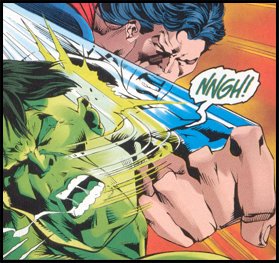
In 1976 the impossible happened -- Superman met Spider-man!
Twenty years after that landmark crossover, expectations were further defied by the announcement of a DC versus Marvel crossover mini-series! Against all odds, the two comics giants would surrender control of some their most popular characters, to allow fans to vote for the outcome of battles between their heroes! Marvel won the 1996 clash as determined by popularity of the time, but the great irony of the event was that it documented some of the most amicable days shared by the two rival companies.

It's unsurprising that there would be a sense of rivalry between two companies who dominate the space of a particular medium, friendly, or not. Until recently, Marvel had spent the majority of the modern age of superhero comic books reeping the benefits of a domination of the top ten sales month to month. That came to an end, however, in October 2009, when DC captured six of the top ten comics -- a first for the company since the sixties!

Ordinarily the HOTW is inspired by something positive in cross-media adaptations, or significant comic book developments. There is something like that contributing to this week's Hero, but I'm inclined to say the Hulk isn't the only green-eyed monster motivating this week's feature.

It's impossible to deny that DC have spent the best part of 2009 in the control seat. Successful marketting of the Blackest Night, Flash: Rebirth, and Batman: Reborn events helped propell them to the top of the sales charts, while creative vision ensured there was enough substance behind it all to make them worthy of the praise.
It wasn't necessarily their best year. Honestly, I would claim that DC have been on a creative high spanning the best part of the last five years, while Marvel have been scattershot with their ideas, struggling to find diversity and the hits to balance their many creative misses.

During the week, Marvel renewed hostilities by announcing a trade scheme being offered to comics retailers that would allow them to exchange the removed covers of select DC issues for a limited edition variant cover for their event mini-series, Siege.
The DC titles targetted were tangential issues of the Blackest Night event, each of which came with promotional plastic powerrings upon release a few months ago. For retailers, the attraction of this offer would be the potential to sell the variant Siege cover for a high price, whilst sacrificing the relatively low income the back issue market now represents, on issues that might've been over ordered in accordance with the powerring promotion.

On his Twitter account, Marvel editor, Tom Brevoort, plays it innocent in a string of posts, offering an open palmed suggestion (on raised hands) that retailers send the innards of DC's issues to soldiers overseas. It smacks, however, of a hollow gesture of phony goodwill coming from a company that's inciting the destruction of competition product in favour of very, very unremarkable replacements. It could be argued that variant chase covers create a false economy, harboring the kind attitude which turned a booming multi-million dollar print industry sour in the early nineties. Brevoort sniped, presumably with a hint of knowing irony, "We're doing this because we're in the business of selling content rather than Cracker Jack prizes. And we need retailers..."

The skeevy move feels in keeping with the character Marvel have developed over the past few years as slightly juvenile, and slightly antagonistic. High prices, unremarkable releases, cheap gimmicks (as opposed to the fun and clever DC powerrings), and a string of dud storylines, have helped create an aura of negativity around the once proud House of Ideas. Fortunately, it hasn't all been bad, with some of their mistakes being smoothed over with small victories, such as the recent spike in quality of Amazing Spider-man comics, which had been shedding sales after deleting twenty years of history with their One More Day storyline.

The fight between the two major companies continues in other mediums, extending to DC's triumph in 2009 with Arkham Asylum, and the 2008 battle between Iron Man and The Dark Knight in the cinema. "Planet Hulk" marks one of Marvel's final animated gestures before their purchase by Disney instigates what will surely be a renewed effort -- one more likely to challenge the animated powerehouse of DC's feature and serialized productions.

Planet Hulk adapts the 2006 story of the same name, which saw the incredible Hulk propelled into space by a collective of heroes known as The Illuminati. Mr. Fantastic, Iron Man, Dr. Strange, and all of Earth, ultimately felt the full brunt of Hulk's rage as he returned to the planet with alien allies and a new penchant for strategic warfare. World War Hulk was the slightly more inclusive follow-up to Planet, and may yet be a future project to spin-out of the animated escapades of the green goliath on other worlds.

The legacy of these events continues to be felt in the comics, where life isn't getting any easier for the Hulk!

After spending the past year competing for attention with a Red Hulk, a Red She-Hulk, his son Skaar, and a slew of other characters, the entire Hulk family will now come under threat from a collective of Marvel's deadliest and most brilliant villains. Dr. Doom, MODOK, the Red Ghost, the Wizard, and more will wage war on the Hulks to end their violent lifestyles once and for all!

All of this makes Hulk a very worthy HOTW.
That, and the whole "green-eyed monster" motiff sat rather well with Marvel's latest stunt...

<< Hero of the Week 01/24: Flash       [Home]       Hero of the Week 01/08: Wonder Woman >>

Originally posted: http://www.1up.com/do/blogEntry?bId=9017004

Friday, January 08, 2010

Hero of the Week 2010 #1: Wonder Woman

WONDER WOMAN (DC)
Real Name: Diana
First Appearance: All-Star Comics #8 (December, 1941)
Group Affiliation: New Guardians, Amazons, Justice League
Gaming Credentials: Justice League: Task Force (1995); Justice League: Injustice for All (2002); Justice League Chronicles (2003); Justice League Heroes (2006); Justice League Heroes: The Flash (2006); Mortal Kombat vs DC Universe (2008); DC Universe Online (TBR)
Infinite Wars Cumulative Ranking: #13

It's not easy being Wonder Woman!

Not only does she have to contest personal nemesis, manipulative gods, and the over ambitious villains who spill over from her Justice League colleagues, but she also shoulders the burden of being a public female superhero. If you haven't thought about it before, you might not realise that that burden involves more than super sanitary products, hairspray, and double-sided tape -- there's a very important real-world countenance to being a significant female pop culture icon.

In the comics, Wonder Woman has the conflicting duality of being both a diplomat of peace, and a sword-wielding kicker of butt from the Amazon island of Themyscira. She's not just a card carrying member of the JLA, but also an icon to man and super-man alike -- a heroic figure who has adopted the United States of America as her home, and adorned herself in the red, white, and blue, of the flag.

Here in the land of non-fiction, she's regarded as one of the trinity of major popculture icons, alongside Superman and Batman, that headline DC comics. While it's a reasonable title for a character that's weathered seventy years in print, it's not necessarily an accolade that lines up with her in-fiction portrayals, or her penetration as a comic book hero.

Truth be told, it's been a good few decades since Wonder Woman has cracked the top of any sales chart. One would like to think DC comics would have the dedication to keep their character alive in the face of any adversity, but there's every likelihood that, were a contract not in place to demand monthly publication as a stipulation of DC's ownership, the heroine would've fallen out of print long ago.

These varying factors have led Wonder Woman to be an incredibly complicated character, despite the relative simplicity of her design as a beacon of truth and justice. DC have struggled to find a definitive account of the character, constantly revamping their approach in an effort to bring Wonder Woman to the level of intrigue that her status as the best known woman in comics suggests.

The release of Bayonetta has renewed discussion in the webspace about sex relations in games.
Speaking relatively, video games have actually been reasonably progressive in the acknowledgment of strong female role models. There's the unfortunate omnipresence of double-D busts that come with characters like Lara Croft or Mai Shiranui, but even those prominent curvacious figures have contributed something to the battle of sexes along with iconic female heroines like Samus Aran, Chun-Li, and Sonya Blade. Heck, by 1988's release of Super Mario Bros. 2, even Princess Peach was burning bras and smashing glass ceilings, as she went from damsel in distress, to gliding playable protagonist!

It's fair to say American superhero comics have had their fair share of femme fatales, as well.
Behind Wonder Woman is a long line of lady liberators ready to represent the fairer sex, including Catwoman, Invisible Woman, She-Hulk, Powergirl, Batwoman, Storm, Jean Grey, Supergirl, Ms. MarvelHawkgirl, Witchblade, and a whole host of others, each running the gamut of personality traits, powers, and roles within their stories. Even so, for the most part, women remain a slight minority in a world where boof-headed hunks of muscle spend their time busting faces and oozing testosterone.

This first HOTW of the year was inspired by the release of DC's Blackest Night #6, which converts several of their iconic heroes into barers of Lantern powerrings that represent different aspects of the cosmic emotional spectrum. Wonder Woman numbers among these, converted into a violet-themed "Star Sapphire" for her capacity to love [pictured right].

Blackest Night has been heavily anchored by the manifestation of characters who represent these coloured rings and emotionally driven Corps. Wonder Woman -- famously referred to as an ambassador for peace -- rightly fits the bill for the violet power of love, but there's a reasonable argument to be made about her conversion which has resulted in an even more suggestive pink costume than her traditional star-spangled panties and golden bustier. An argument over whether or not this is a just depiction of a character whose responsibilities go far beyond breaking the jaws of evil doers and spreading goodwill to all of mankind.

It's the type of dialogue that consistently arises in comics, represented, but not defined by, the phenomenon of Women in Refridgerators -- a phrase coined by writer Gail Simone and her collaborators on an original site that discussed the use of women as disposable mcguffins [referring to the demise of a Green Lantern's girlfriend in the nineties].
When Fangirls Attack is a prominent hub for links to these types of discussions, and an extension of the "WiR" phenomenon, which arguably borders on sensationalist argument, but is a symptom of a realistic male dominance of the superhero super-genre.

Wonder Woman -- as a long standing popculture icon as relevant to video games as she is comics -- will always be a heavily scrutinized figure. Unfortunately, this high profile status and the jostling claims to the character have harmed her as a fictional entity, as much as it's helped. Wonder Woman may remain in the spotlight, but corporate sensitivities have frozen the character in an often bland state of mediocrity. Discussing the definitive Wonder Woman has become a nigh impossible task, with alarmist opinion often undermining any involvement of complexity the character might have in events like, Final Crisis; where she was dispatched by a mind controlled Mary Marvel, or Blackest Night; where she now shares the sexually provocative design of the Star Sapphire character(s).

This dissemination of characters and their handling by creators is something I don't think video games have really succumbed to, which, in a strange way, has allowed a more open acceptance of sexuality. Bayonetta is one example of a character that will inevitably offend, but I wonder if the conditions of video games have allowed a lighter, and consequently, better balanced analysis of what it means to be an empowered female in the modern world. The Lara Croft phenomenon of the mid-to-late nineties certainly proves that there can be more to a character than overt sexuality, and that attentions can lapse, just as easily.

Video games aren't generally regarded for their penetrating reflection of the human condition.
They certainly do, however, reflect as much as any other artform or entertainment exploit, speaking to the best and worst of our society. Video games and comic books have so many things in common, but by boosting characters like Samus and Chun-Li to the very top of the pile in their early days, it seems gaming has had an advantage over the print medium.


Wonder Woman introduces Raiden to the bloody-side of her Amazon fist!

Wonder Woman featured as one of the hard-hitting heroes in Mortal Kombat versus DC Universe in 2008, and will return to video games later this year as one of the many iconic heroes walking the world of DC Universe Online. In comics, you'll find Wonder Woman appearing prominently in DC's mega event series, Blackest Night, in her own three-issue spin-off, Blackest Night: Wonder Woman, and in her solo series, Wonder Woman. Check out DCcomics.com for more info!

<< Hero of the Week 01/17: Hulk       [Home]       Hero of the Week 12/31: Black Hand >>

Originally posted: http://www.1up.com/do/blogEntry?bId=9016004

Thursday, December 31, 2009

Hero of the Week #31: Black Hand

BLACK HAND (DC)
Real Name: William Hand
First Appearance: Green Lantern #29 (June, 1964)
Group Affiliation: Black Lantern Corps
Gaming Credentials: DC Universe Online (TBA)
Infinite Wars Cumulative Ranking: #603

If you read the penultimate HOTW for 2009 [The Hood], then you already the score -- I'm finishing the year with representatives from the corporate "big two" and I'm forgoing my usual desire to tie that somehow to video games. I've regularly brought a comic book perspective to aspects of video games and I suppose I'll just have to embrace that (unless you offer gainful employment to freelance writers who could use the work, and are really willing to change this time! No, really!!! BABY!!!).

If you read the afforementioned previous HOTW, you probably also noted a hint of cynicism toward the once proud House of Ideas. At the beginning of the decade, they were instrumental to turning around the slump comics incurred in the mid-to-late nineties, reinvigorating the creative landscape of four-colour heroes with a renewed emphasis on characters and urban pseudo-realism. By the middle of the double-ohs, many of the key players in Marvel's turnaround were elevated into new positions of power, and sadly, their touch wasn't as golden at the top. A problem DC hasn't struggled with as they elevated some of their brightest talent from writers-for-hire, to architects of a DC Universe that will hopefully find it's way into the MMO gamespace in 2010. [There's that game connection!]

At the forefront of DC's hike to the top has been Geoff Johns, who's of special note today for his role in moving forward the Green Lantern franchise and spinning his work out into the DC-wide undead extravaganza that has been Blackest Night!

Putting a face to the name, at least until the real big bad revealed himself, was Black Hand: a villain who started the year a typically trounced upon halfwit out to cause problems, and has ended it as one of the most threatening figures in comics! As a scion of Nekron -- guardian of the universe and master of the dead -- Black Hand hasn't actually been dishing all that much mayhem himself, but like any general, is as culpable for raising armies of undead Black Lantern versions of characters as the murderous zombie-lanterns themselves. Moreso, if you consider the notion that the exhumed bodies are merely psychologically intriguing vessels through which Nekron is attacking the heroes!

It was in Green Lantern #45 that readers were introduced to the first official Black Lantern -- Black Hand himself! Detailed in an entire issue dedicated solely to the villain was a man twisted and demented, so obsessed with death that he had become barely human, ultimately willing to murder his entire family as a sacrifice to his idol, Nekron. In that story, Black Hand was elevated with a single chilling page, depicting his own suicide! The sinister and slightly disturbing character study, a trademark of Geoff Johns, and a terrific way to establish the creepy tone of the event and it's villain!

Blackest Night wasn't the only story to put DC on top in 2009, but it was instrumental to one of their first sales victories in an estimated four decades! Blackest Night #4, along with several related issues, pushed DC into the top six slots of top ten issues sold in October 2009 -- a rare win for the company who've often failed to garner the same blind dedication Marvel's media presence has. Of course, events like Batman: Reborn and Flash: Rebirth have also kept DC bouyant in the 'event' stakes, while quieter efforts have maintained the company's prestige when it comes to more experimental fare.

Just as they did in the comics; DC also succeeded in defying expectations and redefining what it means to make a licensed video game. Batman: Arkham Asylum was an undisputed Game of the Year contender for it's high-concept simplicity, attention to franchised detail, and competence in bringing a character to life whose exploits in the medium have often been less than admirable. It's little wonder that we're now looking toward a Batman sequel -- to say nothing of their efforts to crack the MMO genre open with story-driven adventures, free roaming superheroics that have the potential to defy the standard of stat-counting, and the iconic characters gaining traction in all mediums, in DC Universe Online!


Blackest Night player, Sinestro, is confirmed for DCU Online, while Black Hand remains an outsider possibility.

DC won't be able to rest on their laurels in 2010, however, as Marvel initiate their Siege counterfire that already looks like a vast improvement over some of their recent failures. It also paints a stark contrast to the continuation of DC's Blackest Night juggernaut, which, although well orchestrated and enjoyable for it's simplicity, has been spread quite thin! Fortunately, there's plenty on the DC horizon with announcements preparing fans for the return of Bruce Wayne from his in-universe fake-out death, and a new effort to explore original graphic novels with a pair of single-volume stories coming in the form of Earth-One Batman, and Superman.

With that, we bring 2009 to a close!
Barring unforseen distraction, we'll do it all over again in 2010 with a brand new sweep of influences to steer observation across the world of superheroes and beyond! If you haven't quite had enough for this year, ring in the new one with more me via the Best of 2009 recap, or head over to The Comic Book Fight Club and vote in the Annual Year-End Infinite Wars DC vs Marvel Fantasy Fights, whilst wondering why updates stop at July. Hey, it's been a big year, and you are my favourite readers!

Happy New Year, folks!
Hope it's a good one for us all!


In case you missed them, DC's 2009 HOTWs: Batman (06/08); The Flash (06/15); Green Lantern (06/29); Superman (07/13); Hawkman (07/20); Batman (08/11); Aquaman (08/17); The Joker (08/25); Scarecrow (09/05); Green Arrow (10/04); The Flash (10/18); Solomon Grundy (11/01); Dr. Fate (11/15); The Sandman (11/22); Two-Face (12/13); Black Hand (12/31).

<< Hero of the Week 01/08: Wonder Woman       [Home]       Hero of the Week 12/27: The Hood >>

Originally posted: http://www.1up.com/do/blogEntry?bId=9015028

Tuesday, December 29, 2009

What Ever Happened to the Comic Book Fight Club?...
Seasons Greetings, True Believers!

Y'know, it's a pretty fair question: what did happen?
Long time readers will know I've often been fairly ambitious with my time, but in 2009, more than ever before, time got away from me! 2009 was to be the first year the Infinite Wars would reflect the weekly goings on in comics. Even now I have a hefty stack of comics to my right, no less than two for every week, that were chosen when contemporary, to be our classic Friday Night Fight (with extra madness for Mondays)!

For the time being, I have every intention of working my way through the 2009 stack. Though not quite hot off the press by now, each issue is a worthy addition to our hallowed halls of hard hits! There is still the statistical element of crowning a grand hero (or villain) for Season 2009, as well! I've got my fingers crossed for a late surge up the ranks by Hawkman, but I've got a nasty feeling when I finally feature Blackest Night #1, his chances might diminish just a fraction...

It was a series of events that conspired against regular updates on the Infinite Wars this year, not the least of which was the passing a very dear friend and family member, in October. Things like that tend to take a lot of wind our of your sails, and, hey, I haven't exactly hit that "dot com" boom in the four years we've been doing this dance of review, discussion, and appreciation.

I've been sharing the wonderful world of superheroes on a blog I've managed to keep better updated, partially dude to it's lack of format: http://sixarmedsamurai.1up.com/.
Be sure to check it out, bookmark it, click the thumbs up, read stuff, and just enjoy a slightly different perspective to the Infinite Wars. Hey, don't feel like you can't drop a comment to make me look good, either!

Like so much about 2009, I'm a little late to the punch, but I've finally settled on a series of scintillating match-ups for our Annual Year-End DC versus Marvel Fantasy Fights!
Be sure to check back regularly for the polls (located top-right in the site menu), and vote for the hero or villain who is most worthy of victory! Last year DC completely swept the pot, but it's a whole new ball game, with brand new pairings inspired by the parallels between stories and ideas from both of the major publishers. If you've got a Fantasy Fight suggestion, it's probably not too late to suggest it in the comments, either!

I hope everyone's holidays have been fantastic and your new year starts the same!
Not sure what lies ahead in 2010, but we'll cross that bridge when it comes!

Cheers!

Sunday, December 27, 2009

Hero of the Week #30: The Hood

THE HOOD (Marvel)
Real Name: Parker Robbins
First Appearance: The Hood #1 (July, 2002)
Group Affiliation: The Cabal
Gaming Credentials: -
Infinite Wars Cumulative Ranking: #331

Throughout the year I've been pleased to deliver a HOTW that at least has some tenuous connection to video games. For the most part, that's meant characters who have, at some point in their fictional careers, appeared in the medium, assuming their selection was based on some other influence. Well, with the year about to end, I figure it's time to abandon convention and take these last opportunities to acknowledge characters that shaped 2009!

Second only to the dastardly Norman Osborn [aka; Iron Patriot, aka; Green Goblin, aka; former HOTW] in both command and villainy; The Hood was an unlucky omission from this year's comic inspired action-RPG adventure, Marvel: Ultimate Alliance 2. The hero-v-hero aspects of the Civil War-inspired game no doubt bumped out the villain, who, over the past two years, has been elevated from gun-toting jerkass schlub, to devil-dealing 'Kingpin of Super-Villains!'


The Hood acts as gateway for Dormammu to escape the Dark Dimension and attack, in New Avengers.

As a major player in Marvel's Dark Reign of Osborn: The Hood has gone from controversially beating up former-Avenger, Tigra, to playing host to one of the biggest baddies of them all, in Dormammu, before being stripped of those demonic powers, and boosted instead by Loki, who led him to some Norse rune stones that can make his every wish a reality! It's all part of the job description when you throw in with the most powerful forces of machiavellian evil on Marvel's Earth -- The Cabal!

The Hood represents the attitudes of the current Marvel regime, whose last few years have been a hit and miss mixture of conspiracy and alleged longterm planning. He's a character typical of the type of villain that's emerged throughout this decade, one who plays just a fraction ahead of the heroes who are usually off-side per their own internal conflicts and self-generating headaches, which, in the case of The Hood's meteoric rise, were the direct legacy of 2006's Civil War.

After some less desirable efforts, Dark Reign has proven to be something of a success for Marvel in '09. Creatively less on-song than their DC counterparts, Marvel have been somewhat scattershot in their approach to the many properties under their umbrella. Dark Reign supplied an unlikely creative boost to many corners of the Marvel Universe, providing the apparent shock evisceration of The Punisher, twists in the Marvel Zombies saga, and an A+ shift that took their flagship New Avengers book out of crossover-hell, and drove it forward with a new sense of purpose and excitement!


Iron Man leads Marvel's multimedia charge as their great white hope of 2010.

If you're a gamer with only a casual interest in comics, then chances are your immediate reference point is Marvel Comics. Marvel have assured themself a dynasty of familiarity, starting way back in the sixties with the Spider-man cartoon, right up to the noughties with the advent of blockbuster superhero films, and, of course, video games. Cross media exposure has long been Marvel's ticket to ride, but in 2009, they showed unfortunate signs of weakness as DC gained traction with the ever growing Batman franchise.

2010 will provide a double-whammy of Iron Man when the sequel to the film and it's tie-in game arrive in the second-quarter, but it remains to be seen if they'll improve upon this year's creatively disappointing release based on X-Men Origins: Wolverine, and the under achieving Super Hero Squad and Ultimate Alliance games. It's a state of mediocrity that echoes the coasting of the comics, which were challenged for the first time in decades in sales by DC's powerhouse Green Lantern/DC Universe event, Blackest Night. It will be interesting to see how -- if at all -- Disney addresses issues of quality within Marvel's future output.

As you've no doubt gathered by now, it's been easy to be cynical about Marvel's direction over the past few years. Much moreso than many fans might have you think! Fortunately, while Iron Man 2 might be yet to fully convince, there's still plenty of promise for 2010. The comics in particular have a serve of treats that will begin with what's promise to be a uniquely fast-paced 'event' in Siege, which elevates the stakes of Dark Reign. There's also positive things happening in the world of Amazing Spider-man, which went from carcinogenic just a year ago, to classic by the end of '09!

I'm sure I could go on and on, but it's the holidays, and I'm sure you get the picture.
Watch out for one final villainous HOTW before we ring in the new year. who represents DC's '09!
If you haven't already, you might also like to reflect on the year via my Best of 2009. You should also vote in the Annual Year-End Infinite Wars Marvel vs DC Fantasy Fights poll at The Comic Book Fight Club! Happy Holidays!

Or, finally, check out Marvel's 2009 HOTW offerings here on 1up: Wolverine (06/01); Captain America (06/22); The Punisher (07/06); Iron Man (07/27); Spider-man (09/11); Iron Patriot (09/18); Deadpool (09/26); Carnage (10/23); Magneto (11/08); Dr. Doom (12/06); War Machine (12/20); The Hood (12/27).

<< Hero of the Week 12/31: Black Hand       [Home]       Hero of the Week 12/20: War Machine >>

Originally posted: http://www.1up.com/do/blogEntry?bId=9014675

Sunday, December 20, 2009

Hero of the Week #29: War Machine

WAR MACHINE (Marvel)
Real Name: James Rhodes
First Appearance: Iron Man #118 (January, 1979)
Group Affiliation: United States Military
Gaming Credentials: Marvel Super Heroes (1995); Marvel vs Capcom 2 (2000); Marvel Ultimate Alliance (2006); Iron Man (2008); Marvel Ultimate Alliance 2 (2009); Marvel Super Hero Squad (2009); Iron Man 2 (TBR)
Infinite Wars Cumulative Ranking: #100

Once again we find ourselves looking toward 2010 with a Hero of the Week that has garnered mass attention this week, but for something that won't happen for another 100+ days. I am, of course, referring to the monumental online release of the Iron Man 2 trailer, which sets the stage for the May release of the much anticipated sequel. As you would expect of a project of this nature, there's a video game tie-in on the way, which was the basis of the more obvious HOTW: Iron Man feature, which hit back in September. The game (infamously) features dialogue by Iron Man comics writer, Matt Fraction.

Considering the first movie ran through a rapidfire upgrade cycle that condensed forty-years of comic book armor designs into about an hour of film -- you probably haven't found yourself doubting the necessity of a War Machine. Why would you? In the world of the movies, the benefits of upgrading the armor technology are right there in front of you. If you have, however, found yourself asking what extra bang you're going to get for your buck, then you might look to the comics for a little advice...

Although War Machine (aka; Jim "Rhodey" Rhodes) appears only briefly in the trailer, it speaks to two of the great strengths of the character. Okay, one of those is being a greyscaled Iron Man with giant rocket blasters and guns stuck all over him, but the other is the man inside the armor, who makes similarly brief appearances in the trailer, but can benefit from the overall tone of the preview.

In the comics, Rhodey was inserted as a soldier during the Vietnam War who teamed up with Iron Man while he was still wandering the jungles around Vietcong camps having had a lethal piece of shrapnel suspended in his chest by super-magnets. This is the kind of foundation that lies beneath the relationship between Tony Stark and Rhodes, and why, throughout the eighties and nineties, Rhodes was entrusted to share and uphold the mantle of Iron Man, himself.

Rhodes remained an integral part of Tony Stark's internal entourage for two decades before the War Machine struck out on his own. It'll be interesting to see how some of this interplay finds it's way into the movie, particularly if there's more than overwhelming odds in terms of firepower, and a little demon in a bottle working it's way into Stark's life, to force Rhodes to take the helm.

In the games, War Machine might've been largely relegated to cameos as a colour swap for the Iron Man armor, but hopefully with Don Cheadel stepping in for a less-than-impressive Terrence Howard, we'll get a look at a character on even-pegging with the titular hero. That's certainly what you'll find if you check out current issues of Invincible Iron Man, where Rhodey's been lending a hand to Pepper Potts, Bucky Barnes, Dr. Donald Blake, and Captain America, as they attempt to rebuild the fractured psyche of a vegetable Tony Stark, who inflicted this horrible fate upon himself to protect all whose secret identities he knew from Iron Patriot's Dark Reign! (Trust me, it's not as complicated as it sounds!) You'll also find a special Iron Man vs Whiplash mini-series building up the new Mickey Rourke villain that combines elements of classic foes, Crimson Dynamo and Blacklash!

That's about all you'll get outta me tonight.
Check out the trailer [above] and soak it up. I'd like to say I was giddy with excitement, but I'm really not. You'll find more of my thoughts on the Iron Man franchise over on the Infinite Wars, and more of my thoughts in general, in the Pop Arts: Best of 2009 post. Happy Holidays!

<< Hero of the Week 12/27: The Hood       [Home]       Hero of the Week 12/13: Two-Face >>

Originally posted: http://www.1up.com/do/blogEntry?bId=9013832

Sunday, December 13, 2009

Hero of the Week #28: Two-Face

TWO-FACE (DC)
Real Name: Harvey Dent
First Appearance: Detective Comics #66 (August, 1942)
Group Affiliation: NA
Gaming Credentials: Batman: The Animated Series (1993); Adventures of Batman & Robin (1994); Batman Forever (1995); Batman: Chaos in Gotham (2001); Lego Batman (2008); Batman: Arkham Asylum 2 (TBA); DC Universe Online (TBR)
Infinite Wars Cumulative Ranking: #327

The (Super) Hero of the Week was always about reacting to cross-cultural references that would resonate with gamers, fanboys, and those that fall somewhere between. Arkham Asylum certainly achieved that goal in 2009 by harnessing multiple facets of the Batman license to deliver an experience just as sure to satisfy the hands-on interaction of video games, as it was the customary plotlines more familiar to comic books.
I feel a little like I'm jumping the gun by talking about a character that will inevitably have far greater significance in the future, but there can be no denying the immediate impact of the revealed return of Rocksteady and their take on the Batman license.

Revealed live during Spike's Video Game Award show; the trailer for 'Batman 2' quickly guarantees more quality adaptation from the developer, with a string of references promising a wider perspective of Gotham City as a platform and presence. Honing in on these clues that point to appearances by enduring villains like The Penguin and Black Mask, as well as less subtle inclusions, Joker and Harley Quinn, was eagle-eyed 1up Editor, Mike Cruz. He was first on the scene and already shared his findings with "detective vision" clarity on his own 1up blog.

By nestling deep within the confines of the iconic Arkham setting; the first game set utterly realistic expectations of itself by opting to tackle a single refineable location, rather than the vast landscape of a sprawling stylized city like Gotham. The flow-on effect was felt in everything from the mechanics of Batman's interactions with the enviroment, to the scale of the villains he was set to encounter.

In a game that presented such a respectable slice of the Batman mythos, I personally wasn't about to buy into vague references at the end of the game to Two-Face. Some of us might call that a very obvious way to establish intended content for a sequel -- a method that's a little too conventional, or similar to other popular examples [Batman Begins]. Hyperbole aside; it's seems the duplicitous former District Attorney is indeed set to play a significant role when Rocksteady return to the annals of the Dark Knight Detective. The biggest clue pointing in that direction -- jingoistic propaganda, found at ArkhamHasMoved.com, featuring a (literally) defaced poster of a distinctly half-soiled, gun-toting Uncle Sam figure. Another none too subtle reference sure to be familiar to movie-goers.


Image borrowed from Mike Cruz' blog: Batman Teaser Trailer Impressions.

2008's The Dark Knight presented the second cinematic account of Harvey Dent's fall from grace, combining the chaotic preaching of their version of the Joker, with the half-scarring that gave visual origins to the psychological bifurcation of the former lawman. It was a respectful vision that put the illdefined manic Tommy Lee Jones character of Batman Forver aside, to firmly establish the significance of Harvey Dent as a presence in his life before becoming Two-Face.

Harvey Dent/Two-Face represents many of the ideals that are closely associated with what makes Batman's rogues gallery one of the best in comics. Like Joker or Scarecrow; Two-Face is identified not for any superhuman trappings, but for the simple exaggeration of mental illness that could easily be found anywhere within society, taken to the nth degree in this homicidal package. Despite his relevance to the classic definition of a Bat-villain, it's actually been the continued work of writers right through to the nineties, that has fully realised the definitive Harvey Dent.

The portrayal seen in The Dark Knight owes the bulk of it's characterization to The Long Halloween -- a 1997 maxi-series by Jeph Loeb and Tim Sale, which has been regularly referenced throughout production on the revamped Bat-movie franchise, (Batman Begins included).

Loeb's portrayal of Harvey Dent; who is a central figure in The Long Halloween; was partially inspired by late DC editor, Archie Goodwin, with specific reference to the work of Frank Miller [Batman: Year One], who at some point once described Two-Face as a great under utilized Bat-villain. Dent played only a supporting role to the more significant (would-be) Commissioner Gordon, and Bruce Wayne, in his descriptive telling of the first adventures of Batman in Gotham City. It introduced a dynamic of antagonism between the traditional mobsters Batman fought regularly in his early stories, with the garish "freaks" who became more typical recurring foes in later years. Harvey Dent was to fall somewhere in between, making the transition from fiercely dedicated District Attorney-stroke-potential vigilante, to mentally and physically scarred miscreant.

Loeb's version further emphasised the treaty between Gordon, Dent, and Batman, and elaborated on the drive to see justice done that had made him a prime-suspect for being Batman, in Year One. The motif of duality has since continued in the characterization of Two-Face, who is often seen as more than a simple criminal menace, with the Harvey Dent persona often commanding some form of perspective based around the beliefs he held as District Attorney. It is a lingering presence that has also created a unique personalized relationship between he and Batman, rarely seen in the Dark Knight's dealings with other criminals in Gotham.

It will be interesting to see if these nuances of personality will have a platform to play out in the upcoming Batman video game sequel. If Paul Dini -- the writer behind the game and popular instalments of the animated series and comics -- returns for the sequel, we can certainly have high hopes for a success similar to the first title. As good as the movies are, it was the last game's ties to the source material that really impressed me. Here's hoping the team is ready to navigate the minefield of the sequel, which has the potential to undermine the great work done in the last game if the path forward isn't carefully considered.

I'm reluctant to refer to it as "Arkham 2", if only for the notion that it would be an error to attempt to recreate the confined systems of Arkham Asylum. As much as keeping the game contained to a single location played in it's favour, there's an expectation that sequels will be able to unfold on a much larger scale. There's only so often you can plonk players into the heart of Gotham City and expect the to remain a rat in a maze. This is "the goddamn Batman" we're talking about, after all.

A far less definitive version of Two-Face has been appearing in the pages of Batman as a quasi-caped crusader himself, battling the newly appointed Dick Grayson version of the Dark Knight amidst DC's Batman: Reborn line-up. You can find more information about these titles and more at DCcomics,com, more info about the next Bat-game at ArkhamHasMoved.com, and more blogging from me in my Best of 2009 post!

<< Hero of the Week 12/20: War Machine       [Home]       Hero of the Week 12/06: Dr. Doom >>

Originally posted: http://www.1up.com/do/blogEntry?bId=9012917

Sunday, December 06, 2009

Hero of the Week #27: Dr. Doom

DR. DOOM (Marvel)
Real Name: Victor Von Doom
First Appearance: Fantastic Four #5 (July, 1962)
Group Affiliation: Latveria, The Cabal (former)
Gaming Credentials: Spider-man & Captain America in: Doctor Doom's Revenge (1989); Spider-man: The Video Game (1991); Marvel Super Heroes (1995); Marvel Super Heroes in War of the Gems (1996); Fantastic Four (1997); Marvel vs Capcom 2 (2000); Fantastic Four (2005); Marvel Nemesis: Rise of the Imperfects (2005); Marvel Ultimate Alliance (2006); Fantastic Four: Rise of the Silver Surfer (2007); Marvel Super Hero Squad (2009)
Infinite Wars Cumulative Ranking: #64

If you've played one of the Fantastic Four video games, saw the movie(s), or dabbled in the comics, you probably think Dr. Doom is a pretty bad guy. As the major villain behind Marvel Ultimate Alliance, he certainly didn't do his public image any favours, but while MUA presented a great slice of the Marvel Universe as opposed to the usual brand-specific outings, it wasn't a game that excelled in the plot or characterization department.

Contrary to the name; Victor von Doom is neither an officially recognise practitioner of medicine, nor is he a harbinger of doom. In fact, depending on your reference, he's potentially a downright tragic hero, trapped within a prison of his own making, and intent on redemption through science and mysticism. Behind the cartoon trappings of a European hellbent on world domination, Dr. Doom is a rare breed of villain, as likely to save us all from damnation, as he is to condemn us. It's dramatic tragedy as bold as this that inspired one of cinema's greatest villains -- Darth Vader -- and assured the good Doctor a place in comics legend.

Created by Stan Lee and Jack Kirby in 1962; Dr. Doom was an incomplete concept, alluded to only in the broadest sense, but quickly defined through keen visual design and playful antagonism as one of comics' greatest arch-nemesis.

Since his inception, Dr. Doom's story has unravelled through many interpretations. Some introduced legendary milestones, like the moment he scarred his own face by applying a still hot metal mask to the insignificant scarring he sustained during a failed college experiment to converse with the Netherealm. Other more modern tales have cast doubt on the truth of Dr. Doom's many stories, suggesting a man capable of travelling nimbly through time has, during some stories, been represented by a robotic doppelganger left in his stead. This is the explanation best used to dismiss some of his less refined appearances, where the character has fallen into the mindless antagonism of some of his video game appearances.

Despite forming strong rivalries with the likes of Iron Man, Silver Surfer, Hulk, Namor, Mephisto, and Dr. Strange; Victor von Doom will always be remembered as the arch-nemesis of Reed Richards and the Fantastic Four. It's through this association that the character made his way to the screen, both in live-action film and television animation, and been couriered to the world of video games, typically as a final boss in the heirharchy of villains.

While Dr. Doom is undeniably destined to play the role of antagonist, I feel the most true vision of the character is one less than evil. When Marvel launched their 2099 line of comics set in an possible future; readers were privvy to a glimpse of the world if Doom were to have his way with it. As it turned out, much of the globe came to share the opinions of the Latverians he ruled over in the presence, finding a man as capable of ruling the Earth as he had always claimed.

I think a comparison that does a wonderful job to convey the nuances of Dr. Doom is that of his well known mutant counterpart -- another Lee/Kirby creation from the sixties -- the master of magnetism - Magneto. Though a distinct personality; Magneto has essentially played the same arch-villain role to Professor X and the X-Men that Doom has to the FF. Magneto's experiences with the darker side of humanity have compelled him to turn the same level of intolerance onto the ruling class that once threatened him. Doom's rise against adversity, however, compelled him to practise an entirely different brand of superiority. Where Magneto desires to destroy, Doom hopes to control.

Sure, he's arrogant and uses violent methods, but really, all Dr. Doom potentially wants to do is make sure we're all protected from our own stupidity. Is that really such an awful thing? Y'know, if you assume that that's really what he's all about, and all those crazy Dooms were just rogue or malfunctioning Doombots... And if you don't mind him killing one of America's greatest heroes and scientific minds... And if you don't mind surrendering your freewill to the state...


Latverians -- ready to kill at the snap of a finger, 'cause Doom's a merciless dictator with benefits!

The complexities of Dr. Doom's character are set to play a significant part in Marvel's upcoming special event, Siege, which reunites the figurehead Avengers trio of Captain America, Iron Man, and Thor, for the first time in five years! It will also tell the tale of Norman Osborn's gambit as his Dark Reign over the Marvel Universe is tested by the galvanized union of superheroes once fractured by a Civil War, and by those allies who once stood beside him in The Cabal, namely the likes of Dr. Doom and Sub-Mariner! It should be a doozy and it's also why Dr. Doom is our HOTW!

Siege: The Cabal is a one-shot special released this week, previewing the meltdown of The Cabal and the upcoming Siege event. You should still be able to find it at comic stores if you so desire, or, wait for the event to kick-off proper in 2010. You'll find more information on good comics sites, and somewhere on Marvel.com, too.

<< Hero of the Week 12/13: Two-Face       [Home]       Hero of the Week 11/29: Spawn >>

Originally posted: http://www.1up.com/do/blogEntry?bId=9012114

Sunday, November 29, 2009

Hero of the Week #26: Spawn

SPAWN (Image: TMP)
Real Name: Al Simmons
First Appearance: Spawn #1 (June, 1992)
Group Affiliation: Hell (former)
Gaming Credentials: Todd McFarlane's Spawn: The Video Game (1995); Spawn: The Eternal (1997); Spawn: In the Demon's Hand (2000); Spawn: Armageddon (2003); Soul Calibur II (2003)
Infinite Wars Cumulative Ranking: DNR


When I look at a character like Spawn, and the video games he's headlined, I can't help but ponder the fact that the likes of Hawkman will only make their video game debut in next year's MMO, DC Universe Online. I guess that's just my penchant for the classics talking...

Today's feature is a little duplicitous in nature.

This isn't a celebration of Spawn as much as it is an acknowledgment of an interesting development over in the comics. Not that it isn't worth spotlighting a character who's managed to star in four of his own video games, and guest-feature in a fifth. Truth be told, over in the comics, Spawn's world has changed quite significantly, even seeing the titular role handed over to a brand new guy called Jim Downing.

Spawn was one of the flagship characters that launched Image Comics as a power to be reckoned with, in 1992. Todd McFarlane, creator of Spawn, partnered a coup with other prominent artists of the time to launch a studio that put greater emphasis on the value of creators. Erik Larsen, Jim Lee, Marc SilvestriRob Liefeld, Jim Valentino, and Whilce Portacio, made up the rest of the Image founders, whose legacy is one that has allowed for some of the brightest talent of the past decade to enter the comics industry through independent works.

Robert Kirkman is among the talents to emerge through Image's publishing practises, creating the highest selling independent comic of today, The Walking Dead, along with several other projects that include the immensely popular superhero classic, Invincible.
This success has afforded Kirkman the rare distinction of being inducted into "founder" status within the Image fold, some fifteen years after the company's creation. Now, he unites all founders but Jim Lee for a project that will see the superheroes of the original Image Comics clash in Image United -- a series not without precedent, but still reasonably significant as a curiosity, all these years later.

It's fair to say that the original Image Comics properties created by the founders were very much products of their time. In retrospect, many are regarded with severely mixed feelings, not surprising of practises that placed emphasis on a certain brand of visual flair over writing. This quality of Image Comics, however, was all about graphics and characters for the video game generation. They were influenced as much as they influenced.

Having defined a popular perspective on comics over the course of the nineties, the rise of Image coincided with a mainstream swell in video game releases that saw direct overlap. The first Spawn game was released only three years after the character's debut, and saw Todd McFarlane go on to form an on-going relationship with video games that has led to lending his artistic approach to video game releases, often with results of mixed quality, similar to his comics [ie; the terminally infamous action figure battle game, Evil Prophecy].

Love or hate the exploits of bombastic chain-swinging nineties bad asses like Spawn, they're an important footnote on the landscape of both comics and video games as mediums, and that's good enough to make Spawn our representative HOTW!

The last Spawn video game was in 2003, but you'll find Image United #1 on shelves now from Image Comics! Check listings for subsequent release schedules.

<< Hero of the Week 12/06: Dr. Doom       [Home]       Hero of the Week 11/22: Sandman >>

Originally posted: http://www.1up.com/do/blogEntry?bId=9011190