Thursday, November 03, 2011

15 YEARS LATER: THOR VS CAPTAIN MARVEL!
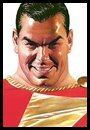
Like a lot of good comic book stories, there was more to consider in the construction of Marvel versus DC than the in-fiction propositions of parallel dimensions at war. The cliché had a real-world truth to bare as the two biggest publishers in American comics submitted themselves to a set of true-blue competitive circumstances, which no doubt required delicate negotiation around some amount of ego.

The great heroes of comics are often servicing higher ideals than the simple test of one ability against another, but here, bonafide diplomacy was as much on the agenda as the previously established wills of man-gods and super-soldiers. An appropriate acknowledgment of status and expectation would surely need to be recognised to some degree, to the satisfaction of the corporate overseers and the fans, even if the ultimate victory would be decided by a democratic vote of five key seats. Selections would require thematic resonance, iconic representation, and an organization that didn't compromise the integrity of characters beyond their ability to cope.

With the conventional wisdom of most modern pay-per-view fight cards; DC vs Marvel promised a gradual escalation in battles, starting with an undercard of six independently contrived match-ups that would build tension toward the deciding results of the fan-voted five main events. The complete list, along with the most fleshed out incidental battles that occurred along the way, can be found in my somewhat sophomoric tenth anniversary summary, which you might have read before, if you've researched the subject. Five years on, I hope I can dwell on the subject a little more without repeating myself too much, in honor of the (belated) fifteenth anniversary [as previously mentioned].
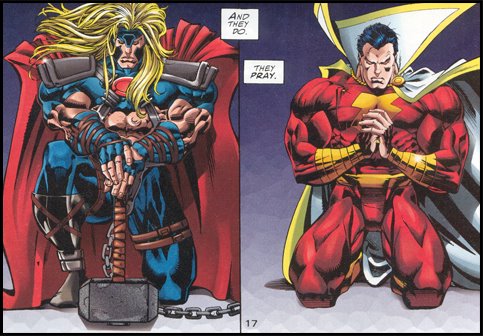
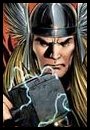
All things considered, opening the contest with Captain Marvel and Thor was an unexpected stroke of genius. In the mid-nineties I personally wasn't thinking about these characters much at all, even though Captain Marvel was in the throes of Jerry Ordway's well received The Power of Shazam! series, and Thor's transformation into a slightly generic shadow of his former-self was probably part of an initiative intended to actually provoke interest from people. What ever the case, 1996 was not always the most assuringly definitive era for comics, and this otherwise very exciting match-up could have easily been occupied by something far more bizarre.

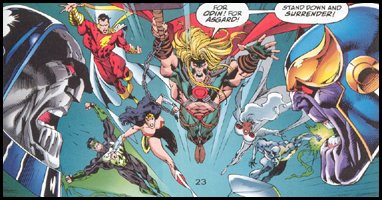
Playing cosmic mcguffin to the entire series' contest of champions were two cosmic, mega-monolithic siblings introduced on the final page of DC versus Marvel #1. Transcending sex, race and creed (in as much as representative red and blue allows), the two reawakening entities are uber-gods of the basic concept of conflict, in all of its ancient, mythic, polarized iterations. Representing the possibility of a cosmic 'one being' that shattered to create the idea of DC and Marvel universes, they add an interesting subtext to the persistent violence inherent in superhero comics, to say nothing of the moment when gods stopped to pray.

I suppose it's actually quite natural for Thor and Captain Marvel to pray, given that they're both agents of senior figures. Odin and the old Wizard Shazam are a natural council for the two to seek, given that the stipulations of the event require the losing team's universe be destroyed. If you observe the predominantly red and blue uniforms of the two, however, you might regard them as particularly fitting avatars for the two universes. The reversed red/blue motif manages to repeat itself in Flash/Quicksilver, corrects for Elektra/Catwoman, and gets all jumbled up when Superboy and Spider-man go at it, to a point of meaningless primary coloration, but in these two godly protectors, it seems special, cosmic, appropriate. Part of a newly discovered mythology, revealing string theory secrets that make the multiverse resonate a shared sense beyond its exclusive, officially trademarked reasonings.

I've always employed a philosophy of professional sports in elements of The Comic Book Fight Club format, and it's always fun to see that play out in the comics themselves. Like extras from the post-apocalyptic outskirts of cinema's The Running Man; Snapper Carr and Rick Jones do as they do best, representing the reader by making the follow along at home scorecard a sub-plot, taking bets on winners in opposing booths stationed outside the abandoned fairground setting for the first fight.

Crossover one-shots like Green Lantern/Silver Surfer immediately preceeded the four issue mini-series, and I have to believe that each of the fights could easily sustain their own over-sized special, if not a complete mini-series. Afterall, as already lamented upon, this kind of encounter doesn't happen every day. A generous perspective might say that the sudden nature of the interdimensional battles, and the rapid threat of their consequence, elevated an otherwise rote premise of heroes fighting within contradiction to a more intense level. Really, I think it was just a bit of a missed opportunity, particularly given the relationship between the two companies continued for more than a year, resulting in the "Amalgam Age of Comics" and a string of thinly conceived, co-published specials, (including the adventures of jointly created hero of both worlds, Access).

It would have been nice if the battles could have had some of the embellishment a one-shot or series might afford them. It's always nice when a superhero fight can provide something more than the simple slugfest, revealing detail about the characters, or a subtext relevant to the unfolding tale. I think it's healthy to forgive a comic like this for playing it simple and direct, but perhaps more of a sense of strategy and sport might have been appreciated. This was a decade before Ultimate Fighting Championship exploded into the mainstream and brought chess-battle Mixed Martial Arts fights into the family living room, but comics have always been capable of more than their most basic.

As the Captain and Thor go to blows for the fate of their universes [in the opening fight], there's certainly the expected amount of simplistic exchange of Herculean man-god punches, and Nordic hammer swipes. Fortunately, Peter David (with credited thanks to Ron Marz that, for all I know, includes the following) was able to reach a bit deeper than the machismo marinated bravado of Thor, (who none-too-subtly beckons for a merciful surrender from his opponent, who in turn figures destruction of fairground property for a better option), to find a poignant, if challenging gimmick.

Using his Greek inspirations to full effect, Captain Marvel hurls an entire ferris wheel like a deadly discus! An airborne Thor is well equipped to deal with such feats, contorting the iron amusement ride with a mighty swing of his enchanted hammer -- sufficient to return it to sender. Captain Marvel braces for impact, but finds himself pinned by the crumpled metals that sandwich him with the ground. Rather than waste time powering his way out, he instead resorts to the now classic, graphic convenience of simply reducing his size, shouting a magic world that returns him to the diminutive alter-ego of youthful Billy Batson! An act that highlights the resonant common theme between the two godly heroes and the destined undoing of Captain Marvel -- lightning!

I'm not entirely sure I'm comfortable with the idea that the Shazam lightning bolt that transforms Batson into his superhero alter-ego can so easily be tampered with, but I suppose if we're given to think that the good Captain can dart out of its trajectory, quick enough to flash-fry an opponent with the "lightning ambush" attack made famous by Kingdom Come; I suppose there's margin for interference. Regardless of my feelings, Thor does indeed profess that it is "... only through my good graces that your power would reach you -- and I am not feeling especially graci--," whilst tossing his hammer Mjolnir in the path of the transformative bolt, interrupting its intended path of empowerment.

The resulting short-circuited "SHAZAAK!" delivers smouldering defeat to the helpless Billy Batson, making it 1-0 for Team Marvel. Restoring balance rather quickly, however, is the fact that the bizarre clash of mythologies has left Thor short one mystically enchanted hammer -- to be collected on the following page by Wonder Woman!

Wonder Woman's retrieval of Thor's hammer obviously lent an interesting footenote of trivia for the annals of comic book geekery, confirming that she is as true of spirit as you might think, and worthy of the power of Thor. It also chalked one up not just for DC's bruised ego, but also the Greek pantheon, who failed to boost Captain Marvel (S.H.A.Z.A.M) to victory. Wonder Woman, of course, is a proud Greek Amazon, and would be one of the feature players later in the series, matched up against Storm in one of the five key, fan-voted deciding fights.

Within the heirarchy of comicdom, Wonder Woman is understood to be a pretty big deal, on the level with Superman in the modern day feats of strength, and pretty much more than a match for any wind riding mutant. With the gentle negotiation of ego and expectation in mind, there was, of course, the small matter of the massive popularity the X-Men were enjoying in the mid-nineties. The cartoon had made Storm and her fellows household icons, a legacy that is still evident in the fetishized interest of people who've, at most, picked up a couple of floppys with their favourite X-Man on the cover, but mostly resigned themselves to writing internet fan-fiction and gushing on non-comics message boards.

In other words; Wonder Woman might have had Storm outclassed in the powers department and will probably always have more stroke for her significance to the aged DC catalogue, but perhaps needed a perception boost to help win the vote with the inclusion of the hammer? [I don't know, but I'm sure we'll speculate more when revisiting their fateful duel, in a later entry.]

In 2011, I suspect the result of a rematch would be much the same.

Arguments might be made about the gods and legends from which Captain Marvel derives his powers, or the magnitude of his feats measured against rivals, but that issue of character stroke weighs heavily on any cross-company encounter. Thor might have been fit for a curtain jerking opener with a gimmick finish in 1996, but in 2011, he's a multi-million dollar franchise, having just enjoyed success as a feature film that is key to the development of Marvel's Avengers movie dynasty.

I suspect any contemporary encounter would be more likely to pit Thor against Superman (as was the case in JLA/Avengers #1), to better reflect the stature of the character, while also meeting thematic expectations. The only drawback -- at least until Zack Snyder's Man of Steel hits theatres -- is that Thor might have the popular vote too well covered to be chanced in a democratic battle against comics' biggest, most significant icon. Then again, these days the nature of these characters seems to be increasingly fickle.

At the time of this writing, Captain Marvel (or something like it) has been announced to be primed for an overdue relaunch in a tangent mini-series from DC's "New 52," spearheaded by Geoff Johns, with visuals by Gary Frank. Johns was instrumental in restoring the Shazam dynasty to trendy main event status in the middle of last decade, starting with plotlines in JSA that unfolded to make Black Adam the t-shirt selling bad ass of the late '00s. By now, Geoff Johns will probably be best known as the powerhouse behind the Green Lantern franchise, but there was a time when his reputation was founded on a gentle, caring touch, which restored darling old characters to prominence with artful compromise for the times that were, and the times that are. One would hope this reputation for delicacy and genius will continue through to this latest reboot of the "Shazam" magic word, but the crackling uncertainty of the DC linewide reboot brings with it the potential for greatness, or yet more pointless, ugly costumed reboots that will be reviled until nobody remembers why and the same mistakes can be repeated.

A newfound mainstream status should protect Thor from a return to his gaudy '96 look, but it hasn't stopped the character entering -- what I'm told -- is his second death in under ten years. Fear Itself, a Marvel event series that has arguably been a fate worse than death, apparently featured the dramatic sacrifice of the Odinson in a story that lived by the high concept of 'everybody gets magic hammers' and died by the sheer boredom that the graduating new school, fronted this time by Matt Fraction, supplanted in the ideas place. Having been so utterly turned off by every conceivable mention of the slow-burn, seven issue horror, so as to not read it, I won't be too certain about the legitimacy of the death, which will be overturned, regardless. It does, however, potentially put the character back on equal footing with Captain Marvel, particularly if a reboot proves successful. Maybe. Sort of. Possibly.

I'm sure I could veer off into salivating criticisms of the present trends and how they would cripple any contemporary DC/Marvel crossover book far worse than the mid-nineties -- where even the worst story usually managed to make it through an issue with a bunch of sound and fury paced faster than a crawl, without the underming pretentions of straight-faced incohrrent coreography. I could, but I won't. I know how uncomfortable that makes you.

When next we meet, I will likely still be without scanner, but just as enthusiastic about talking more about the battles that were -- and the battles that might be! Lurking a mere four or five pages from Thor versus Captain Marvel are the exciting, pre-fab filler fights between Aquaman v Sub-Mariner, and Flash v Quicksilver! So, you guys get excited and introspective, while I try to fix my scanner.

You Might Also Be Interested In:
Monday, October 17, 2011

15 YEARS LATER: DC vs MARVEL - THE RIVALRY RAGES ON!
Somewhere in the eighties and nineties, a small child sits in his bedroom with an A3 tablet of paper, writing all the names of the superheroes and villains he can think of. He draws pictures and wonders how their chemical properties will react when smashed together in the two-dimensional collider of a universe of imagination. The boy grows up, gets hair in funny places and starts noticing girls, but never forgets those Infinite Wars waged across Secret Earths.

If you've honestly never once considered what would happen if Iron Man matched wits and resources with Lex Luthor, or Superman all his powers against the Hulk, I think you've probably been doing it wrong. No matter the art, philosophy, or science of comics, there's an undeniably inherent joy in the comparison of these wonderful, everlasting characters. Characters who burst off the page with power and colour and excitement! Characters who've thrived on the alchemy of tossing raw elements into a four-colour spread, just to see what would happen! Stan knew it, Jack knew it. Johns knows it, Bendis knows it. We all know it to be true, deep down.

The seasonless thrill of superhero comics went hand-in-hand with the internet the minute it became accessible to the common reader. By 2005, there was a whole multiverse of 24/7 fansites and blogs to stumble upon, making it the perfect time to realise the dreams of a seven year old who never had the technological means to do so. The Comic Book Fight Club was a long time coming. Discussing tiers of law enforcement, social equality issues, or the ins and outs of an artform is great on its own, but it's a unique hook with cream whipped dessert when overlayed by Powergirl v Mister Atom, or X-Men v Namor. There was, of course, another reason to finally indulge this overdue concept at the crest of 2005, which brings me back to the beginning...

With a cover date of March (1996); 2006 marked the little talked about tenth anniversary of DC versus Marvel #1 -- the perfect time to launch into the epic world of superhero smackdown! Afterall; the two biggest companies in American comics might have negotiated crossovers in decades previous, but never had they thrown their biggest icons into deliberate conflict with such reckless abandon! DC versus Marvel/Marvel versus DC wasn't just an attempt to appease the imaginations of all those ponderous six year olds -- this was a rare opportunity to actually engage them in a free-for-all of vox pop armchair editing! There would come a winner -- no draws! A daring feat for any corporate company, never seen before [in comics], and not since repeated!

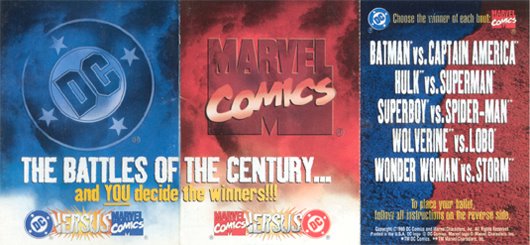
For those who were there, it goes without saying that the DC vs Marvel project wasn't without its significant flaws. For those who weren't, you can glean as much from my own very flawed, oft-sourced accounts of the landmark event and it's many key (and incidental) battles. Ideally, this will serve as an introduction to an improved retrospection, as 2011 technically marks the cover dated fifteenth anniversary of the epic crossover event! Remember -- ultimate victory was decided by public vote in a best-of-five series [collectible ballot card picture above]!

This time around, the occasion has been much better recognised.
Speculation and suspicion has been relatively rampant in these uncertain times, with many fans wondering if DC's line-wide upheaval, and the general decline of industry sales, might not lead to another rare détente between the two giants. Newsarama has discussed it, iFanboy veered into clumsy conspiracy theories, and sites aplenty [including Bleeding Cool] fooled around with the idea, back in April. To say interest is alive and well is to state the bloody obvious.

There's something to be said for representing the DC and Marvel heroes at their most iconic.

Many a mistake has been made with flimsy high concepts and short-lived stunts that malform the fine archetypes that began our favourite eighty-year old universes. It's true that this can be one of the least admirable traits of this wonderous world of fiction, but sometimes, every now and then, the times pull off something completely strange, but fondly memorable.

It's fair to say that distance between the now and the nineties is only just becoming large enough for people to start forgiving. In another blog post, it would probably be intelligent to acknowledge that this reconciliation with our bombastic past is leading us down a path of repeating mistakes, but for this post, let's just assume that not every oddity of the nineties was brilliant. That said, I do rather appreciate that the DC versus Marvel crossover -- with all of its popular vote bragging rights -- didn't shy away from the strangeness some of the characters were experiencing at the time, and would gladly forget, soon after.

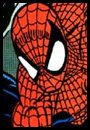
With Ben Reilly occupying the Spider-man suit; Aquaman bearded, angry, and missing a hand; Batman baring the registered yellow oval around his symbol; and Thor clad in futuristic bondage gear from Marvel UK's summer fashion line -- the 1996 four issue mini-series is as much a cultural yearbook, as it is an exciting, corporate phenom of a fight comic.

Superboy still had his tragic, nineties undercut, Jim Lee coat and genetically engineered ability to act like a dickhead. Catwoman was still dressed in form fitting purple; Kyle Rayner was the fresh-faced Green Lantern with no thought for a grey-templed Jordan; and truly placing it in the past, Storm manages to be relevant enough from the X-books to match-up with Wonder Woman! This really is a comic series that reminds us how much can change in fifteen years! Change that makes it all the more enticing to think about doing it again in 2011, with the characters who matter now, and who possibly missed out last time!

At the risk of partaking in another horrid comic book cliché -- the unfulfilling zero issue -- I'll simply state my intention to revisit the crossover in greater detail in the coming weeks, with a fresh look back at the battles of the original, and what it might look like today.

The odds of such a project actually existing still seem slim, even if the players who've famously stood against it are beginning to move on. Twenty years after conception, JLA/Avengers might've found its way into publication in 2003, but the previous decade will be remembered for renewed hostility between the big two. A friendly enough rivalry for the most part, spiked at times by public displays of affection, such as the 2004 Chicago convention panel, where Brian Bendis took it upon himself to air grievances about the now infamous illfated Batman/Daredevil crossover -- which in turn provoked a surprise appearance by then-DC Vice President of Sales, Bob Wayne, in a moment straight out of any Monday primetime professional wrestling programme. The project remains condemned in particular by an apparent dislike shared between then-DC President, Paul Levitz, and Marvel's enduring Editor-in-Chief and all around Sicilian rabble rouser, Joe Quesada.

Could bridges be mended as the business reform themselves? Maybe.
Then again, as much as there is mutual interest in the expansion and reconstruction of a once again flailing direct market, the two companies remain in steady competition. With the battleground moving ever more expensively into the cinema, DC and Marvel's balance between competition and industrial sustainability has never been more precarious. The perfect time for a team-up -- or the most vital time to keep separate in a war for the ideaspace?

Questions to consider, to be sure, but not here. Not when the spirit of the six year old, with his long list of characters and imagined fantasy fights must be answered! See you then, true believer.

Thursday, September 29, 2011

LONG STORY SHORT: MAKE MARTIAN MANHUNTER!
With Marvel's successful construction toward a cinematic shared universe culminating in 2012's [Joss] Whedon directed Avengers; it's difficult to shake the sense of inevitability that hovers over DC Comics' counterpart hero-team, The Justice League.

DC may have made their mark with seminal blockbuster pictures like Superman (1978), Superman II (1980), and Batman (1989), but it's Marvel who have spent the following decades defining an industry.

Films based on Blade, X-Men and Spider-man went a long way to dispelling any belief that superheroes could not transition convincingly to the big screen (beyond momentary fad), but even these trailblazing efforts have become footnotes to subsequent developments in a veritable Hollywood takeover. For better or worse, Iron Man (2008) marks the turning point for the average superhero adaptation.

Embued with a sense of indulgence afforded by the standardizing movies released between 1995 and 2005; once unlikely colours and iconography from the four-colour medium finally became par for the course after Iron Man, which refreshed audiences with robotic heroics and a strong core of character and story.

Combining credible talent with an approach that services conventional storytelling and the broad basics of superheroes [earnestly, for the most part]; Marvel distanced themselves from awkward pubescent disappointments like Daredevil and Fantastic Four. By getting it so right, they earned the credibility to pose the question of going deeper, (starting with a much talked about Nick Fury cameo), declaring their intentions with Hulk, Thor and more Iron Man -- a gradual build that brings us to the present post-Captain America world, where movie marketting has done what comics sorely needs to -- sell people the excitement of franchise accumulation.

Earlier this year, DC (probably) thought they were buying in to the same philosophy when they launched Ryan Reynolds toward certain doom in Green Lantern. Only the most apologetic or optemistic observer could have advanced without a sense that GL was being set up for cannibalized mediocrity, a very distant second to its supposed Iron Man equivalent (and franchise brethren).

It was by virtue of the 2007-2008 Writers Guild strike that DC missed out on beating Marvel to the cinematic ensemble punch, inadvertently averting the even bigger disaster of a JLA film that was reported to have cast a group of youthful alternates (such as model, Megan Gale), before cooler heads prevailed. The project, which had every likelihood of undermining DC's pantheon of franchise vehicles in a single stroke -- including Green Lantern -- speaks to the struggles Warner Brothers have had when converting anything unrelated to Christopher Nolan's critically acclaimed efforts with Batman -- another character almost threatened by the post-Begins lowrent JLA.

The obvious hasn't completely escaped 'the powers-that-be.'
Over the past couple of years, DC has undergone significant structural change, to not only hand over greater powers to the cross-media aspects of the business, but also shock the comics world with a massive brand-wide reboot of all the major properties (currently in its fourth week). The two events seem likely related and it remains to be seen if it's for better, or worse.

After squandering the marketshare of Green Lantern (and Blackest Night) in two mediums, DC in its many forms is clearly reevaluating. In 2012, they relaunch cinematically with the hotly anticipated Batman reboot trilogy end, The Dark Knight Rises, while [Christopher] Nolan also spirtually coaxes Superman in his life after Returns, delivering a second bite at the cherry, Man of Steel, directed by Zack Snyder [of 300 and Watchmen fame]. Representing the modern Hollywood method of repeating tried and true projects, it isn't exactly the most inspiring direction forward, but at least offers respite from the confused antics of mismanaged B-properties.

While there appears to be a massive gulf between the representative brilliance of The Dark Knight (2008) and the confused clusterfuck of Catwoman (2004), DC hasn't had it all bad. Somewhere in between lurk tangents like Watchmen (2009), V for Vendetta (2006), and Constantine (2005), which might not have reached the heights of the comics they were based on, but made for respectable mainstream departures from the extremes of their best and worst. Though not financially successful to the degree expected by more dominant superhero franchises, each is a movie with cache that could soften the blow of more public letdowns, and inform a better way forward, if they were more readily identified with the parent company in the way Marvel's best brands have been.

Not every franchise will be Nolan's Batman reboots, nor should they be.

Just as comics have had to reconcile the creative influence of forces like Frank Miller and Alan Moore over decades of lesser knock-offs, so too has cinema been harmed by the popularity of the 'gritty realistic reboot', which continues to give way to ham-fisted imitators intent on devouring the past.

Marvel have found success in the most logical way, with movies that, to a significant degree, repel from the grim 'n' gritty colourless trends of recent history. There's plenty of room for argument about the details, but by launching their Avengers properties with the robot Iron Man, monster Hulk, fantasy laden Thor, and wartime Captain America, Marvel have at least shown a minimum aptitude for offering diversity in their present movie line-up. From a certain dough-headed Hollywood perspective, this could be interpreted as a necessary live example of the virtues of doing something 'different.'

Where DC has dominated for quite some time is the domain of animation.
With Marvel now under the ownership of Disney, it seems entirely reasonable to suggest that the next great frontier for corporate superheroes in cinema might be animated features. Granted, this would be a battle far bigger than comparing live-action muscle men, requiring a change in box office trends that have condemned traditional animation to DVD and television, but who better to fight the fight against CG (in)animate objects than some of the greatest 2D characters who've ever been drawn?

1993 saw such a feat broached by Batman: Mask of the Phantasm, the first feature spin-off of the critically acclaimed Bruce Timm Batman animated series, which gave birth to the on-going collection of now unrelated DC DTV (Direct To Video) movies. Limited theatrical release delivered high praise and a quality product still relevant. Then there's the more recent acclaim of The Incredibles (2004), a Pixar CG superhero movie that enjoyed plenty of success, playing computer animation against itself, arguably the closest thing the world has to a bloody good Fantastic Four movie.

As a repeat offender, DC needs to invest in good people working on good projects, preferably outside the box, to cleanse the palette of their past mistakes. Throwing millions behind traditional animation might be a bit of a big ask in 2011, but it would be the kind of bold move that might start to rebuild a credibility fitting of the fictional historic heroes they are custodians of, and build a buzz that Green Lantern certainly lacked. It could even have broader implications for the company that owns them, the once proud purveyors of animation, Warner Brothers. There is certainly potential already existing in the lower budget projects hitting Blu-Ray and DVD, ie; upcoming Batman: Year One, and past projects like the 2008 adaptation of DC: The New Frontier [pictured above], but you've gotta learn to walk before you run.

If one accepts that it's preferable for executives (and other potential obstacles) to work from existing evidence, then I think DC's credible sleeper hit is one of the most obvious, but least likely characters, that they could source. Often affectionately referred to as the 'heart and soul' of the Justice League, he is a character that, if successful, could be a preliminary marker for expansion similar to Avengers, who also possesses many unique qualities that would allow for a strong, focused three act film, with unique and intriguing dressing.

I, of course, am talking about Martian Manhunter.

I don't doubt for a minute that Zack Snyder will do good things with his version of the Superman mythos, but with General Zod confirmed as a villainous presence, I can't help but feel flattened by the prospect of repeating the Richard Donner era all over again -- a factor that severely crippled Bryan Singer's infamous (loveletter) approach in Superman Returns. I also can't help but wonder if Snyder's skills as a filmmaker might not have been better utilized on a character like Martian Manhunter!

It isn't at all irrelevant to note that I've been watching Dark City very recently.
The 1998 [Alex] Proyas film is not a great example of a theatrical blockbuster, but has certainly overcome any marketted shortcomings to become an acclaimed cult film as years have gone by. I mention it, because, as pictured above in art by Darwyn Cooke (and less obviously, Ken Steacy), there is an associated nostalgia to Martian Manhunter that, visually, could certainly learn from the retro inspiration of much of Dark City's forties noir costume and set design. Like Dark City, a film based on Martian Manhunter could also pastiche genres in ways that would make it quite unique, particularly in the present market. To what extent the retro aspects were fulfilled would be subject to a director.

Based on the CG embellishments of Sucker Punch300, and design of Watchmen, particularly the urban latter with its neon flourishes; I think of a Martian Manhunter film as a technicolor delight, well handled by a director of Zack Snyder's persuasion.

In a world where CG is so often used as a meaningless gratuity -- or ham-fisted gimmick, see; Green Lantern's hideous costume -- I imagine a Martian Manhunter film as a visual exercise that makes technical use of CG as an artistic, graphic statement, lending a vaguely similar factor of intrigue to Robert Rodiguez' work with Sin City. I see unnatural, deep glowing purples and greens, tech-noir neon highlights, burning red eyes, and a movie that revels in fiction. In a way, it could almost be this era's answer to the bold design of Warren Beatty's Dick Tracy (1990). Then again, there's margin for a much more naturalistic approach, too. More literally like Dark City. Martian Manhunter is really a versatile property, when you start thinking about it.

The story of Martian Manhunter can be approached in many different ways, but is generally a simple high concept with key mythology. Scientist's experiments accidentally transports Martian to Earth; shocked scientist dies a mournful death; Martian is alone in a world he doesn't understand. Martian learns human culture from television, assumes identity of gumshoe detective, battles evil with steely resolve and uncompromising squint. William Hurt's character in Dark City doesn't make for a bad approximation, which is something that inspired elements of The Kirby Martin Inquest, a comic book I wrote that is yet to move past the first issue.

The work of Mark Verheiden and Ken Steacy from Secret Origins #35 tells much of this tale as a flashback, and is a beloved reference that stays with me to this day. It also bares many similarities to the later work of Darwyne Cooke in DC: The New Frontier, which hits a few extra beats about discrimination, humanity, and superheroics. Between the two, I think you have a very thorough bible for a working script, with additional mythology about Mars and Martians worth keeping in mind, even if it's best left unelaborated upon, at least until a sequel.

As much as design and visuals would be a motivating factor for this film -- (probably more comfortably titled Manhunter from Mars); character study and development would provide much of the meat of the project. Establishing Dr. Erdel -- the scientist responsible for bringing MM to Earth -- as more than a mere mcguffin, might be nice. I've always been quite taken by the idea that he was a kind, gentle man, who regretted his mistake in his final moments, providing a positive influence before dying in front of a confused and unprepared alien. The New Frontier captured this, and MM's television education, quite well. The latter of which influences his decision to become a gritty noir detective, buoyed by the backstory of his life on Mars.

In the Verheiden story, "Detective John Jones" (an alias based on his martian name, J'onn J'onnz) finds himself on the trail of kidnappers. In The New Frontier, Slam Bradley and he investigate satanic cultists, intersecting with Batman in the process. The New Frontier pulls upon allusions to modern Batman interpretation as a paranoid, suspicious figure, who famously threatens Martian Manhunter with a hypothetical pack of matches. These themes provide a thriller aspect to the story, lending an interesting narrative of human frailty while also giving Detective John Jones additional stakes. Grafted on to a fellow detective, or perhaps even a government presence, the concept would provide danger for the Second Act, and spice in the Third Act.

Martian Manhunter spent the fifties embroiled in spy tales and that's certainly an interesting element to draw upon, represented in The New Frontier by government interference via King Faraday, who captures the Martian when he attempts to stow away on a rocket headed for Mars. The pair resolve their differences in a series of events that both commit the Martian Manhunter to becoming a heroic influence on Earth, while redeeming the human perspective. I think a tighter, more intensely character driven arc might be necessary to make the Martian Manhunter film worthwhile, but the sentiments are certainly echoed in the source.

Long story short: I'd really like it if someone made a Martian Manhunter film. A good one! With the right balance of indulgence, ingenuity and design, I think it would have the potential to be a very unique project, capable of spinning out into sequels and franchise crossovers, while sustaining itself.

With the right mix of elements, I think this is the type of concept that could really lend itself to the mass market. A good script would balance action, intrigue, character, and atmosphere in ways that reflect the 'swiss army' alien powers of the hero himself. A character of pathos, of bold heroism, of action, of mystery, of heart. Everyman and no man, all at the same time. Relatable, but completely wrapped in the wonderous world of fiction that should be ten times as important.

I'm not sure Martian Manhunter would be the franchise ticket, the one that picks up the slack when Christopher Nolan confirms his departure from the successful Bat-films. Done right, in ways GL wasn't, it would have every potential to be the surprise breakout hit that Iron Man was, though, and above all else, lend a little prestige, versatility and credibility to DC superhero films. If the sense of inevitability that hovers over the JLA is at all true, I think this is the unlikely, but perfect place to start.

Sunday, September 04, 2011

BANE versus BATMAN
Knightfall Part 11: The Broken Bat (DC)
Where:
Batman #497 When: July 1993
Why: Dough Moench How: Jim Aparo

The Story So Far...
He is the dark knight detective that watches over a city of crime, sworn avenger of the innocent, scourge of the underworld. With a sharp mind and trained body, he is the ultimate product of human invention and spirit, but what would it take? What grand gesture, or inventive scheme would finally push the caped crusader beyond his limits? What would it take to break the bat?

Armed with an arsenal of stolen weaponry and a strategic intellect as sharp as The Batman's; Bane arrives in Gotham City as a tortured soul born into the harsh prison system of Caribbean nation of Santa Prisca. Obsessed by the demon of justice Batman represents, he is intent on testing his chemically enhanced strength and brilliant mind against Batman, enacting a plan to combat the dark knight's will in both the physical and mental realms by unleashing his darkest demons like an army of chaos.

The gambit forces Batman to push himself to breaking point, hunting down the escapees unleashed from Arkham Asylum by Bane's surgical srike. Mad Hatter, The Ventriloquist, Amygdala, Victor Zsasz, Firefly, The Cavalier, Poison Ivy, Scarecrow, and Joker are all released to do as they please, forcing Batman to work to breaking point in an effort to bring them all in. Bruised, battered and exhausted, he retires to his inner sanctum as Bruce Wayne, but this respite will be short lived. There, Bane lies in wait to break the bat...

Tale of the Tape...
Strength: Bane 4 (Enhanced)
Intelligence: Batman 5 (Professor)
Speed: Draw 3 (Athlete)
Stamina: Draw 5 (Marathon)
Agility: Batman 4 (Gymnast)
Fighting: Draw 5 (Martial Artist)
Energy: Batman 4 (Arsenal)


Real Name: [Unknown]
Group Affiliation: [Secret Six]
First Appearance: [Batman: Vengeance of Bane #1] Year One: [1993]
Win Percentage: [0%] Last Opponent: [Injustice League]
2006: [#147] 2007: [#254] 2008: [#206] 2009: [DNR]

Born into incarceration within the notorious Santa Priscan penitentiary known as Peña Duro -- Hard Rock; the man called Bane began life guilty for the crimes of his father, a revolutionary rallying against the corrupt governments of the small Carribean Republic. As a child, Bane learned from a school of violence and crime, beginning his path of brutality with blood on his hands at a shockingly young age. While his physical presence grew to meet the needs of prison life, Bane's mental accumen was also sharpened, taking full advantage of the collective wisdoms of various prisoners, and limitless time to study.

Rising through the criminal ranks thanks to his natural abilities and intellect, Bane conquers Peña Duro, raising the ire of it's appointed controllers. Under the watchful eye of Dr. Hugo Strange, Bane is entered into experiments using an enhancement drug called Venom, which claimed the life of many test subjects. Bane proved strong enough to survive the near-death side effects and is embued with a new strength almost instantly accessible with with the administration of the venom drug, every twelve hours.

With the aid of allies, Bane escaped his prison life, entering the world with a view to travel to Gotham City. Obsessed with Gotham's dark knight protector, who rules the city of crime through terror in a way similar to those in prison; Bane hopes to end his internal philosophical struggles by exercising his fantastic deductive skills, phenomenal strategic intellect, incredible strength, and access to the venom enhancement drug, to mentally and physicall break the Batman.

Bane is accompanied by an entourage of close personal allies; Trogg, Zombie, and Bird, former prisoners who escaped Peña Duro with Bane's help. Specialists in various fields, they are trusted assistants to Bane's ambitions to break the bat.

Real Name: [Bruce Wayne]
Group Affiliation: [Batman Inc, Justice League of America]
First Appearance: [Detective Comics #27] Year One: [1939]
Win Percentage: [72.7%] Last Opponent: [Superman]
2006: [#1] 2007: [#2] 2008: [#1] 2009: [#19]

After witnessing the street murder of his parents, the young Bruce Wayne's destiny was forever shaped to be one dedicated to an ideal. Having spent his formative years studying the various sciences, martial arts, and crime fighting techniques, Bruce is ultimately inspired to become the one-man war on the criminal element in Gotham City: Batman.

Perhaps Batman's greatest power is the millions inherited from his industrialist parents, and the various facilities that came with that. They prove crucial in the design and construction of his many weapons, which are typically non-lethal, and have a variety of uses.

Complimented by his keenly strategic mind is Batman's expertise in the martial arts. He is extensively trained in multiple fighting styles, and commonly regarded to be one of the greatest hand-to-hand fighters in the world. He is also extremely proficient in general urban warfare.

Statistics: Batman Ranking: Batman (#1)

What Went Down...
On the verge of exhaustion, the Batman becomes Bruce Wayne, a maskless debt to a faithful servant dedicated to maintaining the charade necessary of their grander goals. Alfred is nowhere to be seen, already the victim of a demon lying in wait. Bruce Wayne makes his way up the Batcave stairs to the manor above, the final trek on a path of misery that began with an assault on Arkham Asylum and his subsequent pursuit of its escapees.

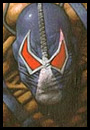
A hulking mass of brawn and brain, Bane greets his opponent with a promise of mercy for the already defeated Alfred Pennyworth. It is not Batman's allies that this cunning hunter seeks, anymore than it is "Bruce Wayne" -- the mask that "no longer serves a purpose" in contrast to Bane's, a luchadore's facade with a direct line to feed "venom" into his brain and bloodstream.

With a flick of a switch Bane becomes more than mortal flesh, energized by the serum coursing through his veins. He is a super-human, a monster of chaos and order in one. As quickly as the venom transforms his opponent, Bruce Wayne becomes Batman again, triggered by the disdain he feels for an evil so callous and thorough it would condemn his city without cause.

He leaps into action, this dark knight. Exhausted and desperate, he is easily caught by a thriving Bane; tossed aside like the regard for his own safety. Treated like a human wrecking ball, Batman is noble to a fault, pleading for Alfred to flee while Bane prepares to choke him silent.


Recalling the trials of his life in the preceding week, Batman is rammed down the passage toward the Batcave, stomped, swatted, and staggered. He throws a punch to the gut, but it does nothing. "You are already broken," his tormentor declares. "It is over. You are nothing. A DISAPPOINTMENT!"


A dropkick sends the dark knight toppling to the lower levels of his Batcave. A clubbing blow to the back of the skull leaves him drained and vulnerable. A kick to the ribs sends him skidding along the ground. A bump against a stand drops a giant novelty penny across his spine. Pinned down, an uppercut adds torque to the wrenching position between the floor and a hard place.

Bane drags the Batman from beneath his massive momento and makes a static weapon of another of his trinkets, the famed Batmobile. Unrelenting, the villain growls, "WHY DON'T YOU FIGHT!?" The answer may be the physical fatigue of the last few days, perhaps the mental.

A stalagmite becomes a bat to club the Batman. He finally gives Bane what he wants, a moment of resistance that swats the stone formation from his hand. It is a rebellion quickly ended by a charging headbutt that sends Batman hurtling toward another trophy, and another mental blow. Draped in shattered glass and a yellow cape, the dark knight holds the symbol of his greatest failure in hand -- the domino mask of Jason Todd...


Rising like a living deadman, Batman throws a punch with nothing to it.
His arms clumsily absorb the impact of Bane's returning blows. Reflexes gone, he eats boot leather. The cave tears his costume. Bane compells him to submit, to beg for mercy. Batman tells him to go back to Hell.


"I am Bane -- and I could kill you... but death would only end your agony -- and silence your shame. Instead, I will simply -- BREAK YOU!"

A broken Batman. A nemesis triumphant.

The Hammer...
In a day not long passed, I would've begun this discussion by lamenting the longterm difficulties of a character like Bane. Best remembered for the fight featured above, he is -- or at least was -- the character who "broke the Bat"! An accolade so big and rare in a corporate environment, it rendered him effectively 'unemployable' in the eyes of those who felt the act could never be topped, and fans who grew to regard these early nineties stunts with bitter disdain.

As the feature villain of Christopher Nolan's upcoming trilogy cap, The Dark Knight Rises, the character is about to become something entirely new. First impressions of the Tom Hardy occupied vision, with distinctive open-muzzle head gear, suggests a liberal adaptation. One that reshapes the basic outline of a character who, in some respects, represents an 'Anti-Batman'. With DC Comics' 'New 52' relaunch shedding its history in favour of a DCU For Dummies, there's every chance this version of Bane will not only take hook with the mainstream masses, but also entrench itself in the comic books themselves, similar to some of the creations that went both ways, in and out, of the likewise streamlined Marvel Ultimate line.

The DC reboot is one of the reasons the opening statement doesn't seem so relevant anymore, but there're more factors at work.

I think it's fair to say that time has made for a relaxed indulgence in both the good and bad of Bane. Recent trends in comics have been flirting with nineties-esque gimmicks for quite a while now, making them seem more acceptable to a mass of internet-age readers who joined comics in the early 2000s. The passage of time has also allowed the Knightfall story to be retold several times over, in different mediums, making Bane's legend much less about a sales spike, and more about a chapter in the saga of Batman. There's also the all-important fact that, unlike his Superman-killing counterpart (Doomsday), Bane had an interesting concept behind the short-lived victory.

While it's clearly true that Bane was envisioned as an opponent capable of challenging Batman in the realms of the mental and physical, he wasn't strictly designed as a dark mirror to the hero himself. Accompanied in early appearances by an inner circle of trusted allies (Zombie, Trogg, and Bird), creator Chuck Dixon is well reported to have begun with the concept of an evil Doc Savage: famed "Man of Bronze" and pulp predecessor to Batman -- the ultimate reneissanceman and adventurer!

Therein lies the saving grace of a character who otherwise might've been relegated to sneering trivia: defined very early by a gimmick, and popularly degraded by a less-than-impressive follow-up appearance in the 1997 Joel Schumacher feature length farce, Batman and Robin.

Before Christopher Nolan and his team will have remade the character (with possible ties to Ra's al Ghul), there will have been many contributions that added depth to the original high concept and simplistic early exploits. Today, Bane is a much more altruistic figure, menacing, but generally treated with a sense of fighting honor that reflects an element of his iconic lucha libre design.

As a powerhouse villain Bane was the crowning obstacle for Jean-Paul Valley; DC's edgy replacement Batman who is better remembered in his own right as the armored, fanatical, violent, and very dead nineties hero, Azrael. Stories of typical villainy have persisted to sometimes undercut the credibility of the character, but time has allowed for other stories to balance the bad with the good.

Lesser characters, like Judomaster during Infinite Crisis, were offered up in sacrifice to recreate and readdress his penchant for backbreaking, reinforcing the mythology of it. There was also the journey of self-discovery, when Bane, with funding from Bruce Wayne no less, discovered his Kobra-fanatic father in a tale that humanized a Bane who literally lacked those qualities via a backstory of imprisonment. Purging the character of the Venom drug also went a ways to reforming the character, emphasising the human strength that was there from the beginning (and allowing for an analagous drug mythology to creep into Gotham's stories). [BTW: It's worth restating that, yes, the guy whose entire life has been one giant revenge-quest because of his parents' murder actually does have the ability to forgive, as was the case years after Batman was healed and back in the saddle.]

In 2007, I featured an issue of Checkmate [#12], wherein Greg Rucka and Nunzio Defilippis restored further credibility to the character in a story that saw Bane in his native Santa Prisca, politicized in a war against drug cartels and government corruption. It largely played background to other action, including a firey face-off against Son o' Judomaster, Tommy Jagger, but the idea was appreciated. From there, Gail Simone had her way with Bane, casting the back breaking brute in a cartoon role, clumsy and stoic as a member of Secret Six, with glimpses of brilliance leading to an eventual restoration of the villain, which presumably signals the design of any future Bane predicaments in the "DCnU".

The Dark Knight Rises and DCnU New 52 will in all likelihood canonize Bane as an unimpeachable feature member of the Batman rogues gallery. I think that's nice, but hope that the shift away from years of history doesn't simplify the character in unflattering ways. In the case of Nolan's films, that seems unlikely, even if the approach differs from The Dark Knight (for example), which embellished and showcased great elements inherent to The Joker character, without veering from a recognisable model. With a strong eye for story, it seems certain that the film version will not suffer the pitfalls of Knightfall, driven by an idea probably much stronger than merely breaking Batman's back.

I'm obviously looking forward to the film and am pleased to have finally been able to get back to this here Comic Book Fight Club. I won't pretend it will be a regular thing, like years gone by. I've had this particular entry sitting in my drafts from the day Bane was revealed, and in the time since, my faithful (and sometimes streaky) scanner has seemingly given up the ghost. I'm pleased that one of its last tasks was to capture the art of Jim Aparo, not at his all-star best in this particular issue, but still a Bat-favourite.

In keeping with the pro-Bane theme of this discussion, I should acknowledge the work of Doug Moench on the issue, as well. With Aparo, he plots a fine final battle, one that is among the most iconic fights in comic book history! The full page shot of Bane snapping Batman's back across his knee is inarguably one of the best recognised images in the game, right up there with Miller's impalement [from Daredevil #181, folks]! Bane's intrusion into the Batcave is also one of those things that people really seem to remember, perhaps because it plays out with such brutal significance throughout the battle. What I really want to mention, though, is one of my favourite quirks about the fight -- it starts with a conversation!

The fact that the hero and villain engage in reasonable dialogue before the iconic punch-up is something that stays with me, perhaps because I'm a ham for pro wrestling promos (and fights), or because it flies in the face of all of those versions that distilled the character into a hulkish brute who breaks backs. A depiction that is gleaned from the last page of an entire issue.

Winner: Bane
The Fight: 7 The Story: 4.5 The Pictures: 4.5

Friday, August 26, 2011

Mortal Spotlight: Q&A with Darren Shahlavi!
Darren Shahlavi is Kano!With a career-defining role as British boxer "Twister" in the 2010 Hong Kong hit, Ip Man 2, Darren Shahlavi confirmed his status as the ultimate martial arts baddie you'll love to hate! A familiar face of film and television, the breakout fighting role made him a natural choice when Kevin Tancharoen was given license to bring MK back to live-action with the anthology webseries, Mortal Kombat: Legacy.
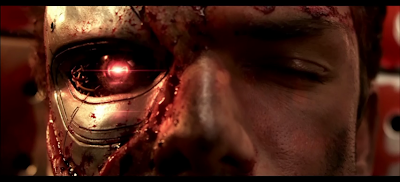
Appearing in three of the nine episodes; Darren Shahlavi will be remembered by Mortal Kombat fans as Kano -- the Black Dragon crook famous for killing Sonya Blade's partner and igniting one of the series' longest running blood feuds. Starring opposite Jeri Ryan (Sonya) and Michael Jai White (Jax); Shahlavi plays key to bringing the classic plot to life, injecting MK's original rogue with a fresh brand of delicious contemptibility.

The role proved to be Shahlavi's second brush with MK, one of the interesting facts he shared in this special interview with Mortal Kombat Online. With a Blu-Ray release coming November, MKO probed the actor for further insight into the role, the work, his history, the future, and which character he'd love to beat the snot out of.

[MKO]: How did you get involved with MK Legacy?
[Darren Shahlavi]: I got a message from Larnell Stoval, the fight choreographer, a few months earlier, saying he may want to get me in on something. Later, I heard they were doing Mortal Kombat as a web series, I asked my agent to look out for it, I also contacted Larnell, who knew about me. Kevin [Tancharoen; series Director] had seen Ip Man 2, where I play a rather brash British boxer, and they both thought I'd fit as Kano.

What is your background in martial arts and acting?
I started Judo when I was seven years old, and once I saw Bruce Lee, I was hooked on martial arts and films. I trained in everything and studied all the movies, too. I was most impressed with the Hong Kong films and when I was a teenager I took part in film fighting seminars, including one that [Ip Man star] Donnie Yen was doing in London, England. That gave me the confidence I could work in Asia as a bad guy, and by the time I was twenty, I was out there, working in film.

What was your impression of Mortal Kombat before Legacy?
I was very familiar with MK, mainly the movie and the soundtrack. I loved it. I trained to the music all the time. I didn't play the game much at all.

The first movie I ever did was a Hong Kong movie that starred Robin Shou a few years before he was Liu Kang. We met each other again in Hong Kong in a bar and he told me all about the filming of Mortal Kombat and showed me pics from the shoot in Thailand. I also visited him on the set of Annihilation in London. He said he could get me a small part in it, but at the time I'd just got a lead role in a martial arts movie called Bloodmoon, where I fought Hakim Alston, the guy who Robin fights with bo staff in MK1.

Kano's background has been connected to Japan, the United States, and finally Australia. You yourself have an interesting heritage. Is that something important to you as an actor?
Of course my background is very important to me. It is who I am. Born and raised in England, I grew up in Hong Kong and live in North America. I've worked on movies all over the world. As an actor, I'm sure it helps me that my roots may not be too deep, but wide spread.

Did you have a particular place in mind when you played Kano?
Good question, but the short answer is no. I didn't give us a location.

How would you describe your Kano, in general?
Seriously enjoyable, loves to be bad! He wants to be feared rather than loved, without a clue, that will change in time.

Kano gets an upgrade in MK Legacy!
Did you feel a specific sense of character or attitude was important for the role?
Absolutely. Untouchable, domineering, masculine yet proud arrogance. A pretty petty little gangster with dreams to be bigger than his dream.

The late Trevor Goddard made a real impression playing Kano in the 1995 film. You share some of his iconic dialogue. Did you take inspiration from his portrayal, or feel any pressure?
When I was younger my best mat Jawaz and I didn't see much of each other, as we lived far apart. We would greet each other with the line, "Hello, baby. Did you miss me?"

I loved what Trevor Goddard did with Kano and decided to play him more internally. I added "I'm gonna miss you, baby" [in Legacy Ep. 1] as a nod to Trevor's Kano. You don't try to top a great performance. Only to differ.

A lot of people are going to recognize you from other recent work -- I personally loved Ip Man 2. How does Kano stack up against another classic bad guy role
Twister" Milos?

Kano is Twister's little cousin. Can you imagine going out drinking with them both? It would be a riot. Someone asked how I prepared to play Kano, I said by playing Twister and having so much fun. The audiences everywhere loved to hate Twister, so I knew who Kano was right away -- Twister's little cousin. An ignorant, arrogant, small timer with big dreams, misguided, but going places because of big balls and a bigger mouth.

Your fight with Jax (Michael Jai White) set the tone for Legacy's action. What did you think of the style of action and choreography?
Larnell called me the Sunday before we went to camera and said, "Where are you?" I said, "At home watching a movie with a cup of tea." He said they were rehearsing the fight and waiting for me!

Somebody from production forgot to contact me and tell [me] about the rehearsal, so by the time I got there I was playing catch-up and didn't get any chance to add anything I wanted to the choreography. When we came to shoot it, they had been shooting other stuff all day and we had two hours to rush through the fight. Believe me, at the rate of speed we were going, Kevin, Larnell, our DP Kim [Miles] and the crew, and Mike and I, we did good. We had to skip some of the stuff and normally I would have been saying I need to do some kicks here, etc, but there was no time. Larnell did a great job. I just saw Sektor and Cyrax; the fight was magic. Kevin has a wonderful vision and is prepared to the brim. He has an infectious enthusiasm, with experience and conviction way beyond his years.

If you could have any fight with another character or member of the cast, who would it be?
I want to fight Goro. I want Kano to kick the shit out of Goro, up and down and all around. Big, fast, powerful, well placed kicks, like Hwang Jang Lee against Andre the Giant!

So, what was it like having your eye punched out by another man? Was that something that attracted you to the role, or was it just a little extra bonus?
That's the strangest question anyone has asked me in a while! Never crossed my mind.

How cool is it having a cybernetic eye? How was that special effect achieved and was it as awesome as it looks?
It was uncomfortable. Modifications will need to be made, but I thought it looked wonderful. It actually had an LED and a battery behind my head, so the light did glow. All the crew wanted pictures with Kano that day!

Kano really bookends Legacy, appearing in the first and last episodes. He's a stalwart of the games. Is this a character you would like to do more with?
I'd love to play Kano again, a number of times.

There is a lot that one can do with a young fresh bad guy like that. We've only just begun.

What do you think might be in store for the future?
No idea. Nobody has officially mentioned anything to me.

Legacy feels like a hot girl you got to shag once, and you hope to run into her again soon and really get to know, explore, and play around. Have some fun and maybe get serious.

Originally Posted: http://www.mortalkombatonline.com/content/News/read.cds?article=1552

Monday, July 18, 2011

Mortal Spotlight: Q&A with Shane Warren Jones!
Programmed to Fight -- Cyrax as he appears in Mortal Kombat: Legacy!Comic-Con International 2011 runs July 20-24 and it's there that -- after a month a half's wait -- fans will finally get their chance to glimpse the long awaited ninth episode of Mortal Kombat: Legacy!

Featuring a surprise spotlight on Cyrax [pictured right] and Sektor; the episode will tell the tale of Lin Kuei warriors fated to become unfeeling, mechanized weapons. With a design borrowed from the latest Mortal Kombat video game, the episode speaks directly to fans, spotlighting the MK3 additions in a curious close to a series that featured mainstream icons like; Sonya (Jeri Ryan), Jax (Michael Jai White), Scorpion (Ian Anthony Dale), Raiden (Ryan Robbins), and more.

The unexpected delay in schedule already has many speculating about what lies ahead at Comic-Con, which has become one of the most reported launching pads for new and existing projects. With an uncensored BluRay release already on the cards, possibilities of a television expansion, or feature film, remain open.

In anticipation of the episode and the series' conclusion, Mortal Kombat Online took the opportunity to talk to Shane Warren Jones before he officially becomes a cyborg assassin. The actor stars in dual roles as both Cyrax and lesser known Malibu Comics creation, Hydro. MKO probed him for more on that surprising twist, as well as his experiences with the series and hopes for the future.

[MKO]: How did you first get involved with MK Legacy?
[Shane Warren Jones]: Well, I first heard about it when a couple friends of mine had worked on the MK: Rebirth pitch. I literally got an audition a week before shooting started and flew out the following weekend for a fitting and two days later we began shooting.

It seems to be a role that demands a lot of physicality. What kind of background do you have?
The physical background I have is in dance and martial arts. I've studied kung-hu for a few years and dance all through high school/college. I started training at a gym called White Lotus Martial Arts in Los Angeles about three years ago, and have been studying a sport called Tricking ever since. It's a good work out.

As an actor/martial artist, which skills have been most stretched by MK Legacy?
Definitely the martial arts aspect.


You play a cold-blooded cyborg programmed to kill in one of the most violent fighting franchises in games. What's something warm and reassuring people might like to know about you?
[Laughs] True, true, that is an accurate assessment of my character. Well, I'm a huge nerd and hopeless romantic at heart... So... yeah... The complete opposite of a cold blooded cyborg anything! If you get me in a room and talk comics I'll probably nerd out with you. I grew up with the stuff. But shhhhh, don't tell anyone. Ninjas can't love, or nerd out.

What was your impression of Mortal Kombat before joining Legacy?
Like I said; I knew some of the guys on the Rebirth pitch and I was very impressed with the quality and realism put into the project for an under the table pitch [laughs]. Then I got to read the script and my role on the plane and I couldn't help but get excited.

How familiar were you with Cyrax before getting the part?
I was familiar only through his introduction in MK3, but I did my research and was really excited to see that the character had such a cool arc to it.

Have you played the new game at all?
I didn't get to play the new game until after I had already shot, but I've played it at the launch party, loved it and will say that I did beat our director, Kevin Tancharoen, in one round at the party... Which, in my opinion, isn't bad for never having practiced before. That dude plays a mean Smoke! [laughs]

Hydro -- Illfated Lin Kuei Fighter Created by Malibu Comics!There have been a lot of reports that you're playing two characters -- Cyrax and Hydro. Is that accurate?
Yes, that is correct. All I can say is that Hydro is also part of the Lin Kuei. [smiles]

What were some of the demands of playing two characters? How did you separate them?
Well, I was lucky in that there wasn't a lot of info on Hydro, so it was pretty hard to mess him up. It all came down to what Kevin wanted out of me performance-wise. Some of the difficulties would be, what are essentially the different, distinct mannerisms of the individual characters themselves. I tried doing some research on [Hydro] and not very much came up other than, 'He only appears in a few issues of the comic.'

The games have seen a lot of plotlines over time. Is Cyrax a character you'd like to do more with?
Oh, absolutely! Like I said before, Cyrax has really grown over the course of the past six games. While I haven't played the ones in between MK3 and MK9 at length, I am aware of the turn the character takes and his journey in juxtaposition to Sektor's journey, and without revealing too much before the episode, I believe we've only touched the surface of it, and I would LOVE to really flesh that character out for the fans.

We've seen pictures and trailer clips of the suit. What was it like to wear? Does the work diminish the 'cool factor' of the look?
[laughs] The suit was snug, to say the least, and there was no cool factor being diminished. What's the point of being a ninja if you can't even enjoy wearing the cool gear... Am I right? [He's right, folks.]

Cyrax and Sektor -- Looking Quite Cool!

The last episode has been held off for a month and a half. Has the added wait been as tough for you as it has been for fans?
[laughs] Harder even... trust me. It's been quite a ride.

What do you think the future holds for MK Legacy and its characters?
I hope, much like everyone else, that we get a series and/or movie going with the grittiness that Kevin wants and can deliver. MK is a really visceral franchise and needs someone who can really put that on the big screen.

What are you hoping people take away from the SDCC unveiling of the episode?
What I hope people take away is that first and foremost that we are badasses [laughs]. I'm kidding.

What I hope fans take away, those who enjoy the series and those who had other expectations -- (I've read some of the venom spewed on YouTube [laughs]) -- is that there is an incredible amount of work that goes into the entertainment that they enjoy. Not just from the actors, but from the crew -- directoir, stunt coordinators, stunt men, producers, studios, etc etc. This is all done to please them because we love what we do. I hope they enjoy it and it makes them dream a little bigger.

Originally Posted: http://www.mortalkombatonline.com/content/News/read.cds?article=1528

Friday, January 14, 2011

HULK versus SILVER SURFER
Planet Hulk: Exile Part IV (Marvel)
Where:
The Incredible Hulk #95 When: July 2006
Why: Greg Pak How: Carlo Pagulayan

The Story So Far...
Approached by SHIELD to undertake a mission in space against a rogue satellite; Bruce Banner, as he so often has, attempted to turn his burdened curse into a force for good. As his alter-ego, Hulk, the conflicted hero learned of a plot to rid the Earth of his existence, hatched by Iron Man, Mr. Fantastic, Dr. Strange, and Black Bolt -- members of the secret cabal of heroes known as The Illuminati. Having grappled with internal rogue elements as dangerous as the reality altering Scarlet Witch, they no longer saw a tennable solution for the Hulk's unpredictable and devastating rampages.

Ejected into outer space; Hulk attempted to free himself from The Illuminati's vessel with brute force. The assault knocked his ship from it's course to a remote, habital planet, instead sending the green goliath through a wormhole, which deployed him to a distant, savage planet called Sakaar.

Weakened by his intergalactic journey, Hulk is quickly sold into slavery on Sakaar, powerless to prevent his admission into the Empire's gladiatorial system held in the Great Arena. Inadvertently thrust into a group of surviving warriors, Hulk's powers begin to grow anew, posing a threat to the Emperor's rule as he aids his fellows in their battles. A win away from freedom, with the Emperor's blood on his mighty green hand, "The Green Scar" and his Warbound must now face the ultimate challenge. A warrior captured from the stars and forced to fight. A master of the power cosmic. A former ally to the Hulk himself -- The Silver Savage!

Tale of the Tape...
Strength: Hulk 6 (Invincible)
Intelligence: Silver Surfer 5 (Professor)
Speed: Silver Surfer 7 (Light Speed)
Stamina: Draw 6 (Generator)
Agility: Silver Surfer 3 (Acrobat)
Fighting: Hulk 6 (Warrior)
Energy: Silver Surfer 7 (Cosmic)


Real Name: [Bruce Banner]
Group Affiliation: [Warbound]
First Appearance: [Incredible Hulk #1] Year One: [1962]
Win Percentage: [59.26%] Last Opponent: [Rulk]
2006: [#6] 2007: [#10] 2008: [#5] 2009: [#36]

Dr. Robert Bruce Banner, a slight and insignificant scientist, lives slavishly dedicated to the pursuit of knowledge, as funded by the United States military.
Though Banner justifies his goals as means for peace, he becomes one of America's leading weapons designers after inventing a gamma radiation bomb.

During preperations for a test launch in the desert, Dr. Banner spots a reckless youth on the testing ground, and in a moment of magnificence, knowingly throws himself on a bullet that would grant a far crueller fate than death. Bitterly aware of the Communist conspiracy of his fellow scientist, Banner struggles to usher he and the boy to safety while his colleague continues to countdown the launch.

After succumbing to an ordinarily lethal doses of gamma radiation, Dr. Banner soon finds himself undergoing a horrific transformation. Originally by night, but soon triggered by rage or unease, Banner discovers the superhumanly strong alter-ego within himself, dubbed simply - the Hulk!

As Hulk, Banner's brilliance is reduced to a childlike lumbering, while his slight frame conversely comes to possess size, strength, and durability never before imagined. After being ejected into space by the secretive superhero Illuminati, Hulk came to land on a planet called Sakaar. While there, he developed a moderate intelligence with a keen mind for combat, hardened by forced gladiatorial combat. In The Great Arena, Hulk is joined by Korg, Brood, Shadow Warrior, Elloe, and Miek, collectively the Warbound.

Hulk has no specific known weaknesses, but is fiercely protective of the few who earn his favour. Though generally good hearted, Hulk is prone to wild rages and varied personalities, particularly provoked by any challenge to the identity of his persona, particularly where matters of his physical dominance are concerned.

Real Name: [Norrin Radd]
Group Affiliation: [Galactus' Heralds]
First Appearance: [Fantastic Four #48] Year One: [1966]
Win Percentage: [50%] Last Opponent: [Beta Ray Bill]
2006: [#21] 2007: [#22] 2008: [DNR] 2009: [#119]

Once an inhabitant of the paradise world Zenn-La; Norrin Radd was forced to enter into a faustian pact for his soul in order to protect his planet and beloved, Shalla-Bal, from the endless hunger of omnipotent world devourer, Galactus.
Pledged to serve as herald to the devourer and seek out planets to satisfy his sustainance, Radd was bathed in the Power Cosmic, transforming him into the chrome-coated space rider and harbinger of death, the Silver Surfer.

When first leading Galactus toward Earth, the Silver Surfer was engaged by the Fantastic Four, who were aided by The Watcher. During battle with Thing, the Surfer was knocked into the studio appartment of a blind artist, Alicia Masters. The kind touch and concern of the sculptress was key to reawakening the spirit of Norrin Radd, who then chose to use his powers against his master. Galactus spared Earth, but exiled his herald to the confines of the Milky Way Galaxy. As a result, he briefly held membership with The Defenders, along with adventuring many more times alongside the Fantastic Four.

The Power Cosmic grants Silver Surfer a near limitless array of abilities, many of which are rarely explored. At the outer limits of his skill, the Surfer has been shown to adapt telepathy, convert matter into alternate substances, and even time travel. More typically, he possesses greatly enhanced strength, stamina, and endurance sufficient enough to withstand even the harshest of environments unphased. He channels cosmic energy into projectile bolts as a means of combat, and can also control all aspects of his board, upon which he travels. The board is an extension of his being, but does not have any inherent baring on his power.

Additional: On designate Earth-2149, Silver Surfer had an encounter with zombie versions of Hulk and the other Avengers. In this reality, Silver Surfer was still herald to Galactus, arriving on Earth much later than his counterpart in mainline continuity. Hulk was strong enough to bite through the Surfer's cosmic chrome, leading both Silver Surfer, and his world devouring master, to suffer the ironic indignity of being eaten. The Surfer's fate was sealed in Marvel Zombies #3.

Despite a long association between the characters, which includes their mutual status as founding members of The Defenders, this is the first time the two have met on The Comic Book Fight Club.

History: N/A
Statistics: Silver Surfer Ranking: Hulk (#6)

What Went Down...
A triple drum call echoes throughout the realm, announcing a public holiday for the citizens of The Imperial Crown City. It means but one thing for those whose path leads to the Great Arena -- "It's gonna be a bloodbath."

Entering the arena first are the challengers, whose record includes victory over the Maw and Wildebots, with the loss of only one warrior, Lavin Skee. They are Horoim the Shamed, the mighty Shadow Warrior; the descriptively titled Brood, from Broodworld; the stoney Korg of Kronan; loveable fighting bug, Miek the Unhived; and the hulking hero of the people, The Green Scar!

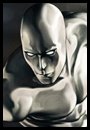
Their opponent, the ultimate contest for these Warbound warriors, is a chrome skinned hero from the stars, repackaged for the Great Arena as a board-shielded, mace wielding bad ass, The Silver Savage!

The Green Scar, Hulk, clearly recognises his opponent, revealing his identity to be that of former ally, The Silver Surfer! Controlled by the same retarding slave discs that punish any sign of rebellion amongst the Warbound gladiators, Silver Surfer is unable to resist the Emperor's demand for combat.

The first blow belongs to this Silver Savage, who delivers a devastating charging uppercut with fixed mace, powerful enough to shatter Hulk's shield and send the armored Green Scar and his fellows toppling like never before!

Hulk ties up with his former Defenders teammate, to share a piece of his mind. The Surfer plays it a little more direct, however, sending Hulk careening across the arena with a cosmically charged headbutt, for his troubles. His utterance, "forgive me...," offers little consolation to his fighting foe.

The rest of the Warbound join the fray, but Brood and Miek are just as easily defended against. Using his modified board as a shield, the Surfer blocks Miek's leaping attack, whilst tending to the more effective Brood with a swing of his arena supplied, energy crackling fixed mace.

A rampaging Kronan would likely rock any other being to their core, but the Silver Savage is swift in his dismissal of the undisciplined assault, counter attacking with a simple rise of his board. The impact of Korg's landing sends a destructive crack through the Great Arena seating!

With an eye for a more strategic attack; Hulk, still recovering from his first dash against the cosmically powered Surfer, formulates a motivated assault on the Surfer's only obvious weakspot, on the same page as former Shadow Warrior, Hiroim. The fallen former imperialist leaps into the air for an overhead strike!

The Silver Surfer confidently raises his shield to defend against the aerial attack, leaving himself wide open to a head-on collision from the incredible Hulk! Hulk drives Hiroim's spear directly into the control disc attached to the Surfer's chest, successfully rupturing it! The effect is quick working, freeing the Silver Surfer from the device's controlling influence. His gratitude is swift. Hulk is swifter...

As the Green Scar's mighty fists come crashing down upon the limp silver form beneath them, something primal, old, inherent in his DNA comes out. The crowd's cheers turn to shocked silence, but the Hulk hears neither, unleashing a rage that decimates a Silver Surfer who is no longer a threat. The stoney hand of Korg stays Hulk's pounding fist, "Hulk, no. We've won."

A monster's roar gives way to a sense of clarity.

The third victory is secure.

Hulk has earned his freedom...

The Hammer...
Given recent history, I'm reluctant to promise a lot of these 2011 updates, but I do so very much enjoy the prospect of returning to these meaty, instant classic battles. In the scheme of things, The Comic Book Fight Club has dwelled so often in obscurity, the contemporary, or personal obsession, that some of the biggest battles and most famous comic book rivalries have failed to make an appearance. In the scheme of things, this is a comics blog that has only scratched the surface of it's subject matter -- an exciting prospect!

I have to admit straight away, I passed Planet Hulk up on it's initial run. Worse still, what really inspired me to bring this particular battle to the site was the animated film based on the comic, which notably omits this fight in favour of an adaptation featuring Beta Ray Bill in Silver Surfer's place, who was licensed elsewhere. This really isn't an illigitimate way to breach characters, or stories, but as a die hard old comics reader with designs to be a credible source of information, I guess I'm just not used to resorting to second-hand second-glimpses, like that.

Ultimately, even after comic and cartoon, I'm not entirely convinced this is a story for me, but I so totally admire the conviction of Greg Pak's story, and the Planet Hulk concept as a whole, that I cannot deny it it's dues. To really get a grasp of Planet Hulk from this context, I think you need to look at the whole.

In these heavy thinking times, Hulk has become a far more difficult character to write than the basic concept might suggest. A brilliant, peaceful scientist who becomes victim to the raging beast within is still a very interesting and viable concept, but the Hulk's legend has grown over time so much so that accepting his simple existence in a Marvel Universe has become a tricky subject.

Some of my favourite features on the site come from guest-spots, or one issue stories, but Hulk can no longer meander from one appearance to another as freely as he did in decades gone by, certainly not without raising larger questions from an increasingly savvy audience. Causality is nothing new in superhero comics, but the bredth of it's reach has expanded and intertwined with other concerns, such as a tone of consistency and greater, more plausible balance of risk and threat in fiction that depends on the survival of it's iconic characters.

This conspiracy of ideas, to refine the purity of Hulk's status as "strongest one there is," alongside the desire to do so with a sense of superhuman versimiltude, has meant that the classic enterprise of pitting the Hulk's mindless strength against other heroes now demands an event unto itself. It's not enough to have Matt Murdock meet Bruce Banner in New York City by chance [Daredevil #163], or let Hulk walk away from a clash that threatened the lives of the American Winter Olympic team [Marvel Treasury Edition #25]. Now there must be consequence, and if forty years of an unpredictable power of Hulk's significance demands a sense of consequence, then attempts at longterm solution become inevitable.

I like Planet Hulk because it comes from a couple of good places.
On the one hand, the premise of ejecting Hulk into space comes from the simple perspective of wanting heroes to have the credibility of recognising a threat, in a world where an ultimatum between franchises can never be made. Ejecting the character into space, even in the knowledge that it won't last, is as elegant a way to make everyone look good without creating an unsolvable, impossible situation. Quite the contrary, when, this is the basis for an opportunity to work with a high concept that, in one sense, plays very much to the character, but in another, takes it to a whole new place.

[Greg] Pak credits Marvel Editor-In-Chief, Joe Quesada, with the invention of the Planet Hulk story. There seems to be no denying, however, that the success of the story comes straight from the writer himself, who was given enough rope to tell an unlikely story, his way. The result is a textured approach to event comics, as big an idea as something like Civil War, without the loss of character that comes from such a large scope. This is "event comics" with the grounding of the tried and true method of writing storyarcs, bolstered by a dedication to a focal point, even if attention is shared with other strong characters.

The gladiatorial aspect of Planet Hulk seems right up a vintage alley, relevant to some of the earliest Stan Lee adventures, which gleefully pitted Hulk against his fellow Marvel heroes in some of the earliest examples of these classic rivalries [ie; Tales to Astonish #79]. The idea of dropping Hulk on an alien planet, where his powers aren't at their height, is twisting that original combative premise on it's head in a way that makes good use of the unique situation. Combine this with the presence of the Warbound supporting cast and their converging plotlines, and you've got a very admirable and unique chapter in the Hulk's illustrious history.

You couldn't talk about the event of Planet Hulk without mentioned World War Hulk, which bridges the gap between then, and now. The most enduring legacy of World War Hulk remains the invention of Red Hulk -- gamma irradiated alias of General Thunderbolt Ross -- which has very specifically represented a rebuttle to the kind of thinking that brought us to now. "Rulk" and Hulk have been a part of a couple of years of storytelling under Jeph Loeb [and Ed McGuinness], who've very much retreated back into a way of approaching the Marvel Universe that has very few signs of consequence, initiated by the mass destruction of World War Hulk, but taking it much farther in it's disregard for other characters.

Personally, I think Planet Hulk got it right.
There's a balance in the world that takes a very individual, removed perspective, but retains a referencial tone. Pak balances his own goals with the pop precepts that drive Loeb's action-heavy guest spots, giving us this rather exciting issue of Hulk versus Silver Surfer, with a more organic consideration for what's plausible or appropriate. Granted, the story makes a time-based exception to allow for the concurrent Annihilation event that featured Silver Surfer, but does so quite elegantly, with the overriding consideration that Silver Surfer is an enticingly connected character within the Hulk mythos, with every potential to be there. It's something the Loeb stories lack, or at least, fail to exhibit with as much delicacy.

Back matter in the letters page of single issues includes blog-like scans and reference material from classic Hulk comics -- a feature that almost redeemed farcical opus, Cry For Justice -- which reveals Pak's efforts even further. As a side, it not only makes buying the back issues well worth it, but also exhibits a technique that really should've been more prevelant in comics since the 2006 cover date. As an invested fan, I enjoy the context and wallowing in the history and continuity of the canon. For younger readers who have become notoriously characterised as stupid and lazy, this kinda stuff should be a good way to indoctrinate some backstory and perspective into them without the contextual vagaries of Wikipedia descriptions.

Visuals are vibrant and exciting, with Pagulayan looking equally comfortable when emoting the melodramatic expressions the story demands, or having the Silver Surfer explode into a fullpage assault with a fixed mace. He's joined by Marshall Rogers early in the issue, who contributes for a flashback sequence describing how the Silver Surfer came to be on the planet Sakaar.

All in all, if you fully comprehend that this is as far removed from the Marvel Universe and Hulk stories of the norm', then there's no reason to hesitate in getting a closer look. By it's removed nature, I'm not sure it can ever stand as one of the all-time great Hulk tomes, but as time goes on, I'm sure Planet Hulk will be fondly remembered as something a little bit different.

Winner: Hulk & Hiroim [w/ Brood, Korg, and Miek.]
The Fight: 5 The Story: 4.5 The Pictures: 4.5