skip to main |
skip to sidebar
 JUSTICE LEAGUE versus WOOD KINGAll Together Now (DC)
Where: Secret Origins #32 When: November 1988
Why: Keith Giffen & Peter David How: Eric Shanower
The Story So Far...
On the distant planet of Appellax, the Kalar has been assassinated! Seven Appellaxians claim responsibility for the murder, seeking to succeed their beloved leader by the law of warring tradition. In order to reveal the true Kalar among them, a competition is devised, a trial by combat!
Rather than risk devestation to the Appellaxian people, Earth is selected as the arena of their gladiatorial quest. Transported inside strange meteors; the seven warriors take synthetic form, their false bodies possessing unique powers to aid them in a quest across the globe to defeat their rivals. Such a task may prove more difficult than anticipated, however, as their violence tempts the unanticipated interference of Earth's newest wave of champions!
With five of the seven warriors already defeated, the individual heroes responsible converge on Florida upon reports of another meteor landing in the everglades. There, the group face an opponent unlike any of the others!
Tale of the Tape...

 Strength: Martian Manhunter 6 (Invincible)
Intelligence: Flash 5 (Professor)
Speed: Flash 7 (Lightspeed)
Stamina: Green Lantern 6 (Generator)
Agility: Black Canary 4 (Gymnast)
Fighting Ability: Black Canary 4 (Trained)
Energy Power: Green Lantern 7 (Cosmic)
 - The Justice League are: Aquaman, Martian Manhunter, Black Canary, Green Lantern, & Flash.
Born of necessity; the Justice League represent a coordinated effort by the world's finest heroes to protect and serve in the many iterations of their regional representation, and on a global scale. Boasting some of the planet's most powerful humans and extra-terrestrials, the League is equipped to combat any threat that should overwhelm the individual efforts of their member, or conventional defenses of the world's nations.
The League is classically defined by the core membership of it's founding members, affectionately referred to as the big seven. Overseen by stalwarts, Superman, Batman and Wonder Woman, they are; Flash, Green Lantern, Aquaman and Martian Manhunter. Several of these members would come to be succeeded by others baring their name, Wally West and Kyle Rayner, while many other heroes would come to be prominently listed with the group; Hawkman, Atom, Green Arrow, Black Canary, Zatanna, Elongated Man, Firestorm, Captain Marvel, Red Tornado, Blue Beetle, Booster Gold, Fire, Ice, and others.
- Wood King is a member of the gladiatorial race of the planet Appellax.
Upon the death of their leader, the Kalar, Wood King was among seven Appellaxians who claimed credit for the murder. In an effort to settle the dispute at a minimal cost to the planet Appellax, each warrior was granted a synthetic vessel empowered, with unique abilities, to combat each other on distant Earth.
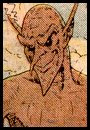
Wood King, as his name suggests, beheld a body made of wood.
Like some of his counterparts, he possessed the ability to transform other humanoids into wooden minions under his control. This ability served him well during a confrontation with a pre-Justice League collective.
History: Prior to their encounter with the Wood King, each of the eventual Justice League were to defeat their own Appellaxian opponent. The following match-ups include five key encounters, as well as an additional battle fought in Antarctica by a lone Superman. In this version of the Justice League origin, the group does not approach him, and consequently does not petition his membership.
Martian Manhunter battled Stone God
Aquaman battled Mercury Monster
Black Canary battled Glass Man
Green Lantern battled Golden Roc
Flash battled Fire Giant
Elsewhere, Superman faced the Crystal Creature
Math: Justice League Ranking: Green Lantern (#28)
What Went Down...
One by one the heroes funnel in to the everglades, each falling victim to the same strange trap! With no alien warrior in sight, only the eerie glow of a partially submerged meteor greets them, it's proximity beginning a transformation that roots each champion to the ground -- literally!
Trapped inside a wooden facade, the heroes stand helpless as human-trees!
The strange meteor splits in two with an explosive crack, finally revealing the creature responsible: the Appellaxian dubbed, Wood King!
With the wills of the Green Lantern, Martian Manhunter, Flash, Black Canary, and Aquaman under his control, the Wood King begins a slow march toward his final opposition - the Crystal Creature - whose landing has brought him to Antarctica!
Recognising the potential power of the Green Lantern, it is Aquaman who begins the vital chain reaction in a plot to escape. Summoning an unlikely resistance to the Wood King's control, Aquaman shifts his weight just enough to bump into the wooden visage of the Martian Manhunter!


 The knock is enough to clumsily steer the Martian toward the Green Lantern, inspiring in him the same plan as his fellow. With an effort of his own, his branch-like hand does enough to crack the shell encasing Hal Jordan's ring!
With his will supressed by the Wood King, the inexperienced Green Lantern, Hal Jordan, proves unable to escape his predicament single handedly. Instead, he summons what little effort he can, firing a beam with the intention of freeing the hero at closest poximity, the Black Canary. Unable to resist Wood King's for long, he is only able to expose her head, but in the case of the Canary, it is enough!


 With the Wood King sensing resistance from his slaves, the Black Canary takes her fleeting opportunity, directing the sonic waves of her "canary cry" to offer Flash the nudge necessary to allow him to vibrate his molecules enough to escape the transformation process!
Wood King attempts to use his strange powers to once again entrap the Flash in his own body, but without the element of surprise, he cannot overcome the speedster's unique ability to control the movements of his own molecules!
 Moving at super-speeds, the Flash converts his hands into human buzzsaws!
He makes light work of the synthetic wooden form that houses the spirit of this Appellaxian warrior, freeing the other heroes in the process!
 The Hammer...
With the entire team contributing vital assists, it is the Flash who secures victory for they who would become the Justice League!
For those who came in late -- this concludes our abbreviated tour through the characters who finished 2008 at the top of our seasonal ranks. The Infinite Wars uses superhero fights to steer us through the review process, giving us the unique opportunity to make a gestured attempt at tracking the battling success of the heroes and villains of the major superhero publishers. Longtime readers will know this, but I recognise that sometimes it wouldn't hurt to recap for those just joining us.
While I was tempted to conclude the month with the Final Crisis: Reqiuem special, (highlighting the Martian Manhunter), it did occur to me that I've owed this week's entry for quite some time. If you're curious about the previous instalments of this version of the Justice League origin, you'll find all of the individual battles, as well as Superman's brief appearance, in The Tape section.
As is so often the case on our strange little blogsite, curious resonances emerge from this week's deviation. While avoiding a slightly more topical review, we inadvertently find ourselves inducting Barry Allen into the first 2009 Top Five. The Silver Age Flash, of course, will be the subject of DC's upcoming mini-series, Flash: Rebirth, which follows on from his apparent "return" in Final Crisis.
 With our annual January tradition out of the way, Final Crisis will be a subject sure to emerge prominently in the next few months of Infinite Wars.
Among the February features stemming from the much-discussed series will be our thoughts on a potential post-FC reinvention of the Justice League franchise -- another approriate connection to this week's review!
While I'm inclined to be very critical of misconceptions about the complexity of DC comics, I do have to acknowledge, there are hiccups to navigate when exploring the historical development of major brands. The Justice League are certainly no exception, as evidenced by this, the 1988 Secret Origin, which had the duty of redefining history after the deconstruction of Crisis on Infinite Earths.
Recent history has seen something more reminiscent of the original origin reinstated. Replacing Black Canary in the original line-up is Wonder Woman, while both Batman and Superman; colloquially the World's Finest; can claim responsibility for thwarting the Crystal Creature, thus inducting DC's trinity into the founding formation of their leading super-team. Likewise, it restores the famed legend of the Justice League "big seven."
Top 25 Justice Alumnists
#1 Batman (1960)
#2 Superman (1960)
#3 Wonder Woman (1960)
#4 Flash (1989)
#5 Steel (1998)
#6 Green Arrow (1961)
#7 Hawkman (1964)
#8 Hawkgirl (1977)
#9 Green Lantern (1960)
#10 Green Lantern (2003)
#11 M. Manhunter (1960)
#12 Black Canary (1969)
#13 Flash (1960)
#14 Aquaman (1960)
#15 Zatanna (1978)
#16 The Demon (2002)
#17 Green Lanter (1987)
#18 Firestorm (2006)
#19 Black Lightning (2007)
#20 Red Arrow (2007)
#21 Green Lantern (1996)
#22 Atom (1962)
#23 Dr. Fate (1987)
#24 Red Tornado (1973)
#25 Atom Smasher (1994)I'm sure, somewhere out there, someone shares a similar affection for the 1988 origin, to me. I do not think any of us could rightly criticize DC for their desire to maintain the influential presence of their three major icons. The modern era has consistently looked to Superman, Batman, and Wonder Woman, to define the parameters of the vast landscape. They are among the most enduring characters in comics, surviving the Golden Age in a transcendance that has ingrained them in modern history in ways the traditional JSA characters have missed.
That's not to say the JSA have been wronged by this new tradition, either. Through the shifting timescape, the Justice League become exactly what they were -- a deeply influenced byproduct of the JSA's history.
As described in modern versions of the origin, the Justice League derive their name from their predecessors.
The trinity, in leaving behind their Golden Age history, become tributes to it, reemerging as part of a sense of legacy that defines the DC universe.
Despite being part of an awkward crunch of history, it requires little imagination to suspend the cynical dissemination of un-reality, giving room for what eventually becomes beautifully poetic simplicity.
This sense of merging real-world function in the rolling development of superhero fiction, with it's in-fiction consequences, was an underlying feature of Final Crisis. That, however, is a subject to be discussed further in February!
The Fight: 4 The Issue: 5.5
Unfortunately, to the best of my knowledge, the restructured history of the Justice League has rendered this version of their origin moot, and out of print. Fortunately, the Infinite Wars Gift Shoppe contains collected editions of many great stories featuring the Justice League and it's members! There you'll find editions featuring most issues reviewed previously in the Infinite Wars, all of which will contribute to the site upon purchase. So next time you shop, stop by!
QUICK FIX DOUBLE FEATURE: Appelaxians Attack!FLASH versus THE FIRE GIANT
All Together Now (DC)
Where: Secret Origins #32 When: November 1988
Why: Keith Giffen & Peter David How: Eric Shanower
Quick Fix...
Well, while DC's weekly series Countdown simmers toward the boil of Final Crisis, we've got our own convergence of plotlines! Over the past couple of weeks we've been talking superhero teams, and after closing on the League, it seemed like a perfect segue to go back to the Secret Origin of the Justice League! We'll talk more about the League in the second half, but if you want to get yourself up to date, why not check out the back issues! [A League of their Own!, An Appelaxian A Day..., JLA: Classified #3]
Blink and you'll miss the subject of this half of the Quick Fix!
If you're new to the site, you might like to know that we review and tally superhero fights whilst talking about the medium and the materials in question. Amongst the many feats of multi-tasking is our cumulative Super Stock rankings, now entering their third full year of record. Anyone keeping tabs will know the Flash, in his many incarnations, isn't looking too shabby against the competition, but that isn't quite enough for me...
Regardless of your preference, the Flash is undeniably one of the greatest superheroes of all time. It's the unashamed colour of the character - bright red with a yellow lightning bolt - and the simple distillation of superhuman feat: the ability to run faster than anything in the world.
As the science of speed thrust itself on the modern readership in the Silver Age of comics, the character gained new complication through contrivances for abilities new and old, but for the most part, it's left the basic mechanics of the character uninterrupted for nearly seventy years. The Flash runs fast!
So, who is the Flash?...
 When I think of a character that embodies the viability of succession in mainstream superheroes - it's the Flash! From the original 1940 Jay Garrick, the Flash was among the successful crop of Silver Age DC revamps that also included distanced revisions of Green Lantern and The Atom.
In 1956 DC debuted it's new union suited scarlet speedster, who was struck by a bolt of lightning that embued him with the powers of the superhuman speed force! A police scientist by day, Barry Allen straddled the line of magic and fantasy carried by his predecessors, while also incorporating pseudo-science in ways that would define the Silver Age and the following Marvel Age of the 1960s.
Allen's reign as Flash introduced many classic elements into the comic book zeitgeist, among them the lightning bolt origin, and the hidden costume compressed in an inconspicuous ring. The character continues to be revered to a degree that has kept him officially dead since the 1986 Crisis on Infinite Earths, where his heroic sacrifice prevented the destruction of everything at the hands of the Anti-Monitor's anti-matter canon. A rare feat in comics!
Allen was succeeded by the Flash most modern readers will be intimately familiar with; Wally West. West was anything but a new character when he graduated into the role, having spent several decades in a yellow version of the suit as the original Kid Flash. Though there remain to this day dedicated fans to the former, West's transition has to be one of the most impressive in modern comics, with his widespread acceptance leading to an ironic pickle.
Twenty years after West's successful transition into the title role, it seemed DC comics were to attempt to do it all again with then-Kid Flash, Bart Allen. The move proved unpopular, and by design or response, the new Flash was killed months after accepting the role, coinciding with the official return of Wally West, who remains the Flash to this point.
The Flash, (similar to the Green Lantern), has become a tent-pole amongst fans for their fandom and era of readership. Most can describe their version of the character, and for me, particularly through a childhood of back issues, I've come to regard Barry Allen as my Flash. Of course, Wally West has been a present and enjoyed influence, but in thinking about it, I realise I prefer Allen.
Definitely one of the big hitters of his time, the Barry Allen Flash is consistently numbered amongst the founding membership of the Justice League, despite it's many revisions. In the version we're looking at from 1988, Flash finds himself accepting acknowledgment from the Queen of England, when word of wildfires takes the speedster across country for an investigation.
 The Flash arrives to discover a giant flaming man stalking the streets of Croydon. Quick thinking leads Allen to generate a mighty wind to attempt to blow the creature out, but alas, the Appelaxian is only ignited further by the gust.
As with the other Appelaxian invaders, the Fire Giant attempts to use his abilities to transform the Flash into a creature of flame. Fortunately for our hero, control over his molecular structure is key to the manipulation of his speed, meaning he easily vibrates to a frequency of normalcy.
Freed of the afflication, the Flash heads for a nearby lake, using his speeds to tread water and create a contained typhoon. He manages to direct the swirling funnel of water toward the flaming giant, but the heat of the creature's flame reduces the water to steam before it hits. Looking for an alternative, the Flash tries the same trick, this time with sand, but the Fire Giant uses his heat to turn the sand to glass!
 Recognising his failures in fire fighting, Barry Allen's smarts kick in, and it finally occurs to him to remove an element to extinguish the flame!
Moving at super-speeds the Flash creates a vaccuum in which the creature cannot sustain it's flames -- revealing beneath the grey form of a humanoid shell. In it's native tongue the Appelaxian howls cries of objection as his mind is wrenched from the vessel in which he was to compete.
As with the other heroes who encountered the Appelaxian gladiators, Flash learns of the presence of another in the Everglades. At mach speeds the Flash makes a beeline across the ocean, in the direction of the United States!
 In keeping with our recent discussions, I do confess my preference for the Barry Allen Flash, but not at the cost of progress. I appreciate the reverence with which the character is regarded, and enjoy the influence Allen continues to have on the mantle of the Flash, but also happily accept the succession of the role.
Time constraints have hindred the fluidity with which I wanted to talk all things Flash, but there's still time to wrap up on a key issue that convinced me to tackle this issue now. Despite an A-list resurgance for the character under writers like Mark Waid and Geoff Johns, the Wally West Flash is in the worst shape of his printed life.
After the bungled mess of Bart Allen's brief stint as the character, and the shafted disappearance of West post-Infinite Crisis, attention cast on the character has been mostly negative. Mark Waid failed to endear to audiences in his suspended stay on the book, leading to fairly despondent remarks from the writer, who was somewhat baffled by negativity for the domestic themes of the series, and the introduction of superpowered kids fastracked to adolesence.
Ordinarily this might be where we'd devise some sort of simple solution, but y'know what? If DC want a writer they can hire me! Hmph! That, and we are running long on time and I have other things I need to do.
The Flash is a very sure thing in comics terms.
Bringing the character back from a scenario as dire as this is hardly the toughest gig in comics, but one does wonder if this might be another negative underside to the editorial strangle at DC comics. As other characters are more intrinsicly attached to developing stories, has the Flash perhaps been left to languish in a world without purpose, or his famous rogue's gallery?
With the Rogues wrapped up in Salvation Run, it certainly seems like the mutant-kids have become the unwelcome distraction in a title forced to internally generate problems in an event-driven franchise. Whether or not this is an excuse, or an explanation, I leave to you, but it's certainly a disappointing turnaround from the glory experienced just a few years ago.
 The Fight: 4.5 The Issue: 5.5
Winner: Flash
This version of the Justice League origin is no longer in print, but that doesn't mean you can't find other great stories collected in the Infinite Wars Amazonian Gift Shoppe! Who knows, you might even find a solution to Flash's creative problems. Seriously! Amazon is that good! And remember, by using purchase links provided, you help sponsor the Infinite Wars of Future Past!
SUPERMAN versus THE CRYSTAL CREATURE
All Together Now (DC)
Where: Secret Origins #32 When: November 1988
Why: Keith Giffen & Peter David How: Eric Shanower
Quick Fix...
After five individual tales of triumph, this is where I'm supposed to tell you what happens when the would-be Leaguers descend on the Florida Everglades.
Thing is, that one's a little long for the Quick Fix, and while this version of the League condenses the membership to skim over the world famous trinity, it does still have an Appelaxian to account for: The eerie Crystal Creature!
Before we get to the very brief events of this encounter, it might be worth elaborating a little on previous versions of the story.
The Justice League is effectively borne out of the necessity of their combined efforts in the Florida Everglades. That said, if you're keeping count at home, and remember that Wonder Woman, Batman and Superman feature in the original version of this tale, then there's one Appelaxian too few.
1962's tale, told in Justice League of America #9, described the meteor vessels for the Appelaxians as containing Kryptonite. Thus; when the final alien lands in Greenland, it's requires the attention of the 'World's Finest' pairing; Superman and Batman; who respond in a two-pronged attack that sees Batman towing the meteor with his Batplane, leaving Superman to turn the Crystal Creature to coal.
 1982 recalled the story thirty-years later!
Justice League of America #200 revealed the heroes hid the meteors across the planet, resulting in a story that pits a mind-controlled 'big seven' against their contemporary counterparts. One of these days we might get around to reviewing the battles of each heroic pairing, but for now, this is digression to the Nth-degree!
In this 1988 revision of the story, (which has since been reset to the original), the Trinity are removed to be senior members of the superhero community.
The previous five are rallied in much the same way, albeit with Black Canary switched out for the lower key version, and when a lone Superman finally arrives to the story, the others are left in awe.
 In fact, so distanced is Superman from the other heroes, that his battle with the Crystal Creature is gleamed over to a degree that we're introduced only to a track of footprints in the snow, an a dark smear that was once the alien.
That's right! You don't even get to see what this Appelaxian looked like!
So, as I struggle to find ways to fill space without stealing time from the next inevitable discussion, which will be about the Everglades team-up, we see the flipside of what this version means for the Justice League, and perhaps one of the reasons I prefer this version.
There's a delicate balance, I find, in the theory of the big seven heroes of the Justice League, and how that translates to modern comics. Even though we saw a very viable example in Grant Morrison's take on the team [JLA: Classified #3], noone could honestly describe Aquaman as a feature character in today's lineup.
As much as we theoretically like to think of this version of the league as the penultimate representation, ultimately each character is far too involved in their own divergences to logically be a part of the League's global watch.
Batman alone epitomizes the disbelief, given his staunch dedication to Gotham. One city in a country, or world, the League supposedly polices. So, as much as it's nice to think of this great seven teaming up for the establishing years of the Justice League [of America], there's so much more to be considered.
Top 25 Leaguers#1 Batman
#2 Superman
#3 Steel
#4 Green Lantern
#5 Green Arrow
#6 Flash
#7 Hawkman
#8 Flash
#9 Martian Manhunter
#10 Aquaman
#11 Wonder Woman
#12 Zatanna
#13 The Demon
#14 Hawkgirl
#15 Green Lantern
#16 Green Lantern
#17 Black Canary
#18 Atom
#19 Guy Gardner
#20 Powergirl
#21 Phantom Stranger
#22 Dr. Fate
#23 Zauriel
#24 Captain Atom
#25 Dr. Fate
For me, I like the compromise of this origin.
By focusing on second-tier characters, I admit, it strips some of the majesty of the League, but it makes up for this in plausibility. While Batman, Wonder Woman, and Superman observe their own territories, as well as the global concerns that creep into their perspective; this version of the League plausibly dedicates their time to team adventures.
Sure, there's still a suspension of disbelief for crossover.
Aquaman has Atlantis, Flash has Keystone City, and Green Lantern has an entire Sector 2814 to oversee; but, the nature of the team as a response to larger problems, and the expected suspension of disbelief, is so much more managable with characters not supporting major features and multiple titles.
Or at least, that's what I'm saying now.
This might be one for a rethink. My brain's on whitenoise and I don't think I've given this the thought it really deserves. Still, hopefully I've at least given you something to think about. Lord knows I haven't done the thinking... I need a drink!... Get off my lawn!
 The Fight: 1 The Issue: 5.5
Winner: Superman
While Mike "recharges his batteries," why not fund his dirty habit by heading over to the Infinite Wars Amazonian Gift Shoppe! Wonder Woman might have been erased from the 1988 version of the JLA origin, but that doesn't mean you can't still get a bargain from Amazon online! By using purchase links provided on the site, you help sponsor future entries in the Infinite Wars. Entries better than this.
QUICK FIX DOUBLE FEATURE: An Appelaxian a Day...BLACK CANARY versus THE GLASS MAN
All Together Now (DC)
Where: Secret Origins #32 When: November 1988
Why: Keith Giffen & Peter David How: Eric Shanower
Quick Fix...
For those of you fiercely dedicated to the Marvel heroes February on the Infinite Wars probably hasn't been the greatest of times. As we slowly correct an inadvertant bias toward Marvel casual readers might find themselves disgruntled by the balancing onset of DC titles reviewed.
I can't really begrudge anyone for having their preferences, at least not without engaging them on the subject, but there is a related matter that really bothers me. The misconception that DC's comics and characters are somehow impenitrable totems of history is completely wrong.
Many a stupid reader has justified their compulsions with vague, poorly established arguments that struggle to claim DC's characters are moreso steeped in their histories, or less human, than Marvel's characters.
There are issues with many of these points, the least of which being Marvel's own sixty-year history which is no less garbled, but we won't dwell on that today, because that isn't what this segue is for. What's interesting to observe is the glimmer of hope DC's television provide as critically acclaimed works of art, and as alternate introductions to characters endearing even to Marvel zombies.
We'll talk more about that in the second half of the Quick Fix, but that does give us a clean entry to the first feature. If you're an avid watcher of WB's Smallville, then you've just seen Black Canary join a long list of characters who've cameoed in the series to form a makeshift Justice League. Ooo, classy segue!
 No doubt the Smallville appearance exposes the character to a different audience to the Justice League Unlimited animated appearances, but in a similar fashion, I hope it's provided a point of interest for at least some of you who might like to know more about the character. It's this kind of informative branching that's inspired this entry which began with the announcement of Trinity, DC's newest weekly year-long series, and the decision to branch out to feature some other prominent members of the Justice League [League of their Own].
I have to admit Black Canary's history might be one of the more confusing, stemming directly from the transition demanded by the 1980's reboot event, Crisis on Infinite Earths. The Canary, unlike others, was given something of a blank slate, divded between mother and daughter, rather than a traditional revamp. Honestly, even though [Dinah Drake] slides backward to remain in the Golden Age, while her contemporaries slide forward with new histories, the whole Green Arrow/Dinah Laurel marriage prospect sort of creeps me out...
This particular version of the League origin features the Canary exceptionally early in her career, and destined to occupy the slot more popularly filled by Wonder Woman in other versions of the origin. Actually, so early is this adventure, that we open with Dinah [Laurel] perched atop a rooftop in full regalia, nervously lamenting on more typical inheretences.
The Canary's torn from her self-doubting when a scream echoes from the streets below. The blonde bombshell springs from the rooftop and launches herself off a fire escape to make a quick path to the alleys below! There, the Black Canary is surprised to find not a lowly mugger, but rather a strange alien humanoid made of glass! Worse still, she soon realises that the creature has turned not only her damsel in distress, but all other nearby innocent bystanders, into glass!

 The creature begins firing beams of energy from it's eyes, eventually catching the acrobatic heroine with a shot to the leg [pictured earlier]. The Canary carefully sommersaults through the street,
  rolling to her feet. Despite the massive handicap, the Canary remains cool as the creature lets out a creepily antagonising laugh.
The joke, as it were, was on him.
The Black Canary unveils her sonic cry, more than capable of shattering the strange alien creature with a high frequency wave of sound! The scream makes light work of the alien, and returns the surrounding inhabitants, along with her own foot, back to normal.
Of all the entries from this story, this is probably the one that most specifically distances itself from the better known version hinged on the involvement of the Trinity set to star in the weekly series which has inspired these posts.
As will be revealed in a later entry, Superman remains involved in the attack of the Apelaxian aliens, albeit in something more akin to a cameo role that doesn't feed into the forming of the League. In that respect, the omissions of both he, and the urban-bound Batman, are probably notable, but by no means as defining as the substitution of Wonder Woman for Black Canary.
It's a pretty fascinating choice and I'm not nearly versed enough in this history to say with any certainty what prompted it. I suppose it might have had something to do with more vivid reinventions felt by the Batman, Superman and Wonder Woman characters, post-Crisis. On the other hand, to use Black Canary in the League, without the closely associated Green Arrow, still seems highly unusual. The Canary has both bucked and enforced that theory with recent appearances with the JLA, as well as a relaunched Green Arrow series, re-titled Green Arrow/Black Canary.
A note for the uninitiated: If you've been introduced to the character and are now looking to find more; Birds of Prey has been home to the character for roughly the last ten years. Under the watchful eye of fan favourite writers like Chuck Dixon and Gail Simone, the character has definitely found a strong corner of the DC Universe, even in a world where she's again been replaced by Wonder Woman in the League.
To go back to earlier notes about the shift from pre, to post-crisis, I have my issues. The character has managed to teeter on both sides of the youth scale, sometimes bogged down in the all too typical situation of being a weak link.
Obviously that was considerably downscaled when Huntress, a character who typifies the luckless youngster, joined the team admist issues with the guardian who touches most facets of this world; Batman.
This story wraps up like all the individual tales do, ending on the convergance of heroes to the Florida everglades being isolated by US Military. They all find their way by different means of gathering information, but few have such a clean transition as Black Canary's. Confronting a howling creature [Martian Manhunter], the young Canary is startled by what she finds, to which JJ replies, "Who wouldn't know fear with something like this?" Enter the Green Lantern!
 The Fight: 3 The Issue: 5.5
Winner: Black Canary
Black Canary also starred in the short lived "Birds of Prey" television series, featured as the youngest member of the team struggling to come to terms with her powers and legacy. The series, a blend in the vein of Charmed meets Buffy, featured the story of a future Gotham, after Batman and Joker have disappeared in a fight to the death.
GREEN LANTERN versus THE GOLDEN ROC
All Together Now (DC)
Where: Secret Origins #32 When: November 1988
Why: Keith Giffen & Peter David How: Eric Shanower
Quick Fix...
Up until now you might have noticed that the alien invaders, Apelaxians, all have fairly simple and descriptive names for the vessels they've assumed for combat on Earth. Drawing upon that childhood love of mythology [ala; Man, Myth, Legend!], I can end your confusion about the next opponent's name in the gauntlet, going from one bird of prey, to another!
The Roc is a giant mythological bird famous, at least in my mind, for having the ability to carry away and eat elephants! This information bares very little on this particular entry into the Infintie Wars, but like I said, it's a subject close to my heart.
Also close to my heart is Hal Jordan, who's already been described on the site as 'my' Green Lantern in the chain of generational succession. Perhaps moreso than some of the other stories, this one stands out as a great representation of the character. Later allusions are made to Jordan's loss of wonder when he casually accompanies Martian Manhunter and the rest of the League on their journey, but this chapter really brings home Hal's balance of maverick and stodgy traits, the latter having overtaken the character in more recent times.
 When Hal Jordan is at his best, he's a loveable rogue aware of his responsibilities, but not afraid to push the boundaries and enjoy himself. In the contemporary era of post-Miller and Moore grim and gritty comics, those qualities have probably been lost through a filter of seriousness and a push for younger characters, like Kyle Rayner. It was those things that inadvertantly led to the total besmirchment of Jordan as stodginess gave way to complete insanity and his transformation to Parallax, a role later recast as an alien possession.
This sense of hindsight has benefitted Hal Jordan not only with recent stories like Rebirth and Sinestro Corps War, but also with retro takes on the character, including the newly animated, DC: The New Frontier, which recounts the character's origins with a slick and honorable reinterpretation.
The success of DC's recent animation projects, including New Frontier which was released on DVD earlier in the week, brings us back to a point that occurred to me in the former portion of the Quick Fix Double Feature.
Green Lantern is a great example of a character lazily interpreted by a lot of uninformed fans as little more than a costume, and to their rare credit, some writers have been unflattering to the character, but that's an image gradually being chipped away. No doubt the work of Geoff Johns has been integral to improving the status of the character in the comics, but one has to expect a new surge of interest courtesy of the animated version of New Frontier -- which even comes packaged with a Hal Jordan action figure, if you buy at Walmart.
The fans I take issue with, the ones who wave a white flag when it comes to approaching the DC Universe, are the ones who will often refer to the lengthy publication history as their biggest deterrent. These same fans typically fail to see any irony in their staunch dedication to Marvel characters, but it's here that the pieces should start to fall into place.
While DC has been popularly been represented in animation for a very long time, I tend to think Marvel's mainstream exposure through animation has been crucial to creating this sense of immediate familiarity with their characters. It's a point that I've wanted to discuss before, but as DC pushes forward with DTV animated features, it seems like a good time to start to ponder the prospects of the future.
Marvel, without meaning to undermine the fantastic work of the comics, have had an audience bought and paid for for the majority of their publishing history thanks to the unforgettable cheese of the 1960's Spider-man cartoon. Since then, characters have been prominently represented in easy-to-find animation through most decades, right up to the present where we leave behind the MTV Spider-man to await the latest animated series, Spectacular Spider-man.
It will be very interesting to see how the pantheon of DC toons, already very popular amongst their own generated circles, will affect the success of the DC comics into the future. One might already speculate the steady presence of Batman in mainstream culture has helped him become one of the most identified characters in comics, rivalling even the classic pop culture icon, Superman, so well known he rivals even Santa Claus!
For those of you going deeper now, this story brings us to a point in Hal Jordan's career where he's already had quite a bit of experience fighting earthbound foes, as well as those that would oppose the Green Lantern Corps, with whom he has officially joined up with at this point.
Heading back to Earth after a space mission, Jordan runs afoul a meteor careening toward our planet, but just as he expects to intercept it on it's entry, the missile speeds up and changes course toward Africa!
The Green Lantern pursues, finding the meteor hatching after it's crash landing, giving birth to a giant bird - golden yellow, much to the Lantern's chagrin.

 Much like the other Apelaxian aliens, the creature begins firing beams from it's eyes that transform other animals into yellow winged creatures! In an effort to intervene, Jordan turns his ring to a creative solution to it's inability to effect his will on anything yellow. He constructs a giant magnifying glass in an attempt to burn the creature, but it escapes the beam, suffering only minor singes.
 Sprouting yellow feathers from his arms, Jordan uses his ring in an incredibly obscure fashion to call down a shower by reaching a beam up into the clouds. The cloud rains down hailstones, agitating the giant bird enough to loosen it's grip.
Freed, Jordan is shocked to discover his transformation speeding up, rather than slowing. With time of the essence, he leads the giant golden bird toward a waterfall, maneuvering even with the added weight of wet feathers into a position able to double back on the creature. With the giant bird engulfed in the fall, Jordan uses his ring's mysterious science to once again achieve the improbable by freezing the waterfall solid!
The move proves successful in, presumably, killing the creature, releasing both the Green Lantern and the African animals from the alien's influence, much the same as the other cases. Keeping the theme, GL learns of the disturbance in Florida, and soon joins the other ill-fated heroes in their thorny destiny.
 Now, this might be the influences of The Absorbascon, but having already defied science by creating a hail shower in Africa, and a frozen waterfall with green willpower energy, Jordan caps his tour de stupid with one final act: He whisks the transformed animals to a zoo... Way to be a wildlife warrior, Hal!
And that about wraps this one up, folks.
The schedule's been well and truly knocked off course in the latter half of the month, but your continued visits are greatly appreciated. No doubt there'll be more discussion about the animated New Frontier tomorrow, as we continue our theme of accounting for DC heroes not yet well represented in the Infinite Wars!
 The Fight: 3.5 The Issue: 5.5
Winner: Green Lantern
Stay tuned as we head back to New Frontier territory, and in March keep watch as we continue to look back at this incarnation of the Justice League's origin! There's still three more Apelaxians to account for, and the tiny matter of the formation of the League! Plus: coming up Saturday, the Monthly Punch-Up! And don't forget to visit the newly added Secret Wars on Infinite Earths Gift Shoppe!
QUICK FIX DOUBLE FEATURE: A League of their Own!MARTIAN MANHUNTER versus STONE GOD
All Together Now (DC)
Where: Secret Origins #32 When: November 1988
Why: Keith Giffen & Peter David How: Eric Shanower
Quick Fix...
Q: (Art and Literature) What does Wonder Woman have all over her blue shorts? A: Yellow stars.
The follies of my 1983 edition of Trivial Pursuit aside, a lot has changed for comics' most recognise icons. Despite their trials off the page, the trio of Wonder Woman, Superman, and Batman, has been elevated to that of a holy trinity within the DCU superhero community.
As DC attempts to rebound from a disppointing follow-up to the weekly comic mechanic [Countdown (to Final Crisis)], they put their best foot forward, announcing a fifty-two issue series built with their biggest heroes central to each story. From here the geneology of supheroes branches out to the Justice League, and from there, outward to a universe of characters.
Like many things in comics, the origin of the Justice League has seen multiple iterations. The moments that bind them, and the characters that are bound, has varied from version to version, and although the DC Trinity represents the foundation of the League for many, I find myself gravitating to a different tale.
Modern storytelling carries with it the gift, (or burden), of sixty years of history, politics, and characterization. As the stories strive for a greater sense of reality, influences from the past help steer and cement characters and places.
This worldly approach to story telling elevates characters like Superman, Batman, and Wonder Woman, onto a global scale.  For these characters entrenched in their own affairs, it seems almost implausible that they could maintain a regular presence with a team of watchmen, which makes an alternate all the more palatable.
In 1988 the origin was retooled, keeping the threat of an alien gladiatorial invasion, without pulling the Trinity into the heart of the story. While Wonder Woman and Batman get the snub treatment, the Man of Steel manage to clock an appearance, albeit a cameo, dealing with his own threat from afar, too intimidating for the rest of the would-be League to approach.
There has been, and will no doubt be plenty more of, entries featuring the DC heavy hitters. Thus, for a change of pace, I thought it might be nice to celebrate Kurt Busiek and Mark Bagley's upcoming work on Trinity by refocusing our attentions on the other individuals that make up the Justice League elite!
Following the order of this segmentalized Secret Origins story, we find our starting point with a character often referred to as 'the soul' of the Justice League: J'onn J'onnz -- the Martian Manhunter.
Set during the early part of his career as a Detective in disguise in Denver [as opposed to his better known base of operations; Gotham City]; J'onn glides high above the city contemplating the potential ramifications of revealing his true identity to his law enforcement colleagues. From this bird's eye vantage point, the astute alien is able to identify a town frozen, it's citizens and vehicles resembling stone statuettes. He recognizes two policemen, right down to shaving scratches observed earlier that morning.
Returning to the sky, the Martian Manhunter quickly spots a giant, featureless stone humanoid marching through the city. From it's eyes, the giant emits yellow beams of energy, responsible for the predicament of Denver's denizens.
Under the cloak of invisibility, the Manhunter swoops in to strike a super powered blow to the creature's cranium, but it goes completely unnoticed. Desperate to turn about events, the Manhunter turns to his skills of telepathy in an effort to  communicate with the silent behemoth.
 The attempt backfires as the beast absorbs all information from the Manhunter's psyche. This includes his morbid fear of flames, and with that the creature ignites petrol from a nearby gas stop!
With anxiety his greatest threat, Martian Manhunter braves the flames to spiral toward the street where he collides intentionally with a fire hydrant. The hydrant spews water, quashing only part of the fire, which feeds on the flowing supply of fuel.
The Martian again confronts his greatest fears, heading for the stone creature with a zen-like determination. His ability to focus on the point beyond his objective and reject fear allows him to pierce the alien host body like a speeding bullet!
His Martian strength shatters the stone giant, and in doing so, frees Denver of the effects of it's Medusa-like gaze. With the people returned to normal, J'onn J'onnz finds himself in the unexpected predicament of being exposed to humanity in his true form. Recovering from the blow, he is met with disbelief by passersby who lament on his unconvincing appearance, assuming he is a costumed actor in a film. This assumption provides him with convenient anonymity, as he makes a sheepish escape.
As far as Martian Manhunter stories go, this chapter touches upon all the key elements. You've got his conflicted relationship with humanity; his so-called weakness to fire; and a superheroic show that rivals the scale of any Superman adventure story. Perhaps indicative of his vital role with the League, the Manhunter is the first to be conscious of a larger threat, having learned of other creatures from his brief mindscan of the Stone God [named-so in a later issue featuring the conventional Justice League, including the Trinity].
Not too long ago I had a brief exchange online with a couple of the lads from iFanboy, debating the viability of Martian Manhunter as a starring soloist.
This story, by no means, backs up my claims that there is still untapped potential in the much-loved greenskin. Now that I think about it, that might just be fodder for a quick fix in the near future, because Martian Manhunter really is a character I believe in. Evidence of his viability dates back to his earliest appearances in the fifties where, albeit as a less popular character, he sustained stories touting pulp, science fiction and espionage themes.
 The character's retroactive history positions him in Gotham City, making his relationship with humanity all the more interesting. If Superman is the immigrant who placed his faith in America and was rewarded by it; Martian Manhunter is the same to [almost] opposite ends.
DC is characterized for it's fantastical and iconic heroes, but often overlooked is an underlying theme of celebrating the outsider.
Far less overt than Marvel's supposed 'everyman' approach, DC pushes among it's top tier, immigrant heroes from Krypton, Mars, Themyscira, Atlantis, and Thanagar.
Martian Manhunter is unique in that he is inevitably positioned as an outsider.
Adopting the persona of Det. John Jones, he lives the stoic life of a hard-edged detective; married to the job, and as abrasive an icon to crooks, as to colleagues. Hailing from a planet where telepathic communication is common place, it is debatable that his stodgy, repressed alias is a similar commentary on human-life as Superman's frail and overlooked, Clark Kent.
Like Superman, this last survivor of his race could be said to be 'coloured' by his environment. Much like a humble upbringing in Kansas influences Superman to adhere to wholesome values; Martian Manhunter may be coloured by a history in the tainted city of Gotham. It's decaying musk is known to filter many of it's personalities through a distorted lens, where it's not unreasonable to think his identity-crisis and paranoia might be fed by a town dripping in corruption.
Martian Manhunter is a favourite character, and as much as I enjoy his position on the Justice League, I love seeing him in a solo capacity. The points needn't necessarily be exclusive, but that might be best left to discuss another day.
Though not recognisable from a major motion picture; Martian Manhunter has been exposed to a new fanbase through the Justice League cartoon series'. Heavily portrayed as the stoic and mournful outsider of the team, Martian Manhunter instantly carries a "cool" factor readily identifiable by mainstream youths in contemporary culture. I wonder if you, the reader, have a story about the Martian Manhunter and how you've come to observe the character.
Be encouraged to scroll down to the comments and let me know, because that's definitely a point of interest!
 The Fight: 3.5 The Issue: 5.5
Winner: Martian Manhunter
I'd love to give this story a higher rating, but there's no denying that it suffers from a clunky arrangement and corny plot with no heart beyond dragging the characters together. This is a common symptom of this type of storytelling, and was subject of many criticisms in our reviews of Omega Flight, and references to the New Avengers, who failed to form, let alone fight crime, for several issues.
AQUAMAN versus MERCURY MONSTER
All Together Now (DC)
Where: Secret Origins #32 When: November 1988
Why: Keith Giffen & Peter David How: Eric Shanower
Quick Fix...
Following the order of chapter-based features, we arrive at perhaps the most baffling DC property in the modern age.
Aquaman is a character best noted for his struggles to appeal to contemporary readers. The best efforts of writers like Peter David, Will Pfeifer, John Arcudi, and Kurt Busiek have succeeded only in further complicating the history of the character, reinventing him through means grim, gritty, traditional, and fantasy-inspired.
The character is often measured by against the Sub-Mariner, two years his predecessor. Though comparable by their connection to the Atlantean lore, the characters are otherwise decidedly different; a popular footnote to their encounter in the DC/Marvel crossover [Marvel versus DC #2].
Like the rest of the team, Aquaman is returned to his roots for this first-year tale of the Justice League, calling upon elements of the 1950s revision that redefined Aquaman as Arthur Curry; surface-dwelling son of a lighthouse keeper, and Atlantean. New to his powers as Aquaman, and the existance of Atlantis, this hero is not without his own struggles with alienation.
 The story; part of a line-wide post-Crisis reboot; manages to break the fourth wall to draw upon doubt over Aquaman's value to a superhero team operating on the surface, with powerhouses like Superman.
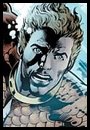
 Aquaman's self-doubt is tested when he discovers blobs of a mercury-like substance floating through the waterways. The source is soon revealed to be a larger mass of the substance, emitting a beam that transforms the sea-life into more of the substance. Alas, Aquaman is caught in it's ray before he can act.
Losing control of his physical form, Aquaman is at the mercy of the tides, helpless in combat moreso than ever.
Attempts to ride the current toward the alien host body prove unsuccessful. Though without character, the creature is able to sense his approach, reforming to leave the hero to drift harmlessly aside.
The creature continues to transmorph the sea creatures in it's wake as it drifts in the direction of Atlantis. Feeling despair for his predicament, the threat to his newly discovered home is enough to pull him from depression.
Noting a whirpool in the distance, Aquaman considers that the alien lifeform might not understand the implications of the phenomena, and begins refocusing the landscape as a homeground advantage.
Aquaman does his best to call upon his telepathic capabilities to encourage a school of fish to head toward the raging whirlpool. It requires great effort, but finally the frustrated deepsea ruler is able to communicate his message.
Lured by the fish, the mercury-like creature moves closer, only to be caught by the roaring spin of the ripping tide. It shreds the glooping host body, dispersing it diluted through the waterways, and returning the sea life to normal.
 It is an unremarkable victory for the king, all too reminiscent of the defeat of Namor.
To Giffen and David's credit, they make use of one of Aquaman's more individual skills -- the ability to communicate telepathically with sealife -- that said, one wonders if the solution for a character like this is to play upon his weaknesses.
Unfortunately, Aquaman does seem to have been reduced to a puzzle for any would-be writer that would be assigned the job. Various reboots have found limited, mostly short-lived success, and with such a wide range of approaches taken, indicated few solutions for a character once, long ago, deemed viable.
Aquaman very nearly received a shot in the arm with a television series, Mercy Reef, set to spin-out of the character's appearance on the hit WB teen drama, Smallville. The project ultimately failed to 'hold water,' but the unaired pilot managed to garner plenty of attention from TV-philes, and fanboys alike.
Looking back on the history of comic book revivals, Aquaman really is in an ironically favourable position. In the tradition of tarnished and disgarded heroes like Swamp-Thing, Animal Man, or even Batman; Aquaman is in a prime position for something radical to open the floodgates to success. Of course, this would require a serious rethink of strategy on DC's part, and an admission of defeat for a new character holding the mantle with mixed results.
Not too long ago we made reference to the pie-in-the-sky prospect of joining DC and Marvel's review-copy mailing list [JSA #65]. The concept here would be for DC and Marvel to directly sponsor characters in our makeshift rankings, using the site to promote weekly issues starring their franchise characters.
At first glance this sounds like a silly and selfish want, but is actually meant to propose an edict central to the concept of the Infinite Wars. Both companies have been guilty of placing great value on the names of writers and artists, and to their credit, the recognition is not only deserved, but demanded by fans who vote with their dollar. Even so, characters will inevitably transcend the people who make their adventures possible, and as much as the creators deserve their slice of recognition, for characters like Aquaman, the push to attach recognisable and/or acceptable names to projects seems to have superceeded any heart-felt attempts at a relaunch.
Not to say there haven't been strong hi-concepts attached to relaunches.
Over the last decade, Aquaman has been identified by three hard shifts in creative direction. The loss of a hand, Sub-Diego, and 'lord of the rings' beneath the sea have all pushed a strong concept that has failed to tread water, arguably losing steam as they enter the deep end of on-going runs.
There's no 'quick fix' to the Aquaman problem.
Honestly, if approached with the opportunity to redefine the character, I'm not sure I'd be confidently up to the task. I've got ideas, sure. There are character traits waiting to be drawn upon, but all of them seem, to me, to stem from DC taking greater investment in the character. That means suffering hard choices to avoid undermining the character with hard reboots. It might also mean turning one of the so-called 'big seven' icons loose to allow for organic transition, but above all else it means investing in the character.
What are your ideas for an Aquaman revamp?
Would you turn the character loose on an endless world of science-fiction and fantasy, or is the irreverant parody a prospect that speaks to your whims? Scroll down to the comments section, and let us know!
 The Fight: 3.5 The Issue: 5.5
Winner: Aquaman
Bonus points in this otherwise tame fight for ingenuity!
More droning rantings as we follow the rest of the post-Crisis Justice League origin sometime in the very near future! If time allows, no doubt we'll get a chance to talk more about Martian Manhunter in the entry promised earlier in the fix. More Aquaman is unlikely... Maybe some Sub-Mariner. Or maybe just Batman...

 - The Justice League are: Aquaman, Martian Manhunter, Black Canary, Green Lantern, & Flash.


 Moving at super-speeds, the Flash converts his hands into human buzzsaws!


 The Fight: 1 The Issue: 5.5


 The Fight: 3.5 The Issue: 5.5


