skip to main |
skip to sidebar
 EARTHREALM versus OUTWORLDDeath Moves (Malibu/Midway)
Where: Mortal Kombat: Battlewave #6
When: August 1995 Why: Charles Marshall
How: Vinton T. Heuck
The Story So Far...
Held once every generation; the sanctity of Mortal Kombat was intended to be Earth's saving grace. By pitting their greatest warriors against the forces of Outworld in controlled one-on-one contests, they fend off invasion. Representing their evil emperor, Shao Kahn; Shang Tsung and Outworld's fighters need only win ten straight tournaments to be granted freedom to attack Earthrealm.
Lust for power led Shang Tsung to deviate from the course of traditional combat and pursue the powers of a mystic book called the Tao te Zhan. With the tournament compromised, Earth's greatest champions were forced into battle Goro outside of the rules, only to be flung into the depths of Outworld upon the champion's disappearance. Both hero and villain united their efforts to curtail the unleashed forces of the Tao te Zhan, but the Emperor is not so easily curbed.
In his bid to claim the realm of Earth, Shao Kahn takes full advantage of the kidnap of Sonya Blade. Intent on marrying her as a means of crossing the threshold between worlds, Shao Kahn has his minions manipulate the special forces agent's mind, but he failed to account for her friends...
Tale of the Tape...

 Strength: Shao Kahn 6 (Invincible)
Intelligence: Shang Tsung 5 (Professor)
Speed: Reptile 4 (Olympian)
Stamina: Raiden 7 (Unstoppable)
Agility: Smoke 7 (Formless)
Fighting Ability: Goro 6 (Warrior)
Energy Power: Raiden 6 (UWMD)
- The Earthrealm warriors are: Raiden, Liu Kang, Sonya Blade, Jax, Johnny Cage, Bo, Sing, Sang, Kung Lao, Sub-Zero, Kitana, & Baraka.
As one of the key realms of the universe, Earthrealm is a land of great promise and potential. Protected by the god of thunder and lightning, Raiden, the Earth stands steadfast against it's opposition, survived by the courage of generations of warriors pledged to light and justice.
Among the great champions to spring from Earthrealm was the warrior called Kung Lao, who first earned victory in a tournament with Outworld. Kung Lao's reign may have been brought to an end by the Shokan Prince, Goro, but decades later his descendents carry on the flame. Liu Kang, accompanied by Kung Lao II, follows in his ancestors footsteps to become the new champion of Mortal Kombat.
- The Outworld warriors are: Shao Kahn, Shang Tsung, Goro, Kintaro, Reptile, Mileena, Smoke, Jade, Kano, & Scorpion.
 The realm of Outworld was once the domain of the fabled Dragon King, whose desires to become immortal proved his undoing. Shao Kahn, once an advisor to Onaga, poisoned his master to usurp the throne. In doing so, Kahn destroyed one horror only to become a far worse alternative. His desire for power sees the invasion and conquest of many realms, such as the once beautiful kingdom of Edenia, which was merged into Outworld by the tyrant.
Shao Kahn's most recent preoccupation is Earth where the sorcerer, Shang Tsung, acted as an emmissary of Outworld in the tournament called Mortal Kombat. Ten victories in the tournament would earn Outworld the right to invade Earthrealm without the intervention of the gods. A warrior named Kung Lao once held the title, but his reign as champion was undone by a Shokan prince called Goro.
Outworld is home to many violent species, some displaced by the destruction or assimilation of their home realms. Within Kahn's empire are the nomadic mutant creatures, the Tarkata; the four-armed powerhouses, the Shokan; and the horse-legged Centaurians.
Math: Earthrealm (Ttl) Outworld (Avg) Ranking: Shang Tsung (#19)
What Went Down...
Having endured the hypnotic suggestion of Reptile - Sonya Blade is on the verge of accepting Shao Kahn's hand in marriage when a solitary voice echoes into the tyrant's chambers. Unintimidated by the collective of evil, Liu Kang stands proud, confident as the champion of the Temple of the Order of Light.
 Goro, former champion of kombat, charges his newest nemesis with evil intent, but Kang is ready. He leaps the descending fist of the four-armed man-dragon and counters with a skillful kick that staggers the beast!
Shao Kahn's other minions descend with overwhelming numerical superiority, but just as they do, a hurricane wind and thunderous roar usher the arrival of Earth's protector god -- Raiden! Shang Tsung shoos his own allies away, intent on exacting revenge for one of his greatest opposers.
Coming to aid in the scrap are two more of Earth's destined warriors - Sonya's Special Forces partner, Jax, and the actor with a special affection for her, Johnny Cage. Together with Cage's bodyguard, Bo, the trio make an immediate impact against Reptile, Smoke, and Kano!

 Just as Goro steps up to make the save, yet another warrior makes a dramatic entrance, this time the merged mortal whose soul is comprised of both living and dead -- Siang! Having been manipulated with the use of a rare gem, Siang again falls beneath the mystic control of Prince Goro, who himself was responsible for killing one of the brothers, Sang.
 The rebel collective of Kitana, Kung Lao, Sub-Zero, and Baraka, enter to complete the opposition of Kahn's sinister plot. The Lin Kuei ice warrior, Sub-Zero, quickly renews his vendetta with the ninja whose spectre remains bound to torment so long as he lives. Scorpion is quick to sting, but finds an opponent at the ready!
 While the blood fued boils on, kombat spills throughout Shao Kahn's throne room. Kung Lao battles Reptile, while the many other combatants tackle their own foes. The mutants Baraka and Mileena; Princess Kitana and her former ally, Jade; Bo against the combined prowess of Goro and Smoke; and Jax a double-team by Kintaro and Kano! It is a fitting conclusion that mirrors the struggle between realms that gathered these warring factions.
 Baring witness to this bitter clash of nemesis', Shao Kahn achieves a moment of clarity. Recognising the passion that drives them to attain physical superiority, he questions the value of any attempt to bring the two sides together.
Even as he observes the mutual hatred shared by denizens of the opposing realms, Shao Kahn is set upon by his would-be bride, the Earthrealm agent he'd attempted to brainwash! Free from her programming, Sonya topples the Emperor with a jump kick to the back of the head!
 It begins with a cackle and ends with a booming speech.
In an effort to bring about a conclusion, Shao Kahn declares a challenge to decide the superior force. Thus, Mortal Kombat begins anew, pitting the fighters from both worlds against each other in a race for a sacred artifact...
 The Hammer...
After what really amounts to a series of dramatic introductions, we can only conclude that neither force gained certain enough a blow to obtain victory. Ergo, it is a draw for all concerned!
Now well into December, it seems we have quite a bit of catch-up to do. While this means we won't get to milk quite as much out of the month of Mortal Kombat vs DC Universe as originally intended, let it never be said that a Friday went unrepresented in the Infinite Wars!
MKvsDC Super Stock
#1 Batman (DC)
#2 Superman (DC)
#3 Shang Tsung (MK)
#4 Wonder Woman (DC)
#5 Catwoman (DC)
#6 Green Lantern (DC)
#7 Shao Kahn (MK)
#8 Sonya Blade (MK)
#9 Flash (DC)
#10 Raiden (MK)
#11 Kano (MK)
#12 Darkseid (DC)
#13 Deathstroke (DC)
#14 Kitana (MK)
#15 Sub-Zero (MK)
#16 Captain Marvel (DC)
#17 Lex Luthor (DC)
#18 Scorpion (MK)
#19 Joker (DC)
#20 Baraka (MK)
#21 Liu Kang (MK)
#22 Jax (MK)The idea behind this post was to preceed next week's entry (which will feature Darkseid) with the classic MK boss who put the "Kahn" in Dark Kahn. Admittedly, impatience leaves us with a pretty vague entry for the character, but it's yet another opportunty to indulge in the vast cast of characters that Mortal Kombat has to offer.
Malibu Comics by no means made any kind of delicate effort to weave an intricate story of subtlty and subtext, but we should give them some credit. In practise it proves to be a fairly cumbersome idea, but I rather like the motivation behind Battlewave's interpretation of Sonya as famous captive of the Emperor during MKII.
Presumably inspired by the background that had many fans buzzing with theories in 1993; Sonya, in a subplot pulled straight from modern living, finds herself as the ticket for Kahn to be allowed what amounts to a visa into Earthrealm.
When put alongside established fact from the series - such as Kahn's wedlock to the Edenian Queen, Sindel - you can imagine the scheme as a trump card in the complicated game of the Elder Gods' rules.
What will be lost on neophytes is the fact that the second MK game exists as part of a farcical tournament that serves as little more than a distraction.
The much maligned cinematic sequel, Annihilation, revealed to unfortunate mainstream audiences the core plot of MK3/Trilogy pertaining to the resurrection of Sindel in Earthrealm. If we consider these backdoors into Earth as a routine practise for the conquerer, it stands to reason he might just as likely marry to gain entry into realms, as he is to fight. Whatever works, eh?
Man-slut doesn't really do this boss character justice, however.
Multiple fake-out deaths and a string of varying characterizations have left Kahn in a bit of a state. Back in the day you might have been naive enough to take his lauding exclamations as an acknowledgment from an honorable warrior, but cries of "excellent" and "outstanding" should never have taken away from his menace!
Kahn dealt super-power blows at a cut-price to gamers who made it far enough to enter his arena. Like Bison/Vega before him, Kahn represented the stuff of legend to fans who believed Mortal Kombat's digitized graphics, cartoon gore, and mythologically inspired storyline was king of the arcade.
As much as is possible in storylines dependent on such big and loud plot-twists, I like to think of Kahn as a respectable warrior who is as cunning as he is powerful. A character who is master not only of harsh hand-to-hand combat, but also the dark mystic arts that allow him insight into his allies, enemies, and the world around him.
It's characters like Shao Kahn that gave me fairly high hopes for the meeting between Mortal Kombat and the DC Universe. It felt like an ideal opportunity to take advantage of a T-rated audience quite possibly trained to indulge further in the story and character driven events that surround the DC characters. It was disappointing that the series, largely unrecognised or mocked by other fanbases, could not rise to the challenge.
If Midway can fight to live another day, it will be very interesting to see where they take the series in it's first focused step into this current generation of consoles. With iterations that improve in some way the previous fight engine, Mortal Kombat appears to have a plan for the future, even if this type of scenario has crumbled to mediocrity before. With financial destruction looming, the future of MK remains a very interesting subject.
While we play catch up, be sure to tune in daily for the annual DC/Marvel Fantasy Fight polls, and much more in the Infinite Wars!
The Fight: 3 The Issue: 3
For more on Mortal Kombat versus DC Universe, check out the official website, our Q&A interviews with Jimmy Palmiotti and Hans Lo, and our series of character spotlights and discussions: one, two, three, four, five, six, seven, eight, nine, ten, clues special, bonus one, two, three, four and Dark Kahn spotlight, Final MK cast, Final DC cast! ALSO: C2C editions Mortal Kombat vs DCU, Finish Him...!, Heroic Brutality, Heroic Fatality, Mooortal Kombaat!
Don't forget! The holidays are right around the corner! For the fanboy in your life, the Infinite Wars Gift Shoppe offers a range of the titles derived from the many issues reviewed in the Secret Archives! You'll not only find a great Amazonian deal, but also help sponsor the site by using purchase links provided! Cheers!
QUICK FIX MEGAMIX: MORTAL KOMBAT ARMAGEDDON! Armageddon Intro Video (Midway)
Where: Mortal Kombat: Armageddon When: October 2006
Why: Midway Games How: PS2/XBOX/Wii
Quick Fix...
Two years is a lot of time to find perspective, and for critics of 2006's Mortal Kombat: Armageddon, the release of a new title might just reflect positively on the old.
With Mortal Kombat vs DC Universe already hitting some stores [as of November 13]; facts about the game's minutia are fast coming to light, and to the inevitable dread of some fans, much of this entails very little not already confirmed or assumed prior to release.
From the onset of mainstream internet accessibility in the mid-nineties, Mortal Kombat has been an online staple.
Communities fast took advantage of the interactive opportunity to share their interests in the gaming series, establishing for Midway a strong and vocal fanbase. This online presence has presumably influenced the company's decision to heavily focus it's promotions on an internet audience - something they've done incredibly well. Few brands could be said to tend to their fanbase as successfully as Midway. We discovered this first hand earlier in the year, conducting interviews with MKvsDC writer, Jimmy Palmiotti, and MK producer, Hans Lo.
The importance of drip release details in promotion seems to have backfired on Mortal Kombat more than once. Deadly Alliance and Deception suffered from the cut-off of deadlines, but neither title seemed as damaged to the degree of MKvsDC, which, based on initial reactions, contains few surprises.
The unusually small cast is complimented by only a few character cameos in a storymode far less impressive than the presence of professional comics writers might have suggested. The written voice of characters is hit and miss, but it's the driving skeleton of the mode that falls flat. The result proves surprisingly conventional for a game that seemed all too aware of the conceptual pitfalls of forced confrontation between intercompany rivals. Pseudo-explanations, like the functional RAGE mode, seem to undermine as much as they justify.
A reception like this will seem eerily familiar to fans who've loitered around the series. It echoes Armageddon in particular, albeit with vital exceptions...
Following on from the history of 1995's Ultimate Mortal Kombat 3 and it's 1996 Trilogy upgrade; Armageddon faced the shadow of compilation games typified by poorly balanced gameplay and inattentive story. By reproducing so much of the previous two games' content, the expectation that great secrets were being held within original content, set many-a fan up for a fall.
While Armaggedon addressed the stiff and clunky gameplay of Deception, it did so with almost negligable iteration. "Aerial Kombat" - reminiscent of features from the Shaolin Monks adventure spin-off - failed to distract from the lingering disappointment of stop-starting animation sequences that can leave a player waiting their turn to fight. Arbitrary fight styles did nothing to compliment characters, moving ever further away from the triumphant entry into the "3D" arena that was Deadly Alliance (2002).
One would argue that MK's legacy has always been one of average gameplay.
Even in the technologically limited days of competing for 2D dominance with Street Fighter; Mortal Kombat did not instill the sense of individuality and style it's competition had. Digitized graphics wowed an era of cartoon animation, but as series like Virtua Fighter and Tekken demanded more, the only constant MK could bring with it from history was it's dedication to characters and a plot.
 Armageddon's saving grace was undoubtedly a Konquest mode that unfurled the details of story that brought the sixty-plus cast together in one game. Expected details, like establishing biographies, were omitted, as were meaningful character endings, but the Konquest mode still managed to at least flesh out many key characters' involvement in the apocalyptic plot.
As often as it feels like Mortal Kombat under represents the concepts that drive the franchise, it is still the story that's kept my interest.
Kart racing mini-games are a lot of fun and command some crucial replay value (as does multi-player modes), but investment in narrative and concept are the currency by which I would measure a release. It is this that leaves me concerned that MKvsDC might be yet another step down for the franchise, despite it's fundraising interaction with the DC universe, and further incrementalizations on the clunky frustrations of it's stiff gameplay.
I would like to believe there's still a chance we might see something amazing come out of MKvsDC, but that's not something we can confirm today. What we can do is have a little fun, initiate the first video game pseudo-review on the site, and honor the wonderful cast of characters from Mortal Kombat!
Like any comic or film review on the site, we intend to inform as thoroughly as possible, entertain if we can, and unveil glimpses of the product in question. Industrious readers will no doubt be able to find Armageddon's video elsewhere on the internet, but for our spotlight, you'll have to settle for dodgy stills.
Traditionally we would not include content from a video game on the site, but MK's association with comics goes right back to the original game. Not only has the series crossed over into the medium, but is also inspired by many iconic tropes and characters from the superhero super-genre.
The Infinite Wars tries to take all mediums into account in formulating reflections of characters. While the canonical value of Armageddon's intro video can be doubted, it remains an animated representation of what the characters are capable of. We will only observe feature encounters from the video, rather than the many inconclusive skirmishes that can be noted in scene backgrounds.
HOTARU versus LI MEI
Almost the entire core cast meet in a collision of powers, but the first definitive blow is struck by the new guard of MK heroes! In fact, it's a Seidan Guardsman who strikes the first blow, impaling Li Mei on his staff! Those observant enough to track Hotaru as the camera wobbles it's way through handheld frontline photography will notice the amusing struggle the Seidan undergoes in the background, trying to wrench his staff out of his victim.
 I would love to know what kind of process went in to plotting the opening sequence. On the surface it's a big dumb fight sequence, but enough attention has gone into the details to populate the area with background sparring, and character details that emerge even outside the feature moments.
I wonder what gave these characters the edge, in terms of being the first to show a definitive blow. Li Mei debuted in 2002's Deadly Alliance, while Hotaru came out of the Order/Chaos sub-plot introduced in 2004's Deception. Perhaps it was simply a function of having the impact of an impalement. Either way...
Winner: Hotaru (Fatality!)
KANO versus KITANA
Two MK veterans take the stage next as classic series villain, Kano, charges in to smack Edenia's princess right in the mouth! Kitana takes another clubbing blow to the head, but retaliates with a couple of kicks, the latter of which sends Kano hurtling off screen!
 I suppose if we were to try to rationalize the motivation behind each of these fights, we might perceive the contrast between Hotaru/Li Mei and Kano/Kitana as the different generations of Mortal Kombat. From the four characters' debuts we can draw assumptions of the first two games of the series, and the first two from the (2002) franchise revival. I wouldn't be inclined to read any more into than that, but I suppose it could be observed as a loving acknowledgment of the two eras of the series. Lord knows searching for any more meaning than that will only result in phantom apparitions! Crazy!
Winner: Kitana (Brutality!)
KINTARO versus KITANA
Alas; Kitana's victory is short lived, as with most characters.
 Beloved MKII sub-boss and graduate from Kitana's class, Kintaro, sneaks up behind to swat her far into the distance with a Shokan double-fisted uppercut!
I have to admit: I'm a bit of a Kintaro fan!
As much as I would've liked to have seen development in his character beyond snarling and punching, Kintaro's emergence from the dust at the beginning of Armageddon's intro is a classic fanboy moment. He doesn't get a lot of airtime after that, but then, I'm not sure you can really top that!
Winner: Kintaro (Excellent!)
SCORPION versus SUB-ZERO
It's a pair of characters that needs no introduction.
Arguably the faces of the franchise, for better or worst, Scorpion and Sub-Zero are two of the best known characters in American gaming. While the characters have clashed in more than one game, Scorpion's famous vendetta was actually with this Sub-Zero's predecessor, his older brother, now Noob Saibot.
 Even so, every fan of the duo will no doubt appreciate the clang of swords as the two charge at each other at the centre of the pack. Sub-Zero's kori blade withstands Scorpion's blows, providing an active defense before the Lin Kuei grandmaster turns the tables, fending Scorpion off to finish him with a jumping axe handle slice that topples the spectre.
The alliance of the famous rivals originally caused a stir during test screenings of Paul Anderson's 1995 Mortal Kombat film. Ironically, the debut of the second Sub-Zero in Mortal Kombat II (1993) produced an ending that was poised to set the pair up as allies. While this was never specifically followed up, the renewel of Scorpion's pursuit garnered hidden truths in MK4, where he earned Quan Chi as a new arch-nemesis.
Winner: Sub-Zero (Superb!)
SHINNOK versus RAIDEN
Previously spotted hovering in the sky, Raiden makes his feature arrival plummeting into an unsuspecting Sub-Zero! Shinnok presses the advantage, using the dark magic possessed by a former Elder God to summon giant skeletal hands from the Netherealm! The hands crush Raiden into the ground, but with his arms free, he blasts Shinnok with lightning!
 Shinnok's evil was revealed in the 1997 digitized adventure spin-off, Mortal Kombat Mythologies: Sub-Zero. Plots established there and in MK4; where Shinnok rises to strike back at the Gods who expelled him from the heavens; provided threads upon which subsequent storylines have been developed, namely those surrounding the arrival of the Dragon King!
As the chief boss of Mortal Kombat 4, Shinnok went down in infamy for his immediate playability and borrowed movesets from the rest of the cast. Forced onto the bench in subsequent games, the fallen elder god was one of the characters redeemed in his reincarnation for Armageddon. While slightly enfeebled in his role, the character also enjoys a major appearance in Armageddon's Konquest mode, manipulating protagonist, Taven.
Despite lacking gravity in his first appearance in the beat 'em up franchise, the rivalry between Shinnok and Raiden felt sincere. Raiden was crucial to defeating Shinnok during his initial downfall and his MK4 attack on the realms, making this one of the most weighty fan services in the MKA intro!
Winner: Raiden (Outstanding!)
BARAKA versus KUNG LAO
Mortal Kombat: Gold offered Dreamcast players the chance to play MKII and MK3 characters replaced by new additions in the final build of MK4. Despite adding only six characters, the 1999 update produced many details that have continued to inform subsequent entries. The rivalry established for the game between Kung Lao and Baraka hasn't really been one of them, but is appreciated none the less.
 Baraka and Kung Lao appear evenly matched as they exchange and avoid acrobatic blows. A kick from the Shaolin Monk puts distance between he and Baraka, who unsheathes the blades from his arms, before taking the battle skyward!
Kung Lao doesn't hesitate, tackling the Tarkata's mutant claws with a blade of his own. The two swing and block in the allusion to aerial kombat before Baraka finally succumbs to an impaling blow. Though he floats out of control as blood gushes from his chest, Baraka is still able to gain balance, firing off a spark of energy that knocks Kung Lao out of the air!
 Despite not being well known enemies in the MK canon, their short lived manufactured rivalry might be alluded to here by their airborne battle.
It was Kung Lao who was said to be responsible for a mortal wound that resulted in a new Baraka design in Gold that featured large staples over a scar on his chest. It insinuated something along the lines of Kung Lao's MKII fatality, which sliced opponents in twain with the razor edge of his hat.
Winner: Draw (Ohhh!)
JAX versus QUAN CHI
With a flourish of sparks coming from his cybernetic enhancements; Jax charges into battle, confronting the necromancer, Quan Chi! The sorcerer avoids his wild swinging blows, but a couple of close quarters strikes trap him in Jax's grip!
The Major snatches Quan Chi's kick and drives his fist into a vulnerable knee with super-enhanced force!
Despite the immense blow, Quan Chi's snapped leg maintains it's integrity, allowing him to regroup to summon skeleton warriors to do his bidding! Jax shatters the animated skeletons with ease, but does not see the Outworld Emperor, Shao Kahn, looming behind him with a giant war hammer...
While this scene doesn't appear to stem from any specific vendettas; Jax, as a lead protagonist, was one of the many heroes who opposed Quan Chi during Shinnok's invasion in MK4, and fell victim to Quan Chi, as part of the Deadly Alliance. Kitana, Kung Lao, Sonya, and other absent characters in Deception were also fatally wounded by the Deadly Alliance, but it's something.
Winner: Shao Kahn (w/ Quan Chi)
 SHAO KAHN versus...
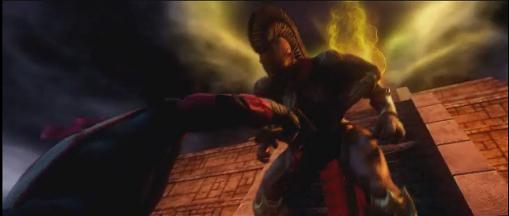
Jax is but the first to fall to the Emperor's war hammer!
He strikes indescriminately at nearby warriors, scoring victorious blows against; Reiko, Johnny Cage, and Darrius! Darrius' trajectory brings him in line with hallowed Edenian ground from which a sacred temple emerges.
The towering structure rises from the dirt to finish at the feet of the Outworld Emperor -- a warrior who once succeeded in conquering the realm and merging it with his own. It is an ominous scene that forecasts the impending doom.
While various deductions could be made, it's amusing that Kahn strikes an almost unnoticable blow to Reiko. For a time; MK4's enduring legacy was the question of whether or not Reiko was actually the previously defeated Shao Kahn!
The theory, reasonably enough, came from an animated ending featuring the mysterious warrior emerging from a portal to assume a helmet and throne.
Winner: Shao Kahn (Toasty!)
STRYKER versus MILEENA
Flames emerging from the top of the pyramid signify the coming of Blaze -- a character who appeared as set dressing in MKII, but, as plot would have it turn out, was actually an elemental being created by the Elder God Argus and his wife Delia as a tool to protect the realms from the amassing powers of kombat.
 At the foot the pyramid the gathered warriors are all enticed by the presence of the flame. Their gathered stupor is quickly ended as Stryker makes the first move, sucker punching Mileena, before heading up the pyramid!
Winner: Stryker (Brutality!)
KABAL versus STRYKER
The riot cop doesn't get far before Black Dragon survivor, Kabal, makes a dash up the pyramid to challenge. Stryker blocks his kick easily, however, and sends the cybernetically enhanced crook hurtling off the structure.
 It's pet peeve time, so the diehards might like to tune out for moment, if they haven't already. In broad terms a baseline logic usually informs the basic abilities and attacks of MK characters, but Kabal, a mortally wounded warrior who survives mutilation with cybernetics, kinda breaks the mould. By MK3 the team might've been running out of broad strokes with which to colour their characters, because Kabal features a range of moves not specifically related to what we can certainly know about his enhancements. One of those was a dash attack that, in the lead-up to MK vs DC, created confusion about whether or not the character was a Flash-styled super speedster.
Throwing the dash move into the MKA intro is a nice enough nod and functional way to initiate the race, but it only feeds that confusion. Granted, the MK team are inclined to canonize odd details, even misconceptions, if they're discussed enough. I would, however, like to think Kabal's respirator doesn't miraculously extend to his legs. Homage to an in-game function is one thing, but as is often the case, it would be nice to see MK invest deeper in the integrity of concepts.
Winner: Stryker (Brutality!)
 KANO versus STRYKER
Kabal's criminal clansman, Kano, follows to stop the cop in his tracks with a beam of energy from his own cybernetics! The red beam puts an end to Stryker's climb and punctuates an edict that has so often differentiated the MK brand from it's contemporaries by giving a glimmer of hope for evil.
Winner: Kano (Toasty!)
KANO & KOBRA versus BO' RAI CHO
 Bo' Rai Cho takes the initiative to make his charge up the pyramid, but suffers a knife in the back from the Aussie crook. The violent attack proves insufficient to stop the drunken master from Outworld who turns to put an end to the Black Dragon's campaign, unsticking both Kano and Kobra with a flood of vomit!
The pair tumble down the pyramid's many steps.
Winner: Bo' Rai Cho (Brutality!)
SHEEVA versus BO' RAI CHO
 The Shokan warrior charges past the slippery stain of Master Cho's bile to strike viciously with an unforgiving flurry of double-fisted strikes! The master withstands three double-blows before taking a dive down the edge of the pyramid, clearing a path for Sheeva.
As you might have gathered, we've entered a bit of a rush period in the anarchic battle. That said, this almost literal translation of the games' trademark arcade "ladders" is arguably the closest thing we've seen to an actual tournament in the past few games.
I wanted to match the frenetic pace of this section of the video by mapping quickly through the brief encounters, but it's a point we'll likely come back to. As MK struggles to compete with the functional quality of other franchises and it's story spirals outward into bigger ideas, one almost wonders if they shouldn't explore the adventure modes as key releases. Shaolin Monks, despite mixed reactions, proved to be a very fullfilling adventure, even if it struggled with honoring established fact within the period it was placed. Games that move forward, more like Armageddon's Konquest mode, would surely be free to shake off those negatives and take full advantage of all the MKSM positives!
Winner: Sheeva (Brutality!)
 CYRAX versus SHEEVA
Set up as the one to beat, Sheeva takes a spirit arrow to the back from Nightwolf, as the Special Forces cyborg, Cyrax, looks for the double-team! He leaps onto her back, but is easily shrugged off by the powerful Shokan warrior-woman! Her battles with fellow MK3 alumnists is far from done, however...
Winner: Sheeva (Superb!)
NIGHTWOLF & ERMAC versus SHEEVA
Nightwolf follows up his spirit arrow with the aid of the legion-creature, Ermac!
The pair charge Sheeva, unleashing a non-stop combination of punches that are all blocked as she fends off the assault with two arms dedicated to each.
The towering warrior snatches both opponents by the throat, lifting them high into the air! The offensive pays off, sending both tumbling down the pyramid, but leaves Sheeva vulnerable...
 Winner: Sheeva (Flawless Victory!)
KENSHI versus SHEEVA
With Nightwolf and Ermac held in her four-fingered hands, Sheeva's seemingly unstoppable defensive comes to an end as Kenshi drives his expert sword through the exposed torso of the Shokan.
 The sword saint spins around his opponent and with a flowing graceful swipe disects her mid-section, seperating her body from her legs with a spray of blood. It's a scene like this - that specifically speaks to the skills that define the character - that makes you long for a more involving and fluid fight mechanic.
For Kenshi to ever live up to his reputation as a master swordsman it would take a major overhaul of the system. This was something we couldn't help but discuss during our Fantasy Fights previews, earlier in the year, where we struggled to justify some characters fight ratings given the limited tangible evidence. It's been surprising how receptive some venues have been to MKvsDC's newest additions, but as reviews of the final game come out, this trademark inadequecy seems to be coming to light.
In interviews it's been suggested that the game deliberately avoids high level gameplay in an effort to endear to players of all skill levels. This latest spin feels more like a marketting exercise than a legitimate claim, particularly given how uninviting and frustrating the now definitive clunky fighting can be.
Winner: Kenshi (Fatality!)
QUAN CHI versus KENSHI
The MK3 kombatants fade away to give wake to the new guard once more!
Quan Chi leaps from lower on the pyramid with twin broadswords drawn, ready for a clash with the master swordsman! He narrowly misses the opportunity to take advantage of Kenshi's assault on Sheeva, but instead finds a worthy opponent.
Kenshi parrys the sorcerer's twin sworded attack, defending each blow with a defensive counter strike of his own. Leaping backward up the pyramid, Kenshi does his best to defend his position on the structure, clutching the top of his sword to create an impenetral steel defensive. A leaping strike briefly turns the tables as Quan Chi is forced to throw both his swords into his counter.
 With teeth grit, Quan Chi throws his strength behind individual strikes, looking to chop through Kenshi's defense. With swords crossed over his opponents, Quan Chi is finally able to drive one of his blades through the sword saint's gut!
While only the most general of rivalries occuring between these two characters, they're a hero and villain who are often cited as two of the most promising creations to come from the transitional "3D" period of the series. While only Kenshi emerges from the post-Tobias era, Quan Chi flourished even after his creator was gone, developing into a lead antagonist as half of the 2002 titular Deadly Alliance (with Shang Tsung).
As much as Kenshi's brief appearance honors his unfulfilled status as one of the world's greatest swordsmen, it seems a shame he has to go down to Quan Chi. I might've liked to at least have seen some treacherous magic involved to break the split, which clearly attempts to give Kenshi a fair go, but moves on to other subjects. Granted, undercutting Quan Chi might've been disappointing, but leaving Kenshi to deal with the next fighter might've been a better use of rivalries...
Winner: Quan Chi (Fatality!)
 SHANG TSUNG versus QUAN CHI
As Quan Chi looms over Kenshi's fallen body with a sword above his head, it appears as though the blind swordsman's greatest ally, Ermac, has returned to his aid. However, after tossing Quan Chi from the mountain with a telekinetic throw, the legion creature leaps into the air to come crashing down on Kenshi's broken body -- revealing himself to be the shape shifting sorcerer with whom Quan Chi was briefly allied -- Shang Tsung!
We've already talked Deadly Alliance, but even though they're the first characters to really take ownership of central title, it fails to really bring home the gravity of their value. As much as Scorpion and Sub-Zero continue to dominate the market face of the series, and Liu Kang the heroic mantle, one might argue Shang Tsung and Quan Chi have come to define the series from within the fiction.
Quan Chi finds his way into a crucial expositional role in the MKvsDC story mode, but was arguably the most surprising omission from MK/MKII centric cast.
The villain was popularly touted for a third feature film, while also playing a role in other cross media adaptations, in both the animated and live-action series.
For a modern generation of fans he is one of the most central villains to the series, well known for his cursed rivalry with the ninja spectre, Scorpion.
While Shang Tsung has remained a mobile piece of the MK puzzle, one could argue Quan Chi was the staying villain that stamped a new era. As we look beyond MKvsDC one can't help but wonder what contributions might be made to the next chapter in the Mortal Kombat saga, and whether they can live up to the generations that came before.
Winner: Shang Tsung (Excellent!)
SHANG TSUNG versus SHAO KAHN, SUB-ZERO, SINDEL, STRYKER, KANO, KOBRA, DAIROU, TANYA, & RAIN
Of course, as much as an impact as Quan Chi has made, I guess you can't beat the originals. Shang Tsung's a popular fellow in the world of Mortal Kombat!
His treachery has not only earnt rivalries with heroes like Liu Kang, Kitana, and Kenshi, but also ire from other villains such as Shao Kahn, Quan Chi, and Onaga!
 As the pack gradually fights it's way toward the top of the pyramid, Shang Tsung turns to unleash a flaming skull that disperses the crowd with it's explosive impact. Of the long list of kombatants caught in the blast, only Shao Kahn is immense enough to resist it's power. He is not known for his forgiveness...
Winner: Shang Tsung (8/9!)
 SHAO KAHN versus SHANG TSUNG
Kahn leaps through the smoke and fire of Shang Tsung's attack, brandishing the hammer that already decimated a great number of fighters. Shang Tsung proves nimble enough to play the avoidance game, leaping free of the Emperor's clubbing drive, and rolling aside to avoid a horizontal strike.
Tsung dares to drive a kick into his former master's chest staggering him back toward the edge of the pyramid, and straight into the clutches of Onaga, the former Dragon King of Outworld! Shao Kahns fate is note made clear as the dragon-creature carries his pray into the Edenian night.
 This entire sequence refers to a tradition of betrayal for Outworld's rulers.
Shang Tsung, despite once being the Shao Kahn's emissary in Earthrealm, famously joined Quan Chi in seemingly assassinating the Emperor.
This echoes the betrayal dealt by Shao Kahn, who once served Onaga, but poisoned the Dragon King to usurp the throne. It could be this "alliance" that the narrator refers to, but eagle-eyed fans will have spotted a figure atop the distant mountains at the beginning of the clip. The Konquest storymode not only reveals the arrival of Taven at the emergence of the pyramid, but also a brief pact between the evils of the series, including; Quan Chi, Shang Tsung, Shao Kahn, and Onaga.
As mentioned in the beginning of this entry, it's hard to ascertain exactly how well the intro clip reflects anything from the story. One might recognise it as the events coinciding with the end of the story mode, but it's hard to say. Either way, it's certainly one of the more resonant uses of character association in the clip, perhaps only outdone by the emergence of another rival...
Winner: Onaga (w/ Shang Tsung)
 LIU KANG versus SHANG TSUNG
2002's Deadly Alliance did many things right to progress the series into a new generation, but one of it's most impactful contributions was an intro video that started with the unthinkable -- the assassination of the series' lead hero and villain -- Liu Kang and Shao Kahn, respectively.
Later instalments unfortunately undermined the impact of these events, but I think it might still be safe to say that Liu Kang's shuffling emergence from the shadows is the highlight of Armageddon's beginning.
Wearing wrist-bound chains revealed later to be the shackles used by Raiden when reviving him; Liu Kang engages his arch-nemesis with a ferocity uncharacteristic of the character in life. Again, while not particularly frenetic or complicated, the fast paced exchange exceeds anything seen in MK's contemporary gameplay. Liu Kang's chains as in-game absence become all the more notable as Shang Tsung uses them to drag his enemy in, and Kang, to strike back.
Shang Tsung puts an end to the exchange with an uppercut that sends his zombified nemesis into the darkness of the pyramid steps below.
Winner: Shang Tsung
MILEENA versus SHANG TSUNG
As the sorcerer nears the flaming top of the pyramid, Mileena leaps onto his shoulder, lifting her veil to gnaw with jagged deformed teeth. Shang Tsung shrugs the mutant clone off with ease, awaiting the next impending challenge.
I have to note, Mileena is an interesting character.
Among a small handful of beloved icons from the early games, her absence from MKvsDC has been questioned, as has several others (Reptile, Johnny Cage).
Having begun life as a pinkish palette swap for the royal blue (and purple) Kitana; Mileena has come a long way. Given the self-conscious plot of being Kitana's deformed doppelganger, Mileena has stayed close to that origin, despite expanding outward into a thinly developed rivalry with another mutant, Baraka, and several henchman roles.
MK fans are conditioned to have an odd sort of taste in character and design, but Mileena might just take the cake. Frankly, in a game limited to only ten playable kombatants, one of which is Kitana, the omission of Mileena can be considered one of the positives of the chosen cast. Why we would have any reason for two characters so deliberately similar, I cannot imagine!
There's certainly room for further development, and it's been refreshing to see Mileena develop her own unique trademarks and design, but let's not get carried away!
Winner: Shang Tsung
SHUJINKO versus SHANG TSUNG
A simple left hook is all that's required to dismiss a charging Shujinko.
Commentary on the value of Deception's newly introduced protagonist? Quite possibly, but I'd like to think it doesn't forecast the future of the character.
 The first hero to make the forray into a dedicated story mode; Shujinko failed to endear himself to fans. While the expansive environments and intertwining story made for a lot of fun, none-too-subtle writing left the manipulated hero looking more like a stone cold idiot than a sympathetic patsy to Onaga's deception.
The character continued his heroic buffoonery in Armageddon, where the new generation of adventure-mode hero, Taven, stumbles upon his predecessor locked in Shao Kahn's dungeons. As appreciated as it was to see the character being utilized, there seems to be an awfully obvious potential for the character now that his journey is established.
Inspired by the legend of the white eyebrowed elder, Bak Mei; Shujinko's design should be familiar to any fans of the Tarantino explosion of fandom, Kill Bill.
His version of the archetypal character - Pai Mei - arguably stands as a ready-made template for Shujinko's future. Having learnt from many icons of the franchise, with a little bit of imagination, Shujinko has every claim to the role of a master of multiple styles. Given his remorse over ushering the return of the tyrannical Onaga, the beginnings of a mythic character become obvious.
We've often talked about the ideal of progressing to a new generation in these fifteen year old fighting series. It feels like it's time to recognise these iconic characters in the same light that legends of the first series were regarded.
The idea of characters progressing to the role of 'boss' has been explored within the series, but the stature of their contemporaries has remained the same. It would be so very refreshing, particularly in light of comments made by series director, Ed Boon, to see a new generation forced to earn their way into encounters with the legends of the last era.
Shujinko, jaded and embittered by experiences, could be the great master who retreated into solitutde. As skilled as he is ill tempered and intolerant, this character's redemption could very well come from a new generation as he is sought out for the wisdom he suffered to learn.
Winner: Shang Tsung
LIU KANG versus SHANG TSUNG
With the power at the top of the pyramid seemingly his to claim, Shang Tsung is tugged backward by two metal hooks hung from chains. Zombie Liu Kang returns to bedevil the man who killed him. As Tsung desperately reaches for the flames of the summit, his youthful facade begins to revert to the aged face of an ancient sorcerer seen in the very first MK.
 As Shang Tsung withers, defeated, we can't help but appreciate the way in which Armageddon's intro alludes to a full circle conclusion. Until a new canonical entry is made into the series, we will not know what truly happened at the conclusion of Armageddon, or if the universe as we knew it still exists.
I would like to see characters move on and, as mentioned in regards to Shujinko, take on the role of the new legends. Just as characters like Shinnok and Raiden have manipulated events from larger than life posts, so too should some of these heroes and villains ascend to grand roles.
 I look forward to the future of the franchise and hope any criticisms garnered by their recent corporate crossover with the DC Universe can be regarded with some perspective. Mortal Kombat might very well have earnt back a little bit of respect in the broader gaming community, but with this attention comes opportunity.
Deadly Alliance made a strong case for Mortal Kombat in the new generation of gaming, but subsequent entries failed to continue that promise. I hope story, character, and by extention, gameplay function, can take precedence.
I hope from the ashes of Armageddon can rise a strong new base upon which sequels can be built for this peculiar generation of gaming. I look forward!
Winner: Inconclusive/Draw (Game Over)
We're running a little behind schedule, but doubt not! We've got a whole lot more Mortal Kombat and DC Universe action coming to the Infinite Wars in November! Mortal Kombat: Armageddon is available in the three-game MK: Kollection, which also includes Shaolin Monks and Deception! You can find that, as well as Wii versions, via Amazon!
For more on Mortal Kombat versus DC Universe, check out the official website, our Q&A interviews with Jimmy Palmiotti and Hans Lo, and our series of character spotlights and discussions: one, two, three, four, five, six, seven, eight, nine, ten, clues special, dark kahn, bonus one, two, three, & four!
QUICK FIX MEGAMIX: BLOOD & THUNDER #3! The Art of War (Malibu/Midway)
Where: Mortal Kombat: Blood & Thunder #3 When: December 1994 Why: Charles Marshall How: Patrick Rolo
Quick Fix...
Lost, Lost, Lost, Lost, Lost!
Today we'll be talking about the island tournament of Mortal Kombat, and while that might not have anything to do with the season finale of the ABC sci-fi/drama, I really wanted to take advantage of that fat Lost web-traffic...
With useless gratuity out of the way, I now officially welcome you all to the latest instalment of our running reviews and discussions of Mortal Kombat.
Reflecting on a month where reviews have been tough to come by, I'm almost a little disappointed we've dedicated so much time to the video game franchise. Apologies to those of you who've been coming by hoping for more iron in your diet in the proclaimed Invincible Iron Month. Hopefully our back catalogue specials will have at least contributed to whetting our apetite.
I don't want to be too apologetic.
Over the past month I've been very conscious of the split audience I've been talking to, and as much as the loyalties of this website are to comics, I feel I should be doing more to champion the Mortal Kombat cause.
Since the announcement of November's Mortal Kombat versus DC Universe, I've done plenty to document the cultural insignificance of this once mainstream phenomena, and the accompanying disinterest of comics fans. What I haven't done terribly well is describe what's great about the franchise that has kept my interests since the first game, released in 1993.
I suppose full disclosure is in order. I like to consider myself a pretty savvy individual, with well grounded criticisms and opinions, but I'm not without my predelictions. As is self-evident, I have a special penchant for combat, and I take absolutely no issue with the simplicity of a narrative dependent on the interactions of two (or more) opposing forces. I like the art of fighting.
Fortunately, Mortal Kombat manages to deliver substantially more in the story department than would otherwise be associated with it's under achieving, two-axis gameplay. Important, given the few admirers the series has earned within the hardcore gaming community, even with recent advancements.
Though far more technically sound; rival narratives, like the more successful Japanese Street Fighter, can be typified by the underdeveloped method of communicating ideas through individual characters. Contrary to this genre-established tradition; Mortal Kombat takes far more ownership of it's concepts and story, delivering serialized epics comparable to the checkpoint storytelling of major comic book events, like Infinite Crisis or Civil War.
Within the larger themes of interdimensional world domination are the personal struggles that develop the characters and embue the sense of verisimilitude within these fantastic situations. These details have inevitably propelled the Mortal Kombat franchise forward into it's most involved incarnations. Spin-off stories tackle everything from; the origins of Scorpion's predicament as a tortured soul; to the law enforcement duties of the Jax, Sonya, and the Special Forces; the manipulations of the eventually resurrected Dragon King; and more.
These finer details that have really made the MK story a valid piece of fictional history are the product of cumulative effects. The departure of creative co-creator, John Tobias, though often connected to the downfall of the series, arguably allowed the franchise to blossom under new creative direction.
Though crucial to laying the groundwork, it's fair to say the natural state of circumstances worked against Tobias and the makers of the first games. Though definitive in the MK canon, the specifics of many important details derived from the early games were retrofitted, and certainly not elaborated upon in detail accessible to the everyman playing at the time.
It's here I think we find the disconnect between MK's once mainstream fandom, and today's smaller, dedicated fanbase. Though not everyone's vice, the story remains one of the most important pieces of the MK puzzle, evidenced brutally by responsive outcry for the announcement of Mortal Kombat versus DC Universe, perceived by many fans as a frivilous, post-Armageddon interruption.
I can't help but wonder what difference might have been made had the details of the Mortal Kombat epic been more accessible to mainstream audiences.
This rather conveniently segues into our review of the comic books, which, though a quaint opportunity to see the characters moving in a narrative environment, offers examples of what not to do when translating the MK story.
Running terminally late; I want to get on to the review/play-by-play portions of this meandering and garbled entry, but consider this a conversation to be resumed at a later point. Sometime in the countdown to the November release of MKvsDC we may revisit these points in relation to the influence and involvement of the Threshold films.
- SIANG versus GORO
Alright. Things have been a bit hectic here on the Infinite Wars, so I've got to stretch it out a little before resuming. Crick, crack, creeak. That just about does it, but I should offer a stern health warning to all of you! Before continuing on to the [mis]adventures of the character Siang, everyone should indulge in some thorough stretching.
It would be fair to say 1994 had it's share of gems!
Real 2 Real released I Like to Move It; Pulp Fiction made Tarantino an undisputed name in film history; we finally found out what would happen if Venom fought Iron Man; and the beat 'em up video game genre enjoyed some it's highest heights with titles like Mortal Kombat II and Street Fighter II permeating throughout the pop culture landscape to reach heights unparalleled.
Comics were teetering between the repercussive harmony of post-grim and gritty superheroics, and the Image-funded shitfest of over developed anatomy and splash pages. At some point all the companies were guilty of selling out to a movement now much maligned, but only Malibu managed to bring together the very worst qualities of mid-nineties comic books, and the video game franchises we know and love.
So foul were their efforts that Capcom ordered the cancellation of a Street Fighter series, infamously identified by scenes of Ken Masters' scalping at the hands of Sagat and the villains of the series. Violence familiar to MK proved to be little more than flash and style - if you can call it that - over substance.
Enter Sing and Sang: vengeful twin martial artists chosen to represent the forces of Shaolin in Mortal Kombat. As individuals they were great fighters, but together they could fuse into one super-powered green-mohawked fighter called Siang!
 You can probably start to see that aformentioned disconnect...
Series star and in-game five-time champion, Liu Kang, finds himself little more than an accepted tag-along for what amounts to a repetitive distraction. Think, though you might, with modern consideration, that Siang would surely be put in such a position to somehow elevate the importance of the central cast, or present some sort of dilemma by which Liu Kang could be baptized.
Alas, no.
Fans of the series surely sigh a breath of relief as Siang, much like Lt. Lance before him, is unceremoniously removed from Malibu's stable in his first fight.
They'd be wrong to get too comfortable, though, as this is not only a comic, but also a Mortal Kombat licensed property, which means Siang is down, out, but sure to return...
By six degrees of seperation you might connect previous issues to Street Fighter Alpha, if only for the fact that the sinister tournament master intends to gather fighters for nefarious purposes underground. You might remember fighters were disappearing in previous entries [Blood & Thunder #1, #2].
 By this, the third issue, any assemblance of an actual tournament goes out the window when the characters are gathered in Goro's dungeons. Scorpion's full-page arrival at the end of #2 proves to be little more than tedious filler, the vengeful spectre opting to free his blood enemy, rather than fight him...
This eventually leads to an impromptu fusion dance as the Kombat warriors wander the labyrinthine halls beneath Shang Tsung's island. The mini-mixxed duo launch a fly kick assault on the four-armed Goro, who welcomes the opportunity to secure the rare feat of two corpses for the price of one.
 Given that Kung Lao is the last direct descendant of Earth's last champion, it's always seemed a little insulting that Liu Kang was chosen over him to represent Earth in it's most crucial entry. Imagine then, how Kung Lao must feel, after this green and gold mook was chosen!
I do not know what Charles Marshall and Malibu were thinking when they devised such a prominent inclusion to the series, but if you weren't a Goro fan before, hopefully you are now...
The Fix: 3 Winner: Goro (Fatality!... Sort of...)
- RAIDEN versus GORO
Shang Tsung's treachery, part of a distracting plot introduced by Malibu revolving around a magic book of riddles, does not go unnoticed by Earth's protector god, the phonetically challenged, Raiden.
Since he's an all-seeing god, you've got to assume he didn't care much for Sing and Sang (aka; Siang), either, because it's not until they've been mortally ripped apart that the thunder god shows himself!

 A lightning bolt precedes the god's entry, which prompts a macho exchange between the thunder god and Shokan champion. Goro absorbs a lightning blast and mocks Raiden's powers, lumbering at him with evil intent. The barbaric assault proves ineffective in battle with a god who can teleport himself.
Challenged as a coward, Raiden finds himself joined by the mortal warriors of Earthrealm. Not a terribly constructive gesture for proving one's bravery, nor a conclusive end to the battle between god and champion!
The Fix: 3 Winner: Draw
- LIU KANG, SONYA BLADE, SUB-ZERO, JOHNNY CAGE, KANO, HYDRO & RAIDEN versus GORO
Having thrown in with Raiden; Liu Kang and Sonya Blade are the first to step up to the champion. Somewhat suitable, given that Liu Kang is supposed to be the champion of the series, and the one to defeat Goro. Of course, depending on what you pluck from the game series, Kang actually becomes champion after beating Shang Tsung... Which has a shakey logic, because Goro's champ...
 Never the less, the pseudo-tournament continues in the bowels of Shang Tsung's dungeons. Kang connects with a flying kick that leaves Goro open to an ice blast from Sub-Zero. Mirroring elements from the game, Goro blasts free from his icey pause, providing the heroes no time to score a free hit.
Enraged, the Mortal Kombat champion begins a rampage against the insolent warriors, beginning with a devestating swat that sends Cage, Sub-Zero, and Raiden sprawling! Then, with Sonya clutched in a vice-like grip with one hand, Goro uses the other to slap one of the Lin Kuei warriors around a little.
 Just as Shang Tsung arrives to enjoy his warrior's dominance the four-armed warrior begins to disappear! Neither the sorceror, nor Raiden, are able to explain the phenomena, but it buys the necessary time to abandon the underground courtesy of an escape blasted by the thunder god!
Mohawks, chains, flames, dodgy art, foil variant covers, bad writing; as the ultimate in shameful nineties experiences, you should be able to guess Goro's fate. Yes, that's right. The first in a small collection of crossover mini-series and one-shots, padding out the Mortal Kombat story with more brilliant Malibu-originals, and a few new colours to add to the ninja tally. Awesome!
The Fix: 3 Winner: Draw
 The Hammer...
At this point Blood & Thunder has featured a sum of two official fights in the Mortal Kombat tournament. Given the implied importance of the rules, one would imagine that would be some measure of problem. That's nto the only qualm to be derived from these early issues though, and since I'm supposed to be offering positive remarks about the franchise, I should probably mention some of the assumed details from the official game canon.
John Tobias certainly seems content to support much of the pre-tournament scenes as depicted by Malibu. In fact, in an official collector's edition comic for the first game, scenes are almost identical, including the scuffle between Cage, Kang, and Kano [Mortal Kombat: Blood & Thunder #1].
To Malibu's credit, even today details of the first game's events are sketchy, and with the addition of highly debated additions; like 2005's Mortal Kombat: Shaolin Monks; very little has been streamlined through recent revisions.
It's generally accepted that post-tournament catastrophe sees the island crumble, taking with it Kano, Sonya, and Goro, who were engaged in mortal combat, along with Johnny Cage. Cage survived to be picked up by Jax and his Special Forces rescue team, in scenes bridging the gap between the first and second games. These events also ultimately connect to in-game backgrounds revealing the unplayable Kano and Sonya in bondage.
We also know Scorpion caught up with his mortal nemesis at the tournament, and indeed successfully returned the favour of his death with a fatality of his own. This beat was revealed in the second game with the introduction of the dead Sub-Zero's younger brother, a more heroic successor to the family mantle of the legendary cryomancer. More recent additions, discussed previously, led to the reveal that the elusive all-black secret character, Noob Saibot, was actually the dead Sub-Zero reborn as a mysterious wraith with the Brotherhood of Shadow. An ironic end for the character whose rivalry with Scorpion was galvanized whilst served Brotherhood patriarch, Quan Chi.
Scorpion's continued presence is likewise elaborated upon through the interference of the necromancer, Quan Chi. As per the original description of Scorpion's curse, it was not only his own death, but the extermination of his family and clan that keeps him bound to unrest, the latter being the responsibility of Quan Chi, and not Sub-Zero and the Lin Kuei as originally thought.
Finally, and perhaps most important, is Liu Kang's victory in the tournament.
Details of whether the Shaolin Monk battled anyone, let alone defending champion, Goro, are unclear, but we do know he was successful in both defeating Shang Tsung, and securing an official tournament victory. A victory that prevented the lawful invasion of Outworld's forces, but began a plot of deception to lure the Earthrealm warriors to an Outworld tournament - Mortal Kombat II.
These are but some of the intricately layered details that have made up fifteen years of Mortal Kombat history. I don't expect to convert the unimpressed with this checklist of confirmed events, but I hope it can at least provide a gateway to a story that seems to have been mistranslated, and ultimately lost to mainstream audiences. In the lead-up to Mortal Kombat versus DC Universe, I can at least hope to appeal to the sensibilities of those already invested in indulgences of this nature.
Fix Average: 3 The Issue: 2.5

 The realm of Outworld was once the domain of the fabled Dragon King, whose desires to become immortal proved his undoing. Shao Kahn, once an advisor to Onaga, poisoned his master to usurp the throne. In doing so, Kahn destroyed one horror only to become a far worse alternative. His desire for power sees the invasion and conquest of many realms, such as the once beautiful kingdom of Edenia, which was merged into Outworld by the tyrant.
 Goro, former champion of kombat, charges his newest nemesis with evil intent, but Kang is ready. He leaps the descending fist of the four-armed man-dragon and counters with a skillful kick that staggers the beast!

 The rebel collective of Kitana, Kung Lao, Sub-Zero, and Baraka, enter to complete the opposition of Kahn's sinister plot. The Lin Kuei ice warrior, Sub-Zero, quickly renews his vendetta with the ninja whose spectre remains bound to torment so long as he lives. Scorpion is quick to sting, but finds an opponent at the ready!
 While the blood fued boils on, kombat spills throughout Shao Kahn's throne room. Kung Lao battles Reptile, while the many other combatants tackle their own foes. The mutants Baraka and Mileena; Princess Kitana and her former ally, Jade; Bo against the combined prowess of Goro and Smoke; and Jax a double-team by Kintaro and Kano! It is a fitting conclusion that mirrors the struggle between realms that gathered these warring factions.
 Baring witness to this bitter clash of nemesis', Shao Kahn achieves a moment of clarity. Recognising the passion that drives them to attain physical superiority, he questions the value of any attempt to bring the two sides together.
 It begins with a cackle and ends with a booming speech.


