skip to main |
skip to sidebar
QUICK FIX DOUBLE FEATURE: Out of the Bag HAMMER versus CAPTAIN COLD
The One You Love Conclusion (DC)
Where: Catwoman #49 When: January 2006
Why: Will Pfeifer How: Pete Woods
Quick Fix...
So, we dared to touch upon the nasty subject of Amazons Attack [Wander Woman], a series that has done absolutely nothing for the otherwise rising star of writer, Will Pfeifer.
In light of that, I thought it was probably worth zooming in to check out some of Pfeifer's much better work, namely picking up the slack on Catwoman after fan favourite writers Darwyn Cooke and Ed Brubaker left the title reinvigorated. Tag neglecters might also like to backtrack to the only other entry from Pfeifer's catalogue, the first issue of Captain Atom: Armageddon, reviewed earlier in the year.
But back to Catwoman. For those not terribly interested in the character or the title, it's probably hard to appreciate the situation Pfeifer was put in. The pressure almost certainly didn't come from the company, as this was among several maneuvers that really positioned Pfeifer as one of the up-and-comers at DC, but for fans and an industry, this was potentially a recipe for disaster!
The title had languished in a decade of reality-defying purple bodysuits, and equally unfathomable boobs, the result of Frank Miller's Year One contribution decaying as it passed through filter, to filter. Such a prominent character was undeniably calling out for a revamp. Fortunately for all concerned, it was masters Darwyn Cooke and Ed Brubaker who ultimately answered in a series of short back-ups in the pages of Detective Comics.
The duo were able to steer Catwoman back to the light with a sexy and smart approach to the characterization, that was achieved through Cooke's fun, chic pencils, and an overall intelligent script. Likewise, fleshing the supporting cast out to include golden age Detective Comics character, Slam Bradley, was a stroke of genius, and the finishing touch to sustaining Catwoman as a property.
Cooke left the book, but Brubaker continued to enjoy success with the visually similar collaborations that followed, most prominently stories with Cameron Stewart. Fill-in writers and artists would follow, while the book ebbed and flowed after suffering War Games crossovers, marking the end of Brubaker's run (#37).
With Brubaker presumably fatigued, and Marvel-bound, the time had finally come to find a replacement on the sleeper-hit of the decade.
Enter: Will Pfeifer and Pete Woods.
Stand-ins filled the void, but it was with issue #45 that the next chapter in the renewed Catwoman's saga began. Pete Woods' visuals departed totally from the cartoony approach initiated by Cooke. Pfeifer represented a slightly less radical shift in the writing, but still delivered what could be described as a less cute, stylized approach to the character, opening her up more to the urban sprawl of Gotham's moving parts, and the super-elements of the Infinite Crisis Society.
It wasn't all about Catwoman, though, and Pfeifer did well to borrow and continue elements established by the previous creative teams.
In issue forty-nine, occasional Catwoman co-hort, Captain Cold, is perturbed to learn of Catwoman's apparent demise at the hands of Angle Man.
 The Society quartet of Hammer, Angle Man, Hugo Strange and Cold see to the body's dismemberment, scattering it across Gotham City so as to reduce trace evidence. They are of course, completely unaware of Catwoman's gambit involving the calling in of a favour from a shape-shifter.
Content with a less brutal way of crime, Captain Cold opts out of maintaining his association with the villains, considering Catwoman's murder "unnecessary."
Displeased with Cold's dated consideration of the criminal fraternity, Strange sets his Russian super-solder on him.
Though far out of his weight-class, the seasoned Cold proves more than enough brain for the brawny Hammer. Reaching quickly for his ice-blasting gun, the Captain fires off a massive blast that encases Hammer from the waist-down, in solid ice.
Cold presses his seniority, taunting the super-powered Russian with the information that he chose to use the gun only on medium -- not enough to be lethal. The show of strength not only immobilizes the deadly Hammer, but punctuates a point that he is not a man to be meddled with.
 With this first storyarc, the relatively untested Pfeifer quickly established himself as a man more than suitable for the job. Though broadly different from the more isolated adventures of the first twenty-five critically acclaimed issues, Pfeifer continued Catwoman's legacy appropriately, meeting the editorial requirements of a DC Universe becoming increasingly interconnected.
Woods maintained a visual style that complimented everything established previously, like the revamped Catsuit, while paying a respect to reality that also served characters like the villainous duo, Hammer and Sickle.
It would be the two Russian characters, who first appeared in Outsiders in 1986, that would continue to plague Catwoman in later issues, establishing the book as a conscious, on-going story in the same vein as projects such as Judd Winick's run on Batman, oft discussed here on the Secret Earth.
 The Fix: 4.5 The Issue: 5.5
Winner: Captain Cold
[The existence of supporting characters, regular and cameo, continues to prove to be crucial to the on-going success of Catwoman as a series. Pfeifer does well here, highlighting his ability to handle just such a task. Not as isolated or stylistic as previous portions of the run, but still a very honorable continuation.]
 TRIPLE THREAT versus CATWOMAN
Paperweight Part 1 (DC)
Where: Catwoman #63 When: March 2007
Why: Will Pfeifer How: David López
Quick Fix...
So, as you may have gathered, Will Pfeifer has remained on the book, continuing his run to now and beyond. Next week issue #71 hits stands, so if you're reading now and are getting jazzed up for Catwoman, rest assured that a familiar product is readily available. We are celebrating the better side of Pfeifer, but I'd also recommend the Brubaker/Cooke/Stewart trades, if you're in the market.
So, Pete Woods departs after the first chunk, paving the way for David López to step in. Like Stewart to Cooke, or Allred, the shfit between Woods and López is minimal, making for a smooth reading experience as Pfeifer continues his story across the issues.
It's probably worth noting the fantastic covers the series has enjoyed post the minimalist approach of the earlier issues. Adam Hughes' efforts on covers have ranged everywhere from action packed stills, insinuative story previews, and super-sexy pin-ups that just scream Catwoman.
Among my favourites would have to be the recent red-background simple cover to #70; the panda-eyes of #51; and the sheer menace of #45, complete with Deathstroke, the character who was believed to have killed Catwoman by the end of her previous series, disguised as on-again-off-again love interest, Batman!
Of particular note on these covers, Catwoman's voluptuous figure, that represents the sexy, sassy confidence of the character, but also manages to portray her as something resembling a real woman. Absent are, dare I quote myself, 'the defiant hips of a fifteen year old,' regularly showcased on inhumanly busty characters suched as everyone's favourite, Powergirl.
One Year Later, life is beginning to crunch on Selina Kyle, who has taken a most unlikely path over the missing year. Now a mother; Kyle's young protégé has represented the mantle of Catwoman while the original take time to recover.
Unfortunately, things get hairy for this young Catwoman as she becomes wanted for a murder commited by her predecessor, and gets caught-up in the pressure of increasing unrest in the unified criminal underworld.
Back in action, Kyle tackles these problems head-on.
Hoping to protect herself and her ward, Catwoman reaches out to The Calculator, the brilliant hacker crucial in facilitating the unification of villainous efforts. She opts for his services in erasing police data, rather than enlist the aid of former Batgirl, Oracle, in an effort to avoid revealing her part in a murder to Batman.
The Calculator, apparently displeased over Catwoman's wavering allegiance, offers her up to a trio of young criminals hoping to put their new genetic enhancements to the test in the name of bigger fish. He diabolically pits the Triple Threat against an unsuspecting Catwoman, as a test of initiation.
 The trio catch Catwoman unawares as she swings toward the Calculator's digs on the assumption he will help her with her problem.
The team-leader snatches Catwoman up and uses his powers of flight to take her airborne with the presumed intent of dropping her from a great height - but things go south, quickly.
Resorting to a less than graceful out, Catwoman throws her leg up, striking the unprotected crotch sufficiently enough to send them earth-bound. She offers some friendly costume advice, recommending padding.
Landing in the snowy ground with the agility of a cat; Selina is again taken by surprise by the super-strong member of the trio. He wraps her up in a sleeper hold, proposing they test her reflexes to see if they're as quick as her wit, holding her for his fellow who sparks with electrical energy.
Once again the Catwoman's feet do the majority of talking for her.
She uses the hold to swing both her feet up, knocking the electrically charged villain's hands up to narrowly avoid being blasted with raw electricity.
 Tired of the amateur assault, Catwoman opts to pull out all the stops.
She snags the lightning-shooting threatster's hand in a scissor lock, again using the leverage afforded by the hold of the other villain, to lift her entire body into snapping the newbie's wrist.
 With two of the three down, she makes a confident insinuation, prompting the final of the super-powered upstarts to run for his life.
In light of the message of our last feature [Wander Woman], it's perhaps some kind of irony that Catwoman represents the morally grey area. Unlike a Wonder Woman, Selina Kyle has enjoyed success in the modern age without any real characterization hiccups or restraints. Her status as neither hero nor villain has certainly contributed to this success, but I think overall she's managed to remain an interesting character through the mounting developments made over the years.
I think it's almost fair to say it took until 2001 for the character to finally be honed to perfection. Brubaker and Cooke refined the character down to it's strongest parts, which has benefitted many-a story since, including tangential tales like Jeph Loeb's Hush. A clearer definition of the character in contemporary continuity made for a thoroughly interesting and successful affair between long-time rivals, Catwoman and Batman.
I think it's fair to say Pfeifer's work on the character has waned slightly in more recent stories. Such may be the nature of the project as it becomes something of a Daredevil style book, to the DC Universe. I'd like to think even at it's lowest points, Pfeifer has earned his place among the "young" guns of comics writers.
Before we wrap this one up, I have to shoot-out a thank you to the ever-so relevant When Fangirls Attack, who have again included one of our features in their regular reference lists. Theirs is a support that is always greatly welcomed, and I hope those of you visiting the site for the first time might get something out of it, and continue to return for more of our fist-shaking antics.
Lots of stuff going on, but we'll be back for the usual Friday hits, with a little bit of a twist for the break while Bahlactus takes a couple of weeks off. Be here!
 The Fix: 4.5 The Issue: 4
Winner: Catwoman
[Despite the questionable efforts of Amazons Attack, Pfeifer continues his run on Catwoman with relative success. Characters Hammer and Sickle continue to be of relevance as he builds on the reality of Gotham's East End through the tried-and-true method of continuing stories, and recurring themes and characters.]
QUICK FIX DOUBLE FEATURE: Wander Woman MONGUL versus JUSTICE LEAGUE
Infinite Crisis (DC)
Where: Infinite Crisis #1 When: December 2005
Why: Geoff Johns How: Phil Jiminez
Quick Fix...
Okay, so the lazy schedule has helped me quickly correct, but if I'm to impress the various important establishments like the BBC, and various other publishers of print and media hitting up this humble blog, I've got to hit the hard issues before they go stale.
If the feminist blogging community has been anything to go by lately, I actually probably have until about 2025 to catch this one, so maybe I'm getting in early. Alas; I'll endeavour to kill the joke no more, and get straight to the topic at hand -- Amazons Attack!
 Haven't they just?
Readers of the on-going saga will know I'm still cash-strapped and months behind on comics, so Amazons Attack isn't exactly something I'm familiar with, but as it so happens, it was something I didn't have any particular interest in anyway, even in those long forgotten months where it was placed before my spending dollar. It just wasn't a story that jumped out at me, regardless of pretty covers of a sword-wielding Batman, and my relative ignorance.
Never the less, the story has taken the internet by storm. Adding fuel to the fire was the daring act of writer Will Pfeiffer to throw to the open forum [on his blog], where he invited the wrath of disgruntled and satisfied readers alike.
There's also been a story floating around the blogosphere regarding the validity of the so-called "DC Trinity," in particular reference to Wonder Woman's claim to the position on the team. These two delicious morcels provide the perfect vehicle for us to make up for a gross lack of representation of the character, and do some chatting of our own with another of our fancy, fun-time double features!
The so-called Trinity converge on the wreckage of the Justice League satellite, destroyed recently with Martian Manhunter aboard. While there are no signs of J'onn J'onnz, another presence lurks in the shadows, listening in to the bitter descent amongst the highest ranks of the Justice League heirarchy.
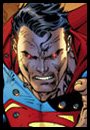
Concerned about recent events involving Wonder Woman's brutal execution of the corrupted Maxwell Lord, Superman is soon distracted from the conversation by the otherwise inaudible sound of a heartbeat. His reaction proves too slow, suffering a slugging fist from the villains Mongul!
The monstrous alien swats Batman aside, but Wonder Woman is at the ready with sword in-hand. She slashes at the hulking beast, who gladly meets her blood letting with a blow that sends her shattering through the ruins of the satellite base. If it wasn't already destroyed, it soon would be!
Superman returns with a vengeance, heat-vision blaring, but again he finds himself swatted away by Mongul's fantastic strength. Looking for a different tactic, he hoists the ever-so human Batman off the ground by the neck.
Assessin Batman's suitability as donor for another skull for his throne, Mongul isn't prepared for a quick recovery by Superman.
 Superman throws all of his Kryptonian strength into a blow that knocks Mongul's face around itself. He continues the ill tempered attack with a stressed combination of fists, unrestrained heat-vision, and fury!
With Mongul downed, Superman checks on the rattled Batman.
Wonder Woman proves less concerned with her fellows' well being, and more with the permanent solution to Mongul's terror. She dives with her sword in the axe-handle position, prepared to strike down the fallen villain once and for all.
 Ever the boyscout, Superman intercepts the killer-blow, catching the sword before it can split Mongul's head like an overripe melon. Even Batman, whose dark justice more closely resembles Wonder Woman's warrior code, questions the warrior princesses' intentions.
While the trio debate their philosophies of justice, Mongul is able to barge through them, making an untimely escape, free to trouble them again in the future.
I've been hovering around the place making tongue-in-cheek references to a slightly cheesy harsh justice trinity of DC royals; Wonder Woman, Black Adam and Aquaman. As silly as it sounds, I'm actually hiding a deadly serious, if under developed, concept. A concept that would perhaps best fit in the Wonder Woman book itself, strangely enough.
It grabs on to some very recent reference points.
I love the implication of Darwyn Cooke's New Frontier work, that revels in Wonder Woman's supposed warrior origins in a retro-contemporary war-time situation. I love that, in the name of good, she gleefully takes part in the slaughter of men who have committed terrible evils. With such a vile situation, I even don't mind that there's a distinct feminist agenda there, that errs a little too narrow sighted for what I'd like of such a prominent superhero.
I also latch on to, of all things, the brief appearances in Brian Azzarello's Superman, which again played to Wonder Woman's strengths as a warrior, and cast her in a scenario closer to man-made suffering than giant snake-haired monsters, or simplified struggles of diplomacy.
I think about these characters; Black Adam and Aquaman.
Black Adam is a character we've talked about a lot this year, as one of the more high-profile anti-heroes at DC comics right now. I expressed concern about a potential return to over-simplified super villainy [Hawkman #24], and certainly this concept asks that you disregard that kind of tact in favour of holding on to his unwavering role as conquering dictator, first confirmed in Black Reign.
Neither he, nor Aquaman, have a book right now, with the latter having his title cancelled in an almost inevitable cyclical series of false-starts.
I look at the commonality of these characters as outsiders who have lived in societies far more advanced than our own, and yet, also somewhat ancient in their design. I consider the viability for these characters to break apart from the mold of the well established characters, to blaze a trail as not only characters depicting a diverse interpretation of justice, but also as a platform for interesting scenarios and world affairs.
As part of the "Trinity" Wonder Woman is either too sympathetic, like Superman, or too harsh, like Batman, albeit, a tad more lethal. As a character whose stage should be the world, I can't help but see untapped potential in a Wonder Woman who breaks away from the conceptually obscure hub of world activity - America - and extends herself, with a coalition of likeminded outsiders, to subscribe to a proactive course of their own warrior's justice. Not that the American hub wouldn't still be a regular touchstone, given the international interests of groups like Checkmate, and the Justice Society.
I don't know how Amazon Attacks affected Wonder Woman or her outlook on the world. I don't know if she was part of the presumed invasion of Amazons on the world-of-man, or if she were revolted by it, (in that Superman-style turn).
I don't know if it really matters. It seems like Wonder Woman is crying out for a strong and certain characterization and course of direction, requiring simplicity, but intelligence, and this might just be the time for it.
It remains to be seen what Gail Simone will do with the character, but I can't say I'm really holding out hope. Short of a one-shot war on refridgerators, I can't see Simone bringing a lot that interests me to this particular character. Will a phoenix rise from the ashes? We shall see...
 The Fix: 6 The Issue: 5.5
Winner: Superman/Wonder Woman
[Something I didn't get to mention was just how refreshing it is to see Batman out of his depth. All too often we see him swiftly counter-acting the presence of Superman-level aliens, which is fun, but a little too consistent. A refreshing take on the situation, in a charged gathering of the "Trinity".]
 WONDER WOMAN versus ETRIGAN
The Region Beyond Part II: Beyond Redemption (DC)
Where: The Demon #17 When: November 1991
Why: Alan Grant How: Val Semeiks
Quick Fix...
It was a while ago now I had a brief online discussion with a man deserving of more recognition on a blog dedicated to superhero fisticuffs, and macho bravado. I of course refer to the one and only, Beau Smith; a man of certain and sure opinion, who had a major creative hand in the life of Guy Gardner as the editorially mandated - Warrior.
During that discussion I peddled a different theory about Wonder Woman. With Greg Rucka's "new" take on the diplomat in shoulder pads and a skirt, I was interested in taking that urban slant and turning it on it's side a little.
From the serious, to the silly, we arrive at this book. Something of an abberation in my collection, it came into my possession by means inadvertant, and has since sat lonely, waiting for just such an occasion as this.
My theory, at least for Wonder Woman's life among humans, was of confidence and liberation. It proposed an almost She-Hulk style sexuality, partially opening the floodgates to all things fanboys have pondered whilst staring at an Alex Ross Wonder Woman's thighs. Because, we already know Wonder Woman finds men attractive, but having been raised on an island exclusively inhabited by Amazonian women, I think it's fair to assume she'd be open-minded.
Actually, I think what takes it from being a little uncomfortable, and brings it back to being an interesting character trait is that she'd be very as matter-of-fact about it. You would have to imagine that there's a familiar bisexuality amongst a race living with women, but apparently also aroused by the presence and mysteyr of man.
I like the idea that the fact has never been explicitly addressed because, for the extremely liberal Wonder Woman, it just isn't an issue. In the same way I don't march around the streets declaring my heterosexuality, for Wonder Woman it would be such a non-issue, she wouldn't consider it. Of course, taking that slightly alien perspective, I also don't think she'd blush educating someone on any of the invoved practises, or anatomical implications of such a lifestyle.
Of course, that's not to say I want to recast Wonder Woman as some sort of lady-about-town tramp. Huh, figures you'd assume that, sperm bank.
No, see, we know Wonder Woman isn't some sort of floosy for the same reasons we know she is attracted to men: It's on the page!
Case-in-point, having been smelted by an evil villain, and cast into the Netherworld by an impishly passing Klarion the Witchboy, Wonder Woman finds herself the subject of the unwanted affections of The Demon - Etrigan!
Confused, Wonder Woman is taken surprise by an evil Banshee creature as a welcome to what appears to be Hell. She puts the creature down hard with an unrelenting fist, but she underestimates the hellspawn creature. It springs back up, launching at the warrior woman while she is distracted talking to Etrigan, who dangles from the ceiling wrapped in chains. [Long story!...]
 Sensing Wonder Woman is pure-of-heart the Demon's host is compelled to go to her aid, but the demonic body is uncooperative with the brain's commands.
Wonder Woman suffers at the hands of The Banshee as it rips and tears at her flesh exposing a flowing trickle of crimson blood that finally awakens the Demon's simmering interests in an explosion of excitement.
Freed the Demon swiftly pounds The Banshee into submission, and leaps at Wonder Woman.
Compelled by the sweet smell of Wonder Woman's blood, the Demon does not stop there. With an excess of enthusiasm he snatches the Amazonian off her feet and passionately throws her to the wall, his demonic tongue wagging at the streams of blood across her face.
Thoroughly offended by the Demon's unsolicited advances, Wonder Woman has no choice but to throw her Amazonian super-strength into a well placed knee. Though powerful, the blow fails to rattle the Demon's cage, instead only enticing him further by his joy for massochism. Overwhlemed, Jason Blood, the demon Etrigan's host, can merely commentate the creature's actions, awaiting the opportunity to wrest control from the savage beast.
 Giggling gleefully the Demon renews his advances, ignoring Wonder Woman's warnings to descend on her with his tongue wagging between massive pointed teeth.
He pins her to the ground, and through a veil of his own twisted sense of romance, begins to wail on her.
It is only the exertion of Jason Blood's will that finally stays the Demon, managing to utter the enchantment that returns him to form of man.
Like I said, I'm not so sure this is the kind of blunt, forward approach to Wonder Woman's romantic life I have in mind, but as something of a curiosity, I just had to throw it into the mix. I think it's fair to say it fits the previously discussed harsh justice, as pictured right.
Harsh, but fair.
Lord knows my knees would wander if I were being molested by a blood-thirsty demon. I don't care how helpful he may have been.
Y'know, despite some mature overtones, this story actually highlights another potentially interesting avenue for the Wonder Woman character, and that would be the young readers line. Like a Captain Marvel, Wonder Woman has struggled to find a strong, consistent characterization, and might even be there that she could begin to build a new franchise opportunity with more light hearted antics.
It's maybe hard to say exactly what's best for the Wonder Woman character, but lord knows it has to begin with some chances. Few characters are as guarded as Wonder Woman, and yeah, some of the things we've discussed here are pushing the mould a little, but maybe that's what's needed. It was testing stories like the Dark Knight Returns that helped reinvigorate Batman, and maybe it's time Wonder Woman got the same leeway to produce the same results.
Now if you'll excuse me, I'm going to get some of the sleep I should've had when I wrote this thing. I'd like to think I didn't, but if it got incoherrent, you know why. I tend to maintain though, the uncompromising Wonder Woman is the one I'd like to see the most. A harsh figure of international justice.
 The Fix: 3.5 The Issue: 4
Winner: Demon/Wonder Woman
[This wacky tale will have to wait for another day to get a better review. I'm going to count it as a double within a double, awarding a shared victory over The Banshee, and a tie between Demon and Wonder Woman themselves. A book that's got the adult shift of the eighties, it probably shouldn't have been in a bargain bag.]
 DOPPELGANGER versus MR FANTASTICThe Enemy Within! (Marvel comics)
Where: Fantastic Four #366 When: July 1992
Why: Tom DeFalco & Paul Ryan How: Paul Ryan
The story so far...
Adam Warlock, a cosmic weapon who reached omnipotence, purged himself of emotions to create two gestalt entities. From all his good came The Goddess, and from his negative emotions, The Magus.
Seeking total domination over the Marvel Universe, the Magus uses his fantastic cosmic power to exist in a pocket reality, manipulating the pawns of his game from afar.
To the bewilderment of Thanos; a man whose motivations are similar bit distinctly different; the Magus wages war on the heroes through the creation of doppelgangers using items resembling the fabled cosmic cubes.
Crucial to his war on the heroes, the battle between dark shadows and crucial figures within the superhero community. Figures like Reed Richards!...
Previous Form:
Mr. Fantastic (#7): Has led the Fantastic Four in battle against Super-Skrull, Annihilus, Paibok and many others.
Doppelganger: Captain America swiftly defeated his Magus created doppelganger.
Tale of the tape...

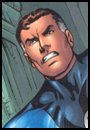 Strength: Mr. Fantastic 3 (Athlete)
Intelligence: Mr. Fantastic 6 (Genius)
Speed: Mr. Fantastic 2 (Average)
Stamina: Mr. Fantastic 3 (Strong Will)
Agility: Mr. Fantastic 6 (Rubber)
Fighting Ability: Mr. Fantastic 2 (Average)
Energy Powers: Mr. Fantastic 1 (None)
Like the Captain America battle [Captain America #408], we've just gone straight to Mr. Fantastic's tape. You can fairly imagine his doppelganger measures up with roughly the same attributes, with the exception that he's far more malicious, and presumably interesting in doing much more killing than Reed Richards. Then again, those of us who read Civil War, might not be so sure. [Boom boom!]
Mr. Fantastic is an interesting character. We've discussed long ago [Fantastic Four #3] the peculiarities of his rubbery powers, and how they potentially make him live up to the cliche of most powerful man in his universe.
Okay, sure. Guys like Galactus can transmogrify him, or just eat around him until there's nothing left, but in the realm of the traditional hero and villain, Richards has probably got to be about the most deadly sleeper.
Think of it this way: He can reshape his body in all kinds of passive and aggressive lethal positions. There's the bouncing ball of doom, the giant hammer fist, the human-blanket, the python fullbody wrap-around... Not only all that, but defensively the guy can hurl most of what's thrown at him straight back to sender! [Although, recent results suggest that while he shares a molecular similarity to rubber, he lacks the super properties as an insulator; Fantastic Four #358]).
So, what's holding him back? Well, characterization has varied.
Almost universally Reed Richards is restrained by the scientist within, who is almost always too busy giving long-winded directions to his fellows, or analysing the threat with an almost perverse curiosity.
Just think, though. In Civil War he managed to created a cyborg clone of Thor, complete with deadly lightning bolts that had no trouble whipping Hercules around like a muppet, and sliced through Black Goliath in record time.
Just what could that brain do if it were turned loose?
I don't mean Dr. Doom loose, either, which is the obvious answer to the question. No, the best Doom is never unlocked to that potential either. Too busy acting in national interest, or bitter resentment, and even then, without those I think Doom still has standards too high to resort to scientific butchery.
I guess, since this is battle with an evil duplicate, we're about to find out what happens. Can Reed Richards handle the opposition? Hard to say. Sometimes he's a well trained team-leader ready to stretchy-headbutt his way to victory. Other times, he's a bit of a blundering fool, just as likely to trip over his stretching ankles as he is to trip up the villains.
The Pick: Mr. Fantastic
What went down...
The Human Torch has left in a huff - again - leaving the FF in one of their cyclical periods of being short-staffed. Having recovered from the threat of the Inniverse, ruled by Occulus, Reed Richards is preparing security to protect his son, Franklin, from the forces that may seek retribution through his endangerment.
Richards won't complete the added measures of security if the evil Magus has anything to do with it. Just then, as though from nowhere, Mr. Fantastic is confronted by a sinister mirror image of himself, completely unaware of events occuring to the other heroes across New York City.
Stretching free of his doppelganger's wrapping arms, Richards gets his barings with a giant-sized fist that knocks the doppelganger back. Unfortunately the maneuver sends the evil shade toward a weapons rack, where the creature is able to utilize all of Richards' intimate knowledge as his own.
 The alien construct turns the advanced weaponry on it's owner, but fortunately Richards' pliable elastic body is able to absorb the brunt of the shrapnel. He flings it back with velocity at his doppelganger, charging in for a supressing offensive-defensive.
With the evil shade playing to Richards' doubts, he faulters, feeling the extent of his own powers as the villainous apparition turns his body into a mass of violently prodding extensions. The move puts Richards on the ropes, giving the doppelganger the opportunity to literally use his head to gain the upper hand.
 Richards, with his back against the wall, tries to convince his opponent that they are too evenly matched. Again the doppelganger advances with an assault on Richards' failings as a hero, revealing lethal intent where Richards would have excessive verbiage and proclamations.
Without hesitation the doppelganger clutches Richards by the throat and stretches his free arm into his mouth. Using the stretching ability to expand his arm inside of Richards' throat, the evil shade attempts to choke him to death.
The doppelganger revels in Richards' doom, claiming to be turning the same stubborn foolishness that defeats foes, and distances Mr. Fantastic from his family, right back against him with lethal results.
Fortunately the original Mr. Fantastic is able to keep a cool head, stretching himself into a human top that flings his other across the science lab.
It comes to a thunderous crash landing, but manages to continue to intercept emergency alarm checkpoints, a tactic Mr. Fantastic has noted the entire fight.
 Richards again attempts an offensive, seeking means to access the emergency alarms. Unfortunately, the murderous clone continues it's assault, manifesting their differences in physical form, utilizing a spiked club transformation in favour of Mr. Fanatstic's traditional giant hammer.
Again the stretching doppelganger gains the advantage, out maneuvering his predecessor, only to turn the situation like a rubber, super-wrestler.
He traps the weaker Mr. Fantastic while he contorts his stretchy body into a giant bow. With deadly speed Mr. Fantastic is hurled into the air, but he manages to reshape his body into a spherical ball, bouncing around to return fire.
 Arrogance finally gets the better of the doppelganger, who falls into Richards' trap of ignorance. Prepared to swat the ball away, the doppelganger instead faces a wall of humanity as Mr. Fantastic expands beyond him at the last second, forming a human blanket!
Contracting around his evil clone, Mr. Fantastic clenches his entire elastic body like a vice. Foolishly he does not completely envelope the entity, allowing it the miniscule space needed to stretch a hand free.
 That hand once again goes for the workshop's rack of weapons, snatching a gun from the wall. Mr. Fantastic stretches his own hand to the wall, attempting to pin his shade's wrist to the wall, but he stretches out of it to fire the gun directly at Reed Richards! The weapon spews a massive blast of flame!
Though stunned into unconsciousness, Mr. Fantastic is not mortally wounded or burned by the presumably alien weaponry. Never the less, his defeat allows his sinister mirror image to carry out it's objective to replace the FF leader.
The evil creature turns it's hand to a slimey mass of tentacles which grow to envelope Mr. Fantastic's body, and though the Freedoms Plaza alarms finally alert Susan Storm to trouble, she arrives unawares to find who she believes is her husband, disarming the "malfunctioning" system.
The Hammer...
Gosh, gasp, wheeze? Not a hoax, not a dream, not an imaginary story! You witnessed it here folks, the evil doppelganger clone of Mr. Fantastic was successful in defeating the original!
Over last month we talked a lot about stories from the past, and the interesting levels of symmetry between then and now. A lot of those examples had to do with comparisons between classic ideas and the deliberately inspired brand that is - the Ultimate line. This of course is an example built on a contrived series made for reinvention, but here we have a much more interesting parallel apparent.
Though Iron Man took the chief position as masthead for the pro-registration side of the Civil War camps, he had a lot of help coming directly from Mr. Fantastic, who many regard as acting distinctly out of character. Was this just a cast of a slanted fan opinion, or could there be more sinister machinations at work, behind the scenes in the Marvel universe?
The irony here is that it was during the Infinity War that much the same scenario arose, where Mr. Fantastic and Iron Man were each defeated and replaced by their Magus-created doppelgangers to become chief agents against their fellows.
Fortunately the heightened senses of characters like Daredevil and Wolverine were able to detect the facsimiles, but with the recent New Avengers development [revealing Elektra to be a Skrull], one has to wonder just how far methods of detection have been undermined. Wolverine was again one of those present who was unable to detect the switch between Elektra and Skrull, a woman Wolverine knows well enough to spot.
I don't know if we can realistically expect any kind of connection. I honestly think it was just a case of shifting opinions in a contemporary atmopshere of fear and concern, but it's interesting that Mr. Fantastic and Iron Man were able to be such crucial catalysts for not one, but two wars designed against heroes.
Reading this, you might know a combination of events have put me a few days behind our regular viewing schedule. Would you believe a one-two of computer problems and a mysterious power outage? Musta been trouble down at the power plant again. Oh, that wacky Electro!
So, we're wrapping this one up a bit quicker than ordinary, but I should take time to remind you that this is, of course, part of a special month in our Marvel Ultimate Alliance Mondays, replicating the later levels of the game where you find yourself pitted against evil clones of your favourite heroes! That of course precedes the concluding battle against Dr. Doom, which will be next month!
Despite all the wacky schedule interference, I have managed to prepare a lengthy double feature for today [Wednesday] featuring a lot of slurred ravings written after stumbling out of bed with a fixation on the DC Trinity.
Readers interested in the fate of Lyja after her apparent death [Fantastic Four #358], might like to know that it's this issue that concludes with the graduation of a new B-story. Paibok, having encountered the Skrull-killing Devos, reveals a plot to undo their mutual enemies, the Fantastic Four, with the suspended body of the Human Torch's wife -- Lyja!
Suspended in a pod of liquid in much the same way the abducted Alicia Masters was found, Lyja becomes an unwitting pawn in a plot against the man she came to love. It's a fairly classic storytelling model that typifies much of DeFalco's work on Fantastic Four, continued before and after by adjacent writing teams.
It is, of course, suitably complimented by Paul Ryan's classic pencils which are Byrne-esque in their construction, and nicely iconic. He draws a good Thing (hint hint)!
Thanks for stopping by, and make sure you keep hitting us up!
We just dropped a Technorati credit point (expired link?), so get out there and start linking to us! Or else I'll have to send my robot Sentinels after you!
The Fight: 6 The Issue: 4.5
[Continuing the fun of the Infinity War, this issue manages to mysteriously find weight through the progression of stories for each FF character, while focusing mostly on the struggle of Mr. Fantastic. Important beats include Sharon Ventura's return while Thing visits the local gym, and Human Torch's speedy recovery from discovering his marriage was a sham.]
QUICK FIX DOUBLE FEATURE: Go For Broke! VEGA versus DAN HIBIKI
The Tournament Begins (Group TAC/Capcom/Manga Entertainment)
Where: Street Fighter Alpha When: 1999
Why: Shigeyasu Yamauchi, Joe Romersa, Reiko Yoshida, & Kirk Thornton How: Kazuyuki Ishikawa
Quick Fix...
With the various goings on around the place, we've had an influx of new readers. Some of them have actually arrived here because of previous Street Fighter entries, but for those who haven't, let it ring out through the village: I'm as keen on superheroes as I am on beat 'em ups!
Okay, so maybe not all beat 'em ups, but I think I've got the basics covered. SF, Mortal Kombat, Tekken, Dead or Alive. Sure, I can stretch to some of the others, but this would undoubtedly be my core, with DOA bridging the familiarity gap between those I'm less aware of, like the SNK series, and those I love, like Street Fighter!
Some fans might ask, why Street Fighter?
It's failed to make the transition to "3D," it doesn't have FMVs, it often lacks in the story department, and the wheels really fell off during the process of Street Fighter III and the pseudo 3D Ex series.
I'd say, sure, a lot of that is true, but the undeniable appeal of that initial idea, and the memorable revamp it underwent going into Street Fighter II keeps me wanting more. It's the characters and the style that have made a loyal fan of me, and also represent such interesting ideas for comic, manga and animé.
As a brand, Street Fighter is now regarded as little more than a nostalgia product to be regurgitated in several vaguely different forms. The product has arguably been squandered over the years, hovering too long around tweaked revisions at the cost of casting an illusion of forward momentum. SFIII, the final true attempt to move forward, remains one of the most disappointing, redeemed only by it's final revision which made long overdue inclusions of classic characters.
Consistency of characterization and the purity of the design seemed lost on the final generation of Capcom contributors. Garrish pseudo-superheroes, monsters and robots replaced the classic formula of martial arts caricatures, complimented by broad, but distinctive, ethnic strokes.
This is a fact almost certainly recognised by those that would develop the property for the minority market still interested. Largely more popular in the US, the Street Fighter Alpha animé "OVA" project was produced, paying close homage to versions of the characters not yet capitalized upon in animated form.
While Alpha stays much closer to the popular starring characters like Ryu, Ken and Chun-Li, it expands it's cast from well known supporting characters [Sakura, Birdie, Akuma] to cameos with Alpha initiates like Adon, Rolento and Cody.
Narrowly missing out on entering an American Street Fighting tournament held in a partially demolished highrise, Ken Masters accompanies an enthusiastic Sakura to find Ryu. There they witness one of the tournament matches, a brutal encounter between the vainglorious Spaniard, Vega; and the similarly arrogant, but entirely unjustified - Dan Hibiki.
 Vega makes good use of his acrobatic abilities, leaping into the air with Hibiki already on the back foot after suffering a slash from Vega's wrist-mounted claw.
The Spaniard twirls earthbound, slashing this time at the pink-garbed martial artist's face.
Vega finds his way behind Dan, wrenching back on his neck before pulling back with his full weight to position Hibiki on Vega's feet. With a springy strength, the masked matador launches his opponent, catching him in mid-air with a flipping stomp. Unrelenting, Vega looks to finish the fight with trademark brutality.
 Letting out a shrill scream, Vega buries his claw in the floored Hibiki's chest, erupting a volcanic explosion of blood and gore. Though his mask hides his emotions, one can only imagine the ecstatic pleasure the sadistic Vega takes.
It would be diplomatic to express some kind of interest in the Dan character, but let's be honest, the world loves a bastard. Vega is one of the prime examples of the enticing and pure characterization of Street Fighter's elite.
Vega is unashamedly comprised of utterly vivid portions of vanity, psychotic massochism, all mixed with the glamor of the Spanish matador. Though his connection to the martial arts is marginal at best (his style lazily described as Ninjitsu by American translators), he remains one of the most memorable characters to come from the first revamp, Street Fighter II.
The Alpha "movie" does manage to stay relatively faithful to the characters and concepts, even though it pinwheels on entirely original material to this particular story. Included for the first time, a data-obsessed scientist, his power absorbing android, and a much maligned fictional Brazilian brother to Ryu.
When laid out like that, it's perhaps evident just how remarkable it is that Alpha can be recalled in such positive regard. Again a testament to the power of using the characters well; Alpha peppers cameos throughout, staying closer to an independent story than the revered SFII animated feature, but utilises the cast much better than the unrelated sequel that follows: Generations.
Even so, with so much weight behind the cast of the series, it's a wonder there wasn't more effort made, particularly in the sequel, to include more characters into the story. It seems unfair to disregard the tale of Ryu/Akuma as what it is, but I think those broader, second-tier character appearances are really what remains the driving force behind any successful Street Fighter venture.
 The Fix: 4.5 The Movie: 5.5
Winner: Vega
[Yes, I'm using the US names. In a perfect world we'd have a streamlined, one-answer option, but with CapcomUS now owners of the franchise, I'm pulling rank. If you're interested in Street Fighter, but are unfamiliar with the story, SFAlpha is a great place to get acquainted, particularly with core characters like Ryu and Ken.]
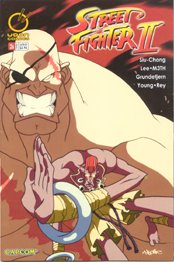 SAGAT versus DHALSIM
Yoga Mind Trick (UDON)
Where: Street Fighter II #2 When: December 2005
Why: Ken Siu-Chong How: Skottie Young
Quick Fix...
Street Fighter Alpha takes full advantage of one of the unique skills of the Japanese, maintaining a relatively simple story, but using style over substance to justify maintained interest in the product. It skillfully dwells on the minutia, without actually going into any depthy meaning or layers. It simply is what it is.
Fortunately, while many of the Street Fighter characters have struggled to develop more complex motivations in film or game; the good folks at UDON manage to maintain not only a beautiful and recognisable visual approach -- but also a script that compliments much of what we know of the characters, while still directing them in a unique, reasonably progressive story. Again, it isn't revolutionarily dense, but on the twenty-two page platform of a comic book, the luxuries afforded in animation quickly melt away.
For comics, Street Fighter perhaps represents one of the most inviting and exciting licenses available. Irrespective of it's in-built fanbase, the characters represent the ultimate in branding. Even the best of the second-tier is instantly recognisable thanks to brilliantly simple design. Each character brings not only a trademark visual, but a two-dimensional characterization that is an extention of their look, a trait that leaves plenty of room to elaborate in an on-going medium, without presenting a slate too blank to enjoy from the beginning.
These well defined characters really do lend themselves to an on-going medium, providing recognisable perspective from which they can clearly react to the on-going events of a story or situation. A true master would be able to develop and shape these characters into more depthy personas, but even the contemporary average need only stay faithful to succeed as the SF brand requires.
UDON does well to do a little bit of both, meandering it's way through familiar concepts (like Cammy White's brainwash ordeal under Bison), but also adds developing spice to stories and relationships, like Sagat's search for knowledge and power in the wake of his famous defeat at the hands of Ryu (circa the first, often forgotten side-scrolling Street Fighter game).
Either taking inspiration from the Street Fighter II V animated series, or arriving by the same logics; UDON takes Ryu on a journey to the mysterious yoga master, Dhalsim. Hoping to find inner peace and a control over the potential of the dark hadou energy, Ryu discovers Sagat, who has also been training to control his inner rages and become a better fighter.
In this back-up story taking place after Sagat's defeat of Ryu [Street Fighter II #2], we learn of Sagat's journey with Dhalsim, and the beginnings of his exploration of the mysterious yoga arts.
 With the glow of a campfire to light them, Sagat confronts Dhalsim in the heart of a forest. There he challenges Dhalsim to prove the value of his yoga teachings, apparently unconvinced of their capability to aid his already impressive strengths.
Dhalsim gladly takes the challenge, using his defying contortions to evade Sagat's kicking attack. Instead of matching the violence, the stoic Dhalsim makes a fool of Sagat's brutish style, forcing blood to cascade from the Muay Thai fighter's nose with little more than the power of his energy.
 Dhalsim follows it - extending his limbs to strike Sagat's proud jaw - before sending him through a tree with a devestating body blow.
The yoga master schools Sagat not in the physical art of fighting, but the clarity of mind. He decrys Sagat's motivations, and willing surrender to anger and hatred, "... the most distracting and dangerous of those emotions."
With quiet confidence, Dhalsim declares there is much he can teach Sagat, before punctuating his point with his signature attack, the yoga flame!
On his knees, Sagat opens his eye to discover he is unharmed. Dhalsim reveals the power of the mind, prompting Sagat to take a meditative position by the campfire. He is now Dhalsim's student.
Most casual fans will recognise Sagat as the scarred Muay Thai fighter of the series, and may even recall his position as final of the three sub-bosses in Street Fighter II. He supersedes Balrog (boxer) and Vega (see above) as Shadaloo bosses working for Bison, his motivations directly influenced by his apparent defeat (and scarring) at the hands of Ryu, who defeated him with the legendary sho-ryu ken attack that left his chest marked forevermore.
It's those origins that always leave me a little conflicted about a Sagat who is portrayed in a more positive style. In the TV anime series, SFII V, Sagat is portrayed as a fallen champion who was framed when he refused to take a dive for the criminal pawns of Shadaloo, the Ashura. In prison he encounters Ryu, undertaking a similar quest to develop his martial arts skills, and the two become friends as Ryu reignites his fighting spirit and good heart.
If I had to choose, I'd definitely take the UDON version.
Having missed a chunk of the first series, I'm not certain when I assume Sagat has not yet come into the service of Shadaloo. His motivations resemble Ryu's more closely, desiring only of fighting superiority, initially in the name of besting Ryu in a rematch, but after Dhalsim's training, in a more general sense.
Sagat, like Vega, is one of those secondary characters that really jazzes me.
Highlighted by his varying characterization, Sagat's story really doesn't begin until it breaks away from Ryu, and even then further depth is sketchy, additions like his service to Bison, and his arrogant student, Adon, being noteworthy.
Still, despite this general consistency of minimally developed characters, I just can't get enough of Street Fighter. Still months behind on purchases, it's perhaps the UDON translated manga and original releases I'm missing the most right now. Maybe to make up for it, we'll consider a little experiment...
The Street Fighter universe famously brought about a convergence between gamers and comic fans with the Capcom versus Marvel series, and it's many different entries. On a website dedicated to ranking superheroes based on their fights, can they possibly hold their own against an incursion of street fighters?
There are only three months left in season 2007, so maybe we'll play a little game with Saturdays. Let's see if A) I can keep it up, and B) if a Street Fighter character can usurp a top five ranking in 2007 before the year is through.
One would expect someone like a Ryu to take the spot, but without specifically contriving such a result, we'll leave it open. We may just get a surprise!
 The Fix: 3.5 The Issue: 6
Winner: Dhalsim
[UDON continue to honour Capcom with their contributions to the Street Fighter franchise. Will they contribute to catapulting a Street Fighter into the Infinite Wars top five? Drop a comment and show your interest, and stay tuned to see if the impossible can happen! Get ready fighters. Go for broke!]
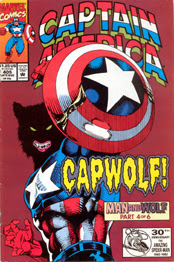 WOLVERINE versus CAPTAIN AMERICADances With Werewolves (Marvel comics)
Where: Captain America #405 When: Late August 1992 Why: Mark Gruenwald How: Rik Levins
The story so far...
Having escaped the feral clutches of lycanthropy before, Captain America finds himself once again strapped to the table of the evil Dr. Nightshade. Intent on turning him permanently, she injects her formula, incurring immediate results.
The feral Captain America proves strong enough of will to resist the influence of Dredmund; Nightshade's partner in crime, and self-proclaimed lord of Werewolves.
Confused and disorientated, the turned Captain America sprints into the surrounding Massachusetts wilderness, his super-soldier body origins giving him an edge against the opposing werewolves. Unlucky for him, werewolves aren't the only feral creatures in the wilderness: Enter the Wolverine!
Previous Form:
Wolverine (#4): Killed Cap in an alternate reality, having already hacked off a few limbs.
Captain America (#5): Aided SHIELD and the X-Men in putting Wolverine down.
Tale of the tape...
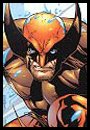
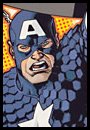 Strength: Draw 3 (Athlete)
Intelligence: Draw 4 (Tactician)
Speed: Captain America 4 (Olympian)
Stamina: Wolverine 6 (Generator)
Agility: Captain America 4 (Gymnast)
Fighting Ability: Draw 6 (Warrior)
Energy Powers: Captain America 2 (Projectile)
So, you remember in that last entry [Captain America #408] I mentioned Captain America was battle fatigued? Yeah, well now you have at least some clue why.
After being turned into a werewolf by Nightshade, Cap snaps free of his shackles and bounds off into the village, where Dredmund turns a bunch of innocent bystanders, and sends them off in pursuit of the Captain. Not that any of that particularly matters, just needlesly elaborating.
These guys have a history together that continues to develop as pieces of Wolverine's missing past continue to surface in stories like the current arc in Wolverine: Origins, featuring WWII encounters between the characters.
On our watch, the first time these two met in opposition was back in our very first entry! [Wolverine #25] saw a Hydra controlled Wolverine finally put down by the intervention of Captain America, but not before he took the X-Men to task, and murdered gay-icon, Northstar. Ouchie!
Wolvie got the chance to even the score up in a What If [Wolverine was never deprogrammed?] spinning out of the same story. In this world, Wolverine was able to evade the finishing blow and hack himself a tasty, side of patriot.
In this world he's able to take the wheelchair bound Captain out. Not sure if that really means anything, but it fills the tape, and gives you somewhere else to go.
If you don't mind breaking a bit of kayfabe, it's fair to see how Captain America has the almost impossible advantage: Harmlessness.
In times of International war, who knows? But in his adjustment to contemporary life, Captain America made the decision never to take a life unless entirely necessary. That makes him a much more child-friendly victor when fighting a man whose chief offense is metallic, eviscerating claws that extend from his wrist.
 On the page, it could just about go either way.
Each character is supremely skilled in military maneuvers, and both are capable hand-to-hand combatants. Wolverine, more inclined to feral rages and brazen arrogances, is more likely to put himself in a losing position, comfortable in the fact that his healing factor will keep him in the hunt for a later opportunity.
Both men are one-man army corps (*cough*), but Cap probably comes to mind more immediately when you think piles of Hydra goons. That said, despite all this evidence, he has one of the highest loss percentages in the Infinite Wars, currently sitting at an anchoring 37.5% (versus Wolverine's 23.8%).
The Math: Captain America (Meta Class)
The Pick: Captain America
What went down...
With his strength and agility enhanced even further, Captain America swiftly evades the oncoming attack of Dredmund's wolven followers. He sprints further away from their growls, coming across a "man with long claws," who is lost in an entirely different haze of animal ferociousness.
 Instincts and muscle-memory give Cap-Wolf mind to call upon the defensive aid of his shield as Wolverine slashes wildly with his adamantium laced claws. They rake across the vibranium alloy of the shield, literring the ground with sparks.
Cap-Wolf grapples with the raging Wolverine, wrapping his own clawed fingers around the mutant's wrists to defend against his wild slashing. Through the red fog of his feral transformation, the Captain tries to communicate with the berzerker Wolverine, trying to find audible understanding.
Though Wolverine pauses for a moment to exchange snarls, it proves a costly opening for the lycan-Captain. Wolverine connects with his adamantium claws, opening up Cap-Wolf's shoulder with a deep gash.
 The pain of the wound only stirs Captain America's animal urges further, sending him into a reactionary rage that he cannot control. With reflexes enhanced by both lycanthropy and super-soldier serum, he lashes out with a clawed slash!
 Blood sprays, and Wolverine is momentarily blinded by the slashes across his eyes. Before his healing factor can stitch them up, Cap-Wolf hoists the spandex-clad mutant above his head, and with the villager werewolves closing in, hurls him in an unsolicited variation of the fast-ball special!
Cap will almost certainly be hearing from the X-Men lawyers, but as far as the battle goes, he is free to gallop deeper into the woods, victorious!
The hammer...
Bringing it up two-to-one in his favour over the clawed X-Man, your winner, by a snout -- Captain America!
If you're a regular reader of the Infinite Wars, you'll already know that Captain America is eventually freed from his curse of science, and goes on to kill a weird, spacey clone, and takes the Falcon out to dinner. Okay, that last part I made up, but y'know, the rest is true... If you missed it, you can find it here.
Much like the afforementioned previous issue of Captain America, this one contains a handful of additional fights. With our new format, no doubt you'll be seeing some of the quick fixes in the near future, along with some other battle featuring more obscure characters, like Dr. Druid. Until then...
This is usually the part where the feature would somehow flow into some point of discussion. Maybe some sort of recap of recent comics history, a perspetive of reflection upon something contemporary, or maybe even a rant about making the Sub-Mariner kingpin of crime. Unfortunately, the relevance of Man and Wolf is questionable beyond the geek-chic of a werewolf Captain America.
Why go there? Heck, what kind of a website would we be if our statistics weren't coming from every avenue, regardless of long term impact or relevance?
We got here through Marvel Ultimate Alliance Mondays, and we stayed here because, well, I just felt like it. Maybe it was because President Bush is currently all over the place with the APEC summit, or maybe it was just the chance to see another hero-v-hero battle with Captain America AND Wolverine involved.
 Actually, to be fair, this clash does bring us to one of the long debated facts of comics history.
If you've been following along at home, you'll no doubt be aware of the Alex Ross headed project set to bring a time travelling Invaders trio [Captain America, Namor, Toro] to the post-Civil War present.
The team, fresh from the Second World War, represent a younger, more battle-ready generation of heroes from the past. Among the many noteable comparisons we can expect, will be more aggressive and pro-active heroes than we may otherwise be used to, even in a time when heroes hunt and imprison each other.
If you're one of the many new schoolers hitting us up, you may not have ever stopped to consider the violence perpetrated by the heroes of the 1940s. A popular, if non-specific reference, is often then teen icon, Bucky, who as sidekick of the super-soldier Captain America, was to regularly have appeared toting an automatic weapon, gleefully mowing down hordes of Germans, or Japanese.
There's a contention between factions that argue exactly what it means to be a "superhero," and exactly how that translates to the wholesome, star-spangled heroes of the Second World War.
Idealists tend to prefer to consider the mark of the hero's worth by his ability to fight the good fight, without ever needing to take a life, however, that particular slant has a way of reinventing history, rather than honoring it.
I personally fall somewhere in between. I'm without a doubt a traditionalist, but at the same time, I can't help but be interested by the prospects of moral diversity in heroes. I like the idea that perhaps we can have it both ways, and that it's perhaps even greater to measure Captain America as a hero who survived bloody war times, and made the choice to take advantage of what is essentially a second-life, and do something truly extraordinary with it.
Speculation surrounding the Invaders/Avengers time-spanning crossover mini has been too distracted by teaser images to worry about the degree of violence that may accompany these battling Invaders. The earliest promotional shot used the central image of Captain America as a teaser for his apparent "return."
This, of course, has since been revealed to be a tagential return for the character, but the inevitable question remains: When, and how, will Captain America return to the Marvel universe?
Fans seem resigned to the fact that of all the heroes to stay dead, Captain America is among the least likely. This time around probably doesn't seem like the occasion to do it. Still, despite his death, Cap remains as hot a property as ever, with promise of a film sometime after the 2008 Iron Man feature sitting gingerly on the horizon. Can it be long before the mass media has a chance to spoil his return, in the same way they spoiled his death? Time will tell.
Bahlactus may tell, too, for he sees all, sucka!
It's Friday Night, which means, barring confusion and lack of concession for my time difference (living in the future, as I do), he may well be seeing us!
Bahlactus remains a cosmic force- neither hero nor villain- dedicated to the consumption of all things fight!
Gaze upon him and tremble... Before a two week hiatus!
If you're looking for a fight fix during the break, be sure to stop by!
Wrapping up with the plugs, you can also catch more sketching goodness from Pedro Cruz, who has returned from his travels abroad. I got to get giddy like a schoolgirl over being an author on a blog that wasn't mine for a week while posting for him while he was away, and you know what else has me giddy like a preteen? The Kirby Martin Inquest #1, which is on sale at Nite Lite Theatre.
If you haven't, you should do the right thing, and go get yourself a copy.
It's only $2.99 through the ever-snail paced ComixPress. They may be slow, but really, aren't they just making it all the more exciting? Wheeee!
The Fight: 3.5 The Issue: 3
[The #408 review highlighted presumed editorial interference impeding on the story. As "Billycomics" so rightly pointed out, it really wasn't the most stellar story to begin with. A fun nineties comics, not at all worthy of the flame breathing hatred of some, but likewise not about to win any awards.]
QUICK FIX DOUBLE FEATURE: Millarky in the US HAWKEYE versus AXIS OF EVIL
The Axis Of Evil (Marvel)
Where: Ultimates 2 #10 When: March 2006
Why: Mark Millar How: Bryan Hitch
Quick Fix...
Credit where credit's due, sure, but if you're an avid follower of the Infinite Wars, you'll probably have sussed by now that I'm really more of a character, story and leg man. Sure, creative teams are a part of the equation, but for me, a comic doesn't live or die by a writer, artist, or sychophantic obsession.
Well, okay, that last part isn't true. Maybe you get an extra look in if you've got some solid Sub-Mariner or Super-Skrull action going on -- but even then, I'm not about to sell the house to fund my comics obsessions. (Venting!)
Still, given the nature of the medium and it's intent on milking anyone or anything for all they're worth, certain creators are recurring factors in mainstream superhero comics. Then you break it down to the common denomonator of our big action smackdown format, and you refine those commonalities down to this man -- Mark "Yarrrrrrrrr!" Millar.
These two fixes do not contain individual "name" characters doing combat, and yet, they have been among the most recommended entries for the Infinite Wars.
When you consider our current most popular battles are things like Thor/Captain Marvel, Hulk/Superman, and Batman/Superman, that's no mean feat!
So, what is it about Mark Millar that makes him so enduring?
Well, it might be something he's managed to do that even his British predecessors haven't, and that's truly indulge and revel in superheroes as a summer blockbuster opportunity to go all-out action and fun!
His brief, usually year-long runs on titles, provide those books with an exciting injection of energy, often complimented and well earned by the pencillers involved. Men like Bryan Hitch, Steve McNiven, Terry Dodson, John Romita Jr; they've all been featured in the Infinite Wars delivering solid, widescreen performances in each of their unique styles.
Here, Hitch delivers a Millar script that continues the hardcore military adventures of the Ultimates. Divided and set upon by evil variations, the Ultimates are taken apart from the inside-out by their allied Communist rivals.
Already taken hostage, the embattled Hawkeye finds himself strapped to a chair in a tiny interrogation room, where one of the victims of his tour in Croatia eagerly awaits the opportunity to extract a little payback for the brutal scarring he sustained at Clint Barton's hand. The soldier of the Axis of Evil taunts the helpless Ultimate with requisites that involve keeping him alive, and with one functioning eye -- a scenario that leaves plenty of latitude for their torturous desires.
 Dragomir, the interrogating soldier, grabs at his throat with a gurgle, signifying a turn of fortunes in the tiny interrogation room. Though disarmed, restrained and injured, the mercenaries soon realise they have still underestimated the supremely trained marksman that is Clint "Hawkeye" Barton.
Awkwardly ripping the fingernails from his own hands, Hawkeye systematically takes apart the cell put together to hold him. He forces the weakest of the men to free him from his shackles, before learning of the certainty of Dragomir's involvement in the murder of his family. With that, Hawkeye snaps his neck.
 Alerted to the development, more heavily armed soldiers are ordered to the tiny containment cell, where Hawkeye has already claimed no less than five scalps.
The soldiers charge in to take the US Ultimate soldier's back, finding him squatting unarmed beside one of the deceased's weapons.
Despite a considerable position of leverage held against him, Hawkeye coldly refers to the scared soldiers as idiots, somehow avoiding their fire in the contained space to mow them down with much the same ease exibited previously against their comrades.
The Ultimates remains one of the most enduring of the Ultimate titles, holding on to a vision that set it apart and justified this unique take on the characters featured. Hawkeye; seen here unleashing his far more broad skills as a marksman; finishes up with ten soldiers to his belt in a fashion one would never imagine the purple-garbed, wise cracking, Secret Avenger would use.
It's easy to see why this brief exchange between a costumeless character and ten relatively faceless drones was so revered. Allowed to push the boundaries beyond the norm, Millar writes an action scene that serves the story well.
His books are now almost universally late, and his layouts often quite liberal with the use of space, but it's always that singular fact that the story is served first that separates him from his much maligned 1990's Image-cut peers.
Presented with lavish splashes of inks and colours, these artists take full advantage of a story that doesn't necessarily contain nuanced layers, but benefits greatly from the attention to detail.
 The Fix: 5 The Issue: 5.5
Winner: Hawkeye
[I read recently a quote from John Byrne, decrying those who would remove the gaudy, colourful costumes of superheroes. I can see where he's coming from, but the Ultimates is a prime example of how both sides of the coin can work. Not a particularly dense read, but as is often the case, Millar delivers exactly on what he promises!]
 CAPTAIN AMERICA versus SHIELD
Civil War Part One of Seven (Marvel)
Where: Civil War #1 When: July 2006
Why: Mark Millar How: Steve McNiven
Quick Fix...
Gee, am I sensing a theme here?
So, in the last double feature [Longshots] we were kinda clutching with the whole 'both involve gunshots' tie, but I think we might have some fun with themes in the next few. Things broader than just a writer.
Not that there's anything wrong with "just" a writer.
Hey, I happen to think writers are pretty important. Gee whiz, have I mentioned? I have a comic book currently onsale, and you can pick it up online right now from Nite Lite Theatre by following info on the main page to ComixPress, super online distributors extraordinaire! (If a little bit slow. Patience is a virtue!)
So, we already used up a lot of the discussive material about Monsieur Millar and what makes him such a big ape in the world of crime-fighting comics writers.
Without dredging up unnecessary medical references, I'm directed the only logical course of action: Discussing Civil War.
Yes, you might be sick of it, but consider for a moment - the options!
We can talk more about the storyline that was (and could have been) Civil War, or I can make more obscure puns based on detective primates. The choice is yours!... [Pause]... You want chimp references, don't you?...
If you somehow missed out on the media frenzy surrounding Peter Parker's canonical reveal to the world press that he is, and since age fifteen has almost always been, Spider-man: congratulations! The real world coverage of that event [featured in the second issue of the Civil War mini-series] garnered as much press as the fictional story within the Marvel universe. That deserves a crikey!
If you pick up a Marvel comic today, you'll see the repercussions of the Civil War event, that not only tore the Marvel heroes apart, but also led up to such major tangents as, the death of Captain America [Captain America #25] and the formation of the Secret Avengers, whose operations remain seperate to the SHIELD sponsored team run by pro-registrant, Tony Stark aka Iron Man.
Ultimately tensions between registered and unregistered characters have settled down. Seasoned street-level veterans like Daredevil and Moon Knight have been granted amnesty from pursuit in a time where the majority of opposing heroes have already been registered, or incarcerated. For the most part, this is a world post-sensation, where the disaster that sparked the event - an explosive accident at a school - is a forgotten catalyst for world change.
Though described as something of a bullpen story, with notable contributions from then-DC exclusive writer, Jeph Loeb; Civil War is another example of Millar blurring the lines between militant, politically charged psuedo-realism, and openly indulgent, four-colour superhero action.
The fear-driven reactionism of the superhero registration movement, and the harsh measures afforded by the political atmosphere, all closely commentate on developments in our own security-obssessed world. Even so, essentially these reference points facilitate one of the biggest superhero smackdown clashes of recent years, following in the vein of classic superhero rifts presented in stories like; Secret Wars, Infinity War, and Infinity Crusade.
 During this event of broad strokes, Captain America becomes the almost zealous representation of the free-rights movement. He staunchly supports those heroes that would wish to protect their identities for reasons of their own, beginning his crusade when first approached by Maria Hill aboard the SHIELD helicarrier.
Asked by the recently appointed commander to turn on his fellows, the Captain stands his ground, driven to distain by the implication of fighting those who have done so much good for their country.
Showing brazen opposition to the impending movement for registration, Captain America finds the SHIELD soldiers present willing to enforce their rule preemptively. With their guns drawn, Captain America is forced to make a decision then and there. Like he has so many times against assembled groups of AIM or Hydra agents, he explodes like a one-man army -- against his men.
 Using both armoured-soldier and adamantium alloy to deflected the tranquilizers fired by the SHIELD agents, the Captain makes his stand for the rights of his fellows. With devestating precision he strikes, using shield, fist, and expert training to shatter protective helmets of would-be oppressors.
With the writing on the wall, Captain America has no choice but to make a break for the helicarrier external windows, charging shield-first through the glass.
Hill orders the immediate capture of the super-patriot as he defends against gunfire in mid-air, making an uncontrolled descent from the SHIELD aircraft.
 A maneuvering bomber provides convenient salvation for the American icon.
Taking advantage of the lack of progression on the registration movement, he plays on the uncertainties of the pilot, ordering safe passage to the ground.
Once there, he will go into hiding, beginning the rebellion against the registration act that will tear the superhero community apart.
Before I segue neatly into our conclusion I must mention the stealth bomber surfing scene (following the above panel), which closely resembles what eventually turned up in the recent Die Hard 4.0, where John McClane [Bruce Willis] beautifully recreates the scene under his own conditions.
It isn't always the most popular opinion, but off the strength of performances like Unbreakable [a movie Mr. Millar just happens to tote as a favourite!], I find it hard to go past Willis for a big screen Captain America!
Sure, you've got your whippersnapper punks who want to see a pretty boy twenty-something, or a Brad Pitt in the role, and yeah, there's that argument.
I get that Cap is supposed to have been borne into the army at a tender age, and I get that the super-soldier serum has prevented him from aging, but damn it! It's characterization like this in Civil War that just highlights the grizzled and senior quality the character holds. Something only an actor of the calibre and familiar standing of Willis can pull-off.
I also, going back to his role in Unbreakable, like to think of the possibilities presented by the 'man lost in time' angle. Something that affords the character a very basic sense of humanity, that I believe Willis could convey beautifully.
Picture Willis -- in conservative slacks and shirt -- staring solemnly into the window of a store that, forty years ago, was his favourite place to buy novels.
A man who looks everywhere and sees not the sea adverts for iPods and Playstations, but rather the ghosts of what used to be there, and all the people and places he fought for. Things he knew he probably would have had to have given up even if he hadn't found himself frozen and thawed into a modern age.
 So, that's about it for the double-feature.
You might have gathered that it's 'the new toy' and there'll be a handful of doubles coming up over the next month. I'm already chomping at the bit for the opportunity to weasel in some more diverse entries, and ranking statistics.
No doubt this isn't the last we'll see of Civil War, but for now, adieu!
The Fix: 5 The Issue: 5.5
Winner: Captain America
[Lasting repercussions have made Civil War one of the most memorable event comics to come from Marvel this decade. Though it resulted in a hefty hangover, particularly in light of a weak ending, it remains a positive mark on the Marvel map. Well worth further investigation now that it's finished, if you missed out!]

 The Society quartet of Hammer, Angle Man, Hugo Strange and Cold see to the body's dismemberment, scattering it across Gotham City so as to reduce trace evidence. They are of course, completely unaware of Catwoman's gambit involving the calling in of a favour from a shape-shifter.
 With this first storyarc, the relatively untested Pfeifer quickly established himself as a man more than suitable for the job. Though broadly different from the more isolated adventures of the first twenty-five critically acclaimed issues, Pfeifer continued Catwoman's legacy appropriately, meeting the editorial requirements of a DC Universe becoming increasingly interconnected.
 The trio catch Catwoman unawares as she swings toward the Calculator's digs on the assumption he will help her with her problem.
 Tired of the amateur assault, Catwoman opts to pull out all the stops.
 With two of the three down, she makes a confident insinuation, prompting the final of the super-powered upstarts to run for his life.


 The Fix: 6 The Issue: 5.5

 Strength: Mr. Fantastic 3 (Athlete)


 SAGAT versus DHALSIM

 Strength: Draw 3 (Athlete)


