Showing posts with label Ken Siu-Chong. Show all posts

Monday, May 18, 2009

QUICK FIX: "MACHO" MIKE HAGGAR vs ZANGIEF
Final Fight: Bonus Story (UDON)
Where: Street Fighter II Turbo #6 When: May 2009
Why: Ken Siu-Chong How: Eric Vedder

THE TAPE...
Strength: Draw 4 (Enhanced)
Intelligence: Mike Haggar 3 (Straight A)
Speed: Draw 3 (Athlete)
Stamina: Draw 5 (Marathon)
Agility: Draw 2 (Average)
Fighting: Draw 5 (Martial Arts)
Energy: Draw 1 (None)

Math: Mike Haggar
Ranking: Zangief (#740)

THE FIX...
If I remember correctly, I mentioned at the beginning of May's entries that I was planning to be a little bit more ambitious with the schedule. For Infinite Wars, that meant trying to incorporate more quick fix entries to expand content. As it happens, we weren't the only ones trying to be more ambitious, it would seem.

UDON unleashed the first glimpse of their Capcom licensing expansion in the form of a four page short story summing up the life and times of "Macho" Mike Haggar. The story acts as a disconnected prequel to what will almost inevitably be a new Final Fight series from the studio-cum-publisher. UDON are actually playing coy for the time being, teasing fans with artwork and appearances of characters in the Street Fighter II Turbo series, while petitioning for e-support.
Ostensibly this is the confirmation of another Capcom sourced series.

I have to confess to being distracted this month with a side-project.
Yes, I've been cheating on you with a younger, sexier subject, but it isn't entirely irrelevant to today's quick fix! Truth be told, sometimes the rewards for running a blog like this are few and far between. I love comics and keeping a reader like you informed and entertained, but for the second or third time, the gamers have embraced me enough to seduce me to maintain regular free-flowing updates on a blog at 1up.com (recently featured on the front-page "Popular Blogs" list).

If you look closely at the panel above, you'll notice a handful of colourful characters from the other games. If I'm not mistaken, squinting into the middle of the pack will reveal Dan Hibiki just below Zangief's boot, and possibly even the enigmatic Street Fighter III character, Q, shrouded in shadow on the right. More interesting, however, and pertinent to the posts I've been making on 1up, is the presence of characters from the early nineties Saturday Night Slam Masters games (known in Japan as Muscle Bomber)!

The burly bearded fellow on the left is Kimala the Bouncer (Jumbo Flapjack in the United States), the masked lucha libre giving thumbs up is El Stinger (Stingray in the United States), and with him, Aleksey Zalazof (Biff Slamkovich in the US).
These guys, along with Zangief and Haggar, have been part of an experiment I've been conducting on the 1up blog to try to stress test a theory that Saturday Night Slam Masters would be viable as a retro revival, complete with modern wrestling game mechanics like an indepth storyline driven career mode.

To test this theory, I've decided to take a shot at writing a year's worth of real-time results for Muscle Bomber's feature promotion, the Capcom Wrestling Association.

If you've read any previous Street Fighter entries on the Infinite Wars, or somehow remember me as a writer for prowrestling.com, then this fact probably won't come as a huge surprise. Even less so if you've hired a private investigator to dig up dirt on me, and know I dabbled in a little bit of online text-based fantasy wrestling. Ouch!

Should you find yourself curious about this combative experiment, then you can find all the mammoth "kayfabe" (in-character) write-ups at the following URLs:
- Undisputed Muscle Bomber Comeback!
- CWA: The International Blowout Preview
- CWA: The International Blowout
- CWA: Saturday Night Slam Masters (06/13)
- CWA: Saturday Night Slam Masters (06/20)

The results combine characters from various Capcom properties, including Street Fighters like R. Mika, Zangief, Alex, and El Fuerte; Final Fight characters like Sodom and Hugo Andore; and the ten SNSM originals and four characters added to the numerical Slam Masters sequel. Storylines and characterization bridge from what's established in the game canons to contrive prowrestling-style feuds, while inventing new details, and even borrowing a few ideas from the likes of UDON, ie; El Fuerte's fandom for R. Mika, as revealed in a previous Turbo back-up!

Mike Haggar also features in a non-wrestling role, building on the canon that will be elaborated upon should UDON go ahead with their expected Final Fight comic series. As the Turbo back-up story reveals, Haggar was a famous prowrestler (in the Saturday Night Slam Masters games), but first appeared on the streets of Metro City as a retired-fighter turned city Mayor, intent on cleaning up the crime ridden streets with his own brand of piledriving street fighting.

Final Fight was the side-scrolling beat 'em up released by Capcom in 1989 as a follow-up to the very first Street Fighter arcade game. In fact, some early artwork reveals their original intentions, billing the game as Street Fighter '89: The Final Fight!

Haggar appears alongside Cody Travers and Guy; two protagonists who found their way into the Street Fighter canon as playable characters in the Alpha series. They appeared opposite Final Fight villains, Sodom and Rolento, who also trainsitioned from their roll as Mad Gear Gang sub-bosses in the scrolling fighter, to be fully playable.

Though Haggar's history in wrestling was reflected in his distinctly burly moveset, it really wasn't until the first Slam Masters game in 1993 that this facet of his character was really elaborated on. Interesting, considering that would effectively render the wrestling fighter a prequel to his adventures in Final Fight, barring an unforseen dismissal from his celebrated position as Mayor of Metro City.

Though his "Macho" monikker suggests reference to wrestling great, Randy Savage; it would not be surprising if some influence came from eventual Governer of Minnesota, Jesse Ventura. While it would not be until 1998 that Ventura would reach his famous role a Governor, in 1990 he was elected as Mayor of Brooklyn Park, a position he remained in until 1995. Final Fight was released in arcades in Japan in 1989, but I can't be certain if plot details such as Haggar's role as Mayor were present then, or instated right around the time Ventura was as well, making them a topical reference to the time. Either way, there's curious symmetry.

As depicted in the panels featured earlier, UDON have Haggar stepping in to the ring with Russian rival, Zangief! While gamers never got the chance to have the dream battle, the tale pans out in favour of Haggar, seeing the fight finish with a 360 lariat that follows the finishing spinning piledriver!

Console gamers with Street Fighter IV got a taste of the action with the alternate costume downloadable content that garbs Zangief in the trademark belt/slacks get-up of the Macho Mayor. It was a fitting scenario, given their shared use of the two trademark moves depicted in UDON's short story battle, but has already started rumors about possible appearances of Haggar and other characters in a potential sequel or SFIV iteration.

Producer and driving force behind the Street Fighter revival, Yoshinori Ono, showed some reluctance in interviews about potentially including characters from other Capcom fighters in the the fourth numerical instalment. Second generation Street Fighters like Fei Long and Cammy White, along with prominent Alpha inclusions like Sakura and Rose, all made their way to console versions of the game despite dedication to SFII aesthetic. Given Capcom's propensity for churning out interative re-releases of their Street Fighter games, often boasting the addition of new characters, it seems of reasonable plausibility.

No word yet on when (or if) a Final Fight series will emerge, but back-up stories will continue to be featured in monthly issues of Street Fighter II Turbo. Characters from the Final Fight franchise will also be appearing in the Street Fighter story itself, as some already have. As has been a regular theme in more recent times, we would caution that UDON should carefully consider their choices when adding clearer detail to the Final Fight narrative, suggesting perhaps the consideration of a writer other than sole contributor, Ken Siu-Chong.

The Fight: 4 The Story: 4
Winner: "Macho" Mike Haggar

For more game talk and fantasy Saturday Night Slam Masters results, check out http://sixarmedsamurai.1up.com/, and the recent post recap to help catch you up! Be sure to leave a thumbs up!
Street Fighter II Turbo is currently appearing monthly via UDON comics, along with other Street Fighter and Capcom titles. You can follow (archival) information in the Infinite Wars Shipping Lists, or keep in touch via the UDON website! You'll find other issues of the Street Fighter comics in the Secret Archives, with complete links in the online store to collections featuring those issues reviewed. By using purchase links provided on the site, you help sponsor future entries on the Infinite Wars. Triumph or die!

Friday, February 20, 2009

ABEL versus BIRDIE
(UDON/Capcom)
Where:
Street Fighter IV #1 When: February 2009
Why: Ken Siu-Chong How: Joe Ng

The Story So Far...
With his past shrouded in a fog of uncertainty, the French mixed martial artist cum mercenary called Abel relies on a single certainty to give him purpose. Having been found in his amnesiac state in a Shadaloo cell, and rescued from the demolition of the facility by the USAF Lieutenant Charlie Nash; Abel seeks answers and retribution by launching a one-man assault on the international criminal empire responsible for Charlie's death!

Following a lead to London; Abel finds the pro-wrestler turned small time crook, Birdie, running a bungled weapons smuggling operation for Shadaloo's arms dealing branch, S.I.N! Things turn from bad, to worse, as the French fighter seeks information from the hoods about this organization rising from the ashes of Bison's apparent defeat, but Birdie is no slouch in the fighting department!

Tale of the Tape...
Strength: Birdie 4 (Enhanced)
Intelligence: Abel 3 (Straight-A)
Speed: Draw 2 (Average)
Stamina: Draw 4 (Athlete)
Agility: Draw 2 (Average)
Fighting Ability: Abel 5 (Martial Artist)
Energy Power: Birdie 2 (Projectile)


- With his past shrouded in mystery, Abel made for himself a new life as a mixed martial arts mecenary hailing from France. Abel was discovered by US Air Force Lieutenant, Charlie Nash, whilst scouting a Shadaloo SIN weapons facility before it's destruction. It was Charlie who placed the scarred and confused fighter in the care of the mercenary he came to know as his father.

Devestating in his proficiency with the fighting style learnt from his adpotive father, Abel is a capable grappler and striker. He uses these skills in his pursuit of any vestige of Shadaloo's operations he is able to track.

- Hailing from England, the former pro-wrestler turned punk rocker, Birdie, is an undisciplined fighter with aspirations of joining the international crime syndicate, Shadaloo. In an effort to get noticed, this wannabe thug partakes in petty crime on the streets, while using his trademark chain as a weapon in street fights.

Birdie eventually used his reputation to reach the ranks of Shadaloo, but when the temptation of power leads Birdie to devise a plan to use M. Bison's psycho-drive as a means of overthrowing him, a subsequent team-up with Balrog leads to Birdie's undoing, and the alleged collapse of Shadaloo.

Math: Abel Ranking: Birdie (#299)

What Went Down...
Just as Birdie berates his gang for confusing shipments of dolls containing armor-piercing ammunition, the French dynamo enters to learn more about the weapons specialist division of Shadaloo called S.I.N!

Abel puts Birdie's goons out quick with a palm strike and toss, but leaves himself open to the Brit's deadly chain. It wraps up around his neck from behind, but the Frenchman shows incredible strength, using the length to drag Birdie into his clutches for a punk-shaped hammer toss that levels the rest of the gang, before dumping their leader on his head!

Birdie shows considerably more resilience than his gang buddies, laughing at Abel's confidence as he launches into his own unique attack, a rising headbutt the Frenchman didn't see coming!

With unlikely agility for a man so large, Birdie springs to his feet, whipping his chains in trademark style in the same motion. Abel dives beneath the stinging stream of metal, getting into close quarters that return to him the advantage.

Like a raging bull, the grappler charges with Birdie in his unbreakable clutches!
The Brit becomes a human battering ram as his giant frame smashes through wooden crates before colliding with the back wall of their warehouse!

Abel unloads with a three-string combination of punches, before launching into a flipping throw that vaults Birdie's enormous frame overhead to provide a landing pad for the leaping Frenchman! The blow puts an end to Birdie's rebellion, leaving him helpless against the wall once more, with no choice but to divulge the secrets Abel seeks to continue his battle with Shadaloo and his past.

The Hammer...
Let us welcome Abel into the annals of Street Fighter and Infinite Wars history as we declare him the undisputed winner! Yay!

Flash back to the end of February and there's every possibility you were a part of a movement that spread across home consoles worldwide -- Street Fighter IV for PS3 and Xbox 360!

Those who've splashed out to pick up the obscenely priced collector's edition will have already familiarized themselves with the peripheral source of story for the game, which relegates depth of narrative to an hour long animé feature on DVD.
In this respect, the coindiciding release of UDON's most recent expansion of the Capcom/Street Fighter license agreement plays a role as part of a cross medium promotion. To the initial benefit of the work, the series hasn't really been marketted as that kind of a tie-in, but it certainly seems to fit quite nicely!

While the animé provides context for the clash between the heroes of Street Fighter and the looming threat of SIN, the comic dives a little further back, elaborating on the backstory of Crimson Viper and Seth, while also turning attentions to fellow new inclusion, Abel, and overlooked old favourite, Birdie.

Top 25 Game Fighters
#1 Ryu (Capcom)
#2 Shang Tsung (Midway)
#3 Shao Kahn (Midway)
#4 Goro (Midway)
#5 Sonya Blade (Midway)
#6 Dhalsim (Capcom)
#7 Ken Masters (Capcom)
#8 Johnny Cage (Midway)
#9 Noob Saibot (Midway)
#10 Sheeva (Midway)
#11 Raiden (Midway)
#12 Guile (Capcom)
#13 R. Mika (Capcom)
#14 Stryker (Midway)
#15 Sagat (Capcom)
#16 Kano (Midway)
#17 Fei Long (Capcom)
#18 Kintaro (Midway)
#19 Akuma (Capcom)
#20 Hotaru (Midway)
#21 Sakura (Capcom)
#22 T.Hawk (Capcom)
#23 Jin Kazama (Namco)
#24 Rose (Capcom)
#25 Dragon King (Midway)
The British punk rocker from the original game, (later revamped for the Alpha series), seems to be a favourite for writer Ken Siu-Chong, who appears slightly less out of his depth in this latest incarnation of the comic. While not entirely out of the ordinary, the character's appearance does have the negative sting of a series of repetitions that have plagued UDON's releases. If their comics are anything to go by, you certainly don't want to spend time in any kind of restaurant in the land of World Warriors!

Street Fighter IV recovers slightly from a steady decline in quality that culminated in the latest of UDON's sequentially relevant series, Street Fighter II Turbo.
One can't help but wonder if the writer is the sole person to blame, given that the issues really do read very much like something coming from an art studio. The writing, in a traditional sense, is at fault, but I wonder how much of these issues are a collaborative effort, spreading the blame as evenly for the bad, as the good, such as the regular use of visual cues familiar to gamers.

Joe Ng's art style returns to the comics a visual flair more familiar to the Capcom properties than the radically different departure by Turbo's Jeffrey Cruz. Most notable is the difference in pacing, which returns to an evocative flow reminiscent of Alvin Lee's glory days on earlier issues of the license.

One gets the sense that Capcom's presence was more felt on Street Fighter IV, giving it the direction the other series have lacked. This first issue delivers a sense of purpose that seems potentially fitted between the cracks of the animé and game. It has a sense of contributing deliberately to the larger picture, which rarely, if ever, was as present during previous series, Turbo included. Minor discrepencys leave doubt over whether or not it will fit seemlessly into the saga of SFIV, but only time can confirm or deny that.

The team could never be accused of dishonoring the spirit of the property.
The inclusion of Birdie, who was sorely missed from the cast of characters included in the game, highlight this. Afterall, even if his inclusion is a way of avoiding to committing to characters without interrupting their predestined paths, at least they chose to utilize one of the beloved B-listers of the universe!

Walking a precarious line between the classic mould of mixed martial arts and nationalism, Abel might be my favourite of the new inclusions. I can't say I'm especially fond of his amnesia plot line, which appears unresolved in his game conclusion, and has a nervous twitch of Cammy about it, but I like him.

As a sense of story unfolds, I've ever found myself looking upon Crimson Viper with a more positive light. She certainly shines in the feature, but looks set to accept a greater sense of humanity than the role of antagonist allows during her animated pursuit of Ken, and Ryu. Seth too will hopefully grow beyond the boss role expressed in the animé, without losing the associated presence.

As you can no doubt tell, I continually find myself looking upon the sole writer with scepticism. At only four issues, one would hope SFIV can maintain the course suggested by a fairly solid first issue. UDON are certainly tapped into the culture of these characters, who so often suffer interpretations that do not do them the service of their twenty year history. Such strong and vibrant characters deserve a story that can reflect their adventures and story to the fullest, in all of it's philosophical, political, and action-packed glory.

And hey, for those with the issue, I'm sure little nods like the Mortal Kombat hybrid ninja (baring the colours of Sub-Zero, Scorpion, and Reptile), doesn't go too far, either. Like I said; these guys really are steeped in the culture. I just wish they could more consistently use that knowledge for more involving ends.

The Fight: 5 The Issue: 4.5

Street Fighter IV hit PS3 and 360 this week, and it's the collector's edition you'll have to grab to get a hold of all the extra goodies, including the explosive animated adventure that brings Chun-Li, Guile, Cammy, Ken, Ryu, and Sakura together again to fight the forces of evil! You can pick that up, or any of the UDON collections featuring previously reviewed issues, via Amazon links provided in posts, and the Gift Shoppe! By doing so, you help sponsor future entries of the Infinite Wars! You can also stay up to date on the monthly release of Street Fighter IV from UDON!

Sunday, December 02, 2007

QUICK FIX DOUBLE FEATURE: Training Mode!
RYU versus DHALSIM
(UDON)
Where: Street Fighter II #3 When: February 2006
Why: Ken Siu-Chong How: Alvin Lee

Quick Fix...
Well, I, hmmm... It's funny how things can get away from you a bit, isn't it? I thought I had this week's SF entry all planned out, but things kinda went awry when I realised my memory of the Ryu/Akuma credits scene in Alpha was substantially more involving than the actual scene.

Y'know, I'd been thinking about stretching our Street Fighting out to accomodate more excitement in the lead up to the fourth core installment to the [game] series, but I think this delay has given me a good bit of perspective.

September marked the beginning of what will, come the end of the year, be a four month stint of Street Fighter indulgence. Regular War Mongers would be forgiven for forgetting that original mandate; the desire to see if regular weekend features could sponsor a Street Fighter into the top five rankings before the end of the year. As you'll already know from the Punch-Up, no one's reached that achievement, but I think if anyone is going to, we all know who it'll be.

With the "shock" announcement of Street Fighter IV's surprise release, came quick confirmation that iconic characters, Ken and Ryu, would be among those returning for this new beginning. This not only highlights the star duo's staying power, but also the liklihood of their rise to the top of our ranks.
I think we can all safely rest assured that if any Street Fighter can take it to the superheroes, it'll be Ryu.

When UDON relaunched the franchised series, they did more than change the title to the more familiar Street Fighter II. At the core of their creative decision making, the desire to brign the story back from the periphery, to refocus on the spine of Ryu's journey of discovery, and combat.

In combining elements from the various games, they dance around the learning curve for the young fighter. Layered beneath his quest to avenge his dead master is elements that invariably connect to his struggles with the killing urges of the Dark Hadou, and his desire to harness the greater philosophy of combat.

Question, if you will, the handling of the various secondary characters, but impossible is it to deny the success this arc has brought to the Dhalsim character. Despite essentially being characterized as a shamanic pacifist, Dhalsim has been one of the most enduring characters to be included in the games. As noted in a previous entry [Fantastic Four #361], he is among the relative few Street Fighters to have been included in the Marvel vs Capcom series of games.

While it may not necessarily led greater credence to his role as a regular battler, his prevelance in the series is at least complimented by the idea that Dhalsim's yoga teachings can help one master the darkness all of these characters risk facing. There may be a gaming reference for this, but as far as I'm aware Dhalsim's story usually revolved around fighting to raise money for his village; thus making this among the many vague references to other Street Fighter sources, perhaps inspired by a 1995 episode of the V animé, which also connected Sagat to Dhalsim before Ryu would seek training [noted; Street Fighter II V Ep. 9].

Having already trained Sagat in UDON-time [Street Fighter II #2]; the mysterious Yoga master helps Ryu come to terms with his inner darkness, and desire to seek revenge against the murderer of his master -- Akuma!

Dhalsim notes Ryu's impressive strength, speculating that he may even be more powerful than Sagat, when he first sought his training. Even so, Dhalsim floats and weaves around Ryu's attacks with a gawky grace, noting that Ryu's ingrained training may in fact be a greater obstacle on his path.

The master leaps over his student's sliding low kick, decrying rage in one's fist and victory as the ultimate goal, demonstrating it's weaknesses as he thunders down upon Ryu with a twisting yoga spear. Dhalsim keeps Ryu on the defensive, throwing two extended fists, before unleashing the legendary yoga flame!

Ryu blocks the flame attack, but finds his defenses penetrated as Dhalsim makes the claim that, as he is, he will never hope to defeat Akuma. A sensitive issue for Ryu, he explodes with rage, launching into a hurricane kick attack.

Yoga! Yoga! Yoga! Yoga!
Dhalsim ducks Ryu's furious attack, and snatches him up for a humiliating head-pound grapple. Relinquishing the hold, Dhalsim says with a smile, "Are you ready to begin unlearning?" Humbled, Ryu replies sheepishly, "Heh... I think I might be."

Thus, Ryu finds himself on the path to purity of spirit.
With his training just begun, we move onward, to the latter half of the issue.

The Fix: 4 The Issue: 4
Winner: Dhalsim

Despite a mandate to bring the story back to it's core, don't be fooled into thinking Street Fighter II is the Ryu show! Central characters from the games like Chun-Li and Cammy continue to feature, while the likes of Bison, T.Hawk and Gen factor in, also.


RYU versus AKUMA
(UDON)
Where: Street Fighter II #3 When: February 2006
Why: Ken Siu-Chong How: Alvin Lee

Quick Fix...
We've touched upon the Dark Hadou at length in previous entries [Ken v Ryu; Akuma v Gouken; Shun v Zangief], and by now you should be well familiar with it in a context not unlike 'the force' as described in Star Wars.

As a metatextual facet to the mastery of Hadou and the Ansatsuken style used by the "shotos", it represents the evils of hatred and revenge in combat. Ryu's training with Dhalsim reaffirms these values, and steers him toward a path devoid of emotion, but conscious of the life of those around him. Dhalsim specifically refers to fighting with the well-being of an opponent in mind, which can largely be boiled down to terms familiar to any sportsman who finds themselves striking the ball, or hitting the shots, frustratingly well in the relaxed condition of recreation.

Making yet another potential reference to Star Wars, Ryu finds himself mastering the powers of focused ki, when a dark voice questions him confrontingly about his deep-seeded loathing for the death of the master Gouken.

Seemingly confronted by the dark master; Ryu fulfills this grim prophecy, responding to the charging of ki energies with a furious cry, "Akuma!!!"

Ryu comes under the looming Akuma with an uppercut to the gut, before blocking an overhanded chop from his master's killer. Akuma provokes Ryu with taunts of his weakness and inability to avenge Gouken, prompting the young fighter to flow through the block into a devestating throw.

With Akuma on his back, Ryu unleashes a barrage of mounted punches that crush at his enemy's nose. Blood sprays as bones begin to crunch and crack beneath Ryu's gloved fist. His ki crackles around him, gathering into a storm of energies as the fighter is seduced by the prospect of vengeance.

The haze of anger clears as Dhalsim lifts the veil of illusion from the Japanese fighter's mind.

Squat in a crater of his own making, Ryu realises that he has failed Dhalsim's telling test. The master poses a question of Ryu's true motivations, asking him to find within himself the truth of whether he fights for justice, or i motivated by his own deep desire for revenge.

This illusion is reminiscent of the familiar Empire Strikes Back battle that seemingly sees Luke Skywalker come face-to-face with Darth Vader. When Luke succeeds in striking Vader down, he is faced with a dark vision of himself, very similar on a metaphorical note to this scene, where Ryu is turned inward by his master's deceit.

Though Dhalsim fears for Ryu's philosophical future, he reveals to him the identity of a fighter who long ago defeated Akuma - the only known fighter to have done so other than his brother, Gouken. Thus, Ryu's wandering travels begin anew, taking him to the Genhattan Restaurant in Hong Kong - home to the assassin -- Gen!

Ryu's adventures will no doubt feature again, but for now this overdue entry finally comes to a close. If you've noted the absence of the now regular Amazon purchasing links, be informed that Street Fighter II has not yet been collected.
You'll probably be able to retroactively find the appropriate links in the future.

The Fix: 4 The Issue: 4
Winner: Non Applicable

Though one might argue the illusion was cast by Dhalsim, we're going to call this one an internal struggle. No results will be derived from this battle, which leaves only four more entries for a Street Fighter to step up to the top five rankings! Will it happen? Stay tuned for more Sunday Street Fights in December!

Sunday, November 25, 2007

QUICK FIX DOUBLE FEATURE: When Fighters Attack!
RAINBOW MIKA versus ZANGIEF
(UDON)
Where: Street Fighter Legends #1 When: August 2006 Why: Double KO & Ken Siu-Chong How: Omar Dogan

Quick Fix...
Every day at least one new reader finds their way to the Infinite Wars be it by accident, or design. The over-arching scheme of this site is to be a friendly and depthy resource for readers new and old, but it you aren't inclined to quickly hook into what we do, then you're probably out in the cold.

With the exciting announcement of Street Fighter IV [set for release in 2008] there's a contingent of fans finding their way via that particular niche. For most it probably isn't a huge obstruction, but it might be nice to know that, at our centre, we are a comics review/discussion site with a penchant for combat. Not a movie review site, as may have been apparent given the slew of film and television reviews.

There were a lot of Street Fighting battles that hovered around for this weekend, but ultimately I thought it would be nice to quickly check in with the comics again. Sadly, as regular readers will know, I'm more than six months behind on purchases, and a barrage of UDON products are right up there on the wishlist!
A little bit more about those in later, but first, an opportunity to revisit one of the most eagerly anticipated returning characters for SF4: Sakura Kusanago!

Traditionally there seems to a be an obscure divide between average American comics readers, and the trappings of the far East. As a youngster who milled around arcade magazines and machines for a glimpse of the SF characters, I was well primed to be in the thick of things come the animé resurgence of the late nineties.

With that rivetting backstory, I like to think I at least have the credibility to lodge the fact that; despite being quite comfortable with the conventions of animé culture; I am not particularly interested in the shojo, young girls scene.
That said, like any ridiculously dedicated fan, I'm pretty willing to forego that disinterest if there's some sort of pay-off in the form of broader character appearances, which is where Legends: Sakura earns its grace.
[Although, given how bad I'm dragging my heels right now, maybe that grace extends to reading it more than reviewing it... - Malcontent Mike]

If you caught our last Sakura feature [Street Fighter Legends #2], you'll already know the mysteriously popular Hibiki clocks an appearance, along with guest-spots by Honda, Zangief, R. Mika, Karin, and a roster of cameos by characters from Rival Schools. Also making an appearance is Sakura's reluctant sensei, Ryu, who prompts her quest to examine other fighting skills as part of her training. This rather conveniently shoe-horns the wrestlers into the picture, while also creating a logical deviation from the core series. Not a bad line-up for a character largely segregated to a world of sailor suits, homework, and hotdogs!

During one of those rare moments of positivity for the works of Brian "I prefer the square peg*" Bendis [Daredevil #75], we mentioned a predilection for drawing inspiration from real world sources. It's a process I like to read, and indulge in as a writer myself, and if it was somehow lost on you, I also like sports, structured violence, and statistically based leagues and competitions.
It's this recipe - inherent to professional wrestling - that slides effortlessly into Sakura's pop driven fancy, and leads her to a local main event between Alpha stalwarts; Rainbow Mika and Zangief.

The canonical relationship between Mika and Zangief is put aside, presumably by design of both the lighter nature of this reading material, and the similarity between Mika and Sakura's roles as smitten young fighters, characterized by their adoration for longer standing icons of the series.

Here, Zangief and Mika engage in rope hitting action, while Sakura and her friends share cutesy modified versions of iconic WWE isms popularized by Steve Austin, the Rock, and Hulk Hogan. As one comes to expect from any entry level references to wrestling, the parallels here between the SF universe and reality are none too subtle, but enough to sell the world to a casual reader.

Grafting game specials into a world of trademark moves, Mika hits the infamous flying peach butt pump, before going to work on Zangief with a chair, presumably of a steel persuasion. The attack proves sufficient for R. Mika to overcome her burly adversary, scoring her a knock-out win before the capacity crowd.

When Zangief comes to some time later, he furiously calls Mika out for an impromptu rematch. The scene is played for laughs, but highlights the clash of worlds as Zangief personifies Street Fighter logic confronting a realworld performance based perception, held by Mika.

As mentioned earlier, you can find Zangief's disgruntled rampage in a previous Infinite Wars entry [Street Fighter Legends #2], as he carries the fight to the signing table, blissfully unaware of the scripted nature of professional wrestling.

As the importance of so-called realism is pushed further in popular fiction, we sometimes find fiction compromised by it's awkward marriage of the real and imagined. I think in the past I've made my fondness for the internal conceits of the Street Fighter world quite clear, and it certainly relevant to this quick fix.

As much as I like the idea of Street Fighter drawing upon real world reference, the success of the series has always been built on a fiction.
The enduring characters from the first sequel epitomize this formulaic, caricature-based representation of styles, and nation's traditions, that make the Street Fighter fiction work so well. UDON have done reasonably well here to bring the two logics together, without compromising the overall asthetic.

That said, Legends: Sakura notes writing that is particularly light-on.
There's a B-throughline of Dan Hibiki's pursuit of Sakura, but for the most part the series reads as a disjointed collection of cartoony moments. It's probably this kind of storytelling, which lacks any skeletal strength, which is going to befuddle and turn away American readers not already interested in the branding and kitsch of the series.

While I have a great affection for the universe in question, I really regret UDON's decision not to make a more independent move with the franchise. Sakura has enjoyed solo success through the manga, Sakura Ganbaru! ["Hang in there, Sakura!", currently being translated by UDON], and leaves UDON's decision making feeling a little rote.

Of the core series, the most noted concern has probably been similar questions of depth, and if we review the UDON/SF output as a whole, Sakura ultimately drags it down. It might be an unfair assessment, but direction and writing like this inevitably feels like a classic case of a penciller trying to be a writer.
There's a lack of attention that sufficiently facilitates a visual comic book story, but fails to lend any weight to the pages within. Whether or not this is a personal stigma due to UDON's artistic history, I cannot say, but the content of this four-issue mini is what it is, regardless of inflection.

The Fix: 3 The Issue: 4
Winner: Rainbow Mika

This Christmas Sakura's probably strictly for the SF die hards, and maybe wide-eyed young readers.

UDON have expressed interest in pursuing other Legends series, with Chun-Li tossed around as a character to star. While much of UDON's strength has come from strong representation and derivative mythology, I'd rather see them blaze a trail with characters less touched upon. While the core series hovers around the popular icons from the games, anime, and manga, it might be nice to see a Legends series use a character as vehicle to touch upon a theme.
Pursuing similar fiction that touches real world concepts, like the Muay Thai or Boxing characters, might be a fun bit of history to explore.


BILLY versus CHUN-LI
Battle 01: Shad (Tokuma)
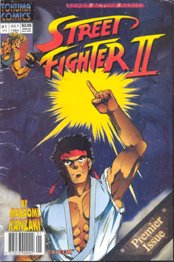
Where: Street Fighter II #1 When: July 1994
Why: Masaomi Kanzaki How: Masaomi Kanzaki

Quick Fix...
If you're a regular War Monger, you'll notice occasional references to When Fangirls Attack, the 'hive vagina' for so-called comics feminists around the internet.

Despite having pretentions on neither side of the debate, I do find myself with a passing interest in that particular corner of opinion and neurosis. For the most part, it deals with the goings on of American superhero comics, but occassionally a manga post will pop up, as far as I'm aware, usually for the positive.

Top 25 Female Characters
#1 Invisible Woman (Marvel)
#2 Storm (Marvel)
#3 Catwoman (DC)
#4 Wasp (Marvel)
#5 Zatanna (DC)
#6 Elektra (Marvel)
#7 Kitty Pryde (Marvel)
#8 Rogue (Marvel)
#9 Hellcat (Marvel)
#10 R. Mika (Capcom)
#11 Phoenix (Marvel)
#12 Black Cat (Marvel)
#13 Wonder Woman (DC)
#14 Black Widow (Marvel)
#15 Lyja (Marvel)
#16 Tabitha Stevens (Marvel)
#17 Hawkwoman (DC)
#18 She-Thing (Marvel)
#19 Sakura Kusanago (Capcom)
#20 Harley Quinn (DC)
#21 Spider-Woman (Marvel)
#22 Firebird (Marvel)
#23 Cheetah (DC)
#24 Powergirl (DC)
#25 Spitfire (Marvel)
Manga has been a phenomena in the comics market that has positioned itself as a perceived threat to traditional American enterprise. Despite well known sub-genres of rabid mysogyny and tentacle invasions, the Japanese have endeared themselves to a market of women and children with parallelled cultures built around a variety of female and feminine archetypes.

This previously reviewed single issue [Street Fighter II #1] exists as a movie-time item of curio in my collection. If subsequent issues were made available at the supermarket I bought it, then I never saw them, but it's a moot point anyway. Fortunately UDON has collected a newer series of translations, which feature artwork unchanged from it's original black and white form.

I refer back to this issue because, it's a bit of fun, and also because the female stars of Street Fighter have been grossly under represented during our weekend romps. Sure, we kinda know that in sponsoring a top five contender, Ryu and Ken are the most likely success stories, but that says absolutely nothing of powerful female leads like Chun-Li, or Cammy White!

Wacky happenstance sees many of the new UDON issues that I've missed containing much of the Chun-Li/Cammy portions of the series, so here we are, arriving at a quick fix feature with Chun-Li and the innocuous dockside sailor, Billy.

Similar to the film, this series depicts a segregated rogue city, this time shortened to just Shad [as opposed to Shadaloo, used in the film, but canonically the name of Bison's criminal organization - Manhattan Mike].
This man-made island has a strong fight culture and a strong criminal element simmering in the bowels of it's seedy underbelly.

On the docks; the wondering fighter Ryu stops to take in the sights, as gambling yobs toss their cash against the prospects of a danty, blue-qipao garbed fighter called Chun-Li. With a win-streak of fifteen bouts, Billy takes the hot odds, but Ryu informs one vocal punter that he's made a greivous financial error.

Behaving like, well, a sailor, "Billy" makes a skeevy attempt to hit on his opponent asking for a date after the fight. As if to foreshadow the events yet to come, Chun-Li shoots him down with a devestating witty retort that makes insinuations about his cognitive functions!

Billy explodes in a rage over Chun-Li's quip, only to run head-long into a barrage of boot blow! The Chinese fighter unleashes the full force of her Hyakuretsu Kyaku attack, setting him up for the finishing blow, a brutal face-shove that leaves Billy's skull to "krunch!" against the street!

As the Interpol agent looking for her father's killer; Chun-Li represents a none too subtle archetype of the genre, but with visuals as strong (yet vulnerable) as her character, she's set herself apart from even folks like Guile; who represents the US Air Force male equivalent of the same role.

Before closing, I do have to lodge the fact that I much prefer Chun-Li's revised outfit of the Alpha series. Apart from being infinitely more believable and practical, it's a great looking suit. I do not, however, weigh in on it's use for crotch shots in the anime, versus the butt shots of the manga.

The Fix: 4 The Issue: 4
Winner: Chun-Li

As mentioned earlier, the Tokuma series of Street Fighter manga by writer/artist Masaomi Kanzaki are now available in newly translated and un-edited form thanks to UDON! An obscure item even amongst some groups of fans, it's the ultimate gift this Christmas for Street Fighter fans across the globe! And in issue two, Chun-Li fights Blanka! Primo!

*Not an actual nickname for Brian Bendis.

Sunday, October 14, 2007

QUICK FIX DOUBLE FEATURE: Triumph or Die!
AKUMA versus GOUKEN
(UDON)
Where: Street Fighter II #1 When: November 2005
Why: Ken Siu-Chong How: Arn

Quick Fix...
Well, that didn't work terribly well, did it?
If you missed out, I thought I'd throw up a twenty-four hour poll to narrow down the selections for this week's Street Fighter entry. The results were... non-existent, to put it politely, which might just be a commentary about the Infintie Wars regular readers, and SF.
If you've got feelings on Street Fighter - good or bad - I encourage you to drop a comment and let us know!

In the meanwhile, we roll on to take a look at two significant historical points in the Street Figher history, each important to the shaping of destiny for the franchise mascot -- Ryu.

As significant as Ryu [and Ken] have been to identifying the series, another character has managed to follow on the tradition of the "shotos" to, for some, overshadow them. That character, as even many casual gamers will know, is Akuma; better known in Japan as Gouki.

Akuma is said to be the brother of the martial arts master who schooled Ken and Ryu in their ansatsuken style of karate. Gouken and Akuma each trained under the master Goutetsu in this style, but Akuma would become seduced by the dark power of the Hadou-ki harnessed in their style. His compulsion for fighting would see him swallowed by the dark hadou, and he would eventually kill Goutestu, perfecting his shun goku satsu attack -- the raging demon.

Akuma made his first appearance in the game series in Super Street Fighter II Turbo, leaping into the arena to defeat Bison if all sub-bosses are defeated without losing a round, before then challenging the player to final battle.
Akuma became the first hidden character in the Street Fighter series, following the now historical April Fools gag in a 1992 issue of Electronic Gaming Monthly, which described a non-existent secret character hidden within the game.

Becoming a stalwart of the series, Akuma would become fleshed out as a villain of murderous intent governed by a strict code. Only the strongest fighters would be worthy of his lethal intent, including Bison, whose reign as chief antagonist of the Street Fighter series would be brought to an end by the wandering fighter.

For Ken, and particularly Ryu, Akuma would remain the subject of unfinished business. Ryu's own mysterious origins would begin to intersect with Akuma's as he finds himself confronted by the same Dark Hadou that corrupted his master's killer. Fandom would begin to question whether Ryu and Akuma may be tied not only by blood spilled, but by that which flowed common in their veins.

Perhaps the only man who could have ever been trusted to deliver Ryu the truth was his adoptive father, Gouken. It was before Ryu's conquests as a Street Fighter that Gouken found himself face-to-face once more with his brother.

Confronted at his dojo, Gouken finds himself forced to fight to again prove the supremecy of his pure art over the zealous faults of the Dark Hadou.
He unleashes a mighty leaping strike on his brother, who makes the claim that Gouken should have killed him when the chance was his.

Denouncing Akuma's self-destructive path, Gouken explodes with the mastery of the unknown arts, delivering a swift kick which sets Akuma up for the rising fist of the sho ryu-ken!

The blow of the dragon fist isn't enough to rattle Akuma's cage. He charges a dark hadou-ken fireball, blasting his brother before attacking with a rising knee. He professes a the brilliance of his developed dark style, and makes threatening speculations about whether or not Gouken's students would be more receptive to his art.

Distracted by fear for Ryu, Gouken leaves himself wide open for the killing blow. Revealing to his brother the greatness of his Dark Hadou, Akuma utilizes his shun goku satsu -- raging demon attack -- murdering his own brother in his own dojo!

Leaving the symbol of his kanji smeared in the master Gouken's blood, Akuma leaves his brother dead, to be discovered by his greatest student, Ryu. So begins the inevitable clash between Ryu and Akuma. In the name of revenge, or justice?

This is the path it seems Ken Siu-Chong and UDON comics will eventually come to explore, in a far more confronting manner than that of the Alpha animated movie, which sees Akuma retaining his neutral qualities to an extreme unimaginable for a confrontation between murderer and student.

One would imagine this arc will coincide with the convergence represented by Bison's tournament, which has been alluded to as the purpose of the current incarnation of the Street Fighter II on-going series. At this point in time it's actually hard to tell if a tournament is quite literally the intentions of the writing, but I'm going to give it the benefit of the doubt.

Evil Ryu is a well known variant on the character depicted in the games, and as Ryu walks a nomadic path across the world, the series looks to poke and prod at how well prepared Ryu will be for both his confrontation with Akuma, and the possession of the Dark Hadou. The tempered change seen in Sagat [Street Fighter II #2] is a good indicator for hope for Ryu, which is a segue into...

The Fix: 4 The Issue: 5.5
Winner: Akuma

[I'm not generally a big fan of variant covers, but when it comes to an issue I'll take whatever's on the shelf. It just so happens this is a superb Ed McGuinness cover, which I'm very fond of! Arn provides a harsh digital painted style for the prologue feature here, reminiscent of Ted Wing III, who provides covers for The Kirby Martin Inquest!]


RYU versus SAGAT
Two Years Ago... (UDON)
Where: Street Fighter #1 When: September 2003
Why: Ken Siu-Chong How: Joe Madureira

Quick Fix...
... So, it's a bit of a Street Fighter history lesson in today's entry. Hopefully you're all paying attention, and taking notes, because there might be a make-up poll sometime in the future. (Actually, that seems highly unlikely...)

Before the eventual expansion of the [game] series with titles like Alpha, most fans were probably more familiar with Street Fighter II, whether they knew it, or not.

Alpha, [called Zero in Japan], boasts one of the fullest rosters of characters come it's third incarnation; but is traditionally regarded as a prequel, begging the question: What happened to Street Fighter 1?

Perhaps naively, I thought UDON might have taken a slower burn to the Street Fighter franchise, particularly given the good will engendered by their association with CapcomUSA. As it stands, the series have mostly been dedicated to adding a linear condition to elements established in the Alpha and SFII games, with the spine of the story revolving around, we believe, events leading up to Bison's SFII tournament.

Largely skimmed over are the events of Street Fighter, which was a significantly less successful side-scrolling beat 'em up game, maligned for it's easily broken arcade punch-pads. It featured many characters popularized through revamps in the Alpha series, most prominently; Birdie, Adon, and Gen.

Street Fighter gave a second-player the option of playing as Ken, but featured Ryu in the main player's slot, and the occupying portion of retroactive story.
It was here that Sagat made his first appearance, acting as the final regional boss in his native Thailand, and for the entire game. The canonical significance of the first game can be distilled into this single fight.

In UDON's account, Sagat taunts Ryu as he throws a spinning kick into a block.
Fighting undercover with an audience gathered, Ryu attempts to block a charged tiger blast with his own ki attack, the hadou-ken!

Sagat's blast proves too powerful, throwing the Japanese fighter into the air!

Dust kicks up as Ryu digs his heels in to screech to a grinding halt. Sagat, aggressively seeking to maintain the advantage, charges and leaps into the air, his giant Muay Thai knee leading.

Sagat's airborne attack inadvertently puts him in the perfect defenseless position for Ryu's rising shoryu-ken!

The rising dragon fist rips through Sagat's chest, spraying a gush of blood from the wound that opens up in the arc of the punch!

The mountain of Muay Thai muscle comes to a harsh crash landing! Leaving his scarred opponent in a puddle of blood, Ryu leaves victorious.

The details of the fight have varied over it's many interpretations, but the retroactive significance is always the same: This is the moment Sagat becomes Shadaloo's pawn, as he inevitably begins a bitter quest for revenge on Ryu.
The strength of their rivalry diverges depending on individual characterization, but the bond between the characters remains in most translations.

Bison is seen in the UDON strip, fulfilling his retroactive role as secret financieer for the first street fighter tournament. He would emerge from the shadows for Street Fighter II, with a trio of fighters at his side; Vega, Balrog and Sagat!

That about wraps up our passing through the Street Fighter universe for another week. If you've just joined us, you might like to know that we're sponsoring a Street Fighter into our top five ranks through weekend reviews! Duh!
Tomorrow the statistical spectacular continues as we wrap up Marvel: Ultimate Alliance Mondays with our month of DOOM! Further emphasising that as much as this is a website dedicated to superhero comics, there's no denying that the video game is friend to the fanboy.

The Fix: 5 The Issue: 6
Winner: Ryu

[This was the first time I ran across Joe Madureira's pencils since his infamous withdrawl from comics work, to "play X-box." Regular readers will know Joe Mad for his role as upcoming penciller on Ultimates 3, being written by Jeph Loeb, who will reteam with collaborator Ed McGuinness for Ultimates 4. FULL CIRCLE, peeps!]

Sunday, September 30, 2007

QUICK FIX DOUBLE FEATURE: The New Challengers!
THUNDERHAWK versus THUGS
(UDON)
Where: Street Fighter II #3 When: February 2006
Why: Ken Siu-Chong How: Alvin Lee

Quick Fix...
Okay, I'm going to start this entry way off on a tangent.
Earlier today I spent a disturbing amount of time sifting through google hits, conventional and blogsearch, looking for dates and issue numbers. I couldn't find them.

I do my best to make sure Secret Wars on Infinite Earths is a multi-layered and enjoyable reading experience, several times a week. If I might not always live up to that lofty expectation, I always find great pride in including explicit and relevant information for cross searching needs.

Now, let the minutes show that it is indeed Sunday, and therefore we must address today's pressing Street Fighter business. On today's agenda, two of the new warriors that made their debut in the revision title, Super Street Fighter II.

When a lot of casual fans think of Street Fighter, they're actually thinking of Street Fighter II. It was in this revamped sequel that the series left behind it's simpler side-scrolling to develop fleshed out characters, and the beat 'em up style that we all know and love. Characters like Ken, Ryu, and Sagat were all explicitly transplanted from the first Street Fighter into the sequel, but for the most part the game boasted a whole new cast of World Warriors.

Super Street Fighter II introduced a brand new quartet of characters from Greece, Jamaica, Mexico and Hong Kong. They were Cammy White, Dee Jay, T.Hawk and Fei Long respectively, and each would become stalwarts of the series.

It was Cammy who undeniably made the biggest splash, becoming an iconic instantly recognised pin-up in a similar fashion to predecssor Chun-Li; a contrast to cult additions like Dee Jay, and today's first subject, Thunderhawk.

T.Hawk's revenge story is ultimately one familiar to the genre.
He enters the Street Fighter tournament seeking revenge against Shadaloo mastermind and final boss, M. Bison, who harrassed the Thunderfoot tribe from their land, and ultimately murdered T.Hawk's rebellious father.

Like many of the most memorable supporting characters from the Street Fighter franchise; T.Hawk's model represents a two-dimensional quality to characterization. He presents much less martial arts style than other characters, instead erring for a strong ethnic charicature to strengthen his identity.

UDON maintain Thunderhawk's strong ethnic visuals, but extrapolate his role to incorporate the strong law enforcement representation to better initiate the character into the story. Chun-Li and Cammy White leave Guile behind to meet up with T.Hawk in his native Mexico, pursuing leads that involve Shadaloo's experiments with brainwashing -- a scenario Cammy herself escaped from.

Waiting for T.Hawk in a diner, Chun-Li and Cammy find themselves in the midst of an armed robbery. Their uniforms attract the attention of the gang's ring leader, prompting the two to debate combat honors, but it is ultimately the arriving Thunderhawk who takes control.

He makes light work of the two stragglers, making his dramatic first appearance with the collision of the would-be robber's heads.

Looming over the crooks, T.Hawk takes the surprised leader by the shoulder, using his turning motion to swiftly disarm him of his shotgun. With a look of distain, he removes the live cartridges.

Relieved of his weapon, the common thug doesn't stand a chance against the towering Thunder Foot warrior. T.Hawk ducks a punch and unleashes a powerful open-palm style, working the gut with a push before sealing the deal with a chop to the neck that leaves the gunman unconscious.

A gracious host, Thunderhawk apologises for the unsavory welcome, and makes a formal introduction to Chun-Li and Cammy.

UDON do well to incorporate elements of T.Hawk's Alpha storyline from the video games, building the sub-plot of Bison's brainwashed Dolls, which plays a significant part in Cammy White's mysterious history. As in the games, T.Hawk makes it his business to seek Little Eagle (Noviembre), along with Juli, who is attributed the backstory of being daughter to a German doctor who provided healthcare to those of the Thunderfoot reserve.

There's a question to be asked of UDON's preperation for longterm planning.
The inclusion of storylines like this, which do well to flesh out characters like T.Hawk, also collide with elements from various other installments in the game series, chronologically released prior to the Alpha expansion.

If one were to really look into the subtext of the situation, this might be an inadvertant glimmer of hope for fans of the games. Burning through storyline so quickly could be an indication that UDON's good will with Capcom and association with yet another revamp of the SFII port might be leading to a potential Street Fighter 4. On the other hand, it may yet be another example of short sighted writing from a studio of pencillers.

The Street Fighter license isn't UDON's to own, so the future may in fact be finite, but I can't help but raise the concern once again that this resembles a case of pencillers working as writers. Typical of a writer is longterm consideration, often absent in penciller's attempts to construct story.

I don't actually know Ken Siu-Chong's history, and I certainly don't mean to inflect negativity on his script work for the series, or pencillers in general.
From a position of interest in the future of the series, and a critical analysis, it's just very difficult to get away from these things. With a tournament allegedly the eventual target for Street Fighter II, one can't help but feel there are a lot of storyarcs building that suggest the logical conclusion of closure from such an event. That doesn't necessarily mean that is the case, but it's a theory.

If you have any theories about the future of the series, be sure to drop a comment. I so rarely here from even our regular readers, and lord knows it's unusual to run afoul Street Fighter fans in the thick of the American superhero comics scene. So say hello, because it's lonely out here.

The Fix: 4 The Issue: 4
Winner: Thunderhawk

[Juggling multiple storylines and groups pays dividends in fan service, but the rush of characters and plot points seems too much, spread too thin. The shift to SFII to streamline was an admirable call, but as the issues unfold it again begins to feel as if the central concept is lost, and stories are meandering toward their conclusion.]


FEI LONG versus MOBSTERS
(UDON)
Where: Street Fighter #8 When: May 2004
Why: Ken Siu-Chong How: Alvin Lee

Quick Fix...
It worked for Guile in his first appearance in the series [Street Fighter #1], and we just saw a strong showing from Thunderhawk, so I guess it's hard to argue against the gang-fight introduction.

Liu Kang (Mortal Kombat), Marshall Law (Tekken), Jann Lee (Dead or Alive): all characters who may have existed without Street Fighter, but represent the same tradition that saw the creation of Fei Long. One of the very first and perhaps most instantly recognisable characters, Fei Long represents the none-too subtle homage to cinematic martial arts legend, Bruce Lee.

Since his inclusion in Super Street Fighter II in 1993, the Bruce Lee clone has become an archetype of beat 'em up gaming, represented in most major series in the genre. Fei Long represents perhaps the most literal representation of the character, sharing many explicity commonalities in appearance, style, phrase, and story.

Fei Long's character and story remain typically consistent across the many adaptations of Street Fighter into various mediums. When he isn't starring in the next action blockbuster, he's practising the philosophies and mastery of the martial arts, sometimes returning to the street fighting circuit to stay true.

As a young and exceptionally talented Hong Kong film star, Fei Long almost inevitably attracts the attentions of criminal interests in the business.
Invited to star in a picture by ladies Xiayu and Yanyu, Fei Long finds himself set upon by thugs in an alley outside the studio where he has spent the day filming.

Despite overwhelming odds, Fei Long defies the pack of mobsters, unleashing the martial arts skills that made him one of the most popular movie stars in Hong Kong. His kick proves so powerful, it sends Dai Loe, the gang leader, flying through the air to the windsheld of his expensive sports car.

Through a muzzle of blood, the mobster orders his gang to kill the movie star.
Quoting the infamous water philosophy of Bruce Lee, Fei Long unleashes the full extent of his skill. With lightning quick kicks and fists, he takes his undisciplined opponents apart.

Like a scene from one of his movies, Fei Long produces a pair of nunchaku, evening up the score against the mob of thugs, some armed with baseball bats and blades. Attacking with devestating precision, he renders the goons embarrassed and bruised, leaving only he and Dai Loe.

Still on the hood of his car, the mobster draws a knife on the stoic Fei Long. The martial arts superstar's wags his finger, prompting Dai Loe to opt for a clean getaway over a confrontation he will inevitably lose.

Despite the decisive victory, Dai Loe still promises death for Fei Long at the hands of his masters. A fate Fei Long will no doubt meet with confidence of fist.

And with that, we wrap up the last post of the month, and another fine double feature inclusion to our weekend sponsoring of the Street Fighter brand. The October Punch-Up will reveal more on the progress of the Street Fighters against their superhero contemporarys, via the regular super stock listing. The list will also include all the other September movers and shakers in the on-going rankings.

We'll also have another exciting Quick Fix for your consumption, and discussion aplenty about issues of varying importance. Until then, it's midnight and I'm gonna hit the sack. We'll talk more about Fei Long in the coming weekends.

The Fix: 5 The Issue: 5
Winner: Fei Long

[Though seamless from the previous issue, this marked the first of UDON's self-publishing efforts discussed in the previous entry. In a call back to the first half of today's post, it's worth noting that Xiayu and Yanyu are both Dolls from the Alpha video games, rather than Hong Kong gangsters.]