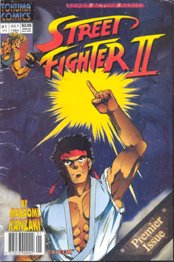
Showing posts with label Street Fighter II (tokuma). Show all posts

Saturday, October 12, 2024

RYU versus DHALSIM
Battle 04: Carnival (Tokuma)
Where:
Street Fighter II #3 When: June 1994
Why: Masaomi Kanzaki How: Masaomi Kanzaki

The Story So Far...
Ryu has travelled from Japan to the crime-ridden island metropolis of Shad in pursuit of earning his place in the renowned Third Annual Grand Fight. Something he can only do by competing in street fights to earn a place in the final stadium tournament bracket.

A victory over former boxing champion Balrog has made Ryu a hot prospect, but to assure himself a place in the stadium showcase he must overcome a warrior with unique insight, who has sensed the power of his chi and is determined to defeat him.

Tale of the Tape...
Strength: Ryu 3 (Athlete)
Intelligence: Dhalsim 3 (Straight A)
Speed: Ryu 3 (Athlete)
Stamina: Draw 4 (Athlete)
Agility: Dhalsim 6 (Rubber)
Fighting: Ryu 5 (Martial Artist)
Energy: Ryu 3 (Explosives)
Total: Draw 23 (Champion)

Ryu is the eternal "World Warrior", wandering the globe in search of truth through fist. Although there are significant departures from established Capcom canon in Masaomi Kanzaki's 1993 manga adaptation (and it's Tokuma Comics version edited for US distribution) -- that spirit of competitive fighting remains true!

Ryu won the first major fight of the localized series when he faced Balrog (aka; "Boxer") in a match that almost ended with his assassination.

The sniper was cut-off by
Guile, but this time the US Special Forces man won't have his back. He joins Ryu as a competitor in the Grand Fight Tournament -- a renowned event held in Shad to crown the strongest fighter in the world.

Dhalsim may not have the outwardly appearance of a muscle-bound powerhouse capable of claiming that title -- but his mastery of esoteric yoga techniques has made him an enduring force in the world of Street Fighter.

In UDON's comic book adaptation, Ryu sought the wisdom of Dhalsim's council as he honed his fighting technique and wrestled with the inner darkness of his desire to avenge his master Gouken -- who was murdered by Akuma.

In that encounter, Ryu was humbled in defeat, as he learned the value of Dhalsim's unusual philosophy towards the spirit of fighting. Something Sagat had already experienced when he sought out Dhalsim's training for similar reasons.

Gamers know Dhalsim is ostensibly a pacifist who uses his fighting techniques to protect and sustain his village in India. He believes in the yogic principles of harmony & understanding, mostly reluctant to use the offensive capabilities of his style, which includes breathing "yoga flame" for a variety of short & long range fire attacks, as well as extending his limbs for uncanny striking reach.

Ryu is arguably a superior fighter to Dhalsim, continually honing his ansatsuken style in friendly competition with his martial arts brother Ken and against powerful opponents like Sagat. He harnesses his chi for a variety of fire-based attacks, famously scarring Sagat with his violent shoryuken dragon punch.

Yet, Ryu has also been shown to still have much to learn. During the prequel plot of the Street Fighter Alpha manga, he was defeated by the similarly enlightened approach of Rose. Will his SFII manga battle be a moment of learning - or victory? Let's drop some quarters in the slot and get this fight started!

History: Dhalsim (1-0-0)
The Tape: Draw Ranking: Ryu (#30)

What Went Down...
Dhalsim pulls away the turban and robes covering his body, revealing sparse decoration on his slender frame. A metal ring clinks and dangles around each his wrists, while three small skulls stare across the street to his eager opponent.

Ryu didn't expect to meet the impressive yogi so soon in his quest to reach the Grand Fight. He can tell Dhalsim is a tough fighter, but has no intention of losing his ticket to the big battle. Dhalsim swears on his skulls that he will win.


Ryu makes the first move, closing in on his opponent with an overhand punch -- but Dhalsim dashes backwards to avoid the blow and create space.

The Japanese fighter is stunned to immediately find himself forced to block a kick!

He can hardly believe that Dhalsim's limbs are closing the divide - stretching for dangerous long-ranged kicks and punches!


Undeterred by the blocked kick - Dhalsim quickly follows with a stretching punch!

Ryu blocks that too, but still feels the mental and physical toll of the blow.

His mind begins to race. He can't find a way to get close to Dhalsim!

The yogi takes full advantage of his command of the space. If his limbs cannot strike their target -- he will try a projectile attack!


The ball of Yoga Fire hurtles toward Ryu!

He does his best to mitigate its burning seer -- dropping and rolling on the ground as gathered onlookers watch in slack jawed awe.

"Like I said, I swear on these skulls that I will not lose."

Ryu regains a vertical base, his arms sizzling as he assumes a ready stance.

Fighting through the crowd, his friends Po-Lin and her young brother are shocked to see the martial artist in such rough shape.

Dhalsim throws another furious stretching punch, which Ryu barely manages to block with his burnt arms.

He attempts to fight fire with fire, unleashing a hadoken fireball!


Once again the yogi stuns his opponent -- standing stoically as he catches the fireball with his bare hands and lets it dissipate to nothingness.

He is impressed by the strength of Ryu's chi, but it will be useless against one who has mastered the ways of yoga in pursuit of a noble cause.

Dhalsim reveals the terrible toll of economic hardship suffered in his country. The pointless deaths of innocent women and children who suffer the frequent wars, disease, and starvation that afflict the poverty-stricken nation.

He once pledged himself to the teachings of Brahman, and the ways of yoga, but came to learn they were useless in protecting his people. So he has abandoned the way, intent on earning victory through fighting to divert his winnings to the children. Children like those who produced the skulls he wears around his neck.

Ryu sympathizes with Dhalsim's plight, but doubts that a street fight will offer much of a solution.

He remains committed to fighting for himself, but as he contemplates his last resort, Ryu recalls his master's teachings: 'Listen, the sho-ryu-ken (dragon punch) is a powerful force... but use it only when necessary! It may call upon death!'

Dhalsim forces the issue with Yoga Flame!


Ryu is doused in the inferno of the spewing flame!

Afraid for his friend, young Wong-Mei cries his name -- and Dhalsim hears!

The child's voice provides a momentary distraction. A distraction that costs Dhalsim dearly as Ryu resorts to his most powerful strike -- the shoryuken!

The Hammer...
In repurposing the original chapters of the Tokuma Shoten manga for a format and tone more in keeping with American comics; the English colorized version creates a cliffhanger that doesn't exist within collected tankobon editions.

Secret Wars on Infinite Earths usually adheres to rules restricting an entry to the contents of an individual issue, but fortunately, this issue's final page ends with Ryu charging his shoryuken -- the finishing move of the fight!

We can therefore cheat a little and record a definitive result, with the impact (pictured below), taken from Street Fighter II #4, page four.

The [almost] full-page image is one of the most striking of the adapted series so far, and one of the most successful applications of colour to the original greyscale Kanzaki art.

Unlike some of the other panels featured in this article - this one removes original black & white shading methods, replacing Dhalsim's zipatone flesh with relatively straight colour. You'll notice in other panels they awkwardly coloured right over the top of horizontal lines used to create darker shades in original black & white art. It's more obvious in the digital scans, but it's still a clumsy visual to the eye.

The process of making this image has pros and cons. The American comic creates a clean, well realized version by completely re-doing background action lines in colour, which presumably also made it easier to replace Japanese sound effects with English translations. Unfortunately, the inks still become muddier and simplified in the process, losing the finer details of impact motion lines on Dhalsim's body, and diminishing the marriage of Ryu's dragon fist in non-linear contrast to the background, which is rendered originally with similar lines, just in different directions. Ultimately, the original looks the best, but this one is still nice.


UDON did a wonderful job of localizing the complete Masaomi Kanzaki story in three black & white volumes in 2007, which includes the entire 450-or-so page story in its original format, with English translations.

In addition to revealing various edits of panel size, layout, and slight changes to context of various dialogue exchanges -- the collections also include an entire excised plot running much longer than the eight-issue American series.

Ordinarily I'd skew towards referencing the original format, but I only have two of the UDON volumes, and I think it's interesting and worthwhile to explore the oddities of what Western gamers were subjected to in the 1994 American editions.

Back then you had to work a little harder to get the story details of your favourite characters. Gamers should have been savvy enough to know Po-Lin and Wong-Mei were invented for the manga, along with the Shad location of the series, but this version of Dhalsim at least skews fairly close to the basic premise of the Street Fighter II video game character.

He remains a deeply spiritual practitioner of yoga in the comic, choosing to fight only to raise funds to protect the innocents of his homeland, who are afflicted with famine and pestilence caused by poverty and war. At the time, the manga may have been one of the most effective deliveries of this premise.

This generally became Dhalsim's motivation moving throughout the franchise, albeit with more specific focus on his village, rather than the entire nation of India, which goes largely unnamed in both versions of the translated manga & comic.

India is only specifically mentioned in Dhalsim's entry in the character bios that are included at the bottom of every page in each American issue. These bios inform readers of each character's background and stats, while also compensating for the different dimensions of American comic book and manga page sizes. The manga is slightly more squat, leaving empty space at the top or bottom of pages.

In the earliest contemporaneous versions of the Street Fighter II arcade game(s), Dhalsim was explicitly shown returning home to a wife after the tournament, with whom he parents an inquisitive young son some three years after the game. That doesn't seem to be represented here, but women & children remain significant.

The undersized skulls Dhalsim wears around his neck provide literal and spiritual protection in the comic. They are motivational keepsakes of the children who died in his country, but are ultimately destroyed while saving his life -- absorbing the brunt of Ryu's shoryuken dragon fist that is described as a potentially lethal killing technique. A reinforcement of their defensive, mystic properties.

The concept of the skulls may be a fictionalized derivation of the Kapalika "skull-bearers" of ancient Shaivite ascetics, who worshipped Shiva and carried begging cups carved from human skulls, among other things. Dhalsim does not appear to explicitly share any of the ritual context associated with those tantric sects.

The American version describes Dhalsim's lapsed dedication to "Brahman", a Hindu concept of reality, with ties to the creation deity Brahma, and appropriate etymological origins denoting "to swell, expand, grow, enlarge" -- much like his extending arms and legs. The UDON translation of this dialogue refers instead to a generic, non-denominational "Yoga god". I presume the latter is more accurate.

Both versions of India are depicted as an overtly war-torn nation. I might speculate that was inspired by the Kashmir territorial conflict between India and Pakistan, but I'm not expert enough in world politics to know, or recall, what tensions and unrest existed within the country around that time.

I do have very specific, fond memories of playing Dhalsim in the Street Fighter II video game back in those days, though.

I was a youngster, grabbing life and pop culture with both hands. I was fairly immediately taken with the international flavour and fantastical martial arts characters of Street Fighter II. The iconic battlecries of the various fighters were like a siren-song beckoning me to any game cabinet that might be in the nearby vicinity -- and back in those days there were plenty!

Arcades, movie theatres, supermarkets, delis, video stores, bowling alleys -- you name the location, and there's a pretty good chance they had a coin muncher or two. Of course, for me, Dhalsim will always be linked with the home PC port.

That was how I beat Street Fighter II for the first time. I used Dhalsim -- a character I perceived as having the basic advantage of punching & kicking across most of the screen. It took hours, and playing through a PC glitch that turned Vega's cage fight into a bizarre, twinkling pixel abstract nightmare, but in the end I was successful. A double rite of passage as it was the first time I had ever deliberately stayed up deep into the AM. Something gamers know all about!

We didn't have a PC at home, but I was sleeping over at a family friend's house. At that point I don't think they had any children, so I enjoyed the loose discipline and pop culture corruption of a pseudo-nephew. Alas, "Uncle" David isn't with us any more, but as with many comic books, this one comes with a nice memory.

There are plenty more memories to be had with the Street Fighter II comic series, but for now we move on to other interests. Like other recent entries, this one was inspired by the release of the Marvel vs Capcom Fighting Collection, but if you'd like to make sure I come back to this topic sooner, perhaps you'd like to consider becoming a Secret Wars on Infinite Earths supporter on Patreon.

Secret Wars on Infinite Earths has featured well over 700 fights and ranked more than 1,000 characters! You can find them all for free by diving into the Secret Archive for a complete index of battles in order of publisher, series, and issue -- or by hitting links to your favourite topics found throughout each entry. For Street Fighter, you might need to scroll through to the bottom. You can also find more from Capcom and the Street Fighter world. Shoryuken!

Get daily links to fights inspired by the topics of the day by subscribing to TwitterDon't forget to smash that like, fave, and share -- and keep your eyes peeled for the week's top trending battles every Sunday on Twitter & Discord! The lively Discord chat is one of the bonuses of becoming a Patreon subscriber!

Winner: Ryu
#24 (+6) Ryu
#75 (-10) Dhalsim

Friday, June 16, 2023

CHUN-LI versus BLANKA
Battle 03: Recall (Tokuma)
Where:
Street Fighter II #2 When: August 1994
Why: Masaomi Kanzaki How: Masaomi Kanzaki

The Story So Far...
The crime-riddled island of Shad is a modern metropolis that plays host to some of the greatest fighters in the world. The best among them will meet in the Third Annual Grand Fight, advancing to the stadium stage by proving themselves under the rule of street fights.

Only in the stadium will they face the reigning champion: M. Bison -- a man without a history, nation, or known fighting style. He is the rumored master behind the criminal organization Shadowlaw, responsible for flooding the streets with a pain-suppressing designer drug called "Doll".

Undercover Interpol agents work to thwart the scourge of Shadowlaw, but their ranks continue to disappear. Now one of their daughters, Chun-Li, fights to find answers, and with the boxer Balrog embarrassed by another newcomer, upheaval within the ranks of the Shadowlaw Lords could deliver her the man she seeks!

Tale of the Tape...
Strength: Blanka 4 (Enhanced)
Intelligence: Chun-Li 3 (Straight A)
Speed: Draw 4 (Olympian)
Stamina: Blanka 5 (Marathoner)
Agility: Chun-Li 4 (GYmnast)
Fighting: Chun-Li 5 (Martial Artist)
Energy: Draw 3 (Explosives)
Total: Chun-Li 25 (Champion)

Chun-Li is the self-described "Strongest Woman in the World", but she'll find a physical match in the mutated Brazilian man-beast that is Blanka.

An outlier as the first "freak" of the Street Fighter franchise; Blanka is best characterized by his hunched muscular physique, wild hair, and typically bright green skin - a characteristic owed to his upbringing subsisting on skin-tinting plant chlorophyll, and maybe even radioactive materials, in the jungles of Brazil.

As the victim of a plane crash that left him to fend for himself in the wilderness, Blanka is a little bit like Tarzan, but his unusual appearance isn't the only product of his strange mutation. He also learned to imitate the techniques of electric eels, generating a shocking natural voltage that electrifies his opponents on contact!

Gamers will also know that his animalistic fighting style is complimented by an ability to launch himself like a cannonball into a fast-moving, flipping attack. The same kind of tumble you'd see Mortal Kombat's Kano utilize, but arguably with even more spectacular results.

That's a lot for Chun-Li to contend with, but the studious Chinese Interpol agent comes with extensive expertise in kung fu, and a fitness regime that keeps her incredibly fast, agile, and mobile, with an emphasis on powerful kicks and leaps.

Her lightning fast Hyakuretsu Kyaku kicks were on full display in the previous issue of the Tokuma Shoten series, and when she matched the physically imposing Birdie in Street Fighter Alpha Vol. 1.

Her powerful legs are also famous for delivering the inverted flying Spinning Bird Kick -- an attack similar to Ryu's Tatsumaki dragon hurricane kick. Like Ryu, Chun-Li can also harness her chi into a kiko-ken energy ball, helping her to defeat the blood-thirsty Vega later in the Shoten Street Fighter II series.


Despite his ferocious appearance, Blanka has fallen into a cuddly, comedic role later in the series, but in the 1994 Tokuma adaptation, he is a brutal enforcer for Bison's "Shadowlaw", with aspirations of replacing the defeated Balrog within the ranks of the Four Lords. Will he earn his place? Let's find out!

The Tape: Chun-Li Ranking: Chun-Li (#126)

What Went Down...
Face-to-face with the man-beast claiming to have killed Interpol Investigators that included her father -- Chun-Li begins to give in to furious emotions!

Her only desire is to defeat Blanka and make him talk -- and for a moment it seems as if that might be enough, but not everyone is convinced. From the audience, a mysterious Dhalsim notes that without Ryu's advice - she will lose.


The young agent launches into a furious barrage of kicks, getting her first inkling of doubt as Blanka blocks them all with powerful forearms.

Her leg blazes across the target to no avail, and as anger fuels her continued assault, Blanka's fanged mouth stretches to let out a tiny chuckle.

His goal is to gain the approval of Bison to become a new Lord of Shadowlaw and the energy it gives him is electrifying!


1200 volts super-charge the air and send Chun-Li jolting away from the buzzing body of Blanka as he unleashes a technique learned from observing electric eels!

He presses the advantage, reaching out with lightning fast punches Chun-Li can just barely block.


Blood begins to obscure her sight as Blanka closes in for a knockout blow that launches Chun-Li into the air!

She drifts between the reality of the fight and a fantasy of fighting crime side by side with her father. The vision urges her to stay strong. Cutting through the twilight is the voice of Ryu, who beckons from the crowd, "Concentrate on who you're fighting! Don't fight your memories! Your enemy is right in front of you!"

Her eyes widen with steely resolve as she fully awakens in freefall before her opponent -- and reaches for the ground with tensing wrists.


Blanka is baffled as Chun-Li's hands brace against the floor and she twists her body from a handstand press into a devastating whirlwind kick!

Her feet collide repeatedly against Blanka's face as her legs spin overhead!

Fanged teeth crack and break as Blanka falls to his back.

Chun-Li closes in quickly, delivering a furious punch to an already tenderized face, and as she reloads for another -- a friendly hand catches her wrist. It's Ryu. The fight is over. The crowd goes wild. Chun-Li is on track to make the Grand Fight.

The Hammer...
Even in 1994 you could tell the details were just a little bit off...

Parsing video game storylines sometimes took a bit of extra study back in those days. Obtaining information from fighting games, in particular, required playing multiple times to see character quotes and ending sequences, and sifting through various resources, such as magazines and trading cards, to find official sources describing additional details, biographies, and important backstory.

Street Fighter II came to arcades in 1991 rich with implied subtext in everything from sprite animation to backgrounds, and the subtleties of how characters moved and fought in gameplay.

Returning boss fighter, 
Sagat, implied an entire story with his fresh chest scar and the addition of the Tiger Uppercut move, which quickly became enduring pillars of the Street Fighter mythos, and storied rivalry between Sagat and Ryu.

Yet Street Fighter II was lacking in the basic forthcoming details of the following year's Mortal Kombat, which boasted immediately available in-game character bios, in addition to more informative character endings that fleshed out the world.

This meant 1994 would be a crash course in the good, bad, and ugly of multimedia adaptations, with Street Fighter receiving a dubious live-action movie, more beloved animated feature, and collected comic book series from Tokuma Shoten's American branch.

Malibu Comics had already attempted a truly awful American adaptation in late 1993, famed for its bizarre murder and scalping of KenTokuma's Street Fighter II comics had the rub of being authentically Japanese, originally serialized in issues of Family Computer Magazine, but the translated & localized issues that rearrange, censor, and colour the artwork carry with them their own peculiarities inherent to one of the earliest serious adaptations of the game.

Writer/artist Masaomi Kanzaki makes an admirable attempt to consolidate details from the games into the unique world of the fictional island state of Shad -- one of the biggest apparent changes from the games to manga.

This crime-riddled modern Asian capital, reminiscent of
Marvel's Madripoor and modern Hong Kong, serves as a practical means to anchor the action to a single location, but immediately strips the series of some of its globe-trotting appeal.

The name "Shad" appears to draw reference from recently identified primary antagonist -- Bison's international crime syndicate Shadaloo, frequently localized as "Shadowlaw" for English translations of the time. I find that name conceptually appropriate, but prefer the authentic originality of Shadaloo.

The complete "Shadaloo" name remained intact for the live-action movie, which may have adapted its war-torn South-East Asian country from the city-state of the manga, but it's difficult to be sure exactly how much the manga is an influence on subsequent aspects of games & adaptations, and how much it is itself a living document of what was intended to be fabric of the games' canon.

Shad is described as having been "built by an international consortium", which belies the difficulty Interpol's had in gaining traction to oppose the underground trafficking of Shadowlaw's synthetic drug - "Doll".

If you finished the game with Chun-Li, you already knew she was out to avenge the murder of her father by stopping Bison's drug trade. Subsequent editions, starting with Super Street Fighter II in late '93, modified her "life of a young, single girl" ending with two post-script options, one of which established the more familiar characterization of a committed Interpol detective.

The Tokuma manga, contemporaneous to the amended game, reflects both the shojo-tinged youthful heroine, and the aspiring Interpol agent, presenting her as a little inexperienced, but generally capable and determined. It isn't the definitive Chun-Li, but it's an understandable presentation within its place in time.

New, and ultimately unique to unofficial media, is Blanka's status as an enforcer for Shadowlaw. The SFII games never establish any connection between Blanka and the group, but various adaptations will take the convenience of the vast criminal organization to incorporate loose characters into their feature story.

It's honestly not a terrible way for Blanka to be better integrated into the main plot, but the implication of making him the one who murdered Chun-Li's father is a change that's just too dramatic. It alters both characters and their positions within the series wildly, and as a dyed in the wool fan, it's the kind of thing I hate.

The ensemble of fighting games is one of my favourite aspects, and storytelling within this genre is at its best when it's focused on the motivations and rivalries of individual characters, rather than connecting them all via a conventional narrative, and central villain. This is sometimes misunderstood as being insubstantial, but should be a familiar conceit to superhero comic book readers.

Blanka is difficult to justify in a lot of contexts, but I would generally rather see him drift to the periphery, as in the Street Fighter II animated movie, than occupy a misplaced position.

Details like this unravel the authenticity of the Street Fighter II manga, but I accept there wasn't a lot of opportunity to tell a story about a bizarre, bestial survivor of a plane crash, who is reconnected with his mother after competing in a world martial arts tournament. Not in this eight issue format at least, despite the characters' unusual popularity amongst young gamers at the time.

This is our first time documenting Blanka, who is now appearing with Chun-Li in the latest installment in the long-running fighting game franchise: Street Fighter 6. As a tenured fan, and gamer, I am incredibly excited about the way its honoring the past, while taking steps to intuitively go into a bold new future.

If you'd like to find more Street Fighter battles you can follow links throughout this post, or dive into the Secret Archive for a complete index of featured fights in order of publisher, series, and issue number. Just search for Street Fighter, or scroll through towards the bottom to find independent publishers & series.

Secret Wars on Infinite Earths has documented more than 700 battles and ranked well over 1,000 iconic characters! I'd love to get through all the Street Fighter comics & more and if you become a supporter on Patreon maybe I'll be able to! In addition to becoming a Tier 1 supporter you can sponsor featured content at higher levels, including the famous Rank & File Top 10!

Get free daily links to fights inspired by the topics of the day by subscribing to Twitter and Facebook, or by becoming a freebie follower on Patreon. Don't forget to smash that like, fave, and share -- and keep your eyes peeled for the week's top trending battles every Sunday on Twitter, Patreon & Discord!

Winner: Chun-Li
#74 (+52) Chun-Li
#1007 (new) Blanka

Friday, February 27, 2009

CHUN-LI versus VEGA
Battle 08: Warrior (Tokuma Comics)
Where:
Street Fighter II #6 When: September 1994
Why: Masaomi Kanzaki How: Masaomi Kanzaki

The Story So Far...
On the lawless urban island of Shad, fighters from around the globe are congregating to prove their mettle, and collide in a martial arts tournament held by criminal underworld figure and boss of Shadaloo -- M. Bison!

Joining the tournament, along with many others, is a timid Interpol agent from China named Chun-Li. Her motive for entry proves personal as she tracks the man responsible for murdering her father, a high ranking officer himself. Her journey proves to be one of self-discovery when she meets a Japanese fighter by the name of Ryu. Immediately struck by his power and confidence, Chun-Li finds a martial arts warrior to which she can aspire.

With a string of victories under her belt, Chun-Li quickly finds her wishes granted, as the tournament presents her with the challenge of entering the confines of an iron cage wherein waits the vainglorious Spanish assassin, Vega. Handed a list of data by the American soldier, Guile, Chun-Li learns a horrible truth about her clawed opponent. He is the man who killed her father, and if she cannot find maturity in the heat of battle, he will also be the man who kills her!

Tale of the Tape...
Strength: Vega 3 (Athlete)
Intelligence: Chun-Li 3 (Straight A)
Speed: Draw 4 (Athlete)
Stamina: Draw 4 (Athlete)
Agility: Draw 4 (Gymnast)
Fighting Ability: Chun-Li 5 (Martial Artist)
Energy Power: Chun-Li 3 (Explosive)


- A skilled student of the Tai Chi style, Chun-Li trained under the martial arts master, Gen, before becoming the Chinese fighting-dynamo of the International Criminal Police Organization (Interpol).

After her father's death, Chun-Li is motivated to hunt and destroy the international crime syndicate, Shadaloo, when she learns it's leader, Bison, may have been responsible for the murder. Her pursuit for justice brings her into the company of US Air Force soldier, Guile, who is also seeking justice for Bison's murder of his best friend, and undercover agent, Charlie.

Chun-Li is an incredibly fast and agile fighter, whose greatest asset are her powerful legs. Trademark attacks in her offensive arsenal include the Kikouken chi fireball, spinning side kick aerial attack, and Hyakuretsu Kyaku; better known as the flurrying combo, lightning kicks!

- The street fighting arena provides convenient abandon for the blood lusting Spaniard called Vega. Harboring homicidal tendencies, the narcissistic psychopath in the protective mask made a name for himself as a matador.
Turning his natural swift and speed to the martial arts, Vega values nothing more than the source of his vanity - his beautiful features - and protects them as best he can, while exacting brutal violence with the aid of his clawed gauntlet.

Vega's speed and agility were particularly complimented by the underground practise of cage fighting. In this domain, few can challenge the matador, and many have tasted bitter defeat at the end of his blades. It was this killing instinct that made him the perfect assassin for M.Bison's Shadaloo operations.

Math: Chun-Li Ranking: Chun-Li (#249)

What Went Down...
Shaken by the confronting news that Vega was responsible for her father's assassination, the impetuous Chun-Li becomes blind with rage. The fire within her offers a strong start to the fight as she launches immediately into a charging fist that sends Vega sliding across the mat into the iron embrace of the cage!

Vega, a seasoned killer, fails to recognise the girl's claims of murder, but is more than happy to oblige her in an emotionally charged battle. The masked matador quickly turns the tables as the physical and mental struggle shifts. Springing with lightning speed off the cage wall, Vega slashes at Chun-Li's chest.

The blow strikes as mentally deep as it does physically, rattling Chun-Li enough to render her a sitting duck. Vega's next swipe is far less forgiving, plunging his claw deep into the young woman's vulnerable gut.

The experienced Spaniard takes time to enjoy his obvious psychological advantage. He mocks Chun-Li as she clutches her stomach, drawing aspersions about her suitability to the masculine art of fighting. Her claims of cheap cowardice do little to engender chivalry in the elegantly sadistic matador.

With Honda and Dhalsim watching helplessly from the crowd, Chun-Li is savaged by another wild attack from the claw of Vega! The yoga master recognises the moment as a crucial milestone in Chun-Li's journey from fighter, to warrior.
Desperate to succeed, Chun-Li pulls herself from the void of defeat, recalling the voice of the wandering warrior, Ryu. He compells her to focus on who it is she's fighting and it inspires her to resist.

Skidding to a halt, Chun-Li again pauses, face-to-face with the masked matador. The crowd takes no more seriously than he, offering only disrespect. Heckling and wolf whistles. As if feulled by the challenge of humilation, Chun-Li bursts with energy, and just as Vega flips to bounce off the cage for a finishing blow, the Interpol agent from China discovers a power within herself.

With her chi focused into a singular wave Chun-Li unleashes the kikoken!
The energy sends Vega hurtling back into the cage from which he'd sprung. The scarred warrior bleeds for all to see, unobscured by his mask. Though Chun-Li herself collapses from the effort, it is Vega who is unconscious. Defeated.

The Hammer...
The winner of this bout, Chun-Li!

In conjunction with the release of the already infamous Street Fighter: The Legend of Chun-Li, in cinemas, this was to be a comparison post against one of the most revered fight scenes in the Street Fighter canon. I am, of course, talking about the epic battle between Chun-Li and Vega, as depicted in the animated movie.

Unfortunately, after much delay, I was forced to admit defeat in the face of a DVD too stubborn to facilitate screen capture. Perhaps at a later date we will have an opportunity to "revisit" the milestone film, which is still regarded by many fans as the most triumphant adaptation of the Street Fighter II legacy.

Top 20 World Warriors
#1 Ryu (Japan)
#2 Dhalsim (India)
#3 Ken (USA)
#4 Guile (USA)
#5 R. Mika (Japan)
#6 Sagat (Thailand)
#7 Fei Long (Hong Kong)
#8 Akuma (Japan)
#9 Sakura (Japan)
#10 T. Hawk (USA)
#11 Rose (Italy)
#12 Abel (France)
#13 Chun-Li (China)
#14 Vega (Spain)
#15 Birdie (England)
#16 Balrog (USA)
#17 Gouken (Japan)
#18 Sodom (USA)
#19 Zangief (Russia)
#20 Dan (Japan)
Adaptaing the tradition of one-on-one martial arts video games has proven a difficult one for many within the Hollywood fraternity. The trend hasn't restricted itself to the fighting genre, however. The Legend of Chun-Li joins a string of live-action feature releases that have garnered less than admiral review from mainstream outlets.

Mortal Kombat was the first video game franchise to really find success in cinemas with it's 1995 film directed by Paul Anderson. It followed the financial and critical failures of big screen versions of Super Mario Brothers, Double Dragon, and Street Fighter, all of which strayed considerably from the canon of their source material. MK was far from invincible, however, as was proven by the rushed 1997 sequel, Annihilation, which boasted considerably cheaper production values, a bloated cast, and key roles that did not feature reprisal from their earlier actors.

Like many of the superheroes that have found success in recent years; video game franchises house time tested plot and characters, sharing much with their four-colour counterparts.
Fighting games in particular have traditionally reached deep to quickly establish casts built of vivid characters. Often derived from a particular theme or concept, these characters are as colourful and bold as any Batman or Iron Man, sharing historic events in their story that build a larger universe around them.

The inherent situation of one-on-one fighting typically leaves little room for exposition. Street Fighter has particularly struggled to take ownership of it's canon, relying moreso on the imagination of gamers, and the complicated incorporation of interpretive storylines spun by the likes of Gisaburo Sugii, Masahiko Nakahira, and Masaomi Kanzaki.

Kanzaki's plot in the Street Fighter II serialized manga created a base for the canon that deviated wildly from what little was established in the franchise, whilst exploring basic elements of character and plot. The writer-artist introduced prevelant plot elements that included the brainwashing activities of Shadaloo, the introduction of Ken and Ryu's martial arts master (the now playable, Gouken), and also his subsequent murder (albeit, at the hands of Bison).

It seems reasonable to assume some level of cross-inspiration might have occurred during the development of the Street Fighter II animé, which was originally to have been featured today. Both feature prominent battles between Chun-Li and Vega, who, otherwise, possess little in common. No doubt this subsequently featured a similar battle in the feature film, where Taboo of the Black Eyed Peas takes on the role of the otherwise beauteous Spaniard.

Unfortunately, the purveying influence of these many different sources failed to galvanize a single canon within the Street Fighter source material. In the lead-up to the release of Street Fighter IV, Capcom faced heavy scrutiny for their decision to include certain characters and designs, seemingly positioning the fourth numerical instalment somewhere between SFII and the much maligned, SFIII.

Despite early announcements of fully animated sequences in the game itself, it was left to cross promotional animé and comic releases to further flesh out the plot surrounding SFIV. Thankfully, The Ties That Bind, the animated release included with Collector's Editions of the game, does quite a lot with it's meagre sixty-five minutes to flesh out the SFIV story. Set, it seems, prior to the events of Street Fighter IV, it introduces brand new antagonists, Crimson Viper and Seth, while also bringing back classic heroes like Chun-Li, Cammy, Sakura, Guile, Ken, and of course, Ryu. As with the SFII and Alpha animé features, one could arguably call this a better version of a Chun-Li film than Legend.

Though disappointing that more could not be included in the games to establish the narrative of the franchise as specifically as Mortal Kombat, it is still with confidence that these alternate products paint a universe of strong characters and key events. It takes very little imagination to spin an exciting tale out of these established sources, which could only be supported by a confident visual design akin to the manga reviewed today, or any other of the number of sources previously reviewed in the Infinite Wars.

The fact that Legend of Chun-Li, which was released the same day as the date of this post, completely strips the characters of their iconic visuals and distinct character, is a travesty. I constantly find myself returning to Iron Man, which, although somewhat unadventurous with it's narrative structure, makes a confident leap forward for the incorporation of comic book visuals in cinema.

Having spent such a long time in the dark, it now feels as though this post-9/11 world of film is begging for bursts of colour. Speed Racer might not have set critics aflame with passion for it's CG-heavy stylized visuals, but it makes a similarly stunning argument for the adaptation of bold colour and concept, just like the financially better, Iron Man. Street Fighter, actually arguably more understated than either of those examples, really deserved that grade of treatment and confidence in it's brand.

Springing from a relatively obscure 1987 arcade game, the adventures of Ryu and all who occupy this world of martial arts adventure, have become video game legend. In the canon of the industry, it is one of the most significant series to ever be released, defining a genre through production that has rarely been matched. Why it has thus far been so difficult to realise in live-action, I do not know. Let us hope, however, that if anyone should get a chance to revisit the brand on the silver screen, they show more bravery when they do so.

Tekken will be the next franchise to face the perilous journey to the big screen, mimicking Street Fighter with a double-whammy accompanying the August film release with Tekken 6 on home consoles. Alas, all early indications suggest yet another souless escapade into the world of martial arts, displayed by a less than significant cast who will fill out a variety of roles plucked from the games.

Let us hope, if nothing else, the gears of promotion give opportunity to a Tekken manga, comic, or animé. Something to rival the quality of the fine products we have referred to today.

The Fight: 4 The Issue: 4

Street Fighter II was originally presented as a black and white manga serialized in the Japanese magazine, Family Computer Magazine, in 1993. Tokuma Shoten later collected the series, and translated it for US audiences with colour and rearranged panels under their Tokuma Comics branch. The US printing has since become defunct, but UDON have snapped up the rights, translating uncensored and unedited art for English-reading audiences. Keep this in mind as you follow purchase links to Amazon, each of which helps sponsor future entries in the Infinite Wars! You'll find plenty more Street Fighter, and other books on sale, by exploring the depths of the Secret Archives!

Sunday, November 25, 2007

QUICK FIX DOUBLE FEATURE: When Fighters Attack!
RAINBOW MIKA versus ZANGIEF
(UDON)
Where: Street Fighter Legends #1 When: August 2006 Why: Double KO & Ken Siu-Chong How: Omar Dogan

Quick Fix...
Every day at least one new reader finds their way to the Infinite Wars be it by accident, or design. The over-arching scheme of this site is to be a friendly and depthy resource for readers new and old, but it you aren't inclined to quickly hook into what we do, then you're probably out in the cold.

With the exciting announcement of Street Fighter IV [set for release in 2008] there's a contingent of fans finding their way via that particular niche. For most it probably isn't a huge obstruction, but it might be nice to know that, at our centre, we are a comics review/discussion site with a penchant for combat. Not a movie review site, as may have been apparent given the slew of film and television reviews.

There were a lot of Street Fighting battles that hovered around for this weekend, but ultimately I thought it would be nice to quickly check in with the comics again. Sadly, as regular readers will know, I'm more than six months behind on purchases, and a barrage of UDON products are right up there on the wishlist!
A little bit more about those in later, but first, an opportunity to revisit one of the most eagerly anticipated returning characters for SF4: Sakura Kusanago!

Traditionally there seems to a be an obscure divide between average American comics readers, and the trappings of the far East. As a youngster who milled around arcade magazines and machines for a glimpse of the SF characters, I was well primed to be in the thick of things come the animé resurgence of the late nineties.

With that rivetting backstory, I like to think I at least have the credibility to lodge the fact that; despite being quite comfortable with the conventions of animé culture; I am not particularly interested in the shojo, young girls scene.
That said, like any ridiculously dedicated fan, I'm pretty willing to forego that disinterest if there's some sort of pay-off in the form of broader character appearances, which is where Legends: Sakura earns its grace.
[Although, given how bad I'm dragging my heels right now, maybe that grace extends to reading it more than reviewing it... - Malcontent Mike]

If you caught our last Sakura feature [Street Fighter Legends #2], you'll already know the mysteriously popular Hibiki clocks an appearance, along with guest-spots by Honda, Zangief, R. Mika, Karin, and a roster of cameos by characters from Rival Schools. Also making an appearance is Sakura's reluctant sensei, Ryu, who prompts her quest to examine other fighting skills as part of her training. This rather conveniently shoe-horns the wrestlers into the picture, while also creating a logical deviation from the core series. Not a bad line-up for a character largely segregated to a world of sailor suits, homework, and hotdogs!

During one of those rare moments of positivity for the works of Brian "I prefer the square peg*" Bendis [Daredevil #75], we mentioned a predilection for drawing inspiration from real world sources. It's a process I like to read, and indulge in as a writer myself, and if it was somehow lost on you, I also like sports, structured violence, and statistically based leagues and competitions.
It's this recipe - inherent to professional wrestling - that slides effortlessly into Sakura's pop driven fancy, and leads her to a local main event between Alpha stalwarts; Rainbow Mika and Zangief.

The canonical relationship between Mika and Zangief is put aside, presumably by design of both the lighter nature of this reading material, and the similarity between Mika and Sakura's roles as smitten young fighters, characterized by their adoration for longer standing icons of the series.

Here, Zangief and Mika engage in rope hitting action, while Sakura and her friends share cutesy modified versions of iconic WWE isms popularized by Steve Austin, the Rock, and Hulk Hogan. As one comes to expect from any entry level references to wrestling, the parallels here between the SF universe and reality are none too subtle, but enough to sell the world to a casual reader.

Grafting game specials into a world of trademark moves, Mika hits the infamous flying peach butt pump, before going to work on Zangief with a chair, presumably of a steel persuasion. The attack proves sufficient for R. Mika to overcome her burly adversary, scoring her a knock-out win before the capacity crowd.

When Zangief comes to some time later, he furiously calls Mika out for an impromptu rematch. The scene is played for laughs, but highlights the clash of worlds as Zangief personifies Street Fighter logic confronting a realworld performance based perception, held by Mika.

As mentioned earlier, you can find Zangief's disgruntled rampage in a previous Infinite Wars entry [Street Fighter Legends #2], as he carries the fight to the signing table, blissfully unaware of the scripted nature of professional wrestling.

As the importance of so-called realism is pushed further in popular fiction, we sometimes find fiction compromised by it's awkward marriage of the real and imagined. I think in the past I've made my fondness for the internal conceits of the Street Fighter world quite clear, and it certainly relevant to this quick fix.

As much as I like the idea of Street Fighter drawing upon real world reference, the success of the series has always been built on a fiction.
The enduring characters from the first sequel epitomize this formulaic, caricature-based representation of styles, and nation's traditions, that make the Street Fighter fiction work so well. UDON have done reasonably well here to bring the two logics together, without compromising the overall asthetic.

That said, Legends: Sakura notes writing that is particularly light-on.
There's a B-throughline of Dan Hibiki's pursuit of Sakura, but for the most part the series reads as a disjointed collection of cartoony moments. It's probably this kind of storytelling, which lacks any skeletal strength, which is going to befuddle and turn away American readers not already interested in the branding and kitsch of the series.

While I have a great affection for the universe in question, I really regret UDON's decision not to make a more independent move with the franchise. Sakura has enjoyed solo success through the manga, Sakura Ganbaru! ["Hang in there, Sakura!", currently being translated by UDON], and leaves UDON's decision making feeling a little rote.

Of the core series, the most noted concern has probably been similar questions of depth, and if we review the UDON/SF output as a whole, Sakura ultimately drags it down. It might be an unfair assessment, but direction and writing like this inevitably feels like a classic case of a penciller trying to be a writer.
There's a lack of attention that sufficiently facilitates a visual comic book story, but fails to lend any weight to the pages within. Whether or not this is a personal stigma due to UDON's artistic history, I cannot say, but the content of this four-issue mini is what it is, regardless of inflection.

The Fix: 3 The Issue: 4
Winner: Rainbow Mika

This Christmas Sakura's probably strictly for the SF die hards, and maybe wide-eyed young readers.

UDON have expressed interest in pursuing other Legends series, with Chun-Li tossed around as a character to star. While much of UDON's strength has come from strong representation and derivative mythology, I'd rather see them blaze a trail with characters less touched upon. While the core series hovers around the popular icons from the games, anime, and manga, it might be nice to see a Legends series use a character as vehicle to touch upon a theme.
Pursuing similar fiction that touches real world concepts, like the Muay Thai or Boxing characters, might be a fun bit of history to explore.


BILLY versus CHUN-LI
Battle 01: Shad (Tokuma)
Where: Street Fighter II #1 When: July 1994
Why: Masaomi Kanzaki How: Masaomi Kanzaki

Quick Fix...
If you're a regular War Monger, you'll notice occasional references to When Fangirls Attack, the 'hive vagina' for so-called comics feminists around the internet.

Despite having pretentions on neither side of the debate, I do find myself with a passing interest in that particular corner of opinion and neurosis. For the most part, it deals with the goings on of American superhero comics, but occassionally a manga post will pop up, as far as I'm aware, usually for the positive.

Top 25 Female Characters
#1 Invisible Woman (Marvel)
#2 Storm (Marvel)
#3 Catwoman (DC)
#4 Wasp (Marvel)
#5 Zatanna (DC)
#6 Elektra (Marvel)
#7 Kitty Pryde (Marvel)
#8 Rogue (Marvel)
#9 Hellcat (Marvel)
#10 R. Mika (Capcom)
#11 Phoenix (Marvel)
#12 Black Cat (Marvel)
#13 Wonder Woman (DC)
#14 Black Widow (Marvel)
#15 Lyja (Marvel)
#16 Tabitha Stevens (Marvel)
#17 Hawkwoman (DC)
#18 She-Thing (Marvel)
#19 Sakura Kusanago (Capcom)
#20 Harley Quinn (DC)
#21 Spider-Woman (Marvel)
#22 Firebird (Marvel)
#23 Cheetah (DC)
#24 Powergirl (DC)
#25 Spitfire (Marvel)
Manga has been a phenomena in the comics market that has positioned itself as a perceived threat to traditional American enterprise. Despite well known sub-genres of rabid mysogyny and tentacle invasions, the Japanese have endeared themselves to a market of women and children with parallelled cultures built around a variety of female and feminine archetypes.

This previously reviewed single issue [Street Fighter II #1] exists as a movie-time item of curio in my collection. If subsequent issues were made available at the supermarket I bought it, then I never saw them, but it's a moot point anyway. Fortunately UDON has collected a newer series of translations, which feature artwork unchanged from it's original black and white form.

I refer back to this issue because, it's a bit of fun, and also because the female stars of Street Fighter have been grossly under represented during our weekend romps. Sure, we kinda know that in sponsoring a top five contender, Ryu and Ken are the most likely success stories, but that says absolutely nothing of powerful female leads like Chun-Li, or Cammy White!

Wacky happenstance sees many of the new UDON issues that I've missed containing much of the Chun-Li/Cammy portions of the series, so here we are, arriving at a quick fix feature with Chun-Li and the innocuous dockside sailor, Billy.

Similar to the film, this series depicts a segregated rogue city, this time shortened to just Shad [as opposed to Shadaloo, used in the film, but canonically the name of Bison's criminal organization - Manhattan Mike].
This man-made island has a strong fight culture and a strong criminal element simmering in the bowels of it's seedy underbelly.

On the docks; the wondering fighter Ryu stops to take in the sights, as gambling yobs toss their cash against the prospects of a danty, blue-qipao garbed fighter called Chun-Li. With a win-streak of fifteen bouts, Billy takes the hot odds, but Ryu informs one vocal punter that he's made a greivous financial error.

Behaving like, well, a sailor, "Billy" makes a skeevy attempt to hit on his opponent asking for a date after the fight. As if to foreshadow the events yet to come, Chun-Li shoots him down with a devestating witty retort that makes insinuations about his cognitive functions!

Billy explodes in a rage over Chun-Li's quip, only to run head-long into a barrage of boot blow! The Chinese fighter unleashes the full force of her Hyakuretsu Kyaku attack, setting him up for the finishing blow, a brutal face-shove that leaves Billy's skull to "krunch!" against the street!

As the Interpol agent looking for her father's killer; Chun-Li represents a none too subtle archetype of the genre, but with visuals as strong (yet vulnerable) as her character, she's set herself apart from even folks like Guile; who represents the US Air Force male equivalent of the same role.

Before closing, I do have to lodge the fact that I much prefer Chun-Li's revised outfit of the Alpha series. Apart from being infinitely more believable and practical, it's a great looking suit. I do not, however, weigh in on it's use for crotch shots in the anime, versus the butt shots of the manga.

The Fix: 4 The Issue: 4
Winner: Chun-Li

As mentioned earlier, the Tokuma series of Street Fighter manga by writer/artist Masaomi Kanzaki are now available in newly translated and un-edited form thanks to UDON! An obscure item even amongst some groups of fans, it's the ultimate gift this Christmas for Street Fighter fans across the globe! And in issue two, Chun-Li fights Blanka! Primo!

*Not an actual nickname for Brian Bendis.