skip to main |
skip to sidebar
QUICK FIX DOUBLE FEATURE: Under the Influence/Ones We Love ROBIN versus BATMAN
As the Crow Flies Part Four: Shotgun (DC)
Where: Batman #629 When: August 2004
Why: Judd Winick How: Dustin Nguyen
Quick Fix...
So, Galactus and I might not have a lot in common, but there is one indisputable commonality: We're both sticklers for rules, especially our own.
Which brings us to now. Up against the wire, I feel an obligation to turn in a Street Fighter post for Sunday, a Marvel Ultimate Alliance post for Monday, and, well, okay, that's really about all... But still, here we are, as the clock ticks over to Sunday (here in the future), and I'm starting a post for Saturday! Egads, what sinister plot could provoke such madness?!
A couple of days ago The Fortress Keeper had some interesting things to say about the state of Batman, with a particular slant towards an evolution away from the grim and gritty mania that has gripped the character for the best part of three decades. I, of course, subscribe to that classic take within reason, actually fairly disinterested in progress being made by Grant Morrison to return the hairy chested love-god to his globe trotting throne; but I digress...
Inevitably one travels from Batman's world and state of mind, to the relationships important to his life.
There's a purveyance of opinion that says Batman, in his grittier and more obsessive incarnations, is a two-dimensional character devoid of layers. It's perhaps because of that opinion that many people draft their complexities onto the characters surrounding the Dark Knight Detective. Right or wrong, it provides us another nice segue to use a dangling quick fix from our last entry, but first...
It's actually been quite a while since I've fawned over Judd Winick's run on Batman. Or maybe it isn't, and the increased activity just makes it seem like it's been a while. Regardless, not the case today, as we take a look at the standalone "As the Crow Flies" arc, which preceded Winick's bulky, on-going stay on the book, which I am particularly fond of. Incidentally, it was the graceless intrusion of the interrupting War Games story that broke-up Winick's work, but incidentally set-up much of what I enjoyed so much.
The majority of this story revolves around the cagey relationship between Jonathan "Scarecrow" Crane, and the Penguin, who has employed the former to contribute to his criminal investments. Coinciding with this alliance is the emergence of a hulking Scarebeast, more monster than man, who terrorizes Gotham City and the criminal underworld by night.
Despite his best efforts, Batman is unsuccesful in confronting the Scarebeast, succumbing to it's own unique brand of fear toxin.
Falling into the abyss of fear and panic, Batman's dedicated training sees him able to escape to the Batmobile, where it's autopilot technology can navigate to the Batcave. The mobile also puts Batman in much needed contact with trusted butler, Alfred, who is able to talk him down from his panic for at least part of the long journey home.
With hallucinations setting in, Batman flails his limbs at an imaginary Joker and Two-Face. His fevered attacks damage the Batmobile console, severing his connection with Alfred, and perhaps even sanity. Concerned, Alfred summons the aid of the boy wonder, Robin, who pursues atop dirt bike.
 Where there rides a Robin, the unsettled Batman sees the demon of his greatest failure, the supposedly deceased Jason Todd. Still haunted by the tactics employed by the villainous Hush (and Todd), Batman pops the Batmobile hatch and yanks the young Tim Drake from his motorcycle.
Though Robin lodges a verbal appeal in an attempt to navigate Batman back through the forest of hallucination, he continues only to see Jason Todd. Prompted by imagined taunts, the Batman clutches at Robin's throat, squeezing.
Barely able to overcome the hostility of his adopted-father, Robin manages to lift from a whisper to a call, requesting Alfred to blow the rooftop via remote from the Batcave headquarters.
 The sudden rush of air rips the tiny Robin from Batman's vice-like grip. His acrobatic training helps the young hero maneuver himself to catch the tail of the Batmobile as it thunders into the hidden entrance of the secret Batcave.
Batman is thrown from the convertible vehicle, coming to land in a tangled, bloody mess. Robin makes a far more graceful landing, joining Alfred at his master's side to administer an anti-toxin. For the sidekick, a job well done.
I touched on the fact that I'm one who quite enjoys the darker side of Batman.
Traditionally I'm not a fan of Robin the side-kick as a part of that, but here actually lies a pretty good example of ways to make the character acceptable.
I tend to think Robin is at his best as a character who has grown up to leave the nest. I think that relationship of father and son is one of the most dynamic qualities of the duo, and that's played to particularly strong effect here.
While it doesn't really seem to be examined as the soul focus of what is essentially a strong, if grounded, episode in a superhero adventure; there's a strong undercurrent of fear and what is fear. For a child, I think there are few scarier scenarios than this, where the father is completely out of control.
I don't mean that just in the violence of the way Batman lashes out, but the fact that Batman is such a staunch pillar of certainty. I suppose stability is an important part of a child's life, and as much as an unstable environment can be damaging, it also reshapes a sense of normality. For someone who has viewed a personal aquaintance as an unshakable force of of strength, few things can be more frightening than the dissolving of that.
It's looking at the character's psychological flaws and darkness in manners like this that make me greatly appreciative of the grim and grit of the character.
I tend to feel I can find well-adjusted superheroics, and gadget filled adventure from a lot of avenues, but few characters bring such a rich tapestry of psychological layers, and motivations.
I personally feel in the assumed flat characterization, there is actually more juice than in the showy, gallavanting Batman. The more he supposedly shuts down, the more we learn about the character. The less spoken, the more said.
Winick does well to inject that into what is essentially a monster story, even if Nguyen's kinetic pencils ground it in a more superhero, capes and tights motiff.
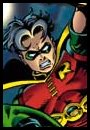 The Fix: 5 The Issue: 6
Winner: Inconclusive
[No one really wins or loses in this quick fix, but it should be noted as but a tiny portion of what turns out to be quite a fun comic.
If most Bat-villains are justified as mirrors held up to Batman, Scarecrow represents the detached. A character who does not distract his reflection through a filter of antagonism, forcing Batman to confront himself quite literally, rather than through a green and white abstraction.]
 BATMAN versus CATWOMAN
Crisis of Conscience: Part Four (DC)
Where: JLA #118 When: Early November 2005
Why: Geoff Johns & Allan Heinberg How: Chris Batista
Quick Fix...
I like the idea that Gotham is an old fashioned city.
A city with a certain musk to it's looming skyline, that eventually colours the denizens within it. It wasn't always as corrupt as it is now, but even the Green Lantern (Alan Scott) will tell you, it had that intangible quality to it.
Robin, in all his colourful glory, tends to represent much of the hope, promise and innocence lost to Gotham City, and to Batman. He personifies, in many ways, a future where Gotham might not need the protection and aid of a man garbed in emotionless black and grey. A man, who like many of Gotham's others, has been dragged so deep into the skirmish that he is almost what he fights.
I like to think Martian Manhunter represents a bit of that, too.
As much as he has walked the streets and tasted the dusty air of Gotham's criminal underworld, he remains the city's secret Superman. An alien from a world outside Gotham, who hides beneath the muted browns and greys of his store bought suits the vibrant green of blossoming nature, and a perspective of everything the city may be.
They don't necessarily enjoy each other's company, or agree on the degrees of what's required to achieve good in the world, but I like to think Batman and Martian Manhunter are always bound by the mutual understanding of Gotham.
 While Batman represents a brutal, corrupted version; he remains a pillar on the non-lethal side of the justice scale we've been talking about. Far more harsh than anything Martian Manhunter would usually subscribe to, but still on the same wave length of what is and isn't crossing the unspoken line.
It's this commonality that brings the two characters together in the pages of Crisis of Conscience, which deals with the aftermath of the revelation that Zatanna spent her career with the League wiping the minds of villains and heroes alike.
For Batman, the matter is a direct issue of intellectual intrusion and doubt, while for Martian Manhunter it's a question of power versus responsibility. As a telepath with the capability of carrying out the same function, he holds dear a moral code that denies any such invasion of personal space.
It is on this level that Martian Manhunter is challenged by the master manipulator of events surrounding the exposure of Zatanna and the League's secret -- Despero. After defeating both J'onnz and Aquaman [JLA #118] he marches them to the Batcave, where he seeks to usurp control of Batman aswell.
Confiding in Catwoman over the anguish and uncertainties brought on by the gaps in his memory, Batman is vulnerable to the surprise attack. Despero quickly takes control, and turns him against the potential interference of his lover.
 The Batman swats Catwoman into his computer console, following quickly with a stiff kick narrowly blocked by the beseiged burglar. She retaliates in a characteristically independent manner, shedding any personal loyalties to slash Batman across the head.
Though unsuccessful in harming the possessed Dark Knight, it does reveal a glowing third-eye beneath his cowl, the trademark of Despero's telepathic control.
 Catwoman is obviously a big part of the Bat-family, even though the two have been somewhat distanced of late.
I like to think she represents a part of the corruption brought about by life in Gotham. I think she connects to the thought processes that govern Batman's brand of harsh justice. She highlights the fact that he has taken the fight so close to villainy, he freely associates with a thief on the merit of her inner goodness. For Batman, the cramped highrises of Gotham prevent scope of the bigger picture, leading him to hold onto only what he knows is explicitly right and wrong.
Sometime in the next week or two I'd like to take a more specific look at the relationship between Catwoman and Batman, but in the mean time, I think it's been a long warm day, and I've become too distracted to wrap this up well.
 The Fix: 3 The Issue: 4
Winner: Inconclusive
[The briefest of quick fixes to be sure, but now you have the full picture for that particular issue. As much as I enjoy Batista's pencils, there a frustrating resemblance to Michael Keaton in his Batman that really bugs me. It's probably just because of the way he draws lips, I don't know... Leave me alone!]
DESPERO versus MARTIAN MANHUNTER/AQUAMANCrisis of Conscience: Part Four (DC comics)
Where: JLA #118 When: Early November 2005
Why: Geoff Johns & Allan Heinberg How: Chris Batista
The story so far...
With their dirty little secrets exposed, the Justice League is imploding into itself in a maelstrom of disapproval and mistrust. The revelations over Zatanna's mind-wiping practises regain their relevance when members of the Secret Society of Super-villains discover the true identities of the heroes.
Unknown to the league, the foe responsible for awakening the minds of the Society, Despero, is hurtling toward Earth in pursuit of a helpless Martian Manhunter. Unable to locate the league, the Manhunter plummets Earthbound with one member in mind -- Aquaman!
Will J'onn J'onnz find the assistance he needs, or has the inner turmoil of their actions exposed a weakness in the League, and allowed Despero the opportunity to finally seek a final revenge on those he has called enemy?
Previous Form:
Aquaman (#73): Gained an unlikely victory over the Sub-Mariner.
Despero, Martian Manhunter: Each making their Infinite Wars debut.
Tale of the tape...

 Strength: Martian Manhunter 6 (Invincible)
Intelligence: Draw 4 (Tactician)
Speed: Martian Manhunter 4 (Olympian)
Stamina: Despero 5 (Marathon Man)
Agility: Aquaman 2 (Average)
Fighting Ability: Aquaman 4 (Trained Fighter)
Energy Powers: Despero 5 (Lasers)
So, this is the first time we've talked about Martian Manhunter, which is kinda one of those travestys of justice you tend hear about. I guess if there's a reason, it might be because J'onn J'onnz traditionally isn't one to pursue combat as actively as others, but that's something you can read more about in the hammer, later in the entry.
Still, like the Batman animated series, I feel like this might be one of the few glaring omissions to what I've done, so it's nice to rectify the situation. Shame about Aquaman. Ho ho, tee hee, ha ha. Yes, I think that's out of the way now.
Yes, I'm a Sub-mariner man, but I'm going to try to be impartial about Aquaman's total inability to have anything but an anchoring effect on this scenario. I of course mean this purely from a statistical standing, which sees Aquaman's particular brand of unique abilities less expressive on the statistics listed above.
Despero's a pretty tough customer. He's one of those space foes that's got a wide bredth of capabilities, and specialist skills like telepathic manipulation, and laser beams, and all that kinda stuff that compliments your usual flight and super strength. He's a character that has to work on a scale of both Superman alone, and also a team that includes Superman, so his capabilities are broad.
Martian Manhunter is on a Superman level, and I'd like to think on his day he could single handedly take Despero out. His telepathy tends to range everywhere from the incredible, to the struggling bare minimum. I like to think of it as levelling out somewhere in the middle, so telepathic dominance might not be within reach for ol' J'onn, but he's got other tools to combat Despero.
Aquaman remains a conundrum on the comic landscape. I don't think anyone is really one hundred percent committed or comfortable with the theory that he has super strength, even if it makes perfect sense for the same reasons Namor's strength makes sense: A lifetime spent in the crushing depths of the ocean.
Together, I'd probably like to lean toward the heroes on paper, even though Despero does represent one of the prominent threats to the League. Right about now I'm too tired to wax much harder on it, saving my energies for later, so...
The Math: Martian Manhunter/Aquaman (Total) Despero (Average)
The Pick: Martian Manhunter/Aquaman
What went down...
 Escaping the Justice League's moonbase headquarters, the Martian Manhunter hardly notices the searing heat as he hurtles through Earth's atmosphere followed by another. Blazing a trail toward San Diego, he telepathically calls to the members of the League, but they're both too busy, and out of reach, as Martian Manhunter combats the dampening effect of Despero's strong brand of offensive telepathy.
Climbing bruised from a crater created by his impact on a barren construction site; Martian Manhunter is picked up by the following Despero. He boasts of the League's distractions, while burying his fingertips into the Martian's malleable flesh, as though to create a physical manifestation of his telepathic invasion on J'onn J'onnz' mind.
Having already unlocked erased memories from the minds of members of the Society and sent them in the direction of the hero's loved ones, Despero declares off the back of his machinations, that there is no one left to save the Martian.
 A defiant answer comes in the form of a spiked piece of construction metal, piercing Despero's alien shoulder in a spray of blood: Enter Aquaman!
 The Atlantean monarch continues his assault, knocking Despero through the surrounding barrier of the construction site, into the surrounding ocean.
The grizzled Aquaman calls ahead, telepathically summoning the aid of sharks to "Make. Him. Bleed."
The deep sea monsters do as commanded, gnawing viciously at the hulking frame of Despero. Aquaman plummets into his domain to strangle the beseiged victim of his patrons, presumably with the advantage in the familiar surroundings of water.
Meanwhile, Martian Manhunter recovers from the assault suffered at Despero's hands. He dusts himself off, telepathically coaching Aquaman in combat.
He offers a stern reminder of Despero's tactics, ensuring Aquaman is ready to defend himself mentally, should Despero find himself unable to match him on the physical plane of combat.
 Aquaman stoicly welcomes Despero to try psychic attack, avoiding a laser blast from the alien's powerful third eye, and an equally dangerous fist that buries deep into the ocean floor.
Aquaman returns Despero's hostility in kind, using his water-bound strength to uppercut Despero out of the water!
The break in the action provides Aquaman the first opportunity for some face-to-face discussion with his Martian teammate. J'onn J'onnz is able to finally reveal his intention to seek out Aquaman, with the hopes that together they could use their combined telepathic influences to overcome the mentallist threat in Despero.
Battered, but not defeated, Despero rises to challenge the Justice League duo to test their strategy to disarm him.
 Though they presumably fight valiantly, the pair are apparently unsuccesful, emerging next as king and rook in Despero's league against the league.
The hammer...
Well, how would you be? We finally invite Martian Manhunter to the party, and what do we do? Serve him up on a platter to our winner, Despero. That's bloody charming, eh?
On a tangent, I came across info regarding The Batman cartoon. You know, that redundant one with the monkey-Joker and other assorted disappointing revisions of classic villains, and the indulgence of Adam West as Gotham City Mayor. As if it weren't redundant enough, it looks like they're spinning the Justice League out of this new Batman. Groan.
The thing that bugs me more than the creatively questionable efforts of the series, is the fact that it's actually filled the few voids I felt the Timm/Dini animated series overlooked. Those, of course, are appearances by Martian Manhunter in Gotham, Solomon Grundy, and the still as yet unchecked emergence of Gotham's Green Lantern, Alan Scott. Oh, give them time...
So, we've been talking a lot about harsh justice lately. It's probably the subject that's kept me from becoming completely derailed, because it's a vaguely interesting subject. We talked about Wonder Woman and then Hawkman and Black Adam, but specifically amongst the royals of the DC Universe there was one more name mentioned -- Aquaman!
I fully realise that so-called "harsh justice" teeters dangerously toward the same kinds of watered down, poorly justified gimmicks of anger and grim and grit that have led many characters down an unsavory path. I fully realise Aquaman is one of those, who enjoyed brief recognition for a revamp dependent on poor grooming, the loss of a hand, and the loss of innocence.
I'd like to think that the saving grace of my suggestions is that there's a vaguely intellectual reasoning, providing some sort of foundation to the ideas. A motivating question about the differences of culture, beliefs, and justice.
For me, these two characters [Aquaman, Martian Manhunter] are a perfect litmus test. When I think of Martian Manhunter, I think of a character deeply driven for common justice, working both close to the streets on a human level, but also through subversive methods, by way of his powers which give him scope to deal with alien threats, too. I kinda see the character the same way Darwyn Cooke looks at him in New Frontier, forever impressed upon by a story in Secret Origins #35, that depicts J'onn J'onnz' early days as a detective in a similar fashion.
I think of Martian Manhunter as an unrelenting force for justice by the book, with exceptions where circumstances dictate. On the other hand, I'm more likely to adopt that more contemporary consideration of Aquaman.
Aquaman is a character who seems to have simply failed to maintain his relevance. In a world where the greatest dangers emerge from humanity itself, it's hard to find a place for a man so far removed from it. A man traditionally more concerned with the rising threat of tri-colour sea monsters and oil spills.
Without an insane agreement to keep the character constantly in-print, like Wonder Woman; Aquaman falls by the wayside, by the bayside. He needs a reason to exist, especially in those uncomfortable situations where he finds himself thrust into the so-called "big seven" of the Justice League, impotent and awkwardly ineffective until the villain takes a dip in the ocean.
In ironic juxtaposition to the Martian Manhunter, we've already talked about the potential to give Aquaman importance as a perspective alien and harsh to other members of the League. Like Wonder Woman, Aquaman's references are Roman and Greek, built on the epic tradition of Atlantis and the warrior code.
He has an opportunity to be a character aware of more than just the territory of the United States of America, opening the League up to it's oft overlooked International jurisdictions. Perhaps as Black Adam was in Black Reign, or Wonder Woman against the corrupted tyranny of Maxwell Lord; Aquaman could be a proactive force, using his immunities and broad world reference to bring justice to communities and nations that might not otherwise see it.
This might put the character(s) at odds with the likes of Martian Manhunter, who believe in due process, but without the injected personal insanities seen in Black Adam's downward spiral, that only makes for interesting and dynamic friction in the superhero community. It also arguably serves as an investment in the certainty of a character lost to a crisis of identity and characterization.
It need not be event driven blanket stories like Amazons Attack, involving the vast kingdoms characters like these represent. The point here is about the attitudes and directions of the characters, who have exhibited these sensibilities at one time or another, but who have not been courageously thrust into the world of moral ambiguity.
The Fight: 4.5 The Issue: 4
[Chris Batista's clean, crisp, well inked artwork is a joy to behold, but this story feels all too run of the mill for a big-name double feature like Allan Heinberg and Geoff Johns. The benefit of hindsight shows just how little it has meant in the developing world of the Justice League post-Identity Crisis. Fun, but disappointing.]
QUICK FIX DOUBLE FEATURE: Harsh Vintage Justice HAWKMAN versus MATTER MASTER
Black Reign: Part Two (DC)
Where: Hawkman #23 When: Early March 2004
Why: Geoff Johns How: Rags Morales
Quick Fix...
Lately we've been talking a bit about harsh justice, and it's application to the superhero world, and this entry gives us the opportunity to take a look at that theory in practise.
It's a particularly interesting topic, given all the different angles. Generally speaking, the sacred cows [like Wonder Woman] are protected from the moral ambiguity of lethal justice, yet, oft times it's these vintage characters that are more likely to be identified with harsh enforcement reflective of the war-torn times they were created in.
The debate rages on between the two schools of thought. For many the definition of a superhero is to be above the moral ambiguity average humans, soldiers, or heroes are regularly faced with. It means not being forced to pull the trigger to save innocent lives, instead using the fantastic to end danger.
We recently discussed a similar argument of whether or not Captain America ever used lethal force during his times in the frontline of the Second World War [Captain America #405].
The morally ambiguous hero got a bit of a tarnished reputation, passing through the eighties and nineties with the baggage of excess, and poor interpretation. The posterboy becomes characters like The Punisher, who more overtly straddle the line of what's right and wrong with a stonecold attitude toward life and death. For the most part these characters do good, eliminating the evils that evade justice by conventional law, but there is always that underlying negative of what we know in reality of the vigilante.
It's almost a funny sort of thing, that "vigilante" takes on such a distinctly different feel across the major spectrum of superhero comic books. Never would any of us truly look twice at a Batman, or Captain America, no matter how rebellious they may be to an administration of excessive order. Yet, in the real world, I struggle to think of many examples of positive vigilante activity.
Sure, there's those cases of a liquor store clerk fighting back, or even a community under siege taking action to patrol the streets, but those stories are either short lived, or mild mannered deterents for relatively simple problems.
What I associate with broad coverage of vigilantes is men and/or women who kick back at personal injustice, flagrantly ignoring what is universally just, and often running the risk of making a greivous error, or crossing an invisible line.
It's a line that seems to seperate the golden arches of true superheroes, and the guys who undermine what that means in a fictionalized society. Characters who in some ways reflect that real-world vigilante scenario, and face that kind of scrutiny, but ultimately have the roll of protagonist, and live decades beyond those characters that would briefly hound them.
What about the other characters, though? Wonder Woman inevitably finds herself reset to a mould more appropriate for a family, cartoon viewing audience; but what about those characters who can drift closer to the line, longer?
Hawkman represents just such an example. A character, who from his beginnings in the early 1940s, he has held memberships with both the Justice Society and Justice League, but has still grown into one of the many violent characters of today's comics landscape. Few stories highlighted Hawkman's violent nature than Black Reign, where he wages his forces against Black Adam in a battle that pits them against one another, but also shows the destructive similarities.
 In his new home of St. Roch, the villain called Matter Master seeks a means of retribution against a foe who has defeated him time and again. Using his matter manipulating wand to take a gala of the wealthy hostage, he eagerly awaits the arrival of his alien-winged rival.
Hawkman bursts into the arena through large glass windows, only to have the shards of glass hurled at him as a weapon by the villainous Master. Tiny slithers of glass bury themselves in Hawkman's only partially armoured body, but do little to slow his wrath.
 The Matter Master elaborately announces the abilities granted by his matter manipulating wand, delighting in the battle that will ensue. He is a steady contrast to the stoic Hawkman, whose demeanour is of one no longer willing to indulge the fancys of colourfully dressed criminals.
Possessing both fixed mace and battle axe, he hurls the latter in the direction of the Matter Master. The blade slices through the Master's arm with ease, burying itself in the wall adjacent.
Having successfully seperated the villain from his weapon, the silent Hawkman pulls his axe from the wall and coldly remarks, "Fight's over."
Harsh justice is something, I think, Hawkman wears very well, and Geoff Johns does well to reinvigorate the character with everything that makes him familiar, but with a confident new edge. This story steers Hawkman toward another character we're about to talk about, bouncing off one of the past lives established as part of the streamlining reveal that both Hawkman and Hawkgirl are caught in a perpetual cycle of resurrection.
I wouldn't be confident in saying where the line lies for Hawkman, but as a character so thoroughly connected to the various houses of the DC heirarchy, I think it's great to have this interpretation of justice among them. It might never be the prevailing argument, but in a medium often gagging on it's own tail, it's characters of diverse opinions on issues important to the fictionali world that will always be a saving grace.
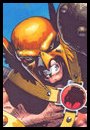 The Fix:5.5 The Issue: 5
Winner: Hawkman
[Without a doubt one of the greatest crossovers of recent times, all crucial to the reinvention of not only the Justice Society of America, but more importantly, Hawkman. Hawkfans should definitely track down the trade of these issues, and maybe anyone else looking to get their feet wet, particularly post 52/World War III.]
 BLACK ADAM versus KOBRA
Prince of Darkness Coda: Justice Eternity (DC)
Where: JSA #51 When: October 2003
Why: David Goyer & Geoff Johns How: Leonard Kirk
Quick Fix...
This quite naturally leads us to cross that invisible line that seperates the right from the wrong, and the justified from the murderers.
In Black Reign it was Hawkman that, in many ways, walked away the bad guy. Teth-Adam, having invaded his homeland of Khandaq, is revered as a hero by the Khandaqi people, while Hawkman is decryed by both the liberated, and the Justice Society themselves, who were led by the usurping Chairman into a joyless bloodbath.
Even so, it is Black Adam who has more traditionally walked the path of villain, recast in that role during a genocidal rampage coming out of the pages of 52.
We can make no bones about sponsoring Black Adam throughout 2007.
It's arguably this moral ambiguity that has propelled Black Adam to the status of the most enjoyable of rising stars to be pushed by DC all year. Dealing with a role as ruler of a nation, Adam has been the slate for reflecting the responsibility and potential carnage incurred by a superpower unchecked.
Like many great villains, Adam is essentially a well intending individual, marred by his regular association with death and bloodshed. The descent into madness began long before 52, starting in the pages of JSA where, having broken away from the group that agreed to take him in, Adam is leading a small group of soldier against those who have escaped justice as they see it.
 One such example is the terrorist cult leader, Kobra.
Having launched attacks across the globe, Kobra was responsible for the death of the mother of one of Black Adam's pliant recruits, Atom Smasher.
Both left the Society over Kobra's subsequent trial and escape, disillusioned by the JSA's archaic notions of legality. With the aid of Brainwave, the group of super-militants track Kobra to his hidden lair in the Himalayas, where they exact the only suitable punishment for a mass murdering menace such as he: death.
 With Brainwave confirming claims of a network of explosives beneath New York are false, Adam plunges his fist through Kobra's chest, ripping his heart out.
With that, justice is served, and the cult of Kobra is left to legend, or methods supernatural.
Much like Hawkman, Geoff Johns earns his stripes as a major comics writer perfecting his skills with the reinvigoration of classic properties. These events have been referenced many times [Hawkman #24] on the site, already described in this very entry for their role as the first action in the spiral that has led to today, where Black Adam is a mass murderer himself, and a broken man.
I've seen relatively recently a Hawkman referring casually to killing a villain, and in much the same way, I would express some disappointment for how frivilously the characters have been allowed to cross that invisible line. For Hawkman, it is obviously a scenario rarely fulfilled, but for Black Adam, it has again been a fullblown devolution into villainy.
Putting a character to blows with the Justice League is almost always going to cast them as villain, but when the motives involve genocide, it's hard to argue.
Perhaps it's the inevitability of so-called "harsh justice" that these characters slip into ill-defined rampages, or off-the-cuff murders, but I've got to wonder.
Just like iconic superheroes define themselves in fiction as characters capable of handing out justice without the cost of human life, so too can't we suggest that super warriors can live by the sword, without impaling their sanity upon it?
In a world where law enforcement still hands down sentences of death, and where wars are waged over just causts, is it so inevitable that those that battle these evils become them? Or is there a school of thought to say controlled lethality is a requirement of an efficient system of justice? Does their come a time when a cheek must demand a cheek in turn, or is simply invite corruption as another symptom of decadence and war?
Can anyone begrudge a police officer that draws a weapon in confirmed self-defense, or is the threat of an error of judgment too great and too common?
Maybe someone like Hawkman, or even Wonder Woman, will be the character to eventually answer the question: Can a hero kill responsibly?
 The Fix: 5 The Issue: 4.5
Winner: Black Adam & Atom Smash (w/ Brainwave)
[This issue marks the end of David Goyer's tenure on the relaunched JSA title. In the main feature, the story features a big ol' magical throwdown between Mordru and Dr. Fate, which will inevitably turn up in a future entry of the Infinite Wars.]
 DOPPELGANGER versus THINGBy Reed... Betrayed! (Marvel comics)
Where: Fantastic Four #367 When: August 1992
Why: Tom DeFalco How: Paul Ryan
The story so far...
The Magus, with the aid of mysterious cosmic power, has created an army of sinister mirror images of the greatest heroes of the Marvel Universe in a bid for total domination!
Forced to face their inner shadows, the great heroes fight themselves for their own existance. For Thing, his doppelganger comes at a time already overcast with inner turmoil. Ex-girlfriend and teammate, Sharon Ventura, returns as he comes to terms with the reveal that his greatest love, Alicia Masters, did not marry the Human Torch. Instead, it was another dark diversion, the undercover Skrull Lyja, who married the Torch, which leaves Thing unsure of his feelings for his former flame.
The Puppet Master is sure of his feelings, desiring the happiness of his daughter, but will his love stop him taking advantage of the Thing's predicament, or will he use his fantastic telekinetic controlling clay to save the Fantastic Fourman?...
Previous Form:
Thing (#16): Clobbered his way through the Frightful Four, Sinister Six, Super Adaptoid, Super-Skrull & Paibok, the Power Skrull.
Doppelgangers: The Magus' doppelgangers have been menacing the heroes with mixed results.
Tale of the tape...

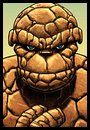 Strength: Thing 6 (Invincible)
Intelligence: Thing 3 (Straight A)
Speed: Thing 2 (Average)
Stamina: Thing 5 (Marathon Man)
Agility: Thing 2 (Average)
Fighting Ability: Thing 3 (Street Wise)
Energy Powers: Thing 1 (None)
Well, here we are for another Monday, and another evil doppelganger feature as commanded by this month's special Marvel Ultimate Alliance posts. If you're new here and you want to know what I'm talking about, scroll down to the archives and check out posts made on Mondays, because we're still a full month away from a recap on all of these damned posts!
Anyway -- keeping things moving forward, we've got ourselves a spotlight on the Thing, who is arguably one of the most underrated characters on the site. Okay, over the past few months we've caught up a lot of stock on the Fantastic Four, but for the most part, you really expect the Thing to be up on a fight site.
When you look at the stats as we rate them, you might even argue that he's been underrated on the Haseloff scale, too. I would invite any of you to make your case for shifting Thing's stats, because it's something I've grappled with, particularly something like his fighting ability.
For Thing, I've really gone with the literal for our stats, which is supposedly the laws by which the catalyst information is governered. The scientific credibility is only as good as the accuracy of the information as it is input into the system.
The scientists of Secret Wars on Infinite Earths cannot be held responsible for erroneous data. Keep them honest.
Who will win this fight? Well, the tape's on the sidelines for this one, because it's just been more trouble than it's worth rating the doppelgangers. Essentially they share the statistical value of their original, with the exception of far greater malice.
I think Thing is typified by his heart, so a lousy bum like this shouldn't be any trouble. I guess it just depends on the time of day, really. If it's a quarter-to-twelve, I'm not sure, but if it's clobberin time, well, there you go...
The Pick: Thing (Champion Class?)
What went down...
So, having been ambushed by Sharon Ventura, Thing is surprised to notice a creepy little bald man staring at him through the window. No, it's not Brian Michael Bendis, it's the supposedly reformed FF villain -- Puppet Master!
Having rescued Alicia Masters from the clutches of the Skrulls [Fantastic Four #358], Thing was surprised to discover she had been abducted long before she supposedly married his teammate, the Human Torch, thus, she still loves Ben Grimm as whole heartedly as the day they each disappeared.
Puppet Master lambasts his one-time nemesis, demanding he recognise the feelings of his blind step-daughter. Just then, while the two argue in an alley, a horrible thing appears from nowhere! Though the Puppet Master tries to warn ol' blue eyes, he thinks it's a trick, suffering a sucker punch from his clone!
 Thing is thrown into the alley by the punch, a dumpster providing a Neutonian means of halting.
Shaken but never stirred, the Thing picks the dumpster up, ramming it into the spikey, charging doppelganger sent by the Magus. The powerful demon bursts through the metal, following his intent to meet Grimm fist-to-fist.
 The ever lovin' original gets in a few good licks, but he pushes his doppelganger back toward a fire escape. The evil shade does well to attack Ben Grimm's mental insecurities, while also assaulting the physical, ripping the iron fire escape to fashion it into a crude restraint!
His arms bound by his side, Thing can do nothing but take the thundering punch delivered by his spikey-self, thrown across the street toward an empty construction site!
The lumbering clone marches his way through the broken barricades as the true Thing gets to his feat, flexing his mighty rocky muscles to burst free of the twisted metal that holds him. Clear of innocent bystanders, he prepares a more severe assault on the monster that continues to taunt him with verbage and visage.
Claiming to be his physical superior, the doppelganger charges at Grimm like a medieval horseman, girder in hand. The blow slams Grimm against the steel architecture, but the shade's attempts to crush him are in vain!
 The Thing bends the girder back, and follows it's momentum to charge at his doppelganger with a devestating right that sends it airborne!
Alas, it isn't enough to put the monster out of commission, placing him instead in arms reach of a mechanical earthmover! He hoists the massive machine above his head and brings it raining down atop the FF's muscle with such force, it breaks through the Earth down into the subway!
The Puppet Master and other innocent bystanders watch-on in horror as the machine and monsters come to land on the tracks! Thing does a little taunting of his own, prompting another head-on collission between the two superpowers.
 Confined to a tight space, these two raging bulls are content to boil it all down to a one-on-one confrontation of fisticuffs. The monster reveals his plans, promising to defeat Ben Grimm and assume his identity, all part of the Magus' secret strategy of domination over the cosmos.
 Watching on, the Puppet Master produces a clay maquette of the Thing, pondering his longtime desire to see him crushed.
As the doppelganger continues to hurl his psychological jabs, he reflects the Thing's own deep feelings for Alicia Masters.
The promise to bring pain to Alicia, and all the Thing cares for, is the final decider for Philip Masters; the Puppet Master!
Resculpting his maquette, he refashions the Thing as he is on this day, to what he once was. Having recreated the spikey doppelganger to the finest of details, he makes his empassioned declaration to defeat the evil shade.
Tossing his psychokinetic clay sculpt onto the tracks, it begins to sizzle and low as it hits the electrified rail of the subway train. Almost immediately Thing appears to gain the upperhand in the fight, summoning his own inner strengths in the name of the blind sculptress the two men share in common.
 Mirroring the fate of the doll, the evil clone falls to the tracks, bursting into a flash of energy before disappearing in a smouldering mass of smoke, much to the shock of Puppet Master and Thing alike.
The hammer...
With the unlikely assist from the Puppet Master, it's a clean victory to Aunt Petuna's favourite blue-eyed nephew, the Thing!
Gah, I wish these scanned up better, because there are some great panels there, that certainly do not look like water-damaged wallpaper.
I don't know how widely recognised Paul Ryan is as an artists, and I've run afoul very little praise for Tom DeFalco, but if you ask me, this was a very fun period for the Fantastic Four.
I'm a by the numbers kinda guy. I like to think our format makes us a fun, unique, and easy to reference website, but this is one of those rare occasions when I wish we were one of those one-panel witicisms weblogs.
This issue really represents the culmination of the evil doppelgangers, concluding with a mass assembly of heroes at Four Freedom's Plaza, then home fo the FF.
Reed Richards and Iron Man ironically stand at the front of the assembly, eventually revealed by the likes of Wolverine and Daredevil, (as well as Invisible Woman via some special detecting technology), to be fakes.
In a scene that hilariously mirrors what eventuated in Civil War, Mr. Fantastic and Iron Man are attacked, before the entire assemblage devolves into a massive brawl, hero-versus-hero. By issue's end Invisible Woman is able to show up to talk some sense into everyone, but not before the evil Mr. Fantastic clone reveals a gamma bomb hidden in the podium -- that he detonates!
We of course learn that the green explosion the issue ends with was actually contained by the unconfident Invisible Woman, and all is well for the Marvel Universe and it's multitude of assembled superheroes.
It's a scenario like this that is actually posed quite relevantly to the upcoming Secret Invasion story, built on the developing knowledge that there are Skrulls who have infiltrated the Marvel Universe, and are thus far undetected.
In a world of psychics, super-senses, and magic, it's tough to really sell this kind of scenario, and it's going to be up to Brian "Pluck-a-Duck*" Bendis and those involved to come up with a satisfactory answer. With the aftershock of House of M still ringing in Marvel fans ears, I think that layer of scrutiny and attention to detail is going to be especially harsh. Particularly off the back of comments from the writer, who laments the inspiration for the story comes from an apparently narrow reference of Skrull stories, where he wondered (as a child) why the Skrulls wouldn't disguise themselves as a loved one and stab you in your sleep.
The fact that this story, building from the Illuminati issue where the Illuminati confronts the Skrulls around the time of the Kree-Skrull war, places it over a written period of two decades of stories, you have to wonder whether or not Bendis will fall victim to his own questions. That's a long time to wait to stab someone in their sleep!
The Fight: 6 The Issue: 6
[As a checkpoint for recent Marvel history, this is definitely one of the most exciting reads. Crammed in here are B-storys revolving around character relationships, Wolverine infiltrating the FF HQ, and a big ass Thing brawl! Find me a current crossover tie-in that's bringing ALL THAT!]
* Not an actual nickname for Bendis.
 GUILE versus BIRDIEStage 01 (UDON/Image)
Where: Street Fighter #1 When: September 2003
Why: Ken Siu-Chong How: Alvin Lee
The story so far...
His name is Bison, and he is the megalomaniacal leader of the world's most vile criminal organization -- Shadaloo.
Involved in every facet of criminality, Shadaloo funds Bison's desires for world conquest, and his interests in fostering the martial arts and his psycho power.
It was during an investigation into Shadaloo that Bison uncovered and brutally murdered Charlie, partner of Interpol agent, Guile. Ever since, Guile has had the burning desire to personally put an end to the Shadaloo empire, and the evil M. Bison.
Patiently working his way through the various branches of Shadaloo, Guile and agents like him pick apart the pieces of the puzzle, working their way closer to the source. Wannabe street toughs, like the English street fighter, Birdie, represent the lower rungs, all useful for tracking back to Bison.
Previous Form:
Guile, Birdie: Each making their Infintie Wars debuts.
Tale of the tape...

 Strength: Birdie 4 (Steroid Popper)
Intelligence: Guile 4 (Tactician)
Speed: Guile 3 (Athlete)
Stamina: Guile 5 (Marathon Man)
Agility: Guile 3 (Acrobat)
Fighting Ability: Guile 4 (Trained Fighter)
Energy Powers: Guile 3 (Explosives)
Hmmm, well, that was a particularly clunky introduction.
Yes, it's the weekend again, which means it's time for some Street Fighter action, and we're heading straight back to the very first (or second, depending on your opinion of #0) issue of UDON's Capcom licensing agreement.
We've got a couple of new inductees into the Street Fighting ranks of the Infinite Wars. Guile was acknowledged, but uninvolved in a previous battle between Ryu and Balrog [Street Fighter II #1], emerging mysteriously to save Ryu from sniper fire after he defeated the Shadaloo boxer.
 When I think back to the days of Street Fighter II in the arcades, and even beyond, I can't help but remember the popularity of Guile. In certain circles he has been regarded as the main character, superceding even the poster boys from the series, Ken and Ryu. His story of vengeance for the death of a law enforcement partner, classic in design, certainly makes him one of the most specifically involved fighters in the Street Fighter tournaments.
Birdie's a popular cat, and actually a fighter who predates Guile, having made his first appearance in the original Street Fighter game. He was able to find a new lease on life as part of the Street Fighter Alpha (or Zero) reinvigoration of the property, featuring as one of many new and reinvented characters.
Birdie, interestingly enough, has gone on to bigger and better things, having a starring role in the second-half of the Street Fighter Alpha "movie," and also a feature spot in the recent translated manga, also available through UDON.
Okay, before this turns into The Hammer, let's roll on to the tape, because the sooner we get this part over, the sooner we can get to solid street fighting!
It's a pretty straight forward scenario of two fighters.
Guile is a powerful customer, but Birdie represents the epitomy of the street fighter of impressive size and strength. He's the kind of fighter who plays to overpower, and will do it by any means necessary, even resorting to less than honorable tactics that include a massive chain -- yeah, not just for bling!
Guile's been around the block plenty of times. He's a mature and strong fighter. Much like the character in the games - who could propose a devestating combination of sonic booms that lure the opponent into avoid their way into a flash kick - Guile is well prepared to out-think and strategise his way through characters.
Birdie's at the bottom rung of the Shadaloo outfit because he isn't the smartest tool in the box. He'll give any fighter a run for his money, but at the end of the tournament, Guile's going to be standing far ahead of the British brawler.
The Math: Guile (Meta Class)
The Pick: Guile
What went down...
Having apparently taken out rival gangs in the area, Birdie and his crew strut into a restaurant to demand protection money. The owner, tired of handing his profits over to thugs, refuses, and suffers the consequences!
Ryu, dining with Ken, steps up to stop Birdie, grabbing his fist as he pulls back for another swing at the helpless owner. Before Ryu has the opportunity to take the fight, an authorative voices calls from the entrance, ordering all to freeze.
Ken calls his friend off, leaving Guile to arrest the Shadaloo thugs, but Birdie has no intentions to accept arrest. The mighty Brit leaps into action, throwing his massive weight into a chain attack, but Guile dodges it with ease.

 He slides around the clumsy attack with ease, and throws a hard backhanded fist at the thugster. Though less than elegant, Birdie is competent enough to lift his impressive fist, blocking the impact of the blow, with chains and all.
He leaps into the air again, looking to use his impressive height and strength advantage to crash down on Guile with an axe handle smash.
Guile proves agile enough to leap out of the path of the move that reduces the furniture to pulp.
Guile stops to casually pull a comb through his hair, taunting the burly brawler whose attempts continue to be unsuccessful. He laughs at the prospect of Bison even knowing a wannabe's name, sending Birdie into a further rage.
 Birdie rises in a dishevled state and leaps into the air, throwing himself at the cool and composed Guile. Guile can't help but smile, a steady contrast to Birdie, roaring like a ferocious animal.
The tactic proves to be all part of Guile's cunning plan, luring the undisciplined fighter into the range of his devestating sommersault kick. The blow snaps Birdie's jaw back and sprays blood in the air.
Birdie comes to lands on his head and neck, out for the count. Guile brings his foot to rest on the defeated Birdie, relishing the victory to the delight of onlookers, and store owner alike.
Unfortunately the defeat does little to intimidate the other Shadaloo thugs. One of the gangsters elbows his way out of custody, and makes a break for the kitchen! Guile orders pursuit, but the thug is too quick -- or so he thinks!
He makes for the back door, only to walk into a blur of yellow and blue -- a flurry of super-fast kicks! On his back, the Shadaloo runt can only stare up at the refined fighting machine that is - Chun-Li!
The hammer...
Guile wins! Perfect!
Actually, I cheated a little bit, and we'll condense a quick fix into this one by also counting Chun-Li for the assist. I didn't plan to, but heck, I'm feeling generous, and I want to give the Street Fighter's a well deserved shot at making top five before the end of the year.
 If you missed us last week, you won't know that the challenge has been issued to the Street Fighter alumnists to use the weekends to earn a top five spot before the end of the year. Considering not only that there's only three months left to do that, and that they're up against eight months of competition, that's a big, and exciting ask!
As much fun as it would be to run through the UDON comics from start to finish, there are a lot of gaps in my collection. Aside from a couple of quick fixes held within the pages of this issue, it might be a while before we see any of the Image published Street Fighter action. Still, that doesn't mean there isn't plenty of Street Fighting to come, from both comic and film.
Y'know, say what you will about any of UDON's faults, you couldn't come up with a better group to tackle the Street Fighter license in American comics. Already tied to a kinetic, manga-inspired style, the artists of UDON slide fluidly into reproducing the Capcom style of games like Alpha, adding that extra layer of familiarity that makes the difference between a good adaptation, and a great piece of licensing.
Over the course of production from the first series, to the self-published Street Fighter II, you can see a really exciting process of evolution and learning in the UDON production team. In these early issues, there's a sense of experimentation in the pages, featuring a lot of familiar frames, and digital effects.
While I think this approach is probably a little heavy-handed, I'm actually really glad that they did it. I wouldn't want to read it in every issue, but it's just a nice quality to have seen tried. It's all too rare to see experimenting and evolution in the process of a comic in such a finite space of time.
Pictured above, you see Guile's famous match-winning taunt of the hair comb.
It's scenes like, and moves utilized by the fighters taken directly from the games, that probably made this such an easily acceptable read. As I said, I think it's maybe a little heavy-handed to literally recreate frames of animation from the gaming sprites, but without it I wonder if the series could've enjoyed the instant acceptance that can be so hard to garner from hardcore fans.
This first volume of Street Fighter represents a lot of fantastic things, and while UDON themselves acknowledge it got a little distracted at times, they did well to bring it all back to the tournament with Street Fighter II, and this remains a fantastic inclusion for any fan's collection.
That's probably about all for this week, but be back here next weekend as we continue to test the strength of the Street Fighting fraternity. We saw them go head-to-head with the Marvel heroes in the games, but this is the true test!
The Fight: 4.5 The Issue: 6
[Street Fighter has the unlikely honor of being the first issue published by Image Comics to be featured in the Infinite Wars. Granted, that's a true oddity on a site dedicated to superhero fisticuffs, but also a testament to the Street Fighter brand. We'll find our way to something else Image one of these days...]
 AVENGERS versus GALACTUSThe End of the Matter: What If The Silver Surfer Had Not Betrayed Galactus? (Marvel comics)
Where: What if...? #70 When: February 1995
Why: Chuck Dixon How: Joe Barney & Don Hudson
The story so far...
So it was, when the devourer of worlds came to destroy the Earth, that the Fantastic Four stood against him. Toppling his gleeming herald, the Silver Surfer would come to land on the balcony of an inner city studio belonging to the blind sculptress, Alicia Masters.
Though blind, she would see something inside the Silver Surfer thought long dead, and with an awareness of all things great on the planet Earth, the Silver Surfer remembered what it was to be Norrin Radd, inhabitant of Zenn-La. Thus, he rebelled and proved to be the crucial factor in defeating the devourer of worlds, Galactus.
Alas, there are other worlds, where events such as this deviate in minor, but devestating ways. Just such a world saw the Silver Surfer remaining steadfast, forcing the Fantastic Four into retreat in the wake of Uatu's death, and the wounding of Reed Richards. With the FF absent, other heroes are forced to pick-up the slack, but can they possibly stand against the might of Galactus?...
Previous Form:
The Avengers [#3]: Victorious over She-Hulk, Atlantis & Sinister Twelve.
Galactus (#338): Suffered a poetic defeat, eaten by alternate universe zombies.
Silver Surfer (#22): Major victories over Green Lantern, Ronan & Super-Skrull.
Tale of the tape...
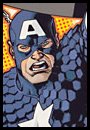
 Strength: Galactus 7 (Omnipotent)
Intelligence: Galactus 7 (Infinite Wisdom)
Speed: Silver Surfer 7 (Light Speed)
Stamina: Galactus 7 (Unstoppable)
Agility: Captain America 4 (Gymnast)
Fighting Ability: Thor 6 (Warrior)
Energy Powers: Galactus 7 (Solar Power)
Alright, convenient filler here is the note to be made that I actually wrote this post yesterday. Through a string of unfortunate circumstances I fumbled my way to a select all, which was instantly autosaved as three accidental key strokes.
We've got to flash back to the sixties for this one. This is a time when the Avengers formula was just beginning to form, long before Brian "Baby Carrot*" Bendis would break it apart and rebuild it in the New Avengers form.
 This particular version of the team, led by Captain America, consists of; Quicksilver, Wasp, Scarlet Witch, Hawkeye, Giant-Man, Iron Man and Thor.
A classic line-up of Avengers to be sure, and over time one of the most seasoned groups of heroes on the block, but in their infancy in 1966 you really have to doubt their ability to cope with a threat the scale of Galactus!
The Fantastic Four coped with Galactus perhaps most importantly through the scientific awareness and preparation of Reed Richards. In that capacity, only Hank "Giant-Man" Pym comes close, with Iron Man's genius being more specifically regarding the realm of technology. Pym's science, though fairly specific, at least approaches an awareness of varying forces in the world.
Characters like Wasp, Hawkeye, Quicksilver and even Captain America are really out of the depth with cosmic threats. They represent some very strong urban combatants, and certainly in battle with many other villains they'd be among the first you'd choose to represent, but Galactus represents an entirely different level.
In fact, it's perhaps only Thor who truly poses a challenge for the cosmic-borne menace of the world devourer and his shining herald. Iron Man might be able to hold Silver Surfer up, but even the might of a Norse God is probably better directed at Silver Surfer than the looming threat of Galactus.
I guess all of this amounts to a longer way of saying, not bloody likely.
The Math: Avengers (Total) Galactus/Silver Surfer (Average)
The Pick: Galactus/Silver Surfer
What went down...
With the Fantastic Four out of the picture, the Avengers respond in their absence, charging in to meet the space menace that may very well have killed the FF for opposing his clearly hostile motives.
The airborne Iron Man is the first to lodge a specific challenge, firing repulsor rays at the giant manifested visage of the would-be planet devourer.
 On the ground, the Wasp takes leave of Captain America to seek more obscue methods of defeating their opponent in his technology sphere. Sadly, the bug-sized Avengers finds Galactus well prepared for such an incursion. His defense technology includes a laser, which does fine to knock her out cold.
Outside, Hawkeye fires off an explosive arrow that bursts against Galactus' mighty chest. Tired of the interference of what would amount to little more than insects, Galactus extends his powerful hand and exterminates the unprepared Scarlet Witch, Hawkeye and Quicksilver.
Only Captain America survives the spray of cosmic energy, able to raise his indestructable shield at the very last moment to defend against the assault.
Lurking somewhere behind the action, Hank Pym grows to giant proportions to take Galactus on in a battle of his own size. Sadly, the scientist's physical efforts are in vein, completely ineffective against the cosmic power of a being far beyond physical squabbles.
 Galactus flashes with energy, radiating power enough to send Giant-Man hurtling across the rooftops of the Manhattan skyscrapers.

 Meanwhile, having struggled against the board faring herald, Iron Man finally suffers the brunt of the power cosmic. Though rattled, the Surfer leaves Iron Man roasted, smouldering from inside his suit.
Captain America uses his shield to maintain his balance, clearly suffering from the power of the blast that killed his fellow Avengers.
Though aware he and his team have been defeated, he declares his defiance to Galactus, unwilling to ever quit -- even in the face of death!
He throws his mighty shield, bouncing it off the gigantic jaw of the world devourer, who turns and silently gazes down at the super-soldier, ending his long career with a merciless blast of cosmic power from his eyes. The Captain dies in flames.
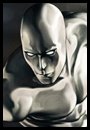
Late to the battle, Thor swings mjolnir above his head, swearing to turn the vengeance of the Odinson against the murderous aliens. The Silver Surfer swoops in to meet his challenge, suffering a direct blow from a hurled mjolnir, for his troubles.
Thor swoops in to retrieve his legendary hammer, clasing head-on with the silvery being that rides atop the board. With the sky and city aflame all around them, the sky reigns down lightning as he and the Silver Surfer grapple.
 Thor's lightning proves a fair challenge, but the Silver Surfer's unfiltered cosmic power is more than a match for even a god. Facing his demise like a warrior, Thor's final thoughts are to expel his own energies in taking the Silver Surfer to the afterlife with him, but alas, the Surfer is too strong.
 "No... I cannot die... So long as the stars burn I cannot die..."
The Avengers, however, can...
 The hammer...
In true What If fashion it's a bloodbath!
The decisive victory going to Galactus and the Silver Surfer.
The Avengers may die in this world, but the battle with Galactus is not yet finished. Like a lot of these sorts of stories [Marvel Zombies], there's an issue of scope here, and that's highlighted by the fact that there's a multitude of heroes who don't appear.
While Cyclops' visor appears on the cover, the X-Men of the day make no appearance, nor do any of the other heroes established in the Marvel universe by 1966.
Granted, it was a far more barren landscape of heroes, and certainly the likes of Spider-man or Daredevil weren't going to have any affect on the situation, but maybe it would've at least been nice to see them. Dare I mention Namor, even?
It's definitely a fun one, and we'll probably revisit this issue at a later date for some of the other tussles featured within. There's a fairly attractive appearance clocked in by Dr. Doom, where we'll get another chance to take a look at one of the many battles in the long rivalry between Doom and the Surfer.
It was around about this time in the second volume of the What If series' life that you can start to see the wheels falling off. The stories start to fatigue around about this time, and it's only a year or so before the stories completely remove themselves from the tried and true formula of changing one crucial element of a historical event in Marvel comics.
Instead, more abstract stories unfold, which frees them up from the shackles of things like the scope we mentioned. Less disturbing than that error of judgment, is the opinion of even prominent writers who believe there isn't enough material to do more than fifth week specials with the concept.
I've probably mentioned before how much of a bee in my bonnet the comments of then- recently appointed EIC, Joe Quesada, were regarding the cancellation of the Mutant X title, deeming alternate reality books to be summarily irrelevent.
This probably brings it all back to my surly stance on recognising the rich history of comics "continuity," but does it not seem a little absurd to consider a book like What If, which represents infinite accounts of events a finite or irrelevent concept? Am I the only person who sees the distinct divide between the potential to be mined from alternate reality stories, and the poor decisions that led to the demise of quality in the What If title?
Well, bitching aside, at least we have the back issues, and joyous websites like ours. Celebrating What If stories seems to be a widspread, if irregular phenomena amongst the blogosphere. They can take the Uatu out of the comic, but they can't take the What If out of the fans... Or something like that...
As mentioned back in the tape, I did actually type this entry up already, so it's a bit of a hassle to have to go back and do it all again. I might leave it at that and move on. I should throw out another thanks to When Fangirls Attack, who featured yet another of our entries right up near the top in their list.
Always greatly appreciated, and a lot of fun!
Speaking of lists, it's Friday (or rather, was) and we'd usually tip our hat to Bahlactus, but he's out of action for a couple of weeks. He was presumably shunted into a parallel universe. The Secret Earth? Still here. Representin'!
The Fight: 3.5 The Issue: 4
[A very fun comic, that might've benefitted expanding the basic concept to examine more of the working parts of the Marvel universe. Not one of the greatest What If stories, but certainly a highlight in the declining years.]
* Not an actual nickname for Bendis.

 Where there rides a Robin, the unsettled Batman sees the demon of his greatest failure, the supposedly deceased Jason Todd. Still haunted by the tactics employed by the villainous Hush (and Todd), Batman pops the Batmobile hatch and yanks the young Tim Drake from his motorcycle.
 The sudden rush of air rips the tiny Robin from Batman's vice-like grip. His acrobatic training helps the young hero maneuver himself to catch the tail of the Batmobile as it thunders into the hidden entrance of the secret Batcave.
 The Fix: 5 The Issue: 6
 While Batman represents a brutal, corrupted version; he remains a pillar on the non-lethal side of the justice scale we've been talking about. Far more harsh than anything Martian Manhunter would usually subscribe to, but still on the same wave length of what is and isn't crossing the unspoken line.
 The Batman swats Catwoman into his computer console, following quickly with a stiff kick narrowly blocked by the beseiged burglar. She retaliates in a characteristically independent manner, shedding any personal loyalties to slash Batman across the head.
 Catwoman is obviously a big part of the Bat-family, even though the two have been somewhat distanced of late.


 The Fix:5.5 The Issue: 5

 Strength: Thing 6 (Invincible)


